
Skip to content

Meles Zenawi

Film exposes risk of Ethiopian descent into tyranny

By David Calleja | Foreign Policy Journal

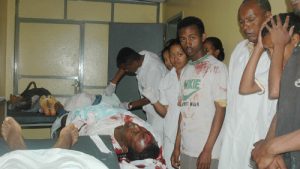
A victim of the Ethiopian government's repression during the 2005 elections

A victim of the Ethiopian government’srepression during the 2005 elections (AP)

In May 2005, the ruling Ethiopian Revolutionary Patriot’s Democratic Front won elections amid allegations of electoral fraud and a campaign of intimidation against opposition groups. Six months and two protests later, nearly 200 civilians were killed and tens of thousands arrested, including high profile opposition leader Birtukan Mideksa. The former judge and popular politician was initially jailed for life, then pardoned, and then commanded to serve out the rest of her sentence.

Next year, Ethiopians will go to the polls again, and the political maneuvering is already underway. Last week, the Sudan Tribune reported on the Meles Zenawi government claims of an alleged coup plot masterminded by former opposition leader Behanu Nega, now an academic in the United States of America. And on May 27, the opposition Unity for Democracy and Justice (UDJ) had their permit application for a protest against the Zenawi government in Addis Ababa’s Meksel Square rejected by the city’s administration. A spokesman for the UDJ, Hailu Araya, was quoted as saying the government continued to play political games, thus weakening the UDJ’s effectiveness in the country.

Ethiopia is an important ally for the United States. Its strategic location near the Horn of Africa makes the country key to Barack Obama’s attempts to win the War On Terror.
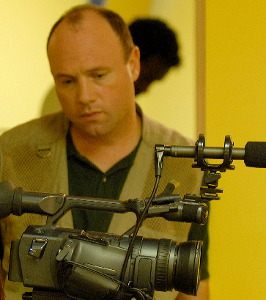
Director of 'Migration of Beauty' Chris Flaherty (Photo courtesy of Chris Flaherty)

Director of ‘Migration of Beauty’ Chris Flaherty (Photo courtesy of Chris Flaherty)

Against the backdrop of the 2010 election, the documentary Migration of Beauty is due for release on the international film festival circuit. Directed by Chris Flaherty, the film recalls the experiences of Ethiopian genocide survivors of the 1970s and the community activism led by the Ethiopian diaspora in Washington D.C. in the run-up to the 2005 election. Flaherty spent two years researching and befriending the witnesses involved in the historic event covered in the film. Migration of Beauty has screened at the AFI Institute in Maryland and Goeth-Institute in Washington D.C.

The Ethiopian government has sent a chilling message to all opposition groups by declaring that it will achieve peace at all costs, a clear reference to the crackdown on protests that tainted the election four years ago that also revives haunting memories of the Dergue’s massacre of students and other civilians in the 1970s. Although the country is not officially a one-party state, the signs of political intimidation risk leading the nation along the path of Burma and Zimbabwe into tyranny.

Chris Flaherty spoke with David Calleja in an interview for Foreign Policy Journal about what could be in store for sub-Saharan Africa’s second most populous country.

Four years after the violence that occurred in the aftermath of Ethiopia’s general elections, what news do you have of the mood in the country, and how do you think this will affect the lead-up to the 2010 poll?

Obviously I have been keeping track of recent events as they relate to the upcoming Parliamentary election in Ethiopia. I would have to say that at this point it looks pretty grim. I think the party in power has been doing a good job at intimidating any possibility of viable opposition against themselves in 2010. With the re-arrest of one of Ethiopia’s strongest opposition leaders, Birtukan Mideksa and the recent announcement by the Ethiopian government that they have launched an investigation against people suspected of overthrowing the government, the prospects look grimmer by the day. From what I have observed many Ethiopians appear to be slipping into a feeling of helplessness. Many are saying, “Here we go again, this government will stop at nothing to retain power.” The biggest fear for me is that Ethiopians will simply give up and accept what happens no matter how illegitimate the outcome.

What factors compelled you to make your documentary Migration of Beauty? Why did you feel that it was necessary to tell people what happened in the 1970s under The Dergue as a prelude to the 2005 elections?

Perhaps the biggest factor that helped me mold the idea for Migration of Beauty was the inspiration I experienced from documenting seemingly powerless immigrants from a third world country engaging the U.S. political process. During the filming I was able to better understand the conditions that drove many of them to zealously fight for ideas that most ordinary Americans take for granted. My approach was to tell their deeply personal human stories about struggling for freedom and dying for it. Some of the people in the film lived through one of the most horrific chapters of Ethiopian history, the “Dergue” period or the “Red Terror”.

By bringing their stories to light I was trying to make clear that it doesn’t matter who takes away your freedom as much as it is criminal for anyone to do such a thing. If your freedom has been taken away the end result is always the same no matter who takes it away, whether it’s Adolf Hitler, Mao Tse-Tung, Mengistu Haile Mariam or Meles Zenawi. And while the current Prime Minister of Ethiopia, Meles Zenawi, has not committed acts as open and obvious as his predecessor Mengistu Haile Mariam, he is still repressing democratic ideas and has committed numerous human rights abuses. It was important for the Ethiopian Americans in Migration of Beauty to connect both stories. They have seen it all before.

There were some moments in the documentary in which you were prevented from filming. Who was behind the threats and what level of intimidation did they offer to the crew or yourself?

I did B-roll filming in Ethiopia directly after the 2005 election massacres. There was a certain tension in the streets. Foreign journalist and filmmakers are highly suspect in the eyes of the Ethiopian government. The Ethiopian government has a long history of repressing the media so I expected I might run into problems. There were two instances where I and my Director of Photography were stopped by the police. The first time I managed to talk my way out of potential arrest by speaking in Amharic and smoothing my way out of the situation. The second time it was the Ethiopian Army that tried to stop us. I quickly discovered that they did not speak Amharic, therefore my language skills yielded no results. I could not understand what they were saying but it was obvious they wanted the video camera. My DP and I simply took off running. For whatever reason they stopped following us and we lost them. We quickly realized that we had to keep our equipment “under the radar” and out of sight. I have heard of worse stories involving intense harassment and arrest of video camera operators. There is one such instance documented in my film.
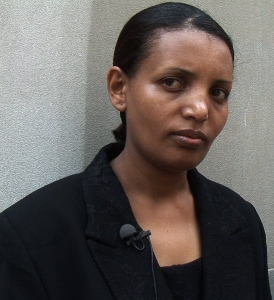
Birtukan Mideksa

Birtukan Mideksa (AP)

Last year, the opposition leader Birtukan Mideksa was jailed for life. According to a Voice of America report, Prime Minster Meles Zenawi government’s official line was that “she had not asked for the pardon” handed to her. What do you think is the real reason for the order to serve out her life sentence? What does Meles Zenawi have to fear from her?

The situation of jailed dissident Birtukan Mideksa is a very interesting one. The former District Judge represented the biggest threat to the party currently in power, the Ethiopian People’s Revolutionary Democratic Front (EPRDF). And while she was jailed for what would appear to be rather “convenient” technical reasons it’s obvious to me that she was put away because there was a good possibility she would beat the EPRDF in a fair election. Considering what happened in 2005 the ruling party appears not to be taking any chance of losing a national election. This is an old story and a proven formula: intimidate, jail and kill all of your viable opponents in order to keep power. No matter how proper and clean everything appears on the surface it’s all the same.

The same report from Voice Of America indicated a tough stance from the government, vowing that they will not allow the protests of 2005 to occur again in 2010. Zenawi reportedly said that, “We will do everything in our power to have peace.” He has also vowed to not only stop any anti-government protests in the wake of the results, but also prevent any possible build-up of opposition support. What tactics do you think he intends to deploy?

We can only speculate what the Zenawi led government has planned for the next election. I will acknowledge that the Prime Minister is extremely crafty with words and has leveraged this skill to benefit his position in the world view. However, to say, “We will do everything in our power to have peace” is an extremely ominous indication considering his well documented past endeavours to keep the peace. Besides possible use of military force, it’s a safe bet to expect him to shut down the press completely and quell all avenues of dissent. My fear is that it could be much worse than it was in 2005. I’m not sold on the idea that everyone will go back into their houses if the government murders a bunch of unarmed civilians. It appears that the populace is deeply frustrated and they might go much further with the civil disobedience than they did in 2005. Either way, I sincerely hope no one gets hurt.

You have quoted Dr. Jedyani Frazer as to making remarks about the dangers of a free press at the Batten School of Leadership and Public Policy at the University of Virginia, and that in African countries, could lead to “ethnic cleansing”, such as what happened in Rwanda in 1994. What message do you think Dr. Frazer’s remarks send, and what justification did he use?

I was taken aback with Dr. Frazer’s comment. To specifically call out the so called “irresponsible press” without mentioning the dangers of media repression is a horrible proposition. Considering Dr. Frazer’s past influence on foreign policy in Africa it was a chilling comment. If the government in hand deems their press to be irresponsible, are we to base our foreign policy on their beliefs? Exactly who gets to decide the parameters of irresponsibility? And while Dr. Frazer did not specifically mention the role of the press in the Rwandan Genocide, most people know it is the 5000 pound elephant in the room. And therein lies the question- how do we balance the two?

My belief is that it is the right of the press to be free… We must base our foreign policy on the ideas we believe in ourselves, regardless of how uncomfortable it makes us feel. And when a particular government is proven to repress their media we should call them out and do nothing to lend them credence. It was the Ethiopian Ambassador to the U.S. himself, Samuel Assefa, who told me that the Ethiopian government must control the press, otherwise Ethiopians might commit ethnic genocide on themselves. All this is coming from a government that has instituted a policy of “Ethnic Federalism” which intentionally creates a divide between the many ethnic tribes within the country. This government has done little or nothing to foster a sense of national identity. It’s an old formula, control the press and divide everyone to decrease the threat of losing power. Comments like the one Dr. Frazer made simply send the wrong signal to the world.

What has U.S. President Barack Obama said regarding the Ethiopian leadership and what foreign policy initiative has he proposed? How can he be more effective in dealing with Meles Zenawi than his predecessor, George W. Bush?

To date, I haven’t heard much from the Obama Administration in regards to issues of democratic process in Africa. It’s obvious they are being very careful. In this respect I believe they are doing the right thing. However, many Africans as well as those in the diaspora appear to be holding their breath to see exactly where he will stand. I can safely say that many have high hopes. It’s a very difficult line for Obama to walk. News coming out of Somalia gets grimmer by the day and the Zenawi led government is the only one that appears to support our interests in the region.

In fact, the Ethiopian government makes this very clear to our elected officials. In my view, it is perhaps the biggest bargaining chip Zenawi can leverage. He knows that many U.S. Congressmen and Senators deplore his style of government but they are willing to deal as long as he represents our so called interests. He’s proven himself to be very skillful in keeping just within the parameters of acceptability in the U.S. As far as Obama is concerned he must make clear where his priorities lie. It was the Bush Administration that justified dealing with any despotic regime in the name of fighting the war on terror.

This policy has proven to be disastrous for the U.S. It makes no sense to support governments that use military force to control their people in the name of fighting terrorism. In fact, the whole idea is absolute insanity to me. This is a special time in U.S. history. We stand at a precipice. We are forced to decide who we are as a nation in the eyes of the world. So often we have preached the virtues of democracy and freedom to virtually everyone. And now more than ever we are understandably challenged on those core beliefs. It is my hope that the Obama Administration will understand and adapt our foreign policy with this in mind.

Do you believe that Birtukan Mideksa is Africa’s answer to the jailed leader of the National League for Democracy (NLD) in Burma, Aung San Suu Kyi? Are there any similarities between the Burmese military regime and the Ethiopian leadership?

No doubt, jailed dissident leader Birtukan Mideksa is an aspiring figure. I notice many similarities between her and Aung San Suu Kyi. Besides both of them being women they possess the types of charismatic characteristics that would help them go far in national appeal. Both are smart and unwavering in their ambitions to see true democracy and freedom in their countries. In the case of Ethiopia, I think many Ethiopians have become disillusioned with the opposition in the past. From what I have been able to access there appears to be tremendous anger with the Coalition for Unity and Democracy Party (CUDP) opposition, the party Birtukan used to lead with Hailu Shawel.

Like anyone anywhere, Ethiopians need to believe in the strength of their leadership. Many felt let down and betrayed when the CUDP failed to stand their ground after their arrest in 2005. Many felt that they made deals selling out the cause of democracy and freedom simply to get out of jail. However, Birtukan was able to help form her own party, the Unity for Democracy and Justice Party and appeared to have a change of heart concerning the conditions of her release from prison. At this point she appears willing to stand her ground against Meles Zenawi and her popularity has dramatically risen as a result. Like Aung San Suu Kyi, her status could become legendary as long as she remains unwavering in her peaceful struggle for true democracy, human rights and the rule of law in Ethiopia. It will obviously be a long hard struggle but if she has the stomach for it she could be instrumental in leading her country to a better future.

While there are many similarities between the regimes in Ethiopia there are also many differences. The regime in Burma appears to be “straight out” dictatorial rule. They make no secret of their endeavours to ruthlessly quash dissent. They have shown time and again that they will send out their military to shoot unarmed civilians in the streets and make no apologies for doing it. However, it’s a bit more complicated in Ethiopia, as the government claims to have something called an “emerging” democracy and says it’s not perfect as it is evolving. In the mean time the end results are always the same.

When push comes to shove, the Zenawi-led government has shown to the world they will commit the same exact human rights crimes the regime in Burma has done. And while Ethiopia has labored very hard to create the perception of legitimacy they will use their military on their own people if they feel threatened to be removed by democratic process. In my opinion the only measure of democracy is whether you have it or whether you don’t. If you have no ability to change the government by virtue of free and fair elections then it doesn’t exist. This is the case in Ethiopia.

How organized and active is Washington DC’s Ethiopian community? What messages have they delivered and who has been at the forefront of such efforts?

From what I see, organization within the Ethiopian diaspora over opposition and election issues is sporadic at best. Certainly I have seen nothing on the level I witnessed a couple years ago in the fight for the Human Rights and Accountability Bill, HR 2003. True, the Ethiopian government has spent millions to stall the bill in the Senate but zealous petitioning from the Ethiopian diaspora has gone flat. I get the sense that many are just frustrated and tired of the fight.

I believe one of the biggest problems is their inability to nationalize the cause. They have a tendency to internalize the issues and keep it to themselves. It’s sad because their causes are ones most Americans can identify with. In my opinion it might work best for them if they phrase their cause as a universal human rights struggle rather than as an internal one. I think it would be most effective if they appealed directly to the American voters themselves the way the Cuban Americans have done.

In the past, the diaspora worked so hard to gain the assistance of people like Congressmen Chris Smith and Donald Payne and now the diaspora is almost never heard from. Nonetheless, I still have high hopes that they will eventually use their rights as U.S. citizens to bring deafening light to their cause, especially as the next Ethiopian election approaches in 2010.

What role has Ethiopia’s past played in shaping a future catastrophe? Do you believe that the persona of former dictator Mengistu Haile Mariam is still prominent in shaping the fear instilled by the Ethiopian leadership today?

This is a very good question. No doubt, many Ethiopians possess what I call “generational fear” which is the type of fear passed down and learned from family and others. For the latest generation of Ethiopians this is not a fear based on personal experience. During the period of the Red Terror thousands were brutally murdered in the streets and as a result an overpowering sense of fear has virtually become part of the culture. Who could blame them? If you knew how young men and women were systematically murdered, their bodies pinned with notes warning everyone to heed the Red Terror, you might better understand. It’s no wonder that the older generation warns their children to, “stay away from politics, it will get you killed”. The damage of cultural fear has stifled healthy interest in governmental participation.

Without a doubt, the Zenawi government has effectively capitalized on the culture of fear instilled by Mengistu Haile Mariam. I am aware that some Ethiopians might be offended by what I am saying but I am speaking from my heart. Recently I read that an opposition party was desperately struggling to get a permit to hold a peaceful rally in a public area known as Meskel Square. Of course the government denied the permit. I was dismayed because no one had the courage to stage the rally without the permit. The rally was planned to be peaceful with no malice intended against the government. While I absolutely do not condone violence, I do believe in peaceful protest. Martin Luther King routinely staged public demonstrations without permits. He knew people would get hurt but he also knew they would never be able to advance their movement if everyone stayed home because there was no permit.

In 1999, the BBC reported that the US Embassy in Harare admitted to assisting Mengistu in finding a safehaven where he was eventually offered sanctuary by Zimbabwean President Robert Mugabe. Should Obama publicly acknowledge that this tactic was a mistake and has this contributed to the political unrest experienced by Ethiopia since?

While it might not bring total closure for Ethiopians the gesture would certainly go miles to break down the years of mistrust they have been feeling as a result of our misguided foreign policy. Besides the issue of the U.S’s involvement in Mengistu’s escape to Zimbabwe they should also be more transparent about their motives with the current regime. From my point of view, the U.S. has very little to lose by appealing to the Ethiopian people apart from the government.

As I said, many politicians in the U.S. are very uncomfortable with the Ethiopian government. Since the 2005 election massacres their credibility has never been the same. The U.S. absolutely needs to acknowledge the bravery of the thousands who struggle for true democracy and freedom in Ethiopia.

Following a trial that lasted 12 years, an Ethiopian court sentenced Mengistu to life imprisonment in absentia in March 2007 for his role in the genocide that took place during the 1970s. Amnesty International and Human Rights Watch estimate that between half a million and 1.5 million people were killed during Mengistu’s reign, beginning in 1974 and ending in 1991.

Before receiving asylum in Zimbabwe, Mengistu is said to have pocketed an undisclosed figure following Israel’s purchase to evacuate 5,000 Falasha Jews at a cost of $300 million. In addition, he pocketed all proceeds following the sale of the Livestock Development Company for $10 million shortly before fleeing Ethiopia for Zimbabwe, where he is now a permanent resident. The Ethiopian people received no compensation.

The Zimbabwean Government has said that it would not force Mengistu to return to Ethiopia. A spokesman for Zimbabwean President Robert Mugabe said that the role Mengistu played in supplying arms and pilot training to the Zimbabwe African National Union (ZANU) in its war against white minority rule in the country formerly known as Rhodesia, helped resistance fighters achieve independence. The Movement for Democratic Change (MDC) accuse him of masterminding President Mugabe’s Operation Murambastvina (Clean Out The Trash), whereby government militiamen allegedly bulldozed the houses of between 700,000 to 1 million civilians in Harare, mainly MDC supporters. He is reportedly offered personal protection by Mugabe’s Presidential Guard battalion and owns multiple properties.

(Email Chris Flaherty with your questions and comments about his documentary or this interview at: [email protected].David Calleja graduated with a Bachelor of Social Science and Master of Social Science from RMIT University in his home city of Melbourne, Australia. He has taught English in China, Thailand, South Korea and Cambodia, where he worked for a local NGO, Sorya, based in Tropang Sdok village. In addition he has also volunteered as a kindergarten English teacher, tutor and a football coach to male orphan students in Loi Tailang, Shan State. He has narrated and produced a video biography of Cambodian students learning English entitled I Like My English Grilled. His video documenting life at Stung Meanchey, Cambodia, A Garbage Life, can be viewed online. Contact him at [email protected].)

Coup-Coup-Coup-loooo!

By Netsanet Habtu

As I was reading the list recently released by Ginbot 7 regarding the ethnic composition of the Ethiopian army, I started thinking that our opposition to the regime for the last eighteen years has for the most part missed the point. Yes, I have known all about the speculation regarding Tigrayan domination in every aspect of Ethiopian political and economic life. What I have not seen is concrete evidence like we have started to see.

The reason I say our opposition was off the mark is because I have come to believe that what we were doing all these years was not based on a proper understanding of what the TPLF was all about. We were organizing ourselves, registering as peaceful and legal parties and treating TPLF as a normal incumbent; when in reality it was a force organized to loot and destroy our country in order to achieve some insane agenda.

I think that it is well overdue that we all; I mean all of us; admit that our country has been under enemy rule for the last eighteen years. Meles Zenawi’s rule is not your standard dictatorship that you hear or read about happening in some parts of the world today. His ruthless ethnic apartheid rule can be fairly regarded as the worst of its kind. And it is with this in mind that I want to talk about the subject of my article – a coup.

Before my readers say anything, I know that Bereket has been busy hitting the backspace key on the original “coup plot” accusation his office put out. But they did put it out once, and the genie is out of the bottle.

On April 25, the regime of Meles Zenawi came out and said it has “foiled a coup plot” by Ginbot 7 and arrested dozens of people in connection with alleged plot. Thousands more innocent people have been arrested and are being arrested to this day. The regime obviously used an accusatory tone when breaking the news. Its hirelings were running up and down the cyber space acting like some sacred object had been handled by sinners. They were enraged. Obviously, from their point of view, it is their jobs and unearned social status that is being messed with. But what they failed to consider, as always, was the perspective of millions of Ethiopians.

I know that listening to citizens is not part of their job. They work for a dictatorship. That is also why their propaganda often misses its mark and forces them to change their stories over and over in an utterly embarrassing manner.

One of the reasons why the regime abandoned its initial press release is an apparent shock at the level of fanfare with which the “coup” news was received. The news galvanized support for the accused organization, and opened people’s eyes to cracks inside the military – the regime’s supposed power base. Many Ethiopians are now left with their fingers crossed fingers sensing that something is brewing deep inside.

These reactions, obviously, are reflections of a yearning among our population. In short, most Ethiopians would like to see the regime of Meles Zenawi ousted, no ifs, and, buts about it. If a coup d’etat takes place in Ethiopia and Woyanne is eliminated most of us will be very happy and proud unlike what the delusional TPLF leaders and their supporters thought.

Every Ethiopian I know, including myself are of the opinion that the regime of Meles Zenawi should be overthrown. In fact, we think that is well overdue. The reasons are very simple. In this article, I would like to build on what a fellow citizen who blogs on UTUBO has written about this topic in this article (click here).

First, let’s briefly summarize the record of the Meles regime:

  • Stolen Election: The regime of Meles Zenawi is an illegitimate government. It is in power through force and stolen elections. On May 15, 2005, millions of Ethiopians went out in a stunning display of hunger for freedom and voted Zenawi’s ruling group out of office. Ballot counting was suspended, ballot bags were stolen in many cases, peaceful protesters were killed, and almost all leaders of the main opposition party were jailed. Thousands of opposition supporters were taken to gruesome detention camps and brutally abused.War Crimes and Crimes against Humanity: Stealing elections was not good enough to assure the regime an absolute grip on power. Killings, arrests and torture of citizens have continued throughout the country to this date. In the Ogaden, the regime has committed what several human rights organizations allege is a war crime. Meles Zenawi and some of his top civil and military leaders are said to be under investigation for war crimes and crimes against humanity.
  • Genocide: These kinds of crimes against Ethiopian citizens did not start in 2005. International human rights organizations say there is enough evidence to charge top officials of the Ethiopian regime with genocide, for the killings that took place in Gambella in 2003. In fact, the President of Genocide Watch has written an open letter to the UN Human Rights Commissioner to look into it.
  • Other High Crimes: Investigations are reportedly undergoing on the street shootings of AAU students and others in 2001; the shootings of peaceful protesters in Awassa and so forth.
  • Destabilizing the Horn of Africa: Meles Zenawi has also shown that he does not back down from engaging in a regional conflict if it means diverting attention from internal problems in order to buy himself a little more time. His invasion of Somalia and the subsequent occupation has left thousands of civilians dead and over a million displaced from their homes. We still do not have any official accounting of the number of Ethiopian soldiers who have been sacrificed. Here as well, international human rights organizations allege that there is sufficient evidence war crimes have been committed by the regime’s army.
  • Disastrous Monetary Policy: As if these crimes are not enough to keep Meles and co. in power, the regime employs short-sighted economic policies that harm the nation gravely as long as it buys itself a little more time. In its unsuccessful attempt to gain supporters after its humiliating defeat in 2005, the regime has handed out money the country doesn’t have like Christmas presents. This has plunged Ethiopia into an upward spiraling inflation rate that is only second to Zimbabwe’s in Africa. The poor went from eating once a day to every other day. People have now resorted into rationing food for their own families.
  • Rampant Corruption: For a bankrupt regime with no vision or societal values, it was important to adopt a rampant open door policy towards corruption and allow its officials to loot the country in exchange for their loyalty and blind sport. Looting has been stepped up to proportions never seen before. A report has shown that in 2006 alone money moving to British banks from Ethiopia increased by more than 100%. The last three reports by the Auditor General (two have been fired so far) show billions of Ethiopian Birr have been unaccounted for.
  • Land Grabbing: What I find more frightening than the stealing of money is the level of land grabbing by high level officials, including the Prime Minister’s wife, Azeb Mesfin. In just one recent incident, for example, it has been reported that she has acquired 40K hectares of fertile land in Gondar area. It is believed that all this rush to grab large scale farming land when they know their seats are shaking hard is to lease it to Arab investors. When a new government arrives, Azeb will no doubt take with her the looted cash. But the investor will stay behind with all his paperwork showing that he made the lease “legally” and has made initial payments to the “owner” of the land. The top officials of the regime, including the Prime Minister’s wife, have thrown away any pretension of accountability. The country is being ruled by a mafia group. And this mafia group, obviously, does not care for the well being of Ethiopian citizens and the long-term interest of the country. In fact, it will destroy anything and everything that gets in its way of looting the country blind.
  • Crashing Economy and More: The Ethiopian economy under the TPLF is crashing. After 18 years of misrule, millions of Ethiopians are dependent on food aid every year. The prospect for the future under this regime is bleak. The quality of education is beyond poor. A recent report by Capital newspaper states that 9 out of 10 vocational college students could not pass national competency exam. Any pretension by the regime of solving this problem all by itself through “reform” proclamations will not be the solution because, as long as its policies of exclusion and repression continue, so will the migration of educated Ethiopians abroad.
  • High Level of Immigration: Because there is no economic and political security in Ethiopia, the number of Ethiopians leaving their country for “somewhere” is increasing by the day. We hear horrendous stories of a thousand illegal Ethiopian immigrants in prison in Tanzania; a hundred in Malawi; about eighty Ethiopian women in a Beirut prison; some Ethiopians looking for jobs in Iraq; and others following dangerous paths through Latin America to get to North America. These were news headlines in the last two months or so alone. For anyone observing the way Ethiopians are fleeing from their country in all directions, it is fair to conclude that the country is like a house on fire that its inhabitants are all forced to evacuate.
  • Ethiopian Interests Endangered: Many Ethiopians consider that their country is ruled by some kind of foreign occupying force. Recently, for example, a large area of land was given to the Sudan with no explanation to the Ethiopian public. In addition, the regime’s use of war with neighboring countries as a way to divert attention from internal problems has made it a destabilizing and dangerous force in the Horn of Africa. This is earning us enmity that will probably last for generations.

Terrible policies and repression by the ruling regime are in large part responsible for the misery our people live in. Bad policies exist in any country. However, in democratic countries, the people have the right to change their leaders through elections. This is what happens when governments are of the people, by the people and for the people.

Ethiopia is being ruled by an unelected regime that has no legitimacy in the eyes of the people; and obviously does not feel the need to fulfill its obligations as a government. Our inalienable rights to the pursuit of happiness, liberty and prosperity and to live peacefully in our own country are being violated on a daily basis.. Moreover, due to the regime’s ethnocentric policies which continue to threaten the very existence of our nation, most Ethiopians have come to feel that what is at stake is more than citizen’s rights – to be blunt, it is nothing less than the survival of our old and proud nation.

When a government fails miserably to fulfill its obligations to its citizens, it is the right of citizens to rebel against it. Since the regime of Meles Zenawi has shown time and again that it is not willing to relinquish power through elections, most Ethiopians have come to agree that it needs to be ousted by any means necessary. One way is for the military to stage a coup d’etat and remove a government that is dangerous to the national interest of the nation, that it is sworn to protect.

Because no government wants to encourage actions that endanger its survival, external support for such drastic measure is very low. For example, the African Union does not give acknowledgment to governments formed through coup d’etats. We obviously understand why, especially since African dictators are the most exposed to such actions.

However, there are some contemporary arguments that are emerging in favor of coups. An example is Alexander Collier’s recently published, “Wars, Guns and Votes”. In this book, Mr. Collier proposes to the international community to stop using aid as leverage in their dealings with dictators, and instead, considers harnessing coup d’etat. He proposes a scheme in which certain standards are set. Those administrations that sign up to the program and meet those standards will be protected from coups; whereas in the case of those who fail to meet the standards, the international community will look into harnessing a military coup that may take place, instead of condemning it.

The West needs to act on what it already knows about the Meles regime. The Meles regime is bad for Ethiopia and Ethiopians. It is bad for the long-term stability of the Horn of Africa. It is bad for the interests of the West. Therefore, if the West still believes it can benefit from a secure and stable Ethiopia, it needs to figure out ways of harnessing a coup attempt, and not oppose it. Any party that wants to continue a healthy friendship with Ethiopia, in the long run, can benefit from aligning itself with the oppressed people of Ethiopia; with groups that are working to remove the illegal regime of Meles Zenawi and those who are challenging its ethnic apartheid policies as evidenced by the total Tiragna minority domination of the military as well as all economic and political spheres of the country.

As for Ethiopians, in addition to just supporting a coup, we also need to find ways to harness it. We cannot sit back and allow what has repeatedly happened over the last 40 years. We should not allow the possibility of our yearning for freedom and democracy to be hijacked again. The only way to stop that is to get involved and keep our political groups and us accountable to our commitment to democracy. We all need to take ownership of the struggle. Standing on the sidelines and only singing the praises of those in the “eye of the storm” has not been beneficial before; and it will not be in the future.

Each one of us must take charge of our respective journeys towards freedom since Ethiopia belongs to each and every one of us. Citizenship entails responsibilities. Let’s find the courage and the resolve to free our people from the jaws of the brutal TPLF regime and save our Motherland.

(The writter Netsanet Habtu can be reached at [email protected])

Is Johnnie Carson rolling-on to Bush policies?

By Amanuel Biedemariam

On May 20, 2009 US Senate Committee on Foreign Relation conducted a hearing regarding the Situation in Somalia on a setting and process that resembled a courtroom. The case could likely be termed as, The State against the State of Eritrea. The process seemed eerily familiar and déjà vu to the previous administration. The victim is the New Transitional Government (TNG) in Somalia. Eritrea is the accused and predetermined-guilty-party to crimes committed in Somalia, and awaits sentencing by a panel of Senators.

While the hearing appeared to be a knee jerk reaction to the fast developing situation in Somalia, it is coordinated and timed to coincide with the new-furious campaign being waged against Eritrea. It is not a coincidence that IGAD called for sanctions and blockade against Eritrea the same day the hearing was being conducted at the US Capitol. Better yet, the AU repeated the same calls, and condemned Eritrea giving Eritreans an early Independence-Day-gift, a day ahead of the main celebration was to be held!

The Senate panel led by Senator Russ Feingold of Wisconsin held identical hearings during the Bush Presidency. The principal actors are different as a result of the election, but the messages and the types of witnesses come from similar backgrounds; which means there is no infusion of new information. So the process seems to have continued with the Assistant Secretary Carson acting as the chief prosecutor, while Shannon Scribner from OXFAM and Dr. Ken Menkhaus sat as expert witnesses. Assistant Secretary Carson’s “testimony” can be summed up as follows: US can attain her strategic objectives with TNG/TFG led by Sheikh Sharif Sheikh Ahmed. And for undetermined strategic positioning Mr. Carson decided to make Eritrea the principal defendant as an accomplice to all the mayhem that is taking place in Somalia. In other words, it is predetermined that Eritrea will be the Whipping-Boy!

However, this assertion undermines the truth and fails to answer fundamental questions. It is also a sad commentary to see a Senate panel conducting a hearing on a setting that can be considered lackadaisical. How is it possible to conduct a hearing about an issue of great magnitude which affects the lives of millions in this manner and in a process that took less than two hours? Why did Senator Russ Feingold fail to have a comprehensive and serious hearing that involved all the stake holders? Why did he conduct the hearing for a policy in the process of being formulated and in a manner that fails to educate the general public in a balanced fashion? Who are the principal actors? What is the intended role of the US and its track record? What is the desired outcome? Why is the US repeating the same process over and over? Why the inconsistencies? Why is the US supporting a leader US and Ethiopian forces dethroned and captured as a terrorist? Senator Feingold knows the actors and the issues very well, but why did he limit the process?

The US supported and financed Ethiopian soldiers to invade Somalia. Ethiopian left Mogadishu in disgrace and in defeat. Ethiopia failed to achieve any measurable success. There is no single functioning standing institution Ethiopia built. And if security is a measuring stick, Ethiopia widened the conflict and made it borderless. Because, in violation of international laws Ethiopian soldiers entered Somalia and occupied a country that harbored historic enmity claiming security concerns and invitation from the previous transitional government, TFG.

Ethiopia received all the diplomatic cover it needed from the US. It was a regular act to see Dr. Janday Frazer defend Meles Zenawi and Ethiopian authorities from their crimes. Dr. Frazer established the Somali Contact Group. She used IGAD and AU to give legitimacy for her policies. She used the UNSC and UN as tools to achieve outlined objectives. Her failed policies created hell on earth while she avoided taking responsibility by blaming others.

Assistant Secretary Johnnie Carson seems to have embraced the same approach and actors to deal with the issues in the Horn of Africa. Mr. Carson stated the National Security Council (NSC) is formulating a comprehensive strategy in this regard. It involves the State Department, Department of Defense, USAID, the Intelligence Community, EU, AU, IGAD, the “Contact Group” and many others. The question here is, if policy is being formulated, why the rush for the hearing? Why legitimize a failed process that went through many TFG/TNG leadership changes in a span of two years? Why not wait to develop a comprehensive, coherent, transparent and reasonable policy?

What is missing? Change! Change we can believe in! President Obama was elected to bring change. Change in policies, approach and fundamental change in the way this country relates to other countries. President Obama said we will listen, engage and we will not dictate. What Assistant Secretary Johnnie Carson did contradicts all that. Mr. Carson has not listened to Eritrea, engaged Eritrea and did not explore how Eritrea can play a positive role. To the contrary he is building unnecessary wall with the people of Eritrea during a spirited independence celebration moments.

The question then becomes, is the new Assistant Secretary for African Affairs Johnnie Carson rolling-on to failed Bush policies? Is he falling on the traps set by the most undiplomatic diplomat, Dr. Janday Frazer who contributed mightily to the unnecessary bloodshed in Somalia? What is the US policy seeking to achieve? Is it stability? The pattern doesn’t seem to indicate that to be the focus; in fact, the opposite could be argued successfully. Why? Because, for the simple fact that the US is supporting Ethiopia, a historic enemy of the Somalis to invade their country Somalia repeatedly!

As Dr. Ken Menkhaus testified, there is a great deal of suspicion and mistrust to US policies in the region. That mistrust will not let up until the US changes her approach. The US needs to give the people in the region a respite they need, seek and deserve. For decades foreign interventions have created a great deal of damage to the people in the region and they are beginning to fight it successfully. The more outsiders try to influence the final outcome the more resistance they will help create thus diminishing US influence in the region as it appears to be the case.

Considering the current economic hardships in the US and other equally pressing and overlapping issues, it is easy to conclude that President Obama will not have the time he needs to explore his policy options thoroughly. It will be at least another year for the President to evaluate the policy options and come up with a comprehensive approach. The president needs to address the continent in a new and meaningful manner with the same vigor he is addressing Moslems around the globe. We need to have faith in a President that came to power seeking to make a meaningful change.

The concern: too many players with interests that want to see the continuation of the statues quo overtaking the process to the point of no return. The US has unparalleled clout and uncontested ability to use regional and international organizations to advance agendas at will with impunity. Organizations like The African Union and IGAD are the tools at the disposal of US leaders to manipulate agendas. That is the process by which US agents legitimize and internationalize decisions they seek.

That means there must be a concerted effort by interested parties to stop the failed Bush and Frazer policies from regenerating. Because if the virus takes over; by the time the President takes over the issue all he can do is try to kill the virus. That will be a huge setback to the region’s hope-for-change! The people in the region understand it is a FUNDAMENTAL RIGHT TO LIVE IN PEACE and they will seek and work to achieve it! So it is up to the people representing the people in the Horn to make sure those who are responsible, like Senator Feingold, to be held to account for their actions and decisions.

And it is my sincere hope and wishes to see Assistant Secretary Johnnie Carson do well for the people of the Horn and to establish a legacy of stature by charting a new way in the direction of legitimate peace with balanced, equal and a fair approach.

(The writer can be reached at [email protected])

Ethiopia court ordered ‘plotters’ to remain in jail

By Barry Malone

Gen. Asaminew Tsige is one of the 41 suspects who are in jail without charge in Ethiopia

ADDIS ABABA, Ethiopia (Reuters) – A group accused of plotting to overthrow the Ethiopian regime were remanded in custody on Monday again after spending more than one month in prison without any charges or visitation rights, relatives said.

Ethiopian Woyanne regime security forces are holding 41 former and current army personnel from a “terror network” the government says was formed by Berhanu Nega, an opposition leader now teaching economics at a university in the United States.

“They will be held for another two weeks,” a relative who did not want to be named told Reuters outside the court in Addis Ababa. “They were not even charged today.”

The 41 are accused of planning to assassinate senior government figures and blow up public utilities to provoke street protests and overthrow the government.

“The investigation was now complete,” one lawyer said.

Security forces killed about 200 protesters after parliamentary elections in 2005 when the opposition disputed the victory of Prime Minister Meles Zenawi’s government.

More than 100 relatives and supporters were gathered outside the courtroom. Ethiopian authorities have named only two of the prisoners despite calls from international rights groups that they name and charge all 41 detainees.

Neither family members nor lawyers have been able to visit the accused in prison, relatives said.

Ending the Culture of Impunity

Alemayehu G. Mariam

The Culture of Impunity

David Dadge, Director of the Vienna-based International Press Institute, the oldest press freedom organization in the world, recently wrote a compelling commentary in The Guardian which should be of special interest to all Ethiopian human rights advocates.[1] He suggested that the current dictatorship in Ethiopia operates in an entrenched culture of impunity (not to be confused with the equally gripping culture of corruption that afflicts it) in which gross human rights abuses are committed routinely without legal accountability of the abusers and active complicity of officials. He argued that this culture could be brought to an end or significantly curtailed by donor countries and international lending institutions.

Dadge offered a partial list of the crimes committed by the current dictatorship with impunity:

… An authoritarian government rules Ethiopia with virtual impunity. Prime minister Meles Zenawi, in power for 18 years, has crushed the opposition. His ruling party dominates public institutions. Worse still, in a vast and predominantly rural country, the prime minister’s underlings control broadcasting and maintain a choke-hold on other media… Four years ago this month, Zenawi’s Ethiopian People’s Revolutionary Democratic Party (EPRDF) suffered its worst loss at the polls since the former guerrilla overthrew a ruthless, Soviet-backed regime in 1991. Rather than accept its losses, the EPRDF-run government responded with a brutal crackdown, claiming outright victory and accusing the opposition of trying to stage an insurrection. Security forces attacked peaceful protesters, jailed opposition leaders, sent thousands of their supporters to gruesome detention camps and accused independent journalists of treason – a crime punishable by death.

The Legacy of Impunity

Ethiopia’s modern history has been disfigured by unfathomable acts of official cruelty and inhumanity. Few have ever been held to account for criminal acts of depravity that can be soberly described as monstrous. The enduring legacy of impunity is too painful to remember: There was the criminal and extreme indifference of the imperial regime to the hundreds of thousands of famine victims in the early 1970s. The fire stoked by that famine consumed the monarchy, and from its ashes rose a military dictatorship of unimaginable savagery. Mengistu and his henchmen orchestrated official “terror” campaigns which resulted in the extermination of hundreds of thousands of innocent citizens. Justice has yet to catch up with those criminals. Today there is a diabolically cruel and wicked criminal enterprise masquerading as a government that has continued the sadistic and barbarous legacy of impunity. The current dictators in Ethiopia operate on the belief that they can commit any crime whatsoever without fear of punishment, legal accountability, or retribution. This culture of impunity must end!

Practicing the Culture of Impunity

Over the past decade, there has been massive documentation of human rights violations in Ethiopia. Yet there has not been a single independently verified prosecution of human rights violations under the current dictatorship. No regime official or member of its security or military force has ever been prosecuted for crimes against humanity. There have been no prosecutions even when there is clear proof of gross human rights violations in the possession of the regime. Just last year, Col. Michael Dewars, the internationally renowned riot control expert, hired by the dictatorship to make recommendations on riot control improvements stated in his report that the Director General of the Ethiopian Federal Police told him, “As a direct result of the 2005 riots, he [had] sacked 237 policemen.”[2] This evidence directly contradicts previous statements by the dictatorship denying specific knowledge of any criminal conduct by the riot policemen who fired into crowds of innocent protesters indiscriminately. It also shows the entrenched and hardcore nature of the culture of impunity in the dictatorship: Even suspects who are “directly” implicated in the massacres of nearly 200 protesters and maiming of nearly 800 others four years ago have yet to be brought to justice. On December 13, 2003, more than 400 Anuaks were massacred by uniformed soldiers of the dictatorship, and tens of thousands were forced to flee to the Sudan. Though there are multitudes of eyewitnesses to the massacres, not one of the implicated “soldiers” has been prosecuted.

Even when U.N. Undersecretary General John Holmes in 2007 visited the Ogaden region and later recommended to the leader of the current dictatorship that large numbers of civilians had been killed by regime troops, their homes burned and deprived of adequate food or medicines, the official response was, “There have probably been cases of [human] rights violations by government troops [but] the violations were not widespread or systematic.” No one was ever identified, investigated, arrested or prosecuted for these “human rights violations”. Indiscriminate shelling of civilians in Somalia by the regime’s troops have resulted in mind boggling civilian casualties and displacement of over 1.5 million people from their homes. No one has been charged with war crimes. There are also thousands of cases in which official criminal acts have been perpetrated against individuals in violation of the dictatorship’s own constitution and criminal laws as documented fully in the annual reports of the various international human rights organizations. No prosecutions in such cases have taken place. To add insult to injury, the dictatorship recently drafted a so-called antiterrorism law which aims to provide full “legal” armor to its decadent culture of impunity. (Legal history buffs will no doubt be amused by the curious similarity of the text, tenor and spirit of the dictatorship’s “anti-terrorism law” with the 1933 Reichstag Fire Decree, which accelerated the entrenchment of the Nazis by giving them a legal cudgel to hammer down their opposition on mere suspicion of “terrorism”.)

Ending the Culture of Impunity

Dadge argues convincingly that donor countries and multilateral lending institutions providing “development” funds have significant leverage against the dictatorship in Ethiopia, and could help bring accountability for human rights violations and closure to the culture of impunity:

The European Union and the United States will pump about $2.5bn into Ethiopia this year, a sum that does not even begin to include the cost of medicines, famine relief and countless other services provided by non-profit groups… There are ways to pressure Zenawi: Donors should deny Ethiopian ministers a seat at diplomatic tables… The Development Assistance Group, created by the EU and other principal donors to co-ordinate aid projects in Ethiopia [should] ensure that international resources do not support policies that are anathema to human rights values…. The EU should aggressively enforce the Cotonou Agreement, which requires Ethiopia and other nations that receive European assistance to respect ‘human rights, democratic principles, and the rule of law’. The EU and the US should wield more of their clout at the World Bank and other international organisations to link development grants to progress on press freedom and human rights.

Implicit in Dadge’s argument are three vital propositions: 1) The indulgence and benign indifference of the EU, the U.S. and international lending organizations are partly responsible for emboldening the dictatorship to continue to practice its culture of impunity. 2) These same donors and lenders hold the key to ending that culture of impunity by making all non-humanitarian aid to the dictatorship contingent on improvements in human rights. 3) The dictatorship will continue to conjure up the specter of terrorism, regional instability and internal chaos to cling to power and perpetuate reflexive support from the donors and lenders.

We have witnessed the Bush administration turning a blind eye to massive human rights violations in Ethiopia so long as the dictatorship was willing to undertake a proxy war in Somalia. Tony Blair and Gordon Brown chose to be romanced by smooth talk of democracy and intellectual pretensions; they too turned a blind eye. Brown insulted the intelligence of all Africans when he invited the current dictator in Ethiopia, universally condemned for his dismal human rights record, to represent Africa at the G-20 meeting. But that has been the history of duplicity of the Bush-Brown-Gordon axis. The EU must also be outed for its hypocrisy. Not long ago, it rewarded the dictators in Ethiopia with a gift of €250 million shortly after they clamped down on NGOs and civic society institutions. The World Bank and the International Monetary Fund suspended some aid in feigned outrage against the dictatorship following the 2005 elections, but later opened up the floodgates of loans to sustain it. None of the donors and lenders did much to stop the killings, mass arrests, imprisonments and persecution of innocent Ethiopians. It is self-evident that for more than a decade, there has been a tragic failure of donor and lender policy in not supporting good governance in Ethiopia based on the principle of the rule of law. Donors have sought to evade the truth about the dictatorship by justifying its egregious human rights abuses as manifestations of benign ignorance, inexperience, incompetence or lack of technical understanding of modern governance. Donors and lenders must be made to support democracy and the rule of law in Ethiopia!

From a Culture of Impunity to a Culture of the Rule of Law

Dadge is telling us that the culture of impunity practiced by the dictatorship could be changed by transforming international donor and lender policies. The first step in bringing about this change is to get donors and lenders to take moral responsibility for their complicity in the dictatorship’s human rights abuses. We must do everything possible to get them to publicly condemn the regime’s repression and atrocities. Second, we must demonstrate to them with empirical evidence that the aid and development loans they provide to the regime are pivotal in sustaining the system of repression and human rights abuses. We must make convincing moral, political and legal arguments that show the rule of law and growth of democratic institutions in Ethiopia will serve their practical and long term interests better than the expediency of supporting a regime that can sustain itself only through violence and brutality. In short, we must use all of our resources to force Western donor countries and multilateral lending institutions to publicly chose between democracy and the rule of law in Ethiopia on the one hand, and dictatorship and human rights abuses on the other. That should be the cornerstone of our global advocacy strategy!

We challenge Ethiopians exiled in Europe to do their part and follow up with Dadge’s suggested courses of action. They have a powerful legal tool to make their case before the European Union. They must insist that the EU live up to its legal obligations under the 2000 Cotonou Partnership Agreement, and deny aid and loans to governments that do not “respect human rights, uphold democratic principles based on the rule of law and maintain transparency and accountability in governance.”

We are not unmindful of the tired, worn out and silly sovereignty arguments (“no donor or lender can tell us to improve human rights”) of the dictatorship. There is one simple truth the dictators need to understand clearly: Beggars can not dictate terms to their benefactors! They accept graciously and gratefully what they are given. Taxpayers of Western donor countries have no moral or legal obligation to provide material support to regimes who use their aid to commit crimes against humanity. A truly sovereign government takes care of its people, abides by the rules of international law and does not depend on the perpetual charity and goodwill of others to feed its people, run its government and maintain its social institutions.

Zero Tolerance for a Culture of Impunity

We must consistently advocate a policy of zero tolerance of a culture of impunity in Ethiopia. This means torturers, killers and other violators of human rights must be thoroughly and independently investigated, prosecuted, convicted and punished. The time to build a transitional bridge from a culture of impunity to a culture of the rule of law is now. Exiled Ethiopians alone can not build this bridge. We must make allies of the citizens of the EU countries and the U.S. and convince them that their hard earned tax dollars must not be used to bankroll a depraved dictatorship in Ethiopia. In the U.S., many of us have taken that challenge directly. We shall continue to work with Congressman Donald Payne and Senators Russ Feingold and Pat Leahy to bring to fruition the “Ethiopia Democracy and Accountability Act” (formerly H.R. 2003), which links U.S. non-humanitarian aid to improvements in human rights in Ethiopia. We are also confident that the Obama Administration will be sympathetic to our cause of human rights accountability. We believe the new administration will not turn a blind eye, a deaf ear and a mute tongue to our plea for help in stopping human rights abuses, ending the culture of impunity and in establishing the rule of law in Ethiopia.

Letter writing campaigns, public demonstrations and petitions are important; but to end the culture of impunity and bring human rights violators to justice much more is needed. Persuasive, convincing and cold hard evidence is required. We must expand and develop an ongoing data collection effort that documents human rights violations on a systematic basis throughout the country. We must apply creative strategies to monitor harassment of human rights defenders, lawyers and journalists, use video and audio technologies to document incidents of abuse particularly by members of the security forces, locate and maintain witness lists for abuse incidents, keep photographic and documentary records of torture and abuse victims and perform other similar activities. We thank those courageous Ethiopians who have undertaken such tasks to date.

Those Who Refuse to Learn From History Should Learn From Their Constitution

George Santayana admonished, “Those who cannot remember the past are condemned to repeat it.” If we do not learn from the burdensome legacy of the culture of impunity, we shall be condemned to prolong and tolerate it for ages to come. The old adage holds true in Ethiopia’s case: “The limits of tyrants are set by the level of tolerance of those subjected to tyranny.” The people of Ethiopia have tolerated a ruthless dictatorship for eighteen years. They are now a hungry and angry people. They are hungry not only for food to sustain their bodies, but also a human rights culture anchored in the principle of the rule of law and democratic institutions to nurture their spirits. They are angry because their basic human rights are violated everyday. Freedom from the rule of those wallowing in a culture of impunity comes at a high price. Many Ethiopians pay that price on a daily basis. We believe history is a great teacher; but the law is a formidable disciplinarian. Article 28 of the dictatorship’s constitution is prophetically instructive:

Crimes Against Humanity. There shall be no period of limitation on persons charged with crimes against humanity as provided by international conventions ratified by Ethiopia and other laws of Ethiopia. The legislature or any other organ of state shall have no power to pardon or give amnesty with regard to such offences.”

Those who refuse to learn from history would be wise to learn from their own constitution!

[1] http://www.guardian.co.uk/commentisfree/2009/may/19/ethiopia-human-rights
[2] http://ethiopiangasha.org/tmp/ALM_October222008.html

The writer, Alemayehu G. Mariam, is a professor of political science at California State University, San Bernardino, and an attorney based in Los Angeles. For comments, he can be reached at [email protected]