Sultan Ali Mirah Hanfare (1921 – 2011) was born in Awsa, Ethiopia in a village called Fursee. He was born to father, Hanfare Aydahis and mother Hawy Omar In the early 1920s. His grandfather Mohammed Hanfare Illalta was a famous king of Afar who participated in the Adwa {www:battle} with the Emperor Minilik against the Italians. He also defeated the invading Egyptian army led by Ismail Basha to conquer Ethiopian lands. Sultan Alimirah himself, as a young man in Awsa, joined the group of young Ethiopians who resisted the Italian occupation of Ethiopia. After the defeat of Italy by the Ethiopians, Sultan Alimirah together with his brother in law Yayo Hamadu were amongst the Afar people who welcomed the victorious return of the Emperor HaileSelassie in Addis Ababa.
At that time Mohamed Yayo, the uncle of Sultan Alimirah, was the Sultan of Awsa. The Afar elders, however, including Yayo Hamadu, suggested that the young Alimirah replace his uncle as Amoyta (Sultan). Emperor HaileSelassie accepted their {www:recommendation} and gave the title of Dajazmach to Sultan Alimirah and the title of Fitawrare to his brother-in-law Yayo Hamadu. He also gave them a well trained brigade from his bodyguard army, headed by a general in case Sultan Mohamed resisted to handover power to his nephew. After several days of journeying, they arrived in Aysaita in the dark of the night. They spent the night in Aysaita while Sultan Alimirah stayed behind. Fitawrari Yayo Hamadu and his followers together with the trained military officers who accompanied them, left for Hinale, where the palace of Sultan Mohamed was located. The next morning, however, the {www:resistance} they were faced with was not as expected. They found Sultan Mohamed sick on his bed. So the military officers who accompanied Sultan Alimirah took Sultan Mohammed to Addis Ababa while Hamadu stayed behind.
In 1945, Sultan Alimirah officially became the Amoyta (Sultan) of the Afar people. What happened to Sultan Mohamed Yayo, however, is a story that will be discussed some other time.
After becoming the Sultan, Alimirah was faced with several challenges. His aim was to create a peaceful and united environment for all Ethiopians everywhere, and for the Afar people, in particular. He worked to bring modern education, agricultural and economical development to the towns in Awsa. Towards the end of the 1960s Awsa became a {www:prosperous} area in Ethiopia. A lot of Afars became cotton farmers and settled in Aysaita, Dubti, Baadu and Daat Bahari. Many Ethiopians from the other regions also became farmers and settled in several areas of the Afar region. The sultan established The Awsa Farmers Association and borrowed money from the Addis Ababa bank, whose general manager, Ato Debebe Yohanes, was the his personal friend. Together they invested a lot of money in Awsa and the Baadu areas, also distributing money amongst farmers. At that time, Awsa was known as the “little Kuwait” because of its prosperity.
In 1974 when the Derg took power in Addis Ababa and invaded Awsa in June of that year, the sultan left behind over 60 tractors, 8 bulldozers and 3 Cessna planes. One of the three Cessna planes was piloted by the Sultan’s cousin, a trained Afar pilot by the name of Hanfare Ali Gaz.
Seventeen years later when Derg was defeated and the sultan returned to Ethiopia none of those things existed anymore, several people had been killed and many things destroyed. The sultan tried to start from scratch but things were very tough.
In 1972, Sultan Alimirah was invited to visit the USA by the USAID through the State Department visitors program. I was one of the 3 Afars who was {www:fortunate} to accompany his highness the Sultan. Myself, his personal assistant Ali Ibrahim Yusef, his personal advisor, Hashim Jamal Ashami, interpreter, the sultan himself and the state department {www:escort} all visited 15 states during our stay.
One of the 15 states we visited was Chicago, Illinois, were the sultan visited operation push, later called the Rainbow coalition which was led by Jesse Jackson, a well known African American activist at that time. When the Sultan arrived there, he was given a standing ovation as he talked about the Ethiopian history and his admiration of the leadership of Emperor HaileSelassie. The sultan was extremely impressed by this. The Sultan also visited, Elijah Mohamed, leader of “The Black Muslims” at that time and also met several state department officials. On our visit to Lubbock, Texas, we were given Honorary American citizenship by the mayor of the city.
The American government, and the American people we visited with the late sultan were very welcoming and greeted us with great hospitality. The sultan expressed his extreme {www:gratitude} to the government of America and its people to the United States Ambassador in Addis Ababa at that time. Very impressed with his visit, he called America the land of “milk and healthy young people.”
As we went to the different states, the sultan was constantly asking if any Ethiopians lived there. In those days, however, not many Ethiopian lived in the States, but we met many students at the several universities we visited. Forty-five days later the sultan left to visit London while I stayed behind to continue my education at the American University in Washington D.C. After His visit to London the Sultan returned back home.
In 1974, when the Derg came to power, Sultan Ali Mirah, being the reasonable man that he was, tried to reach some kind of understanding with the Derg leaders. Briefly he did succeed in reaching an understanding with the Derg when General Amman Andom was the leader. Unexpectedly, however, the Derg killed General Amman Andom and over 60 Ethiopian officials overnight. After that it became clear to him that it was impossible for him to work with them. The Sultan left Ethiopia through Djibouti to settle in Saudi Arabia, where King Khalid welcomed him and fifty of his followers.
During his stay in Saudi Arabia, he established The Afar Liberation Front (ALF) that was fighting the Derg regime for 17 years alongside TPLF, OLF, ELF, EPLF and several other Ethnic groups fighting against the Derg dictatorship.
In 1991, after the fall of the Derg dictatorship, the sultan returned to Ethiopia and attended the July 1991 Conference together with his two sons Hanfare and Ahmed Alimirah as representatives of ALF and the rest of the Afar people. I attended the conference as an Observer.
At the opening of the conference, the Sultan discovered that the Eritrean leaders did not wish to participate in the conference as representatives but as observers. This he later understood was because of their wish to create a separate nation. This was new to the sultan as he believed that after fighting Derg for so long, that they all had the same intention of creating a peaceful, democratic, united country with equality for all, but he was alarmed to see that this wasn’t the case. To argue the point with the rest of the conference members, he raised his hand to be recognized and to state his opinion. When the chairman refused to recognize his presence and allow him to speak, the sultan grabbed a microphone from beside him and said:
In my opinion this conference was not to dismember Ethiopia but to unite Ethiopia. A conference that discusses how to achieve, equality,justice,democracy and good governance for all Ethiopians. The Ethiopian people expect us to come out of this conference with a new government and democracy not two different nations.”
Isaias Afwerki, then leader of Eritrean People’s Liberation Front, stormed out of the room in anger.
The sultan then continued by saying that, “if Eritreans were allowed a referendum for their future that Ethiopians should also be allowed to decide, voices of the Afar people should have particular significance, as a part of Afar land was part of the Eritrean province. He also claimed that he never wished to see Ethiopia landlocked.”
The sultan lived everyday for Ethiopian unity and his loss was mourned by all of Ethiopia and neighboring countries.
I would like to take this opportunity as a dear family member and a dear friend of the sultan to thank all of those who have expressed their condolences through various means. I would like to personally assure all Ethiopians that we, the family of the Sultan – The Afar people, will follow in his footsteps and work for the peace and unity of the Ethiopian People!
In 1991, as the result of military ruling collapsed, Ethiopia established a federal system creating largely ethnic-based territorial units, its framers claiming they have found a formula to achieve ethnic and regional autonomy, while maintaining the state as political unit. The initial process of {www:federalization} lasted four years, and was formalized in a new constitution in 1995. The Ethiopian ethnic federal system is significant in that it provides for {www:secession} of any ethnic unit.
The leading party EPRDF consisted of four parties; although, TPLF led the regime. TPLF working hand-and-gloves with Eritrea rebel at the time had deliberately designed a controversial article 39 so that EPLF should have created its own government and it succeeded to make Ethiopia a country without a port.
The secession clause is one of the most controversial issues in public discourse in Ethiopia and its Diasporas communities today. The TPLF and EPLF soldiers had disarmed Oromo Liberation Front (OLF) and put them in jail; even though, the honey moon of TPLF and EPLF did last for a short period and we all knew that they had bloody war that claimed the lives of 70 thousands innocent people in 2000.
Opponents of ethnic federalism fear that it invites ethnic conflict and risks state disintegration. The Ethiopian state, they worry, may face the same fate as the USSR and Yugoslavia. Others, of an ethno nationalist persuasion, doubt the government’s real commitment to self-determination; they support the ethnic federal constitution per se, but claim that it has not been put into practice. To many critics, the federal state is a de facto one-party state in which ethnic organizations are mere satellites of one ethnic organization, the Tigray Peoples Liberationits Front (hereafter referred to as TPLF), the leading unit in the ruling coalition, the Ethiopian Peoples Revolutionary Democratic Front (hereafter referred to as EPRDF). Finally, those who consider Ethiopia to be a colonial empire sees the federal exercise as yet another colonial trick, and advocate “decolonization.” Supporters of ethnic federalism point out that it has maintained the unity of the Ethiopian peoples and the territorial integrity of the state, while providing full recognition to the principle of ethnic equality. It is important to examine objectively whether ethnic federalism is a viable way of resolving conflict between ethno nationalism and state nationalism. Now that the ethnic federal experiment is more than two decades old, it is possible to make a tentative evaluation of its performance. According to a reliable data, the ethnic conflicts have been exacerbated in the last two decades and more conflicts have been emerged in Ethiopia. The main ones are Somalis against Oromo, Oromo against Harari, Afar against Somalis and within Somalis, etc. ,
I posed a key question, not only about the conflict but about whether the current liberation fronts be it OLF, or ONLF should have the controversial secession sentiment is valid: “The question has hovered over Ethiopia Federal System from the moment the Deg regime collapsed whether TPLF, EPLF, ONLF or ONLF join their cousins fighting in its zone: Was the battle for Ethiopian power the clash of a brutal dictator against democratic opposition fronts, or was it fundamentally a tribal civil war?” The brute answer was a tribal civil war and all the fronts have shown their ugly heads once they got a power seat.
This is the essential question because there are two kinds of school of thoughts in Ethiopia: “real united country approach” with long histories in its territory and strong national identities (Amhara, Tigray, Oromo, Somali, Afar, Gurague etc); and those that might be called “tribes with bullets approach,” or more artificial regions with boundaries drawn in sharp straight lines by TPLF’s pen. Those have been trapped inside their regional borders myriad tribes and sects who have volunteered to live together for centuries and have fully melded into a unified family of citizens if they are not organized along the nation and nationalities line.
They are Somali Region, Afar Region, Amhara Region, Trigray Region, and Oromo Region to name a few. The nations and nationalities and sects that make up these more artificial regions have long been held together by the iron fist of EPRDF, kings or military dictators. They are no real “citizens” in the modern sense. They have been asked to forcefully endorsed the identity of their nation origin aka balkanization of apartheid South Africa.
The balkanization disease has not only gone through the people in homeland, but Ethiopians who live in Diaspora. On April 9, and 10, Ethiopian officials visited 14 cities in North America and discussed the so-called Growth Transformation Plan. According to a reliable information that I got from Minnesota, clash of clans had surfaced among the Somalis.
The President of Somali Region Abdi Mohamud Omar had welcomed his own sub clan Ali Ysuuf of Ogadeni and did not want to see any other Somali clans who inhabited in Somali Region. These had a created a tension among the six other Somali clans had formed an organization to fight under the banner of unity of Ethiopia and distanced themselves from the ethnicization. On one occasion, the President of Somali Abdi Mohamudd Omar had insulted the counselors in Washington DC Embassy because they did give a preference to his own sub-clan during the conference. It seems that the Meles regime is doing deliberately to foment tribal conflict so that he elongated his Power. For instance, Somali Region President has spent 90, thousands dollars during his visit to North America, but two millions Ethiopian Somalis are on the brink of starvation in Somali Region. The same thing is going in Somali Region. Many Somali clans had sent a letters of complain to the Federal Government. This attested how much the introduction of article 39 and zoning had destroyed the fabric of Ethiopian society. The people of Ethiopia had lived for centuries, intermarried and fought together to make Ethiopia a land that had never colonized. Currently, ONLF, OLF and G7 political Organizations are meeting in North America and we urged them to focus on the unity of Ethiopia to dismantle the dictatorial regime of Meles Zenawi and to echo the uprising of Arab World.
Finally, sadly, we can’t afford to divide Ethiopia along nations and nationalities line. We have got to get to work on our own country. If the Diaspora is ready to take some big, hard, urgent, decisions, shouldn’t they be first about fighting for freedom, justice and rule of law in Ethiopia? Shouldn’t he first be forging a real unity that will go beyond nations narrow outlook that weakens all the the unity and true Ethiopian identity and a budget policy that secures the Ethiopian dream for another generation? Once those are in place, I will follow the Meles and his gang to be routed out from the power seat as Mubarek and Ben Ali had been relegated to the history bin.
There is nothing that is both amusing and annoying than the chest-beating triumphalism of Africa’s tin pot dictators. This past February, Yoweri Museveni of Uganda lectured a press conference: “There will be no Egyptian-like revolution here. … We would just lock them up. In the most humane manner possible, bang them into jails land that would be the end of the story.” That is to say, if you crack a few heads and kick a few behinds, Africans will bow down and fall in line. Museveni must have been a protégé of Meles Zenawi, the dictator-in-chief in Ethiopia. In 2005, troops under the direct control and command of Zenawi shot dead at least 193 unarmed demonstrators, wounded an additional 763 and jailed over 30 thousand following elections that year. That was the “end of the story” for Zenawi. Or was it?
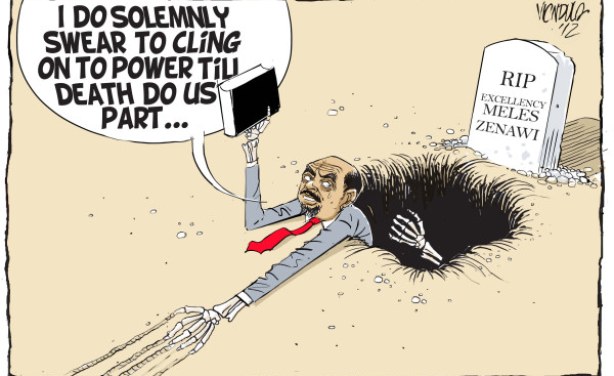
In March of this year, Zenawi reaffirmed his 99.6 percent electoral victory in the May 2010 elections and ruled out an “Egyptian-like revolution” by proclaiming a contractual right (read birthright) to cling to power: “When the people gave us a five year contract, it was based on the understanding that if the EPDRF party (Zenawi’s party) does not perform the contract to expectations it would be kicked out of power. No need for hassles. The people can judge by withholding their ballots and chase EPDRF out of power. EPDRF knows it and the people know it too.” For Zenawi, electoral politics is a business deal sealed in contract. Every ballot dropped (and stuffed) in the box is the equivalent of an individual signature in blood on an iron clad five-year contract.
Following the recent uprisings, the delirious 42-year dictator of Libya jabbered, “Muammar Gaddafi is the leader of the revolution, I am not a president to step down… This is my country. Muammar is not a president to leave his post, Muammar is leader of the revolution until the end of time.” Simply stated: Muammar Gaddafi is president-for-life!
In 2003, Robert Mugabe, the self-proclaimed Hitler of Zimbabwe, shocked the world by declaring: “I am still the Hitler of the times. This Hitler has only one objective: Justice for his people. Sovereignty for his people. If that is Hitler, right, then let me be a Hitler ten-fold.” In Mein Kampf, the self-proclaimed leader (Der Fuhrer) of the “master race” wrote blacks are “monstrosities halfway between man and ape.” Africans have deep respect for their elders because they believe wisdom comes with age. Sadly, the 87 year-old Mugabe is living proof of the old saying, “There is no fool like an old fool.”
What makes African dictators so mindlessly arrogant, egotistically self-aggrandizing, delusionally contemptuous, hopelessly megalomaniacal and sociopathically homicidal? More simply: What the hell is wrong with African dictators?!?
Seeking to answer this question, I conducted an imaginary interview with Africa’s greatest, most respected and universally-loved leader, Nelson (Madiba) Rolihlahla Mandela. The answers below are quotations pieced together from President Mandela’s books, public statements, speeches, interviews, court proceedings and other publications and materials.
An Imaginary Conversation With President Nelson Mandela
Q. President Mandela, many African leaders believe they can cling to power forever by “locking up” their enemies and “banging” them in jail, shooting them in the streets and waging a sustained psychological campaign of fear and intimidation against their people. Is peaceful change possible in Africa?
A. “The government has interpreted the peacefulness of the movement as a weakness: the people’s non-violent policies have been taken as a green light for government violence. Refusal to resort to force has been interpreted by the government as an invitation to use armed force against the people without any fear of reprisals…
Neither should it ever happen that once more the avenues to peaceful change are blocked by usurpers who seek to take power away from the people, in pursuit of their own, ignoble purposes.
If you want to make peace with your enemy, you have to work with your enemy. Then he becomes your partner. It always seems impossible until it is done.”
Q. Many African leaders “lead” by intimidating, arbitrarily arresting, torturing and murdering their people. What are the leadership qualities Africa needs?
A. “I always remember the axiom: a leader is like a shepherd. He stays behind the flock, letting the most nimble go out ahead, whereupon the others follow, not realizing that all along they are being directed from behind. Lead from the back — and let others believe they are in front.
It is better to lead from behind and to put others in front, especially when you celebrate victory when nice things occur. You take the front line when there is danger. Then people will appreciate your leadership.
As a leader… I have always endeavored to listen to what each and every person in a discussion had to say before venturing my own opinion. Oftentimes, my own opinion will simply represent a consensus of what I heard in the discussion.
This [first democratic election for all South Africans] is one of the most important moments in the life of our country. I stand here before you filled with deep pride and joy – pride in the ordinary, humble people of this country. You have shown such calm, patient determination to reclaim this count. I stand here before you not as a prophet but as a humble servant of you, the people. Your tireless and heroic sacrifices have made it possible for me to be here today. I therefore place the remaining years of my life in your hands.”
Quitting is leading too.”
Q. Many African leaders today believe they are “supermen” who have a birthright to rule their people as they wish. Does this concern you?
A. “That was one of the things that worried me – to be raised to the position of a semi-god – because then you are no longer a human being. I wanted to be known as Mandela, a man with weaknesses, some of which are fundamental, and a man who is committed, but, nevertheless, sometimes fails to live up to expectations.”
Q. You have spent many decades in prison. Do you have any regrets for all the sacrifices you have made?
“During my lifetime I have dedicated myself to this struggle of the African people. I have fought against white domination, and I have fought against black domination. I have cherished the ideal of a democratic and free society in which all persons will live together in harmony and with equal opportunities. It is an ideal which I hope to live for. But, my Lord, if needs be, it is an ideal for which I am prepared to die.”
Q. There are African leaders who say democracy and freedom must be delayed and rationed to the people in small portions to make way for development. Can freedom be rationed?
A. “There is no such thing as part freedom.”
Q. What is at the end of the rainbow of freedom?
A. “I have walked that long road to freedom. I have tried not to falter; I have made missteps along the way. But I have discovered the secret that after climbing a great hill, one only finds that there are many more hills to climb. I have taken a moment here to rest, to steal a view of the glorious vista that surrounds me, to look back on the distance I have come. But I can rest only for a moment, for with freedom comes responsibilities, and I dare not linger, for my long walk is not yet ended.”
Q. One African leader takes great pride in comparing himself to Adolf Hitler, the iconic symbol of hate in modern human history. Why are so many African leaders filled with so much hatred, malice and bitterness?
A. “No one is born hating another person because of the colour of his skin, or his background, or his religion. People must learn to hate, and if they can learn to hate, they can be taught to love, for love comes more naturally to the human heart than its opposite.”
Q. Do you believe an election is a contract between Africa’s iron-fisted rulers and the people?
A. “Only free men can negotiate, prisoners can’t enter in contracts.”
Q. What can Africans do to liberate themselves from the scourge of dictatorship?
A. “No single person can liberate a country. You can only liberate a country if you act as a collective.”
Q. Why are so many well-off Africans afraid to take a stand against dictatorship, human rights violations and corruption on the continent?
A. “Our deepest fear is not that we are inadequate. Our deepest fear is that we are powerful beyond measure. It is our light, not our darkness that most frightens us. We ask ourselves, who am I to be brilliant, gorgeous, talented and fabulous? Actually, who are you not to be? You are a child of God. Your playing small doesn’t serve the world. There is nothing enlightened about shrinking so that other people won’t feel insecure around you. We were born to make manifest the glory of God that is within us. It is not just in some of us: it’s in everyone. And when we let our own light shine, we unconsciously give other people permission to do the same. As we are liberated from our own fear, our presence automatically liberates others.”
Q. How can African intellectuals contribute to the struggle for democracy, human rights and accountability in the continent?
A: “A good head and good heart are always a formidable combination. But when you add to that a literate tongue or pen, then you have something very special.”
Q. What is the one important thing young Africans need to guarantee a bright future for themselves and the continent?
A. “Education is the most powerful weapon which you can use to change the world. Education is the great engine of personal development. It is through education that the daughter of a peasant can become a doctor, that a son of a mineworker can become the head of the mine, that a child of farm workers can become the president…”
Q. What is you dream for Africa and humanity in general?
A. “I dream of an Africa which is in peace with itself. I dream of the realization of the unity of Africa, whereby its leaders combine in their efforts to solve the problems of this continent. I dream of our vast deserts, of our forests, of all our great wildernesses.
Never, never and never again shall it be that this beautiful land will again experience the oppression of one by another. If there are dreams about a beautiful South Africa, there are also roads that lead to their goal. Two of these roads could be named Goodness and Forgiveness.
This must be a world of democracy and respect for human rights, a world freed from the horrors of poverty, hunger, deprivation and ignorance, relieved of the threat and the scourge of civil wars and external aggression and unburdened of the great tragedy of millions forced to become refugees.”
Q. What are the choices facing the people of Africa today?
A. “The time comes in the life of any nation when there remain only two choices: submit or fight. That time has now come to South Africa. We shall not submit and we have no choice but to hit back by all means within our power in defense of our people, our future and our freedom.”
Thank you, President Mandela. May you live for a thousand years! Nkosi Sikelel’ iAfrika. (God Bless Africa.)
Reports coming out of Ethiopia indicate that the mass arrest of the Oromos has continued unabated. Meles is engaged in a {www:witch-hunt} strategy to destroy any form of opposition to his dictatorship. Like most desperate dictators in North Africa and the Middle East he unsuccessfully attempted to associate the emerging new pro democracy movement with foreign forces.
The naked truth is that the minority dictatorial regime that has been in power for 20 years through brute force and fraudulent elections is severely threatened by the uprising that is brewing all over Ethiopia. Civil resistance is slowly but surely spreading in almost every part of the country. Like the dictators in the Middle East and North Africa, Meles is trying to deflect public attention by preposterously linking the pro-democracy movement in side Ethiopia and in the Diaspora with foreign forces.
The Global Civic Movement for Change in Ethiopia (GCMCE) strongly condemns the latest {www:political machination} of the Zenawi regime, demands the immediate halt to the mass arrests, egregious human rights violations in the Ogaden, Oromia, and other regions, calls for the unconditional release of all political prisoners and the resignation of Meles Zenawi so that it paves the way for the formation of a Transitional Government.
We also call on the regime to allow the International Red Cross and other humanitarian organizations to resume their operations in the Ogaden and other drought affected areas of Ethiopia.
The Ethiopian youth is once again determined to make history. We have unanimously decided to conduct tactical campaign strategy and remove the despotic regime that has been in power for more than 20 years through brute force and fraudulent elections. In 1974 the popular revolution that overthrew the age old imperial regime was led by the youth. It was the result of the sustained struggle of the Ethiopian student movement that culminated in a popular revolution. After the 1974 revolution, the Ethiopian youth vehemently fought the military regime, and paid dearly. The sacrifice required retreat and change of strategy. In 1991, the youth managed to remove the military dictatorship. Unfortunately like the 1974 revolution, the 1991 revolution was hijacked by poor leaders and blood thirsty Marxist dictators that used ethnic differences as a card to impose an apartheid type minority rule. Today the Ethiopian youth faces severe hardship, has little sense of national cohesion, and is living with grim future. It is facing high unemployment, mass migration, bad education, eviction from its ancestral land to give way to land to foreigners and lost its God given liberty.
On the positive side, there is hope. We are fully aware that our destiny is in our hands. We are also inspired by our peers in Tunisia, Egypt, Libya, Syria, Yemen and elsewhere. There is no reason why we cannot have the Arab uprising in Ethiopia. We can have an Ethiopian Spring that addresses the root causes of bad governance. Therefore, we have resolved to bring the torch to Ethiopia, and liberate the country from the minority dictatorship that has been in power for more than 20 years.
To this effect, the youth wings of major political organizations have agreed to work for peaceful change, with the main objective of creating a platform in bringing the Ethiopian youth together, to network and build solidarity, brainstorm ideas, strategize long term and short term plans to shape the political, social and economic future of Ethiopia. We want to contribute to peace and development not only in Ethiopia but in the Horn of Africa. We want to resolve the Nile River issue with a win win situation for all countries. Our aim is to promote democracy and end minority rule through peaceful resistance. It is to promote equality, justice, unity and mutual respect among all Ethiopians. The Ethiopian Youth Movement is an independent network with structures in most parts of Ethiopia, and in the Diaspora. It has been operating for sometime. It is an action oriented movement that does not aspire to hold a political office. Our movement rejects all forms of extremism.
In the short term, the struggle will focus on removing the dictatorship through peaceful resistance. The struggle period can be short or a protracted one. It aims to minimize the level of sacrifice. Our struggle is not against the ordinary TPLF members or the Ethiopian Defense Forces. It is against the TPLF cabal, the violators of human rights and corrupt officials. We have an excellent relationship with the global youth movement. Our short term aim is to help the formation of a Transitional Government that prepares the country for an unfettered free and fair election.
The Transitional Government, in addition to preparing the country for a free and fair election, shall maintain law and order, and defend the unity and territorial integrity of the country during the transition period. It shall have no hidden agenda. The Ethiopian Youth Movement therefore fully supports the recently issued press statement of the National Oromian Youth Movement, and calls upon the removal of Meles Zenawi from power. We support the suspension of the constitution and the abolition of the rubber stamp parliament of TPLF.
No amount of suppression and propaganda shall confuse the Ethiopian youth from its target. We are very happy to announce that the peaceful resistance for change will start on May 28, 2011. We call upon Ethiopian students, farmers, workers, civil servants, businessmen and women, professionals, political organizations, civic organizations, religious leaders, and men and women in the uniform to join the youth movement to remove the dictatorship. We also call upon all armed and clandestine opposition forces to declare cease fire and support the peaceful struggle.
The struggle for democracy and unity shall continue!
Seventy years ago, Ethiopians won the war against colonial aggression by their {www:archenemy} Fascist Italy. For a people {www:conscious} of its history, seventy years is not far, and for Ethiopians the sorrows, destruction and glories associated with the five-year war are still fresh in their memories. As a {www:tribute} to the patriotic resistance fighters, this write-up presents their perspective with the purpose of reminding the current generation some of what our ancestors approved or disliked in relating to foreign allies. There are two points I wish to highlight. One of them is that the fighters acknowledged British help, but they were essentially proud of their own resistance to Italian presence. To the end of their days, they insisted that they fought a war of invasion from 1935 to 1940/41; their country was not occupied despite a foreign army that they managed to dislodge eventually. The other point of emphasize here is that Ethiopians were aware of contemporary episodes that were used for asserting negative views about their political processes.
Italy crushed an Ethiopian army at {www:Maichew} in October 1935 and took the capital on 5 May, but the southern Ethiopian war front of Sidamo*, Harar, Arsi and Bale, Ras Desta, Dajazmaches Gebre Matyam and Debay, Beyene Merid and others went on fighting until February 1937. Ras Imiru, with members of young standing army cadets, sustained an army and a government in Wellega and the west until June 1936. In and around the capital, resistance picked up as {www:guerrilla warfare} in September 1937 and kept going until 1941. The same type of warfare was conducted in Gojam, Begemder, Wello and parts of Tigre, more or less throughout the same time. Far from extracting colonial wealth, the invader had to maintain a substantial fighting force at a heavy cost to Italy itself.
The United Nations has declared that five-year war as the beginning of World War II. When it ended in Ethiopia in 1940/41, it escalated elsewhere because Fascist Italy joined Germany and Japan to contest world superiority. On top of its provocation in Europe, Italian air force bombed towns along the Kenyan border and even took Galbat and Kassala on the Ethiopian Sudanese border in June and July of 1940. In a well-known historical saga, the British Middle East Command, especially General Platt in Sudan, General Cunningham in Nairobi and the French in Djibouti wanted to use the Ethiopian warriors against the Italians. Their purpose was to ‘mop up’ Italians from their African military bases and secure the Red Sea. The British authorities in Sudan reached out to the fighters along the Ethiopian Sudanese border, and gave them uniforms and supplies. So did those in Kenya and the French Djibouti.
How the British and their agents engaged Ethiopians in dialogue is a fascinating historical episode that has some relevance to contemporary attempts of approaching westerners concerning the country. At the time, only a few held the once wide-spread belief that the League of Nations would help Ethiopia against their aggressor. Indeed, those on the side of the British mission reported that they had difficulty in winning over the confidence of the fighters. Some were highly suspicious that they would only change one European aggressor for another. Others distrusted the claim that the emperor was returning with a British force. Those who finally accepted British offer of help, did so because they strongly believed that the Emperor would have the upper hand in making final decisions on Italian or any other European presence in Ethiopia. They saw the role of the British as marginal to the war effort to throw out the Italians.
Most fighters rejected the offer preferring to take their commands from the emperor. Leaders such as Amoraw Wubneh (styled ras by his followers) told the British in Gedaref “What is the difference to me. White are White, be they British or Italians or British”. Even news of the emperor’s imminent arrival in their midst did not help the British mission that was sent to coordinate the warriors’ efforts. Thus, Lij Belay Zeleke (whose bravery had obliged his followers to style him “emperor by his own might”) would not shake hands with a member of the British mission that had reached his camp in Gojam. In Kenya, General Cunningham had to restrain some Ethiopian exiles who refused to fight under the command of British colonial officers. Only the exiles in Djibouti were happy to fight the enemy as long as the French authorities cooperated with them.
The history of the British involvement in the war in Ethiopia adds another interesting aspect to foreign involvement in the affairs of the country. Once General Cunningham launched the attack against the Italians, he found that the Italians were much weakened in the south. He soon reached the center, and on April 4 had the Royal Air Force bomb the airport where it destroyed 32 planes; the following day, he entered the Addis Ababa. His use of weapons and military force from British territorial holdings in southern Africa was minimal cost to the British. The Ethiopian resistance had already carried the critical cost of dislodging the Italian forces.
Whatever the British thought they were doing in Ethiopia, the Ethiopians accompanying them were made to understand that they were only receiving assistance in their struggle against the Italians. They were easing the advance of the British columns to the capital and beyond, whether they were coming from the north and west or from the south. Later, however, the British put a facile twist of military diplomacy, with a dash of racism particularly from their military bases of their Southern African colonies, and claimed that their relationship with the fighters was one of ‘inciting a rebellion’ in the Italian ‘colony’.
This was a negation of the spirit of Ethiopian sovereignty, and with General Cunningham’s dash to enter the capital symbolically expressed it. Haile Selassie and the resistance fighters were deliberately delayed. The resistance fighters, including the famous Ras Abebe Aregai had hoped to stage a deservedly grand entry into the capital with the emperor in the lead. The same day that Cunningham arrived in Addis Ababa, Haile Selassie hoisted the Ethiopian flag in Debre Markos, Gojam. He and his warriors had to wait for until 5 May to enter the capital. British friends, who considered the emperor as a symbol of unity, also lauded that date as important for being the fifth anniversary of the emperor’s departure into exile five years before.
Once their forces from Sudan and Southern Africa overrun Ethiopia, they set to consolidating their victory over the Italian army. They dismantled its weapons, looted its administrative centers and took what they could carry to Kenya. The emperor and his government personnel had to engage in diplomatic maneuvers to finally get rid of British administrative and military personnel. Some of their administrative decisions included the attempt at forging territorial boundaries in the neighboring countries of North East Africa, notably Ethiopia and Somalia.
The resistance fighters never accepted Italian or any other claim that they had lost their sovereignty. They rejected British claims to liberate Ethiopia, and resented that Britain treated Ethiopia as an occupied territory. It has to be remembered that the British entered the war in Ethiopia as part of their strategy of denying German military holding in Rwanda-Urundi [later Rwanda] and Italian positions to Libya, Somalia, and Eritrea-Ethiopia. It was neither in aid of policing the region nor philanthropic. They knew Italy’s military expenditure was overtaxing it and that even sending troops to Ethiopia in order to ease internal social and economic crisis had outrun its usefulness as a propaganda ploy. Italy was a weak enemy, and the Ethiopian warriors were already giving it a hard time. As a strategy of making the weakened enemy fragile ever further, helping the emperor to link with the guerrilla fighters was vital.
To summarize: The historical episodes –the British agents engaging Ethiopians in dialogue and British involvement in the war in Ethiopia – have influenced the turn of some events in Ethiopian history. Indeed the British sentiment of inciting rebellion in Ethiopia was at work when the British Command in Sudan sent its agents to engage the Ethiopian warriors in a dialogue for cooperation. They were talking cross-purpose of what was at stake. The engagement in dialogue underlined the difficulties in what was to be seen as the rivalry between the resistance fighters who had stayed in county and the exiles. Those who fought the guerrilla wars looked down on the returned exiles; the latter of course were said to have the support of the chief exile, the emperor. It was a rivalry that was reflected in the less than harmonious administration of post-war Ethiopia. Sadly, a more profound legacy of British involvement in the war emanated from their subsequent administrative decisions on the basis of their claim that Ethiopia was their occupied territory. Their attempt at forging territorial boundaries left hostilities among people in the neighboring countries of North East Africa, notably Ethiopia and Somalia.
Both historical incidents have been cited also as basis for characterizing Ethiopians as suspicious of one another, and as a people who lack in coordinating their own efforts. Perhaps drawing parallels between the experiences of the resistance fighters had with the British and current generation of Ethiopians with the global community is unfair. However, there are lessons to be learnt from their negative consequences. Those heroic resistance fighters also used their diplomatic skills to dislodge foreign involvement in the name of war. Follow their example in such involvement in the name of contemporary rivalry for investment is entirely up to whether we seek to learn from our history.