Skip to content

ethio

What Should Starving Ethiopians do to Help Themselves?

Alemayehu G. Mariam

In 1987 when Time Magazine featured a famine-stricken Ethiopian mother on its cover page, it failed to ask the most important question of all: What should Ethiopians do and not do to help themselves?

It is the privilege of those who give to pity those who receive. One of the great indignities of being a perennial object of charity and handouts is the perception by those lending a hand that handout recipients are not only moneyless and helpless but also hopeless and clueless about what they need to do to help themselves. Well-intentioned donors and benefactors often mistakenly assume that recipients of charity should “ask what the world can do for them, and not what they can do for themselves.” But history shows that all societies that have succeeded economically, socially and politically had to pull themselves up by their bootstraps with a little help from friends. Ethiopians are no exception; they must do all of the heavy lifting by themselves if they are to permanently cast off the burdens of poverty, famine, disease, dictatorship and corruption. What should Ethiopians do to save themselves?

Ten Things Ethiopians Can Do to Help Themselves [1]  

It is all about humanity, community and civility, NOT ethnicity, nationality, sovereignty, animosity or disunity.

If Ethiopians have a chance of overcoming their enormous economic and political problems, they must first make fundamental choices. They can choose the politics of their common humanity and collectively build a harmonious civil community, or remain trapped in the dungeon of identity politics and become pawns in the ethnic chess game of uber-dictator Meles Zenawi. If Ethiopians affirm their common humanity, they will see that human rights abuses do not have an ethnic face, nor poverty a nationality. They will understand religion is not a weapon of animosity but a way to divinity. National disunity will never produce prosperity, but it will surely keep the people in perpetual poverty. Ethnicity and identity add diversity in a genuine democratic system. Under a dictatorship, they become powerful tools of dehumanization breeding fear, hatred and distrust among the people. Ethiopians must choose to climb up and steer the Ship of Ethiopia into the horizon or remain lost in their ethnic boats on a sea of tyranny, poverty and famine. That is why I believe Ethiopians need a new unifying civic ideology that transcends ethnicity, gender, nationality, religion, language and other classifications susceptible to insidious use. Ethiopians inside the country and in the Diaspora must build a civic culture based on the Universal Declaration of Human Rights (UDHR), the most translated document in the world. If the values of the UDHR are widely accepted and practiced, Ethiopia will be able to overcome poverty, famine and internal division and achieve prosperity and greatness within a generation.

Ethiopians must become a little bit utopian.

Ethiopia is today a dystopia–  a society that writhes under a dictatorship that trashes human rights and decimates all opposition ruthlessly. Last year, Zenawi told two high level U.S. Government officials what he will do to his opposition: “We will crush them with our full force.” All Ethiopians, regardless of ethnicity, language, religion, class or region must be able to imagine an Ethiopia where no petty tyrant will ever have the power or even the audacity to say he will “crush” another fellow citizen, or has the ability to use “full force” against any person just because he can. Ethiopians must be able to dream of a future free of ethnic strife, famine and oppression; and strive to work together for a little utopia in Ethiopia where might is NOT right but the rule of law shields the defenseless poor and voiceless against the slings and arrows of the criminally rich and powerful. It is true that Utopians aspire for the perfect society, but Ethiopians should aspire and work collectively for a society in which human rights are respected, the voice of the people are heard and accepted (not stolen), those to whom power is entrusted perform their duties with transparency and are held accountable to the law and people.

Learn from the past, prepare for the future.

More often than not, many Ethiopians tend to dwell on the past than imagining an alternative future. The past is a great teacher; we must learn from past mistakes and do things better and differently. But the past can also be a mental prison. Zenawi always reminds us how we have been wicked to each other in the past and waxes eloquent on the alleged crimes, cruelty and inhumanity of long gone kings and princes. He never tires to tell us how this king, that aristocrat or soldier has been cruel and barbaric. He thinks he can make himself angelic by demonizing past leaders. Perhaps he does not see it, but when one points an index finger outwards, three fingers are pointing inwards. The moral lesson is that we need to find a way out of the mental prison of past grievances and liberate our minds with a new civic ideology to embrace a brave new democratic Ethiopia under the rule of law. As the old saying goes, “One can’t drive forward on the road of life if one is fixed looking in the rear view mirror.” So, we have to make another simple choice: Live in the past chewing on the cud of historical grievances or hold hands, learn from the past and put our collective shoulders to the grindstone and forge a new Ethiopia. If we fail to do that, those who cling to power will entrench and enrich themselves and laugh at the rest of us who remain trapped in the dungeons of our historical grievances.

No country or society ever got prosperity by begging or receiving alms.

No country or society ever got prosperity by begging or receiving alms. But recent evidence from Wikileaks cablegrams shows that Zenawi plans to bulldoze his way into economic development at an annual growth rate of 15 percent by panhandling the West. According to U.S. Assistant Secretary of Treasury Andy Baukol, the “Government of Ethiopia (GoE) has become more vocal about its need for sustained aid flows from the West and more recalcitrant about implementing any reforms or liberalization of key sectors such as banking and telecommunications.” A recent IMF report, which Zenawi wants kept hidden from public scrutiny, concluded that Ethiopia’s “macroeconomic performance has deteriorated markedly” because of loose monetary policy which has fueled stratospheric inflation and mindless government control and regulations which have undermined confidence in the private sector.

Foreign aid as a development vehicle has been thoroughly discredited. As Dambissa Moyo has argued, the “evidence overwhelmingly demonstrates that aid to Africa has made the poor poorer, and the growth slower. The insidious aid culture has left African countries more debt-laden, more inflation-prone, more vulnerable to the vagaries of the currency markets and more unattractive to higher-quality investment.” Countries that have achieved rapid economic development have managed to create favorable politico-legal environments for business, industry and commerce, maintained low state debt and accumulated substantial fiscal reserves to meet emergency needs. The spirit of official mendicancy in Ethiopia must be replaced by a public spirit of unfettered entrepreneurship.

As long as Ethiopia remains under a dictatorship, there will always be famine, and not just of food.

Western aid bureaucrats like to sugarcoat the famine in Ethiopia in the politically correct bureaucratese of “extreme malnutrition”, “food crises”, “green drought” and so on. Interestingly, in a recent official blog and testimony before the U.S. Senate Foreign Relations Committee former U.S. Ambassador to Ethiopia Donald Yamamoto and presently Principal Deputy Assistant Secretary of State acknowledged “famine [is] spreading across the Horn of Africa.” That should not come as a surprise as Yamamoto had long concluded that Ethiopia is trapped in a permanent and unbreakable cycle of famine and starvation. In a recently released Wikileaks cablegram,Yamamoto advised his superiors: “Ethiopia’s perennial emergency food dependence is, de facto, a permanent condition.” He outlined that the U.S. has three choices in light of the permanence of famine in the Ethiopian political economy: 1) “continue to provide massive food aid, which is unsustainable, in meeting Ethiopia’s permanent state of emergency food need each year,” 2) “provide significantly greater assistance for sustainable agricultural productivity”, or 3) “robustly to push for a shift in economic and agricultural policies (regarding land tenure, agricultural technologies and practices, agricultural inputs, etc.) to increase domestic agricultural productivity.” The bottom line is that as long as Ethiopia remains in the chokehold of the current dictatorship, there will always be a famine not only of food but also of democracy, human rights, rule of law, accountability, transparency and vision. Western donors must stop supporting oppression, corruption, persecution and repression in famine-stricken Ethiopia.

Plant and water the seeds of genuine multiparty democracy on the parched landscape of famine.

It is oft-repeated that “there has never been a famine in a functioning multi-party democracy” with a robust free press.  In a competitive multi-party political process, there is a much higher degree of political and electoral accountability. A government that ignores or fails to prevent famine is surely destined to lose power. A free press will mobilize public opinion for official and civic action to deal with the problem. Multiparty democracy does not mean the six dozen ethno-tribal “parties” organized by the Zenawi dictatorship to serve as a Tower of Babel and facilitate its divide and rule strategy. It does mean the functioning of political organizations that compete for electoral support and have appeal across ethnic, linguistic, religious and regional lines. Ethiopia can learn a great lesson from Ghana in this regard in light of shared socio-economic and political experiences. Article 55 (4) of the Ghanaian Constitution expressly mandates political parties to have “national character”: “Every political party shall have a national character, and membership shall not be based on ethnic, religious, regional or other sectional divisions.” Any multiparty system to be established in Ethiopia must be guided by such constitutional language.

Ethiopia’s youth are the flowers of today and the seeds of hope tomorrow.

The old Ethiopian saying that the “youth are the flowers of today and the seeds of tomorrow” is true. They need to be carefully cultivated and grown. But the the data on these seeds of hope are discouraging. Forty six percent of Ethiopia’s 91 million population in 2011 is estimated to be under the age of 18. UNICEF estimates that malnutrition is responsible for more than half of all deaths among children under age five. An estimated 5 million children are orphans, a little less than one-fifths from AIDS. Urban youth unemployment is estimated at 70 per cent. The vast majority of Ethiopian adolescents live in rural areas. Some regions in the country have extremely high rates of early marriage. Frustrated and in despair of their future, many urban youths drop out of school and engage in risky behaviors including drug, alcohol and tobacco abuse, crime and delinquency. The ruling dictatorship’s youth, sports and culture agency concedes that youth issues have been long neglected: “In Ethiopia, because of the fact that proper attention has not been given to addressing youth issues and their organizations, therefore, mutual cooperation and networking among youth, family, society, other partners and government had hardly been created.” Much needs to be done to give Ethiopia’s youth hope in the future. Whatever is to be done to help the youth, the starting point must necessarily be a de-marginalization of youth through an explicit acknowledgement of their role in solving problems affecting them. They must be included in all decision-making concerning youth issues and consulted extensively in the policy planning and implementation stages. The bottom line is that without the youth, Ethiopia has no future. Those who ignore the youth should understand that hungry children grow to be angry children and a ticking demographic time bomb.

Empower Ethiopian women.

Birtukan Midekssa, Ethiopia’s foremost political prisoner until her release last year and first woman political party leader in Ethiopian history, enjoyed talking about an allegorical ‘future country of Ethiopia’ that would become an African oasis of democracy and a bastion of human rights and the rule of law in the continent. In Birtukan’s ‘future Ethiopia’ women and men would live not only as equals under the law, but also work together to create a progressive and compassionate society in which women are free from domestic violence and sexual exploitation, have access to adequate health and maternal care and are provided education to free them from culturally-enforced ignorance, submissiveness and subjugation. But if the situation of women in the ‘present country of Ethiopia’ is any indication, Birtukans “future country” is in deep trouble.

The 2000 US State Department Human Rights Country Report on Ethiopia described the status of women in appallingly disheartening terms: “The Constitution provides for the equality of women; however, these provisions often are not applied in practice… Discriminatory regulations in the civil code include recognizing the husband as the legal head of the family and designating him as the sole guardian of children over five years old. Domestic violence is not considered a serious justification under the law to obtain a divorce. Irrespective of the number of years the marriage has existed, the number of children raised and the joint property, the woman is entitled to only 3 months’ financial support should the relationship end.”

The 2010 US. State Department Human Rights Country Report on Ethiopia described the status of women in similar stark terms: “The constitution provides women the same rights and protections as men. Harmful Traditional Practices (HTPs) such as FGM (female genital mutilation), abduction, and rape are explicitly criminalized; however, enforcement of these laws lagged. Women and girls experienced gender-based violence daily, but it was underreported due to shame, fear, or a victim’s ignorance of legal protections. Domestic violence, including spousal abuse, was a pervasive social problem. The 2005 Demographic and Health Survey found that 81 percent of women believed a husband had a right to beat his wife. Sexual harassment was widespread [and] harassment-related laws were not enforced.”

The current dictatorship in Ethiopia manifested its latent misogyny not only by giving lip service to women’s issues but also by dehumanizing the symbol of women in Ethiopia, young Birtukan Midekssa. During her incarceration, the  U.S. Government regarded Birtukan a political prisoner because she was imprisoned for her political beliefs as did all other major international human rights organizations. But Zenawi threw Birtukan straight into solitary confinement after arresting her on the streets, and boasted to the world: “There will never be an agreement with anybody to release Birtukan. Ever. Full stop. That’s a dead issue.” He later literally added insult to injury by mocking her that she was in “perfect condition” in solitary confinement and was eating and sitting around idly and likely to “have gained a few kilos”.

Ethiopian women need to be empowered in all spheres of life. But without young women leaders like Birtukan who can fight for Ethiopian democracy and human rights, and women’s rights, talk of improving the status of women in Ethiopia is a mockery of women.

Only Ethiopians can save themselves.

Ethiopians should know that the West and its billions in aid and loans will help but not save them from a famine of food and democracy. Ethiopians in the Diaspora can help by becoming the voice of Ethiopia’s voiceless. But only Ethiopians can save themselves from famine, poverty, dictatorship and division. Only they can solve their problems by creating common cause, building consensus and forging genuine brotherhood and sisterhood among themselves regardless of ethnicity or other factors. Only when they are able to forge unity of purpose and are irrevocably committed to democracy and the rule of law will they be able to cast off the boots of dictatorship from their necks. There is no need to look for answers to what troubles Ethiopia in Washington, D.C., London, Bonn or Beijing. The solution for Ethiopia’s problems is in Ethiopia.

Give hope. Always keep hope alive.

The old saying is true that “Man can live about forty days without food, about three days without water, about eight minutes without air, but only for one second without hope.” When dictators swagger arrogantly to show the people that they are omnipotent, omnipresent and omniscient, they are telling them they have no hope. Their message is the same as the one inscribed on the gates of Dante’s Inferno: “Abandon all hope, ye who enter here.” But Ethiopians must never abandon hope. To abandon hope is to lose faith in Ethiopia’s children. When the dictators say, “Look how powerful we are. Give up!”, hope says “keep on keeping on. Tyrants for a time seem invincible but in the end, they always fall.” As Martin L. King said, “We are now experiencing the darkest hour which is just before the dawn of freedom and human dignity.” That is why it is important to keep hope alive in Ethiopia.

Tyrants always fall, but what happens the morning after?

Gandhi spoke an eternal truth: “There have been tyrants and murderers and for a time they seem invincible but in the end, they always fall — think of it, ALWAYS.” In just the past few months, Ben Ali fell in Tunisia; Hosni Mubarak fell and is standing trial in Egypt. Moammar Gadhafi fell and is hiding out in a spider hole somewhere in southern Libya. Bashir Al-Assad is teetering as he continues to butcher Syrians who have kept up the pressure through acts of mass civil disobedience. He too will fall. The question is never, never whether tyrants fall. The question is always, always what happens after they fall!

[1] This commentary builds upon my  set of ten reasons to questions posed by Time Magazine nearly a quarter of a century ago: “Why are Ethiopians starving again? and “What should the world do and not do” to help them?

Previous commentaries by the author are available at: www.huffingtonpost.com/alemayehu-g-mariam/ and http://open.salon.com/blog/almariam/

Pastor Daniel confirms severe torture in Ethiopian prisons

Pastor Daniel Gebraselassie, head of Prison Fellowship Ministry in Ethiopia informs U.S. Embassy officials in Addis Ababa that the Meles dictatorship has been perpetrating severe tortures against detainees. The information comes from the recently leaked secret U.S. diplomatic cables that are now available on Wikileaks. The following is an excerpt of what Paster Daniel told U.S. Ambassador Donald Yamamoto:

Through meetings with these prisoners while detained and following their release, Pastor Dan learned that they were subjected to severe torture while in prison. (NOTE: Prisoners refuse to meet with Ambassador Kassa, saying that the Ethiopian Human Rights Commission is not independent of the GoE. END NOTE) Pastor Dan told Embassy officers that prison officials used Derg-era techniques ) e.g. hanging prisoners from the ceiling in arm shackles, beating the soles of their feet and hanging boards from their testicles ) to try to extract confessions. One of the prisoners reportedly died from injuries sustained while in prison, though prison officials maintain that he is “sick in the hospital.” Another of the former prisoners reported that when he was arrested, police dragged him out of his place of work and was pistol-whipped by plain clothes security forces on the way to the detention facility. The released detainees told Pastor Dan that others detained after them on similar suspicions are still held in Maikelawi. In follow-up meetings with prison officials, Pastor Dan was told that such reports are incorrect and that the prisoners were never tortured. However, in a meeting with the Federal Police Commissioner, he was told that some low-level interrogation officers lack the proper training and can sometimes use unsanctioned methods. Pastor Dan told the group of Embassy officers that “officials at the PM cabinet level” do not condone torture either, and that in the past seven years nearly 200 prison employees had been fired for improper behavior.

Read the full text here.

Ethiopian prisons are filled with Shweyga Mullahs

By Elias Kifle

The burning of Ethiopian woman, Shweyga Mullah, by the family of Libyan madman Gaddafi has shocked the world. The bestiality of the Gaddafis in subjecting a fellow human being to such unspeakable cruelty is horrifying to any decent human being. People around the world would be equally shocked if they see pictures of the tortures that are being perpetrated at this very moment by the U.S.-financed regime in Ethiopia.

One of the torture victims whose story the New York-based Committee to Protect Journalist wrote about this week is journalist Woubshet Taye. According to his wife, Berhane Tesfaye, Woubshet and other prisoners are being savagely beaten up and tortured by Meles Zenawi’s security forces. Woubshet told family members that he is unable to hear due to the torture.

The crime of torture by Meles Zenawi’s regime against Ethiopians is not news. Ethiopian prisons are filled with thousands of Shweyga Mullahs. All well-known international human rights organizations have extensively written about savage beatings of prisoners by the Meles rgime.

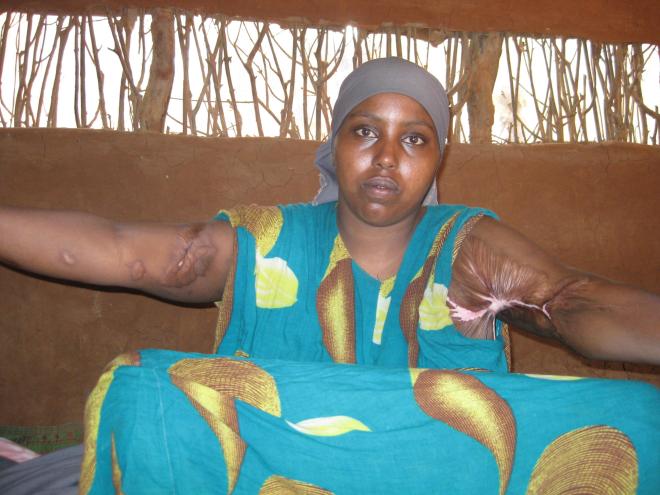
The Ethiopian women shown below have been burned by Meles Zenawi’s forces in Ogaden, eastern Ethiopia:

Torture of Ogaden women in Ethiopia by Meles Zenawi's troops Farhia Mohamed Mahad (Age 20) — Civilians are arrested and jailed in Ogaden on mere suspicions of being part of the Ogaden National Liberation Front (ONLF) and Farhia was no exception. Farhia was only a child when she was arbitrarily detained and jailed at Garbo Jail in the Ogaden. No explanation was given for her arrest. Farhia remained in jail for five years. During her imprisonment, Farhia was subjected to torture, rape, and electrocution. Her body, especially her chest and breast, suffered severe burns as a result direct electric current. Farhia has permanent scar tissues all over her body. Farhia received no treatment for her injuries.

Torture of Ogaden women in Ethiopia by Meles Zenawi's troops Ismail Abdirahman (Age 8) — Ismail came to the refugee camp with his grandmother Hawa Hassan. They fled from Gunagado, Dagahbur. According to Mrs Hawa, the military came to her village, caught many villagers by surprise, and ordered everybody to come out of their houses. The soldiers started targeting and burning certain houses including Hassan’s house. Ismail and his uncle Mahamud were in the house when the soldiers set the house ablaze. Mahaumud was severely burned as he shielded Ismail from the flames. As a result, Ismail suffered burns on his thighs and knees and Mahamud died from severe burns and fumes.

U.S. Ambassador Donald Yamamoto has also written this classified report about torture in Ethiopia:

Recent interviews with individuals who have been held in non-traditional detention facilities have shed anecdotal light on beatings and abuse by Ethiopian security officials against civilians in country. While we cannot confirm the scope or persistence of such mistreatment, these first-hand reports do offer a unique insight into abuse of detainees and dynamics regarding Ethiopia’s non-traditional detention facilities. A handful of released political and other prisoners in Ethiopia have recently reported to PolOff that they and other detainees have been tortured in police station jails in attempts by security officials to elicit confessions before cases go to trial. Depending on the detainee, abuses reported include being blindfolded and hung by the wrists for several hours, bound by chains and beaten, held in solitary confinement for several days to weeks or months, subjected to mental torture such as harassment and humiliation, forced to stand for over 16 hours, and having heavy objects hung from one’s genitalia (males). Based on what our sources have reported, torture seems to be more common at police station detention centers (most notably Ma-ekelawi police station in Addis Ababa), while less is reported at Kaliti prison. Released prisoners have also reported to PolOff cases of prisoners being detained for several years without being charged and without trial, prisoners held in jails despite having been released by the courts, and police interference with court proceedings.

The question Ethiopians ask the Obama Administration is, in light of such overwhelming evidences, including testimonies by U.S. officials about the crime of torture that is being perpetrated by the Meles regime against Ethiopian civilians, why is the U.S. continuing to prop up the regime with billions of dollars in assistance?

Deadly clash reported between Woyanne and ONLF forces

(VOA) — Ethiopian government Woyanne and rebels in the restive Ogaden region have confirmed a deadly clash this week in an area where a Chinese firm is exploring for oil. Each of the two side’s respective versions of the event differ sharply.

Details provided by both the Ethiopian government Woyanne and rebels of the Ogaden National Liberation Force [ONLF] are sketchy.

But they agree that clashes took place this week in Ethiopia’s Somali region, between the main city, Jijiga, and the town of Degehabur, 150 kilometers to the south. The area is about 500 kilometers east of Addis Ababa, where the Chinese firm PetroTrans is exploring for oil.

ONLF communiqué

An ONLF communiqué received by email Friday said 25 soldiers from an elite Ethiopian Woyanne army brigade had been killed, along with a few rebel fighters in a battle last Tuesday. The statement said the army units had been escorting a PetroTrans exploration team, and had been “dislodging farmers from their lands” on the pretext that their farms were located on a seismic fault line.

The ONLF email alleged that the Chinese workers embedded with the army were wearing army camouflage uniforms, jeopardizing their rights as unarmed civilians stipulated in the Geneva Convention.

Ethiopian government Woyanne spokesman Shimeles Kemal ridiculed the ONLF claim. In a telephone interview, he said rebels had attacked what he called “civilian targets,” but had been rebuffed by local militia, suffering heavy casualties.

Contradictory version of events

“It’s the usual lie, the usual fabrication by the ONLF propaganda machinery. There was no attack against Ethiopian Woaynne soldiers that allegedly accompanied the Chinese oil exploration company,” said Shimeles. “What happened was, a bunch of ONLF rebel forces had tried to launch an attack against civilian targets. The local militia had ambushed and preempted their attack, and in the ensuing conflict, 11 members of ONLF were killed there and then.”

Shimeles confirmed that oil exploration is in progress in the region, but denied there had been any attacks on oil workers or their facilities.

“There are some oil exploration companies, particularly PetroTrans oil exploration company, which undertakes an exploration of oil in the area, and this company has undertaken its activities, and so far there has been no incident, no attack on it. They are undertaking their operation peacefully.

The Ogaden has since been largely off limits to foreigners. The International Committee of the Red Cross was expelled from the region by the Ethiopian government in 2008 after being accused of providing aid to the rebels.

Two Swedish journalists were arrested in the Ogaden in July after being injured in a battle between pro-government Woyanne forces and ONLF rebels. The pair remain in jail, and have a court date next week.

CPJ speaks out against the torture of Ethiopian journalists

New York (CPJ) — The Committee to Protect Journalists holds Ethiopia responsible for the well-being of two journalists detained without charge or legal access since June under the country’s far-reaching anti-terrorism law.

Police arrested Woubshet Taye, deputy editor of the weekly Awramba Times, and Reeyot Alemu, columnist for the weekly Feteh, on June 19 and 21, respectively, on vague accusations of terrorism. The journalists have been held for more than 65 days with no official charges placed against them and no access to legal counsel, local journalists told CPJ.

In a court hearing last month, Taye said state officials repeatedly tortured him while he was being interrogated in Maekelawi Prison in the capital, Addis Ababa, local journalists said. Ethiopia’s constitution dictates that a suspect cannot be compelled to make a confession and that any evidence obtained under coercion is admissible. Taye is due back in court on September 13.

Alemu’s overall health rapidly deteriorated during her detention at Maekelawi Prison, according to local journalists who visited her in prison. Her relatives were allowed to visit her and brought her medicine for chronic gastritis, which improved her condition somewhat. She is expected back in court on September 14, local journalists told CPJ.

“We are very disturbed by Woubshet Taye’s allegations of torture and call on authorities to immediately investigate and bring to justice the perpetrators of this crime,” said CPJ East Africa Consultant Tom Rhodes. “Authorities must also provide adequate medical treatment for Reeyot Alemu.”

Ethiopia’s July 2009 anti-terrorism law criminalizes any reporting considered supportive to groups that the government has labeled “terrorists.” In June, the government formally classified five groups as terrorist entities, including the banned political party Ginbot 7.

Latest Wikileaks releases of U.S. diplomatic cables from Ethiopia

Wikileaks: Secret diplomatic messages sent from the American Embassy in Addis Ababa, Ethiopia by U.S. diplomats

2010-02-13 ETHIOPIAN GOVERNMENT HOSTS DIASPORA INVESTMENT FORUM

2010-02-13 JANUARY REGIONAL ENVIRONMENT NEWSLETTER, EAST AFRICA

2010-02-12 Ethiopia: Information on Child Labor and Forced Labor

2010-02-10 ETHIOPIA AND CLIMATE CHANGE, POST AU SUMMIT

2010-02-10 U/S OTERO TALKS WATER IN ETHIOPIA

2010-02-09 BIOTECHNOLOGY WORKSHOP GENERATES DEBATE, GOE SENDS MIXED SIGNALS

2010-02-09 Special Envoy Scott Gration Meeting with JSR to UNAMID Gambari

2010-02-08 FOREIGN INVESTORS GRAB UP MORE LAND IN ETHIOPIA

2010-02-02 UNDER SECRETARY OTERO’S MEETING WITH ETHIOPIAN PRIME MINISTER MELES ZENAWI – JANUARY 31, 2010

2009-12-22 ETHIOPIA: DEATH SENTENCES FOR FIVE GINBOT 7 DEFENDANTS

2009-11-04 HIGH RISK OF HUMAN RIGHTS VIOLATIONS FOR RURAL ETHIOPIAN GIRLS

2009-10-21 DRUG TRAFFICKING IN ETHIOPIA

2009-10-05 RUSSIAN BUSINESS PRESENCE IN ETHIOPIA

2009-06-22 Ethiopian Stowaway Detained in U.S.

2009-06-10 ETHIOPIA’S EMERGENCY FOOD NEEDS – A PERMANENT STATE

2009-06-08 UNDERSTANDING THE ETHIOPIAN HARDLINERS

2009-05-21 ETHIOPIA’S ECONOMIC SCRAMBLE FURTHER STIFLES PRIVATE SECTOR

2009-05-07 Ethiopian Government Builds Case Against VOA

2009-04-30 FOREX CRUNCH IMPERILS REPATRIATION OF PROFITS?

2009-04-21 ETHIOPIA: REPORT ON FISCAL TRANSPARENCY

2009-04-09 TREASURY FINDS AN ETHIOPIA MORE RELIANT ON AID THAN REFORM

2008-02-06 ETHIOPIA: ASSISTANT SECRETARY FRAZER AND PRIME MINISTER MELES DISCUSS KENYA, SUDAN, SOMALIA, AND ERITREA

2007-11-28 OGADEN: COUNTER INSURGENCY OPERATIONS HITTING A WALL

2007-09-06 SHEIK AL AMOUDI DISCUSSES BUSINESS AND POLITICAL CLIMATE

2006-05-16 ETHIOPIAN DOMESTIC WORKERS IN THE UAE

2006-05-11 COMMISSION INVESTIGATING ETHIOPIAN ELECTORAL VIOLENCE INVESTIGATES THOUSANDS OF CLAIMS