Aides Say Obama Chose a Partner in Leadership
By JEFF ZELENY and JIM RUTENBERG, The New York Times
WASHINGTON — In the beginning, Senator Barack Obama was not entirely sold on Senator Joseph R. Biden Jr. And Mr. Biden told friends that he was pessimistic of his chances of becoming Mr. Obama’s Democratic running mate.
Over the course of two months, as the dynamics of the presidential campaign and world events shifted quickly, Mr. Biden’s stock rose through one of the most rigorous vice-presidential vetting processes that Democrats could recall. It was a process in which Mr. Obama applied intense secrecy, careful pragmatism and political input from a team of internal and external advisers that have guided his campaign from the start. And it ended Thursday with a phone call from Mr. Obama, who reached Mr. Biden as he was at a dentist’s office where he had taken his wife to have a root canal.
On Saturday, as the two men embraced before a crowd in Illinois, the new Democratic partnership made its debut. Yet in a moment that could have showcased Mr. Obama’s decision-making, his top advisers made a concerted effort not to disclose how he made his choice, instead choosing to showcase the life stories of the two men on the ticket and to present Mr. Biden as a forceful new critic of Senator John McCain, Republican of Arizona.
“It’s a very personal decision,” said David Axelrod, the campaign’s chief strategist, in a brief interview Saturday. “He approached it in a very serious, sober and reasoned way.”
Mr. Obama reached the decision about 10 days ago while on a weeklong vacation to Hawaii. That week, Mr. Biden’s strengths in foreign policy were highlighted by the conflict between Russia and Georgia, giving his prospects a further boost. Associates of the other main possibility on Mr. Obama’s list, Senator Evan Bayh of Indiana, said Mr. Obama cited the situation in Georgia in breaking the news to Mr. Bayh late last week that he had chosen Mr. Biden.
But people involved in the process said it was not just foreign policy that tilted the balance. They said Mr. Obama’s decision had as much to do with Mr. Biden’s appeal among white working-class voters and compelling personal story, and his conclusion that the Delaware senator was “a worker.”
The plans for the announcement began to take shape in early July. Until the end, aides said, a small team inside the Chicago headquarters planned for four possibilities: Mr. Biden, Mr. Bayh, Gov. Tim Kaine of Virginia and Gov. Kathleen Sebelius of Kansas. Speeches were written, media plans were made and private planes were at the ready to take any of the four to Springfield, Ill.
Mr. Biden was hardly considered a likely pick at the start of the process. His reputation for verbosity was Washington legend. While he impressed at the debates by defying expectations with his brevity, his presidential campaign foundered and ended quickly.
“I think in his heart of hearts he thought in the end he wouldn’t get it,” said Gov. Edward G. Rendell of Pennsylvania, a friend. “During the vetting process you mostly hear why you wouldn’t be a good candidate,” he added, naming “the change issue” and “some of the things he said during the campaign.”
But Mr. Biden had some powerful patrons in his corner whose opinions Mr. Obama respected, like Mr. Rendell; Representative Rahm Emanuel of Illinois, the chairman of the House Democratic caucus; and Senator Edward M. Kennedy of Massachusetts — not only a respected Senate lion but also uncle to a senior member of Mr. Obama’s vetting team, Caroline Kennedy.
As the vetting team sorted through Mr. Biden’s financial statements, political statements and medical records, Mr. Obama’s top political aides — Mr. Axelrod chief among them — reached out to friends in Mr. Obama’s orbit to get a sense of what sort of politician Mr. Biden was. The results belied Mr. Biden’s reputation. Reports came back that he was not only potentially more energetic and disciplined than widely known, but also that he had a distinct appeal suited to the areas throughout the industrial Midwest where Mr. Obama had struggled in the primaries.
But Mr. Obama was seeking a running mate with whom he would be comfortable governing for four or eight years, a bit of advice Senator John Kerry of Massachusetts had given him.
“I get the sense that he was quite serious about thinking through about the nature of who his partner will be there and, I think, the role of the vice president as a future partner in government,” said David Wilhelm, a former chairman of the Democratic National Committee, who worked on Mr. Biden’s 1988 presidential campaign and is close to Mr. Obama.
“I think it’s easy to give that sort of thing short shrift,” he added, “so ‘what kind of partner I’m getting’ mattered quite a bit.”
Much of the process unfolded in silence as dozens of lawyers completed their tedious assignments for the vice-presidential vetting team. They conducted lengthy sit-down interviews with at least six Democratic prospects, and they demanded thousands of pages of documents, including copies of speeches delivered more than two decades ago.
In addition to the four ultimate finalists, Democratic officials said, Gov. Bill Richardson of New Mexico and Senator Christopher J. Dodd of Connecticut were also among those who received extensive consideration. Teams of lawyers, at least 10 for some candidates, were assembled to inspect finances, medical histories and political backgrounds of the prospective candidates and their families.
In an interview Saturday, Mr. Richardson said that Mr. Obama called him soon after he claimed the nomination on June 3 to tell him that he wanted to put him on his list of prospects. But, Mr. Richardson said, Mr. Obama warned him that it would be an intensive process, and asked him to consider whether he was up for it. (After checking with his wife, Mr. Richardson said, he called back to say he was.)
Mr. Obama called to check in with him midway through the process, Mr. Richardson said, before his vacation to Hawaii. As always, Mr. Obama dialed Mr. Richardson himself from his cellphone. Mr. Richardson said he told Mr. Obama that he had not seen his name on lists in the news media, and Mr. Obama responded by saying, “No, you’re in this thing.”
Mr. Richardson was alerted weeks later that his vetting process had gone well, he said, but late last week — he would not say exactly when — Mr. Obama called to thank him and tell him, “I’ve made up my mind, and we’re going in another direction.”
In the waning days, several people close to Mr. Bayh said he remained upbeat over the possibility that he would be Mr. Obama’s choice. He had met with Mr. Obama several times, and the amount of information Mr. Obama’s staff had asked for was beyond anything Mr. Bayh — who has been in contention for the vice-presidential position at least twice before — had experienced.
Mr. Biden, meanwhile, was viewed as undercutting himself with his own behavior as reporters staked out his Delaware residence. When Mr. Biden returned home in his white pickup truck from a garbage dump and made an off-color joke to camera crews last week, an e-mail message circulated among Mr. Bayh’s closest associates that read, “Keep talking Joe, please keep talking.”
He did not.
Carl Hulse contributed reporting.

 BEIJING (Reuters) – Ethiopian Kenenisa Bekele outsprinted his rivals with a stunning last lap to win the 5,000 metres on Saturday and become the first man to complete the Olympic long-distance double since 1980.
The 26-year-old, who retained his 10,000 title last Sunday, raced home in an Olympic record time of 12 minutes 57.82 seconds to give Ethiopia a sweep of all four distance titles after Tirunesh Dibaba completed the women’s double on Friday.
Watch video here.
“It’s very special,” he told reporters. “It’s not easy to achieve this for me, after hard work, after so much effort.”
It was a first major 5,000m title for the world record-holder and matched the feat last achieved by his compatriot Miruts Yifter in Moscow 28 years ago and never managed by another Ethiopian great, Haile Gebreselassie.
Kenyan Eliud Kipchoge, who denied Bekele a world championship double in Paris in 2003, was unable to follow the leader when he broke for home and finished well adrift in 13.02.80.
“In this final the pace was fast,” said Kipchoge. “But if we were in the same position in the last lap, maybe I could have caught up with him. I expected myself to get a gold medal, but I lost it and he was faster.”
The 24-year-old’s compatriot Edwin Cheruiyot Soi took bronze in 13.06.22, while American Bernard Lagat, whose kick was enough to win him the world title last year, found the pace just too quick and trailed in ninth.
“I’m very proud that we Kenyans did a really good job,” said Soi, who ran a personal best to finish third. “I’ve called my family but they didn’t pick up. I guess they’re still yelling.”
SLOW PACE
Bekele, who won silver in Athens four years ago, was never going to allow a slow pace on Saturday despite the heat and humidity and he raced into the lead after the first half a lap.
“My plan was to pick up the pace very fast,” he said. “It was a very fast race.”
He remained at the front guarded by his brother Tariku and the third Ethiopian, Abreham Cherkos, with the two Kenyans and Lagat tucked in behind.
When the field stretched out with three laps to go, Lagat and the two other Ethiopians faded leaving a straight race between Bekele and the Kenyans.
Bekele kicked at the bell and, glancing frequently behind him, had a 10-metre advantage over Kipchoge midway through the back straight which he extended to 30 by the time he crossed the line.
“I had just enough, just enough, I was tired,” he said.
Although outside his world record of 12:37.35, Bekele’s time was good enough to beat the previous Olympic mark of 13:05.59 set by Morocco’s Said Aouita when he won gold in 1984.
Kenyan-born Lagat won the 1,500m and 5,000m double at last year’s world championships but failed to reach the final of the shorter race in Beijing.
“Inside me I was not ready,” said the 33-year-old. “My mind, my body, my Achilles. I could not kick at all. It’s been a tough two weeks for me.”
(Reported by Nick Mulvenney, Reuters)
Ethiopia’s Kenenisa Bekele crushed the opposition as he cruised to 5,000m gold on Saturday, adding to the 10,000m title he won eight days ago.
Bekele led all the way and sprinted to a new Olympic record time of 12 min 57.82 sec to beat Kenyans Eliud Kipchoge and Edwin Cheruiyot Soi.
It is the first time the long distance double has been secured for 28 years.
Bernard Lagat, who had been tipped to push for gold, drifted off the pace with two laps left to finish ninth.
Uganda’s Moses Ndiema Kipsiro was fourth, while Ireland’s Alistair Cragg pulled up half-way through the race.
Although outside his world record of 12:37.35, Bekele’s time beat the previous Olympic mark of 13:05.59 set by Morocco’s Said Aouita when he won gold in 1984.
Bekele said: “I am so happy with this performance. This is very special to me. It has been hard work for so many years.”
Find out about the Beijing athletics and football venue
 Kenenisa Bekele. Call him the emperor, call him the King. Maybe just call him magnificent. Magnificent Bekele was in the Bird’s Nest stadium Saturday, winning the 5000 metres in an Olympic record 12 minutes 57.82 seconds to become the first man to achieve the Olympic distance double since one of his great Ethiopian predecessors, Miruts Yifter, in Moscow in 1980.
Watch video here.
Before that, the greatest of the modern-day Finns, Lasse Viren had won the double two Olympics in a row, but times have changed as the ever-increasing speed of the two events makes them very different, rather than much the same.
Bekele, though, used his own variation of Viren’s tactics in 1976 to take the gold medal. Then Viren ran the speed out of the faster finishers after a slow first 3000 metres, accelerating lap by lap and never conceding the lead.
Bekele, too, faced men liken Kenyans Eliud Kipchoge and Ediwn Soi and world champion Bernard Lagat of the USA who could slip by him in the fnal straight in an even-paced or slow race. So, having used his teammates, younger brother Tariku and Abreham Cherkos, to control the first part of the race, ‘Kenny’ pushed for home on his own five laps out.
Bang, the second gun went off, and he ran 60 seconds, 61.3, 60.8, 60.9 and then sub-55 to totally destroy any chance the faster finishers had. In fact, they had gone by the bell. Kipchoge took second in 13:02.80 and Soi was third in 13:06.22. Whether they had a final kick left, no-one really noticed, or cared.
Source: The Sun-Herald
By Omulo Okoth, (The Standard) —
Another titanic battle is on the cards Saturday

Edwin Soi, Kenya’s only hope to stop
Kenenisa Bekele [photo: NBC]
BEIJING — National champion Edwin Soi is the man billed to stop Ethiopia’s Kenenisa Bekele from a double act.
When the 5,000m final starts at 8pm tonight (3:10pm Kenyan time), focus will be on the 26-year-old, who retained his Olympics 10,000m diadem last Saturday, and the Kenyan-born Bernard Lagat, who won both 1,500m and 5,000m at last year’s World Championships in Osaka.
“We have a good plan for this race. Thomas Longosiwa will be the sacrificial lamb, while Eliud and Soi will wait to attack at the right time,” coach Julius Kirwa said.
“We know the more dangerous man in this race is Lagat, not Bekele. He is the man we want to burn out and we shall reign,” Kirwa said.
Kirwa’s plan is to take the first half in 62:60 per lap to burn out both Lagat and Bekele.
However, depending on the speed of the race, Soi and Kipchoge will have an advantage of different types.
Kipchoge will be fine with a fast race, which Kirwa is planning. But when the race is slow, it may favour Soi’s last minute burst of speed, that saw him win at the national trials last month.
Longosiwa’s speed will come in handy as he will be expected to destroy the field.
A similar plot is taking place in the Ethiopian camp, where Abreham Cherkos or Tariku Bekele will be deployed to open up the field for Bekele, but observers think the multiple world champion is tired after winning the 10,000m last weekend and may not have the strength to win a double.
Kipchoge won a world title in 2003 World Championships final in Paris, with Bekele second and Moroccan Hicham El Guerrouj third.
In Athens Olympics the following year, El Guerrouj won with Bekele second again and Kipchoge third.
But Lagat, who became the first man to win both 1,500m and 5,000m at last year’s World Championships in Osaka, is fresh after bowing out in the shorter 1,500m early this week.
Another surprise, pundits say, may come from American Matthew Tegenkamp, who missed bronze narrowly last year in Osaka.

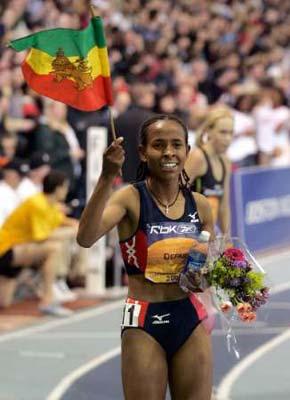 Thank you Meseret and all Ethiopian athletes for representing your country well in the Olympics despite all the hardships of living under a fascist regime.