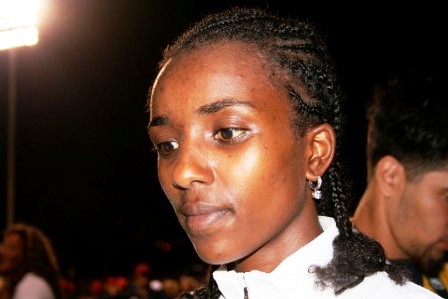
What a beautiful joy to see our athletes wining their race and representing our Ethiopia in the international venues such as Beijing where the world is focusing for the last two weeks, their effort s presented to the world the other side of our Ethiopia than the poverty, famine or hunger (though Woyanne is playing games with these words).
Like most of Ethiopians, I waited for hours to see our athletes at the opening ceremony, and the moment came but my long wait was in vain. Instead I saw unknown individuals, except Miruts Yifter holding the flag, representing Ethiopia in one of the best event ever held and watched by billions of people around the world. I said where is Haile, Tirunesh, Kenenisa, Meseret, Berhane, Gete or even Derartu or Fatuma?
Then I started to look into why our athletes were not part on the opening ceremony, and the first reason which came is shortage of budget! The Ethiopian government [Woyanne] has not enough money to bring the athletes to the Olympic venue on time.
This trigger a question: who will cover then the expense of the persons we saw in the opening ceremony (officials of the Woyanne-organized millennium celebration were part of it though). And then I heard that the Ethiopian National Olympic Committee President, Wzr. Dagmawit Girmay, and some government officials were attending the whole Olympic games. I said to myself this is normal as they have some work to do there. But all of them were with their families! For example Wzr. Dagmawit Girmay was with her husband and children attending the Olympic events for two weeks! Who covered their expenses? The government! She was NOT the only one who brought her family over there. Many of the government officials have attended the Olympic Games with their families, all expenses covered by the Government!
But there was not sufficient fund to bring our athletes earlier to Beijing and get them used to the weather and prepare them for their race!
If this was done, I am sure that the women Marathon race as well as Meseret Defarʼs result would have been much better (Meseret flew to Beijing only two days earlier for the 5000m race).
What a shame! And I am sure they donʼt care!
But as usual, our athletes made history despite all the odds. We are very proud of them!
BEIJING — Kenenisa Bekele won the 5000M gold medal to add to the 10000M gold he won last Sunday, becoming the first in 28 years to achieve the long distance double…
Despite his string of achievements, Kenenisa Bekele has remained largely under the huge shadow of his illustrious compatriot, Haile Gebrselassie. But on Saturday night at the Bird’s Nest, the 26-year-old Ethiopian finally entered a territory that even his great mentor couldn’t approach.
Bekele won the 5000M gold medal to add to the 10000M gold he won last Sunday, becoming the first in 28 years to achieve the long distance double. He is only the sixth man in Olympic history to win the double and the first since his countryman Miruts Yifter conquered the two races in 1980.
The ninth day of the track and field programme — athletics events conclude with the marathon on Sunday — was as action-packed as the previous eight days. However, even an upset of Olympian proportions in women’s high jump and a spectacular series in javelin by Andreas Thorkildsen of Norway could not overshadow Bekele’s feat.
In Athens, the Ethiopian had to settle for silver in the 5000, narrowly losing to Hicham el Guerrouj of Morocco. On paper, American Bernard Lagat was expected to be Bekele’s closest challenger here but in reality, there was no one to challenge the young master as he smashed Said Aouita’s 24-year-old Olympic record of 13:05.59 with a 12:57.82 effort.
His brother Tariku and countryman Abreham Cherkos set the early pace but there was no doubt as to who was controlling this race. Bekele stayed close to the leaders while Lagat was in the middle of the pack along with Kenyans Eliud Kipchoge and Edwin Cheruiyot Soi.
Bekele firmly hit the front with five laps left and went on to unleash his final burst of speed to silence all opposition. Kipchoge, world champion in 2003, took silver in 13:02.80 and Soi was third in 13:06.22. Lagat’s misery was complete as he ended ninth.
“I have achieved many things before, but this is very special. It is a fantastic feeling,” said Bekele. “I made some mistakes in Athens, now I am more experienced. I think about the races more,” he added.
Vlasic beaten
Tia Hellebaut, a complete outsider, ended Vlasic’s long unbeaten streak in women’s high jump. Belgian Hellebaut struggled to clear 2.01 and 2.03 but she went over first time at 2.05. Vlasic, the world champion and hot favourite here, could do it only in her second chance. She then failed at 2.07, a height that was insurmountable to Hellebaut as well.
“I don’t believe it, I still don’t believe it,” said the bespectacled 30-year-old. “Blanka has not lost for over a year, it is a complete surprise.” Vlasic said she was feeling a bit bitter. “What can I do, luck was not with me today. But my motivation is bigger than before,” she said.
Norway’s Thorkildsen defended his Athens gold medal with an Olympic record of 90.57 metres. He threw down the gauntlet with a first round effort of 84.72 and kept going past that mark in the subsequent rounds – 85.91, 87.93, 85.13 and 90.57 – before fouling the last throw. Ainars Kovals of Latvia jumped to silver position in the last round with 86.64, edging past Tero Pitkamaki of Finland (86.16). Americans put behind the disasters in shorter relays, claiming both the men’s and women’s 4×400 while Kenya had two gold medals on the final day. Wilfred Bungei finally won a global title in the 800 before Nancy Langat clinched their first-ever gold in women’s 1500M. World champion Maryam Yusuf Jamal of Bahrain ended fourth.
Results: Men: 800M: Wilfred Bungei (Kenya) 1:44.65, 1; Ismail Ismail Ahmed (Sudan) 1:44.70, 2; Alfred Kirwa Yego (Kenya) 1:44.82, 3.
4x400M relay: United States (LaShawn Merritt, Angelo Taylor, David Deville, Jeremy Wariner) 2:55.39 (Olympic record. Old: 2:55.74), 1; Bahamas 2:58.03, 2; Russia 2:58.06, 3.
(Aqumada) — The Ethiopian team has been somewhat disappointing. The ‘usual suspects’, Keneinsa Bekele and Tirunesh Dibaba have won gold in their specialties. Seleshi Sihine, as usual, has taken the silver in the 10k. Although not the color we expected, Meseret Defar has also grabbed a medal. The rest of the team, however, has performed below par and there is not sign of any up and coming young talent in our traditional events [not to take anything away from the performances of Jarso and Zemzem in the steeplechase].
On the other hand, Kenenisa and Tirunesh have extended the gap between themselves and the rest of the athletes. Both these athletes have made a good case to be considered the greatest long distance runners of all time.
The biggest disappointment: Gelete Burka
There is no doubt that Gelete is one of the most talented Ethiopian runners. Not able to make the immensely talented 5k Ethiopian team, she dropped down to the 1,500 meter and even had the season best going into the Olympics. However, she was unable to make it the finals of this event after running badly in the preliminaries. Gelete is notorious for inconstancy and Beijing has once again proven that she has not matured tactically and there is no sign that she will be able to perform to the best of her abilities any time soon. Clearly, Gelete needs to a drastic change in her training and approach to races. Perhaps she needs to do the Berhane Adere [change coaches and come up with a suitable training for herself]
The greatest moment: Kenenisa’s victory in the 5k
Kenenisa’s victory in the 5k was a demonstration of power, skill, and, tactical brilliance. He has clearly learned from the past that a slow pace in the 5k is as good as handing over the Gold medal to the 1,500 specialists such as Lagat. Kenenisa did not make the same mistake he made in Athens this time. With the help of Tariku and Abraham, he set a furious pace which dropped likes of Lagat early in the race. With a lap remaining, he destroyed the only two remaining Kenyan runners by running 53 seconds last lap. This was not a race. This was a demonstration of dominance by Kenenisa.
The only remaining race for Ethiopian athletes is the Men’s marathon and after watching the condition of our athletes in the rest of the races, my expectations are extremely low.
BEIJING (AP) — Samuel Wanjiru already had made a name for himself in the heady world of Kenyan distance running. Now he stands alone.
He pulled away over the final few miles Sunday to become the first Kenyan to win an Olympic marathon — and he did it faster than anyone ever has.
Wanjiru negotiated the 26.2-mile course through the Beijing streets in bright morning sunshine in an Olympic record of 2 hours, 6 minutes, 32 seconds.
“In Kenya we have many medals,” Wanjiru said, “but I’m glad I have this one.”
His name was listed on the official results sheet as Wansiru, but the Kenyan said that spelling was incorrect.
Kenyans had twice won men’s marathon silver, most recently in 2000, but never a gold.
At the Beijing Games, Kenya won 14 track and field medals, behind only the United States (23) and Russia (18). Five of them were gold.
The biggest concern about this race leading to the Olympics was the quality of the air. World record-holder Haile Gebrselassie of Ethiopia decided not to run because of the pollution. But on Sunday, after an overnight thunderstorm, a glorious blue sky greeted the final day of these games.
The women’s marathon a week earlier was run in a light rain, and the air quality posed no problems for the runners.
The race began at the edge of Tiananmen Square, then wound around the Temple of Heaven before turning toward the Olympic Green and the Bird’s Nest, where colorful dancers, drummers and cyclists entertained the crowd as it awaited the runners.
This was just the third marathon for the 21-year-old Wanjiru, who first set the world half-marathon record at age 18, then broke it twice again last year.
Two-time world champion Jaouad Gharib of Morocco won the silver in 2:07:16. Ethiopian Tsegaye Kebede, winner of this year’s Paris Marathon, took the bronze in 2:10:00. Ethiopian Deriba Merga led much of the race but faded badly at the end to wind up fourth.
The crowd roared as Wanjiru entered the Bird’s Nest, and he responded by raising his left hand, then clapped several times. The final lap in the last event of track and field at the Beijing Olympics was run around an infield painted blue for the night’s closing ceremony.
Just across the line, Wanjiru — all 112 pounds of him — kneeled and crossed himself several times. He had just broken the Olympic mark of 2:09:21 set by Carlos Lopes of Portugal in the 1984 Los Angeles Games.
As Wanjiru was still on one knee, Gharib crossed the line for the silver.
“I had to push the pace to tire the other runners,” Wanjiru said. “I had to push the pace because my body gets tired when I slow down.”
Wanjiru, who trains at 7,600 feet on a trail that runs alongside spectacular Thompson Falls, won the Fukuoka International Marathon in Japan last December and was runner-up at the London Marathon in April.
Americans Dathan Ritzenhein and Ryan Hall finished ninth and 10th, respectively.
Defending Olympic champion Stefano Baldini of Italy, in his final marathon, finished 12th, then praised those who finished at the front.
“In the last 10 kilometers (6.2 miles) it was unbelievable what the … Africans were able to do under these conditions,” he said.
The temperature was 75 degrees with 52 percent humidity when the race began at 7:30 a.m. and it heated up steadily through the morning, reaching 86 degrees by the finish.
The lead pack began to separate through the first three miles. By the halfway mark, eight were grouped at the front, led by Eritrean Yonas Kifle.
After almost 19 miles, the pack had dwindled to three — Wanjiru, Merga and Gharib.
Reigning world champion Luke Kibet of Kenya stayed with the leaders through the early stages but fell back and finally pulled out of the race shortly past the halfway mark. He later said he had a stomach problem.
Tirunesh Dibaba, the humble
champ [Photo: tadias.com]
Tirunesh Dibaba had modest ambitions when she arrived in Beijing she just wanted to compete well in her two events here…
But then, in Dibaba’s parlance, competing well simply means winning well. The results tell the story: gold in 10000M, gold in 5000M. Two out of two, meaning the Ethiopian has indeed competed well — well enough to enter the territory of Olympic legends, for no woman had ever achieved that before.
Dibaba might not have stated it openly, but the 23-year-old certainly was a woman on a mission in Beijing. Two-time world champion in the 10000M and 5000M, she had missed the gold in 5000 at Athens and was keen to make amends. She did that here, though the way she did it did not please many.
Dibaba believes in staying back till the last one or two laps before unleashing her terrific kick. The 5000M, however, was too slow and the question to Dibaba at the post-match press conference on Friday was why she did not increase the pace, putting on a real show for the crowd.
“I came here to the Olympics representing my country and the major objective was to win a medal. I have always done that this way (staying back and attacking at the right time). But now that you have told me, I will start doing so,” she said with a smile, evoking laughter all around.
Having run the 10000M and the 5000M semifinals earlier, Dibaba was certainly not at her best and the pace in the final, she said, suited her. “I was expecting that others would run faster. Luckily, they didn’t do that and I knew I could always out-kick them,” she said.
Dibaba’s boyfriend is another Ethiopian long distance runner, Sileshi Sihine, who won silver medals in 10000M at Athens and here. Asked when the marriage is going to be, Dibaba said no date has been finalised. “Preparations are on,” she said through the interpreter.
(fiftyeight.net) — It was a great spontaneous Ethiopian “Fanfest”. Drivers of trucks, buses and private vehicles joined pedestrians and local residents in cheering their national hero. Traffic came to a complete standstill when hundreds of people gathered at Meskel Square in the center of Addis Ababa to watch the 5000m race Saturday afternoon. The cheering, dancing and clapping increased as Kenenisa Bekele crossed the finishing line, winning the fourth Gold Medal for the East African nation of Ethiopia at the Beijing Olympics 2008. Watch the video below >>