EDITOR’S NOTE: It is the same kangaroo court that stole Ethiopian people’s vote in 2005 and allowed Meles Zenawi’s death squads to unleash terror on civilians. The Derg did not commit half the crime Woyannes have perpetrated against the people of Ethiopia. The Woyanne judged are themselves murderous criminals.
(The Associated Press) — ADDIS ABABA, Ethiopia: Ethiopia’s Supreme Kangaroo Court sentenced an exiled former president dictator Mengistu Haile Mariam and 18 officials to death Monday, a prosecutor said.
Yoseph Kiros said the judgment delivered justice for the thousands of people murdered during Mengistu’s 17-year rule.
“I believe it is the right verdict because these people committed serious crimes against humanity,” Kiros said.
Mengistu, a Marxist leader who was driven from power in 1991 by the current regime, is living in comfortable exile in Zimbabwe and is not expected to be extradited while Robert Mugabe remains Zimbabwean president.
A runoff in Zimbabwe’s presidential race is scheduled for June 27. Mugabe’s opponents say he is using violence and intimidation in an attempt to win the runoff and retain power. Nevertheless, opposition leader Morgan Tsvangirai has said he is confident of victory.
The 18 other officials sentenced to death Monday are all in Ethiopian custody.
Some experts say 150,000 university students, intellectuals and politicians were killed in a nationwide purge by Mengistu’s regime, though no one knows for sure how many suspected opponents were killed during the Soviet-style purges.
Human Rights Watch has described the 1977-78 campaign known as the Red Terror as “one of the most systematic uses of mass murder by a state ever witnessed in Africa.”
Mengistu had previously been sentenced to life imprisonment in January 2007 for genocide, but the prosecution appealed the sentence in July as unduly lenient.
Under Ethiopian law, the current president must approve the death sentences before an execution date is set.
– – – – – – – – – – –
ADDIS ABABA (AFP) – Ethiopia’s Supreme Court sentenced former dictator Mengistu Haile Mariam to death in his absence Monday, along with 17 senior officials of his regime, overturning a previous life term on appeal.
The court followed the request of the prosecution to toughen the sentence imposed in January 2007 on Mengistu, who has lived in comfortable exile in Zimbabwe since he was toppled in 1991, after he was found guilty of genocide at the end of a decade-long trial.
Mengistu, an army lieutenant colonel, was a member of the Marxist junta known as the Derg which ruled Ethiopia from 1974 after the ousting of Emperor Haile Selassie, assuming control of it in a bloody coup in 1977.
The genocide charges arose from a crackdown against opponents in 1977-78 known as the Red Terror in which tens of thousands were killed or disappeared.
The court that passed life sentences in 2007 accepted pleas for leniency from the defence, but Supreme Court judge Desta Gebru rejected them Monday.
“The court has decided to revoke the leniency appeal from the defendants,” he said in his ruling. “It has sentenced them to death.
“They have tortured and executed thousands of innocent people in public, which applies as genocide according to Ethiopian law.”
“Despite claiming that the killings resulted from the chaos that ensued after the (1974) coup, the defendants ordered massacres and abuses several years after the death of the emperor,” the judge added.
“All defendants are guilty of genocide, murder and illegal confiscation and detainment of innocent people. As a result, they will be handed out the most severe punishment in Ethiopian law.”
Desta said the court would await the confirmation of the sentences by President Girma Woldegiorgis — who has the power to amend them again — before fixing an execution date.
Those sentenced to death along with Mengistu included Legesse Afsaw, known as “the butcher of Tigre”, former vice-president Fisseha Desta and former prime minister Fikresellassie Wogderes.
On the reading of the Supreme Court’s verdict, many relatives of the accused in court burst into tears. None would comment to AFP.
Although the death sentence is sometimes pronounced in Ethiopia, only two people have been executed in the past 10 years and none since August 2007.
Following the end of Mengistu’s trial last year, Robert Mugabe’s government in Zimbabwe ruled out his extradition, saying, “Comrade Mengistu still remains a special guest”.
The Federal High Court had convicted Mengistu and 11 of his top aides in December 2006 on 211 counts of genocide, homicide, illegal imprisonment and illegal property seizure.
A further 60 defendants were also found guilty of genocide, but only by a majority 2-1 ruling by the judges, who acquitted some but not all on several of the lesser charges.
Only one defendant was acquitted on all charges.
Mengistu and his former top aides were also accused of the murders of former Ethiopian emperor Haile Selassie, whom they overthrew in 1974, and Orthodox Patriarch Abuna Tefelows.
Of the 73 accused, 14 had died and only 33 were present in court. Mengistu was among 25 defendants tried in absentia.
– – – – – – – – – – – – –
(VOA) — Ethiopia’s highest court threw out a January, 2007 court ruling giving Mengistu and 17 of his senior associates life sentences for their part in the deaths of thousands of people between 1974 and 1991.
In a three-hour reading of the verdict, Justice Desta Gebru said the court has decided to revoke the leniency appeal from the defendants. It sentences them to death.
Justice Gebru agreed with a prosecution appeal that the life sentence was not commensurate with the crimes. After the original trial, which lasted 12-years, the defendants were convicted in 2006 of genocide for torturing and executing political enemies.
Many of the deaths occurred in 1977 and 1978, when Mengistu’s Marxist government, called the Derg, or “the committee,” carried out a purge known as the Red Terror.
Mengistu was an army lieutenant colonel when he led a military coup that overthrew Emperor Haile Selassie. He has been living in exile in Zimbabwe since he was ousted by Ethiopia’s current government in 1991.
But several senior Derg officials were in the courtroom when the verdict was read.
Prosecutor Yoseph Kirkos expressed satisfaction at the high court’s decision. He said the difference between a life sentence and death in absentia may be meaningless now, but it could make a big difference if Zimbabwe’s President Robert Mugabe is ousted in next month’s election.
“For now you can say is no different,” said Yoseph Kirkos. “But for tomorrow maybe the country which protects him, which gives him the right to live there, maybe knows the gravity of the crime, and his involvement in the crime. Maybe one day they can return him. When they look he is a criminal and he is a dangerous guy.”
Former Ethiopian president and historian Negaso Gidada says persons convicted of genocide cannot be pardoned or granted amnesty. He says under Ethiopia’s constitution, only the current president, Girma Woldegiorgis, could commute the sentences.
“In case of person convicted of any crimes stated in sub-article one in these articles and sentenced with the death penalty, the head of state may, without prejudice, commute the punishment to life imprisonment,” said Negaso Gidada.
Negaso and prosecutor Kiros said while the issue of a commuted sentence may be moot for Mengistu, 17 other senior Derg officials are facing death. It was not immediately clear when or how the sentences might be carried out.
Coincidentally, the Supreme Court’s decision came two days before Ethiopia’s national day, when it celebrates the downfall of the Mengistu regime.
Sunday’s running of the Buffalo Marathon had a definite Ethiopian flavor to it. The men’s and women’s winners were both from that African country. Habtamu Bekele won the men’s race in 2 hours, 26 minutes and 5 seconds. Meserte Kotu took the women’s race in a course-record time of 2:43:10; the previous mark was 2:44:57 set by Beth Anne De- Ciantis in 1991.
Kotu was far too good for the field, taking the victory by more than 10 minutes over defending champion Jessica Allen. Kotu has a personal best of 2:30:02, so she figured to be a top contender Sunday. Kotu finished an impressive eighth overall.
“She was great. I’m honored to even share the same turf,” said Allen, who finished in 2:54:48 –almost two minutes faster than her winning time in 2007. “That’s pretty cool. It’s pretty prestigious for Buffalo to get such a runner from so far away.”
Allen said it took Kotu a while to get ahead, but there was no catching her once she moved in front around the 11-mile mark.
“She broke away right after Tifft Farms –pretty much at the bridge coming back into the First Ward,” said Allen, of Hampton Bays, L. I. “That’s where I started to be by myself.”
Allen held off Jennifer Boerner (2:58:14) of Amherst for second place.
Kotu does not speak English and thus was unavailable for interviews. She had the most profitable day of any of the participants, earning $2,000 for the victory plus $1,000 for the course record.
Bekele, who runs out of Marietta, Ga., won by a a relatively comfortable 16 seconds. Jason Lokwatom, a Kenyan running out of Troy, Ohio, was second at 2:26:21.
Bekele has raced throughout the world. He ran the 26-mile, 385-yard distance in an impressive 2:10:43 during the 2003 Rome Marathon. Bekele was second in the Bermuda Marathon earlier this year, finishing in 2:31:26. He ran a 2:26:19 in Atlanta early in April.
Bekele speaks little English, but he did say that he was “very, very happy about winning” and that the Buffalo course was “very good.”
Andrew Carnes of Canton, Ohio, had the lead in the race through the 10-mile mark, but went out too fast then faded under some persistent pressure of the lead pack. Carnes was fourth in 2:33:28. Darrin Pocza of Bemus Point was the top Western New York runner at 2:51:18, placing 12th.
In the masters division, James Derick of Big Flats was the men’s victor in 2:40:40. Gina McGee of Johnstown, Pa., won the women’s division in 2:59:28.
Mackey Tyndall of Panama City, Fla., was the fastest wheelchair competitor in a time of 2:06:59.
“It was a great day,” he said. “The roads were a little rough, but it was a flat, smooth course. I had a pretty good pace. I got a little bit fatigued at the end, but it was a good time overall.”
Tyndall is a retired Air Force captain whose injuries led to doctors doing two total hip replacements and the placement of a metal rod and some screws in his back. This was his sixth marathon of the year, and he says wheelchair athletes have gotten plenty of exposure in events like the Boston Marathon.
“It’s gotten a lot bigger, especially because of the military factor,” he said. “Last year at the Marine Corps [race in Washington], there were double the amount of hand-cycles. The hand-cycles are getting more popular, because of the ease of going from an injury to hand-cycle as opposed to a push-chair.”
In the half-marathon, Fernando Cabada showed why he is considered one of the top distance runners in America. He ran the 13.1-mile course in 1:08:52 to win. Cabada, running out of Boulder, Colo., ran his first-ever marathon in 2:12:26 in 2006. On the women’s side, Natasha Filliol won in 1:22:59. A native of Paris, Ont., she is one of Canada’s top triathletes.
By almost any definition, it was about a perfect morning for running, with sunshine and temperatures in the 50s. Some wind may have kept the times down just a bit.
Race director John Beishline said the final total of entrants was more than 3,000. That’s a big jump from last year’s 2,200.
Men’s Marathon
1. Habtamu Bekele 2:26:05
2. Jason Lokwatom 2:26:21
3. Paul Simboli 2:27:06
4. Andrew Carnes 2:33:28
5. Samson Mulli 2:33:49
6. Gerardo Avila 2:34:26
7. James Derick 2:40:40
8. Benson Osoro 2:44:16
9. Nelson Chavez 2:45:42
10. John Piggott 2:49:46
11. Mark Looney 2:51:11
12. Darrin Pocza 2:51:18
13. Gary Cattarin 2:54:12
14. Daniel Garrett 2:54:18
15. Derek Dunstan 2:54:22
16. Adam Bross 2:58:47
17. Christopher Ciamarra 2:58:54
18. Doug Hall 2:59:07
19. Craig Rudzinski 2:59:41
20. Christopher Occhino 2:59:46
Women’s Marathon
1. Meserte Kotu 2:43:10
2. Jessica Allen 2:54:48
3. Jennifer Boerner 2:58:14
4. Katherine Danner-Aldri 2:58:34
5. Gina McGee 2:59:28
6. Jill Skivington 2:59:35
7. Tammy Slusser 3:01:41
8. Jennifer McNutt 3:05:37
9. Michele Chille 3:18:32
10. Lisa Benzer 3:18:40
11. Emily Johnston 3:19:23
12. Katherine Fredlund 3:22:26
13. Mary LeBrun 3:22:37
14. Jackie Horvath 3:25:39
15. Kimberly Schenk 3:25:52
16. Kim Whitaker 3:26:00
17. Danielle Harmon 3:26:07
18. Kristin Winiewicz 3:26:16
19. Laura Richenderfer 3:26:59
20. Rosemary Wedlake 3:29:04
BERLIN, May 26 (Reuters) – A deal to market Ethiopia’s staple cereal, teff, to health-conscious Westerners may provide a model for ensuring the benefits of biodiversity are shared between local people and firms exploiting natural resources.
Teff, which looks like wheat and has a sour taste, is free of the protein gluten and research shows it can boost the body’s vitality and reduce fat production.
Realising its potential, Dutch entrepreneur Hans Turkensteen set up a company in 2002 to introduce the crop to the West.
But, aware of concern about “biopiracy” under which foreign companies have been accused of plundering foreign plants or animals, he worked out a deal to give some of the profits to Ethiopia, one of the world’s poorest countries.
The case illustrates one of the most difficult issues at a May 19-30 United Nations conference in Bonn where delegates are discussing ways to protect the diversity of life on earth.
Nearly 200 countries are trying to thrash out a framework for a 2010 deal on binding rules on access to genetic resources and the sharing of their benefits.
Developing nations want to reap financial rewards from natural resources which firms in sectors from pharmaceuticals to horticulture and cosmetics are keen to tap.
“We understood teff was not ours and wanted Ethiopians, who have cultivated, conserved and refined it for centuries to benefit from its use elsewhere,” Turkensteen told Reuters.
Health and Performance Food International (HPFI) signed a deal with the Ethiopian government in 2004 allowing the firm to bring the iron- and calcium-rich cereal to the West, to sell and promote it and to help develop teff-based foods.
HPFI gives 5 percent of its net profits to job-creation projects in Ethiopia, which also gets royalties from the profits on teff seed sales and cash for land cultivated by the firm.
Apart from teff, other deals have been made giving companies access to flowers in South Africa or micro-organisms in Kenya.
DAUNTING TASK
“The complexities of the issue are absolutely enormous,” said Rachel Wynberg, co-author of a report on the subject comissioned by the U.N.’s Convention on Biological Diversity.
For example, the pharmaceuticals branch spent about $55 billion on research and development in 2006 but only a small, and unknown, part went on natural products, said Wynberg.
Wynberg says industry should get more closely involved in the U.N. talks on global rules and on compliance mechanisms.
Compounding the problems are ideological differences between firms and governments over “access and benefit sharing”.
“The negotiations are seen as a proxy for addressing huge disparities in income across the world,” Wynberg told Reuters.
Developing countries put a very high value on their genetic resources but often fail to recognise that hefty investment is needed to develop products — and often leads nowhere.
HPFI, which had 2007 turnover of 1 million euros ($1.57 million), has invested 3 million euros and four years of work in researching teff.
It is trying to breed teff seeds outside Africa and is working on gluten-free recipes for bread, cake and beer for consumers allergic to the protein, as well as food for athletes.
All sides agree on the daunting task they face but activists say getting at least a roadmap for the way ahead is crucial.
“We need to send a signal to developing countries to make sure they are respected,” said Greenpeace’s Christoph Then.
By Madeline Chambers, Reuters
Editing by Catherine Evans
(Agence France Presse) — ADDIS ABABA, Ethiopia – Ethiopia’s exiled former dictator Mengistu Haile Mariam, who was sentenced to death Monday, oversaw the 1977-78 “Red Terror” when tens of thousands were tortured, murdered and disappeared.
Now 71 and living a comfortable life in exile in Zimbabwe, the man who came to be known as the Red Negus (“emperor” in Amharic) was convicted in December 2006, after a marathon trial, of genocide, homicide, illegal imprisonment and illegal confiscation of property.
The purge of politicians, intellectuals and other perceived foes came as his regime began trying to transform imperial Ethiopia with its ancient Christian heritage into a Soviet-style workers’ state.
Mengistu, a lieutenant colonel in the army, was a member of the Derg, the military junta which ran the country after the fall of emperor Haile Selassie in 1974.
Three years later he became head of the Marxist regime in a bloody coup which saw head of state General Teferi Bante assassinated.
Mengistu became the de facto ruler, running the cabinet and the military council, and instituted the Red Terror, which saw numerous arrests and thousands of killings across the Horn of Africa nation.
Already chief of the armed forces and secretary general of the Workers’ Party of Ethiopia (WPE), Mengistu was in September 1987 officially confirmed president of the People’s Democratic Republic of Ethiopia.
Seriously threatened from February 1991 by a coordinated offensive by the separatist Tigre People’s Liberation Front and the Eritrean People’s Liberation Front, Mengistu fled to Zimbabwe the following May.
Zimbabwe’s President Robert Mugabe, an old ally of Mengistu, offered him political asylum and has since refused to extradite him to Ethiopia. In 1996, he escaped an assassination bid in the Zimbabwean capital Harare.
Born in 1937 at Wallayata, Mengistu Haile Mariam became a career soldier like his father, graduating from the officer training college at Holetta in 1966 and doing a brief spell of further training in the United States.
After taking part in an uprising against Haile Selassie in 1960, he was a delegate in the armed forces coordinating committee at the time of the February 1974 revolution.
Many Ethiopians still remember Mengistu, with his dark skin and big moustache, haranguing crowds at Revolution, now Meskal, Square, in the heart of Addis Ababa, along with the interminable military parades he organised.
Considered as the brain behind the revolution and a leading member of the Derg from the start, Mengistu in seven months put an end to the world’s oldest surviving empire.
In his rise to power, he showed considerable political skills and was brutally intransigent regarding his opponents.
As well as the Red Terror, Mengistu and his former top aides were also accused of the murders of Haile Selassie and Orthodox Patriarch Abuna Tefelows.
Backed by the pro-Soviet socialist movement during a conflict with Somalia over the eastern Ogaden region, then faced with a nationalist rebellion in Eritrea, Mengistu signed an alliance with the Soviet Union in 1978 and created the Marxist-Leninist WPE in 1984.
He held the rotating presidency of the Addis-Ababa based Organisation of African Unity (today’s African Union) in 1983-84.
In May 1989, Mengistu crushed a coup attempt and executed 12 generals. The following year, he announced more liberal policies aimed at pulling Ethiopia out of economic disaster and civil war. He took accompanying steps to woo the West after renewing diplomatic ties with Israel.
Addis Ababa, Ethiopia- The Ethiopian Olympic Committee (EOC) at a ceremony on Sunday (25) honoured the country’s Olympic medallists and five individuals for their contributions to the Olympic movement.
Contributions to the Olympic movement
The five individuals are: Dr. Woldemeskel Kostre (Coach), Fikrou Kidane (Journalist/Administrator/Advisor), Yidnekachew Tessema (Administrator), Ayalew Tilahun (Medical), and Demessie Damte (Journalist)
At the ceremony held at the Sheraton Addis, the awardees were each presented golden placards in recognition of their performances and their outstanding performances. The ceremony was attended by the country’s head of state President Girma Woldegiorgis and head of government Prime Minister Meles Zenawi.
In his keynote address, Woldegiorgis said of the medallists, “They have made the country proud. They are ambassadors of the country in the field of international sport and have raised the country’s national flag on the world’s stage. We are all proud of them.”
A special award was also presented to Shekih Mohammed Alamoudi, Africa’s only Fortune-500 Billionaire and Ethiopia’s most affluent man, for his contribution to the development of Ethiopian sport.
On a night that doubled as a fundraising event to raise money for Ethiopia’s Olympic participation in Beijing in August this year, Alamoudi was the largest contributor of the evening with ETB 5million (around USD 535,000). The EOC raised over ETB 13.5 million (USD 1.44 million) exceeding its target USD 11 million (1.18 million) in just under three hours of aggressive fund-raising.
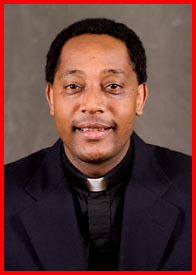
As a boy growing up in a small village in Ethiopia, Tamiru Atraga felt called to do God’s work. But he couldn’t have imagined it would take him halfway around the world.
Atraga was one of seven priests ordained yesterday in a Mass at The Cathedral of the Holy Cross. He is the first Ethiopian priest to be ordained in the 200-year-old Boston Archdiocese, Cardinal Sean P. O’Malley said during the service.
“It is a very historic event,” O’Malley said, prompting applause from the crowd of several hundred that gathered to witness the ordination.
Ethiopians from across the region attended the event, clearly delighted to see one of their own become a man of the cloth. A small group of Ethiopian Catholics attends Mass each week at the cathedral and many of them live in the Boston area.
“Everyone has been wanting to have a priest from our community,” said Bisrat Abebe, who came to Boston with Atraga from Ethiopia’s capital city of Addis Ababa in 2000 as a fellow seminarian. “Tamiru will be a great priest. He’s very prayerful and easy to interact with.”
Fiori Hailemaram traveled to Boston from Washington, D.C., yesterday with her mother to see Atraga ordained.
“This is a blessing,” she said after the service. “I’m very proud of him, very happy. It’s another confirmation of the unity of the church.”
Less than 1 percent of the population in Ethiopia is Catholic. Most Ethiopians are Muslim or Orthodox Christian. In 1993, the country’s northern province of Eritrea declared independence and became a sovereign nation.
“The countries are broken up, but the Church has remained the same,” Hailemaram said.
The youngest of 11 children, Atraga was raised in a devout Catholic family in the southern part of Ethiopia. He felt God’s calling early and entered seminary when he was just 14.
“The voice inside was killing me,” said Atraga, who is now 30. “It was a constant ache.”
In 1996 he met a visiting priest who asked whether he wanted to come to the United States to finish his studies. The pair corresponded for years, and in 2000, Atraga left his homeland to fulfill his destiny. He has not been home since.
But after growing up in a village without any roads or street lights, Atraga had a hard time adapting to life in Boston. Driving was scary. It was cold. The cultures were completely different.
“The most difficult thing was getting to know people in terms of spirituality,” he said. “Yes, you might go out and enjoy a dinner with someone, but it was very difficult to get to know them.”
Over the next eight years, Atraga set about establishing his life in Boston, studying at St. John’s Seminary and working at St. Ann Parish in Neponset as a deacon.
“He’s a very humble and a very joyful man,” said the Rev. Daniel Hennessey, director of vocations for the archdiocese.
With his story of immigration and perseverance, Hennessey said he sees Atraga as a bridge to bring people facing adversity back to the church.
“He’s a man who has asked serious questions about life and faith,” he said.
He has been assigned to Immaculate Conception Parish in Malden and will assume his new responsibilities in the next few weeks.