By Donald N. Levine
At a session on African development a couple decades ago I spoke about the damage Ethiopia suffered from having imported a Marxist-Leninist ideology. One colleague, a respected Africanist anthropologist, objected: “We are not here to engage in paradigm-bashing.” Like so many American academics, my colleague simply had no idea of the enormity of the bloodshed, political repression, economic regression, and cultural derangement that that misguided Western ideology brought to a country that had been modernizing in ways congruent with its longstanding national traditions.
The wholesale adoption of a Leninist creed by so many progressive Ethiopians of the late 1960s continues to have deleterious repercussions, much as the slaughter of a generation of modern-educated Ethiopians by the Fascist Italians had repercussions for the generation after Liberation. It meant that all militant progressive forces of that Generation took cover behind a worldview that considered itself scientifically corroborated, thus legitimating the forceful imposition of collectivist values by an “enlightened” elite. Besides the Derg, many have noted, most dissident movements of the time subscribed to such a doctrine, the difference being that they extended it to a derision of Ethiopia’s national history on behalf of Eritrean, Tigrayan, Oromo, Somali, and other irredentist claims.
The present regime in Ethiopia is the hapless heir of those days. This means that however much they would like to implement a liberal democratic regime-and I am convinced that many EPRDF members want very much to do so-they are stuck with certain policies and procedures that derive from their Leninist origins.
(And to make matters worse, although many who oppose them are now committed to a liberal
democratic ethos, the rhetoric and tactics used by a vocal minority recall the arrogance, Manicheanism, and ruthlessness of the Leninists who indoctrinated them years ago.)
Some of this is all too familiar to those of us who have lived in the United States during the Bush administration. In place of Marxist-Leninist certainty, read right-wing ideological certainty. In place of the messianic vision of a classless society, read the messianic vision of a world made safe for American-business-led democracy (if not the vision of the grand Apocalypse of the Second Coming.) In place of harassment of opposition parties, read what many regard as the theft of the presidency in 2000 and possibly in 2004. In place of the imprisonment of journalists, read anxious self-censorship. In place of the wanton assassination of innocents and brutal tortures in out-of-the-way prisons, read the
monstrosities of Abu Ghraib and Guantanámo.
In place of an invisible inner politburo, read an invisible White House clique. Yet it is easy to focus on miscarriages of liberal democracy in the United States in order to deflect attention from Ethiopia’s failure to move faster toward liberal democracy and then, after a glorious springtime of freedom, to regress in crucial respects afterward. Or else, to give up all hope. When I spoke in Addis Ababa in January of this year, in a talk entitled “The Promise of Ethiopia: Public Action; Civic Forgiveness; Creative Power,” a group of journalists I met with asked, “Is there any promise for Ethiopia?” Since
then, leaders of parties who sincerely wanted to conduct themselves as a loyal opposition felt constrained to withdraw from local elections due to a parade of harassments and worse affecting their
followers. Meanwhile the EPRDF leaders, in some respects like the Bush regime, find themselves
embattled at home as well as mired in a war against perceived terrorist enemies. In this worsening political situation, can we find the Audacity to Hope?
Barack Obama’s message has appealed awesomely to a majority of Democrats and numerous Republican voters in the U.S. and to citizens all over the world. Ethiopians in the U.S. responded with enthusiasm to calls to action from the likes of Mike Endale and Yohannes Asssefa, Emebet Bekele and Teddy Fikre. Like other nationals, they resonate with Obama’s call to stop endless rounds of animosities old and new, of blame and counter-blame, and get on with solving the world’s compelling problems: poverty;
disease; famine; overpopulation; environmental damage; gender violence; loss of species; wars; terrorism.
Ethiopian culture includes many ways to move toward inclusiveness, open communication, and consensual action. Perhaps these ways can be invoked to consider items like the following.
. Diaspora Ethiopian doctors, like the many hundreds in Dr. Ingida Asfaw’s Ethiopian North American Health Professionals Association, go regularly to Ethiopia to offer medical services, provide advanced
training, and improve maternal and child healthcare.
. Dr. Sisay Assefa has initiated an organization of social science professionals-from ye-bet agar, ye-wutch agar, and ye-cyber agar-to develop and exchange critically tested ideas regarding Ethiopia’s development potential.
. The Government has undertaken big initiatives on long-standing issues like expanded schools, health clinics in each village, vast road projects, expanded power generation, and now, forced marriage of young girls.
. Opposition political parties are taking a long view and rebuilding their strength.
. The quest for a free press and fair elections has suffered severe setbacks but still goes on.
. After decades of abuse and decay, Addis Ababa University is striving to regain and surpass its the high quality it achieved as HSIU. Under the leadership of Dr. Abye Tasse and Prof. Tsige Gebre-Mariam, AAU has just embarked on a multi-national initiative, directed Dr. Abye Tasse to provide highest-level training for new cohorts of Ethiopian academics.
. The millennium celebrations stimulated some serious initiatives. In Addis, the InterAfricaGroup organized two symposia on ways to promote communication among Ethiopia’s different constituencies. In DC, Abiyu Berlie and Samson Teffera organized a video conference on Information and Communication Technology for many kinds of IT professionals in Ethiopia and the United States.
You tell me more.
Tadia, yagere sewotch, min zefan yishalal:
Al-chalkum! weynim menalbat, YICHALAL?
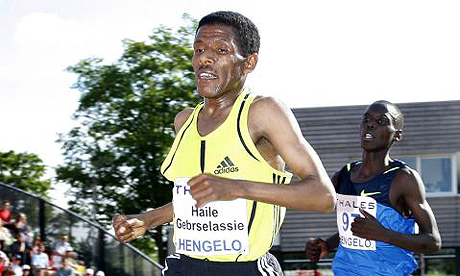
Haile Gebrselassie could have secured his Olympic selection at 10,000 metres with an impressive performance at the Fanny Blankers-Koen Games in Hengelo, Holland.
Having opted out of contesting the marathon in Beijing because of his worries about the pollution, Gebrselassie came to the meeting where he had previously broken three world records to prove he was still good enough to compete at the distance at which he won his two Olympic titles in Atlanta and Sydney.
At 35, there appear to be no signs, however, of the Ethiopian slowing up. In a race billed as a trial, Gebrselassie clocked 26min 51.20sec to finish second behind his compatriot Sileshi Sihine, who crossed the line in 26min 50.53sec. They were the two fastest times in the world this year and should guarantee them selection alongside the world-record holder and defending Olympic champion, Kenenisa Bekele, who won the 5,000m.
“Running under 27 minutes was my goal,” Gebrselassie said. “Now we have to wait and see the results from a few other 10,000m races over the next few weeks and then the (Ethiopian Athletics) federation will decide.”
According to Jos Hermens, Gebrselassie’s long-time manager, the federation’s decision should be an easy one.
“Conditions were not ideal and Haile could have run 10 or 15 seconds faster,” he said. “If the federation is smart, it should pick Bekele, Sihine and Haile.
The highlight of the meeting saw Panama’s Irving Saladino produce the world’s best long jump for 14 years with 8.73m.
Only six men have jumped further and the world champion will go to Beijing as the outstanding favourite to add the Olympic gold medal to the world title he won in Osaka last summer.
Britain’s best jumpers can have little hope of beating Saladino, but the competition did see the re-emergence of Nathan Morgan, the 2002 Commonwealth champion whose career has been blighted by injury.
Morgan, who lost his lottery funding long ago, was fourth with 8.01m, while British number one Chris Tomlinson came sixth.
By Tom Knight, telegraph.co.uk
– – – – – – – – – – – – – – – – –
More from AFP
Concern over pollution has led Haile Gebrselassie to opt for the 10,000m rather than the marathon at Beijing. Photograph: Reuters
It was a run that would have brought him a medal at last summer’s world championships in Osaka, but Haile Gebrselassie was not being so presumptuous.
As he crossed the line in Hengelo, smiling and offering a thumbs-up for the cameras, he found himself in a strange position: on a track in the Netherlands where he had broken numerous world records, this time he was in second place but no one would forget this runner-up.
“I have achieved my goal,” said Gebrselassie after the clock registered 26:51.20 for his most important 10,000m in almost four years. “I wanted to run under 27 minutes. The time was good if it allows me to go to Beijing. But it is not decided yet. The choice of my federation depends on other athletes. You never know. If others run faster, they will not take me. We must wait for the next 10,000m in Eugene or Berlin.”
In the past 15 years it has not been often that the great Ethiopian has had to talk about indecision over selection for a major championship. But at 35, his aim for Beijing this summer has switched from the marathon to the distance where he won Olympic gold in 1996 and 2000 and he understands he is not guaranteed a place.
Gebrselassie, who suffers from asthma, has opted for the track again, fearing the expected pollution in Beijing to be too difficult to handle in 26.2 miles on the road. It was not an easy choice for the world record-holder, but as he demonstrated with this performance, he remains a star attraction on the track.
“Everyone would like to see me run the marathon in Beijing and not just my federation,” said Gebrselassie. “But in the end I am the one to decide. It was a difficult decision. The conditions will be very difficult, and I decided it’s better not to take the risk. I am not as good any longer as I was at the end of the 1990s when I broke [track] world records but I am training well and I have done training sessions on the track again.”
Gebrselassie, who has a 10,000m best of 26:22.75 from Hengelo nearly a decade ago, had bowed out of the distance in Athens in 2004 when he finished fifth in the Olympic final as another Ethiopian superstar, Kenenisa Bekele, took gold ahead of his team-mate Sileshi Sihine. But it was like turning back the clock on Saturday evening in the Netherlands at the Fanny Blankers-Koen Stadium.
This race was seen as an unofficial Ethiopian trial and the little man delivered as though he had never been away. Gebrselassie was always near the front, and took his turn to lead in a race that at first was not even at the pace to which he has been accustomed. “I didn’t expect the pacemakers to be this slow,” he said.
Bekele, the triple world 10,000m champion, opted for and won the 5,000m, yet he is all but guaranteed a spot at the longer distance in Beijing, leaving Sihine to triumph in Hengelo in 26:50:53 with Gebrselassie an equally impressive second. They were the two fastest times in the world this year while, perhaps significantly for the selectors, fellow Ethiopian Gebr Gebrmariam was only seventh in 27:20.65.
Gebrselassie has the upper hand, but if he misses out on the team in Beijing, he has not given up hope on London. “I am serious about still running in 2012,” he said.
Paula Radcliffe, the women’s marathon record-holder, could be left contemplating those Olympics too if she loses her battle to be fit for this summer, which would leave Mara Yamauchi, the British No2, as the team’s leading contender in Beijing. This morning in the capital Yamauchi will have another test of her preparations when she runs in the BUPA London 10,000m in a race that includes Germany’s Irina Mikitenko, the winner of last month’s London Marathon.
EDITOR’S NOTE: The Addis Ababa-based business journal, Fortune Ethiopia, reports that Kuma Demeksa (real name Taye Teklemariam) was selected as mayor of Addis Ababa after defeating a candidate in his district who had died several days before the local election in April 2008. This guy has no conscience, no self-pride what so ever. Even some Woyanne cadres who want to revamp their image among Addis Ababa residents are not happy with the appointment of this fool as a mayor, according to Fortune. Most of the officials serving Meles share common traits with pigs and donkeys — no sense of self-worth.
—————————
(Fortune) — The coronation of the new Mayor, Kuma Demeksa, 50, as Addis Abeba’s 35th mayor will be the main political event this week. A father of seven, a person rather known for his composure, Kuma will be taking over the reins of a city with so many woes. Perhaps Addis Abeba will now have a mayor who stands taller and sees farther. Michael Chebud, Fortune Staff Writer, has researched on the background of the man who will be stepping into the mayoral boots, replacing Berhane Deressa.
This week will certainly be a busy one for Addis Abeba; senior officials of the Caretaker Administration, as well as their lieutenants at district and kebele levels, will relinquish their offices leaving behind the cumbersome responsibility of meeting the abundant needs of residents of the capital in the hands of a new administration, which will be led by Kuma Demeksa.
Kuma will be at the helm of political power in the diplomatic and political capital of Africa, where Revolutionary Democrats have promised to throw the whole weight of their party machinery into overwhelming Addis Abeba, hoping that whatever they accomplish in this melting pot city will secure them a legitimate rule of the country come national elections in 2010.
This view is well reflected by a posting on www.aigaforum.com, a pro-EPRDF blog based in the United States. It stands tall on the row of those websites that support Ethiopia’s ruling party in that it has created “EPRDF Supporters’ Forum” and encourages visitors to the site to become members.
“We have to fight [for] EPRDF to transform before the election,” says one of its latest postings in response to the news that Kuma will become the 35th mayor of the 122-year old Addis Abeba. “Or, we will fight ten-fold the useless opposition after the election.”
The genesis of aigaforum’s desire to transform the EPRDF comes from its disappointment with the ruling party’s decision to install Kuma as its man in town. The blog describes Kuma as a, “typically opaque party hack”. For a web-blog that has been consistent in its support of the Revolutionary Democrats for the past few years, and one considered to be an insider, such rare statements tell something about the discontent within the establishment.
“There is nothing that stands out about him,” says aigaforum. “He was everywhere and nowhere.”
Kuma’s coming to the city council followed his departure from the Oromia Regional Council, which he was elected to, during the May 2005 national elections. In April this year, he ran for the City Council in Bole District, which featured the lowest turn out of voters (52.3pc), from the 91,777 registered in the district.
Kuma stood second in this district with an aggregate vote of 45,271, trailing behind Tesfaselassie Mezgeb, who amassed 47,059 votes, representing the same party. It is in this district that the only candidate from the Coalition for Unity and Democracy (CUD), now under Ayele Chamiso, was elected for the City Council. Bededit Anteneh, the only non-EPRDF addition to the 138 council-members, had died days before the election. She was given 6,037 votes, in vain.
Another Revolutionary Democrat who secured a sweeping victory in Addis Ketema District was Melaku Fenta, minister of Revenues; his district featured a 70.7pc turnout of voters.
Although it was rumoured a few weeks ago that Melaku would become Deputy Mayor, it has become very unlikely for him to stand alongside Kuma when the handover of power takes place this week, according to reliable sources.
Indeed, Addis Abeba will welcome its new mayor, Kuma Demeksa, the tranquil member of the Oromo People’s Democratic Organization (OPDO), and bid farewell to the outgoing mayor of the city’s Caretaker Administration, Brehane Deressa, who held office for two years beginning May 2006.
After managing the chartered city for the past two consecutive years, the accidental faces of the Caretaker Administration have not been able to inspire Addis Abebans with achievements in bringing the city’s woes to an end. In fact, the excitement aroused among the residents of the city by its predecessor – the provisional administration of Arkebe Oqubay, now state minister for Works and Urban Development – has long disappeared.
Apart from calming the political instability that had prevailed in the city, the custodian administration was, among others, tasked with cutting down the unemployment rate, taking swift decisions on illegal land transfers, constructing condominiums for low-income city dwellers, as well as raising access to potable water. It has hardly achieved most of these objectives.
One person disappointed with the ailing performance of the Caretaker Administration is Beyene Petros (Prof.), an MP representing UEDF.
“I’m very disappointed with the mal-administration of Brehane Deressa,” Beyene told Fortune. “Addis Abeba has been swimming in corruption. It is shameful to the administration.”
An alarming rate of corruption is just one of the hurdles that Addis Abeba’s Mayor Brehane leaves behind for his successor. The new mayor will be confronted with a long list of problems, including a high cost of living, unemployment, a shortage of housing, lack of adequate public transport, a deteriorating civil service, and an acute shortage of water supply.
Many are questioning whether Kuma is up for the challenge, and if he has the personality to become the kind of mayor who stands taller and looks farther.
Kuma’s ability to assume these daunting tasks is not questioned by some of his former colleagues, who are familiar with, and confident in his competence for the job. In fact, they identify him as a capable leader. At the mature age of 50, and serving as the Minister of Defense, Kuma is believed to have immense leadership experience under his belt.
No one is better placed to give testimony on Kuma’s ability than Negasso Gidada (PhD), former president of Ethiopia, now an MP, although they are on the opposite sides of the political fence.
“He is good at developing good plans and monitoring them,” Negasso told Fortune. “He is clever in implementations, too.”
The two first met in May 1991, when Negasso had come back from Germany for a brief one-month stay. Kuma was then chairman of the OPDO, one of the parties that form the ruling EPRDF, which also includes Amhara National Democratic Movement (ANDM), Tigray People’s Liberation Front (TPLF) and the Southern Ethiopian People’s Democratic Front (SEPDF).
In August 1991, Negasso had already become a member of the OPDO, which was based in Nekemte, Wellega, and had been closely working with Kuma, who was one of the few rebels fighting the military government and instrumental in the creation of OPDO a year earlier.
Kuma’s passion for politics goes back to the 1970s; it was instigated by the recurrent tussle between the Ethiopian People’s Revolutionary Party (EPRP) and the Provisional Military Administrative Council – often called Derg – which held political power after ousting Emperor Haileselassie in 1974.
Born in Gore of the Illubabor Zone, 620Km west of Addis Abeba in the Oromia Regional State, Kuma is the oldest of three children. His father, Wodajo Tokon, a priest, was renamed Teklemariam after baptism. His family, including his mother, Muluye, lived in Kotore Kebele, Bure Woreda of Gore. Presently, however, his brother, Girma Teklemariam, has moved to the United States, and his sister, Abaynesh Teklemariam, currently lives in Addis Abeba.
Like many of his comrades-in-arms did during the fight against the Derg, he changed his original name, Taye Teklemariam, to Kuma, the nomme de guerre he has retained to date.
Unlike most Ethiopians from such remote parts of the country, in 1965, he began going to the Menelik II Primary School in Bore at a tender age. His perseverance was so strong that he completed his primary classes after daily enduring a 12Km long walk to and from school.
He was transferred to a high school even farther, Hailessselassie I Senior Secondary School, where he did secondary education up to Grade 10.
An exacerbating political conflict between the EPRP and the military officials led to the temporary closure of schools in 1975. Kuma’s strong desire to pursue his education the following year was futile in the face of the continued instability in his area, and across the country, according to an account by a childhood friend. The boys of his age were all afraid of the potential danger posed against them, although the severe massacres reported in other regions, such as Jimma and Wellega, did not occur in the Illubabor Zone.
The EPRP conducted urban guerrilla warfare against the military regime, referred to as the “White Terror” and the government responded with its own brand of terror, the “Red Terror”. The government provided peasants, workers, public officials, and students considered loyal to the government with arms to help its security forces root out those deemed anti-revolutionaries. Indeed, it was a trying period for Ethiopia.
Kuma and a few of his friends subsequently joined the army and moved to Jimma Police Training Camp in 1976. Not much is known about his years within the military. Nevertheless, six years after his departure, his parents and family members, as well as his peers, had thought he was dead, as they had not heard from him for a long time, according to a friend who grew up with him in Gore.
“We were all under the impression that he had died eight years prior to his return in 1991,” this friend told Fortune.
Other sources claim that he spent several years as a prisoner of war (PoW) in the fight with Eritrean separatist groups, and languished in EPLF’s jails in Nakfa. Much to the relief of those who had known him, he returned – very much alive – to visit his native land, Illubabor, and to search for his parents.
They were glad to learn that he had not come back alone; with him were his first wife, Asres, and his eldest daughter, Chaltu, who was born in the field. Chaltu now lives in the United States. The couple had three more children before getting divorced. Kuma is now a father of seven, after having had three more children with a second wife, Debabe Eshetu, the daughter of the late Eshetu Desta who was the administrator of Illubabor during the military regime.
In circumstances that remain murky, Kuma and several other PoWs were released from Eritrean rebel jails and joined in the fight against the military government under the Ethiopian People Democratic Movement (EPDM), a junior partner to the TPLF, who jointly waged a guerilla war up in the north. It was these two groups that originally formed the EPRDF in 1990 before they were joined by what is today known as the OPDO.
Spearheaded by what they called ‘Duula Bilissummaaf Walqixxummaa’ in Afan Oromo, (literally translated as ‘Operation Freedom and Equality), those Oromifa speakers within the insurgent movement decided to form another party, representing the Oromo people in the struggle. In the early 1990s, the OPDO was officially established by rebels such as Kuma, Abadula Gemeda, also reported to be a former PoW and the current president of the Oromia Regional State, and a few hundred other members in Dera, a town in northern Shoa. Kuma was elected as its first chairman, while Ibrahim Melka was appointed as the first secretary-general.
Eventually, the OPDO joined the EPRDF.
Following the fall of the military government in 1991, Kuma was appointed as the minister of Internal Affairs, a security agency embraced by the rebels before it was dissolved four years later in 1995.
When the constitution got ratified and the regional governments were established, Kuma became president of the Oromia Regional State, replacing Hassen Ali, chief of the region during the transitional period.
He remained in charge of the Oromia Regional State until reality dawned on him in 2001, his sixth year in office, during a membership appraisal conducted within the ruling party. Kuma was subsequently sacked from his position as president on July 24, 2001, as well as fired from the Central Committee.
The appraisal and course of party renewal were made following the internal split within the senior partner in the alliance, TPLF, which created two opposing factions. The division within the ruling party had become apparent following the incursion of Ethiopian territories by Eritrea forces. A vote made by 60 executive committee member of the EPRDF dropped a technical arrangement before the Algiers Agreement which was proposed by the United States and European Union; only two of them, Prime Minister Meles Zenawi and Kassu Yilala (PhD), now minister of Works and Urban Development, voted for it.
The division went deeper among the central Committee members of the TPLF. Leaders of other parties were also haunted by this division at the core of the TPLF: Meles, Sebehat Nega and Arkebe’s group on the one side, and Tewolde W. Mariam, Seeye Abraha and Gebru Asrat’s group on the other.
Kuma’s role at the time was reconciliatory, according to a politician who was close to the issue at the time. He was trying to bring about a consensus between the two groups that were up against each other. This was deemed as an indecisive move on his part as it was not clear where his heart was, he was in a wishy-washy position.
His seat at the Oromia Regional State was given to the relatively less known Junadin Sado, who was the Investment Bureau Chief of the region then, and now minister of Transport and Communications.
The fall out seemed to have left a bold scar on his political career, as it took him two years to regain the sympathy and confidence of the top leadership of the party.
In 2001, right after Kuma was removed from the Central Committee, he was appointed as an expert on immigration and security issues, within the office he once was a minister but which had been restructured to into an agency after his departure. Credited for accepting his fate, and the party’s decision, with unreservedly, he made a comeback to the Central Committee of the OPDO in 2003. He was also appointed as one of the three state ministers for Capacity Building, under the sturdy watch of Tefera Walwa, minister of Capacity Building, and one of the close political allies of the Prime Minister. He replaced Woredewold Wolde, once a minister of Justice.
While in this office, Kuma obtained his first and second degrees from the London based UK Open University, and was an active participant when the Civil Service Reform was developed by the Ministry of Capacity Building.
Prime Minister Meles testified to Kuma’s loyalty and commitment to the party before parliament when he nominated him as Minister of Defense, when he set up his current administration after the most contested elections in 2005.
Up until last week, the embattled politician was chief of the country’s defense force. That will be over soon. This week, he will become the 35th mayor of the 122-year old Addis Abeba.
“He is not supposed to stand out by design,” said aigaforum.
The pro-EPRDF web-blog is not pleased by the party’s “communistic style” of the past, which it says is still making the party devoid of “witty, funny, humble, and caring individuals” within the leadership who are able to come forward in fear of personality cult.
The blog referred to Arkebe Oqubay and his popular years in the city government; but it criticized the party for its failure to capitalize on this popularity, while arguing that the opposition parties which waged electoral battle successfully separated him from the EPRDF and used it against the Revolutionary Democrats.
Like Arkebe, Kuma has to begin from scratch, according to observers, in order to win back the hearts of Addis Abebans. These observers say that the new mayor needs to act vigorously as he will only have a reign that will last two years, like his predecessor, if he is not elected in the next national election of 2010.
The new boss in Addis Abeba is expected to become a more familiar face to the residents of Addis who are scorched by a multitude of enigmas, ranging from a lack of adequate housing to a hike in consumer prices.
“With his calm, yet wise personality, I hope he makes it,” says a senior party official who has worked with him closely.
Kuma declined to be interviewed for this piece.