The International Herald Tribune
By Jeffrey Gettleman
NAIROBI — The government of Meles Zenawi in Ethiopia is blockading emergency food aid and choking off trade to large swaths of a remote region in the eastern part of the country that is home to a rebel force, putting hundreds of thousands of people at risk of starvation, Western diplomats and humanitarian officials say.
The Ethiopian [Woyanne] military and its proxy militias have also been siphoning off millions of dollars in international food aid, and using a United Nations polio eradication program to funnel money to their fighters, according to relief officials, former Ethiopian government administrators and a member of the Ethiopian Parliament who defected to Germany last month to protest the government’s actions.
The blockade takes aim at the heart of the Ogaden region, a vast desert on the Somali border where the government is struggling against a growing rebellion and where government soldiers have been accused by human rights groups of widespread brutality.
Humanitarian officials say the ban on aid convoys and commercial traffic, intended to squeeze the rebels and dry up their bases of support, has sent food prices skyrocketing and disrupted trade routes, preventing the nomads who live there from selling their livestock. Hundreds of thousands of people are now sealed off in a desiccated, unforgiving landscape that is difficult to survive in even in the best of times.
“Food cannot get in,” said Mohammed Diab, the director of the United Nations World Food Program in Ethiopia.
The Woyanne government says the blockade covers only strategic locations, and is meant to prevent guns and matériel from reaching the Ogaden National Liberation Front, the rebel force that the government considers a terrorist group. In April, the rebels killed more than 60 Ethiopian guards and Chinese workers at a Chinese-run oil field in the Ogaden.
“This is not a government which punishes its people,” said Nur Abdi Mohammed, a government spokesman.
But Western diplomats have been urging Woyanne officials to lift the blockade, arguing that the many people in the area are running out of time. “It’s a starve-out-the-population strategy,” said one Western humanitarian official, who did not want to be quoted by name because he feared reprisals against aid workers. “If something isn’t done on the diplomatic front soon, we’re going to have a government-caused famine on our hands.”
The blockade, which involves soldiers and military trucks cutting off the few roads into the central Ogaden, comes as Congress is increasingly concerned about Ethiopia’s human rights record.
Ethiopia is a close American ally and a key partner in America’s counterterrorism efforts in the Horn of Africa, a region that has become a breeding ground for Islamic militants, many of whom have threatened to wage a holy war against Woyanne.
The country receives nearly half a billion dollars in American aid each year, but this week, a House subcommittee passed a bill that would put strict conditions on some of that aid and ban Ethiopian officials linked to rights abuses from entering the United States. The House also recently passed an amendment, sponsored by J. Randy Forbes, a Virginia Republican, that stripped Ethiopia of $3 million in assistance to “send a strong message that if they don’t wake up and pay attention, more money will be cut,” Forbes said.
Woyanne’s pardon on Friday of 30 political prisoners who had been sentenced to life in prison could ease some criticism. But Senator Patrick Leahy, Democrat of Vermont, is pushing ahead with measures to more closely vet assistance to the Ethiopian military. According to human rights groups and firsthand accounts, government troops have gang raped women, burned down huts and killed civilians.
American officials in Ethiopia said they were trying to investigate the situation but that the Ogaden was too dangerous right now for a fact-finding mission. American officials said they had heard persistent reports of burned villages and that the blockade was putting the area on the cusp of a crisis.
Villagers say that anyone who criticizes the government risks getting killed. According to Ogaden Online, a Canadian-based news service that has been highly critical of the Woyanne government and covers the region through a network of reporters and contributors, some equipped with satellite phones, four young men who were videotaped by The New York Times at a community meeting in an Ogaden village in May were later tortured and executed.
The claim could not be fully verified independently, but their identities may have been discovered by Woyanne soldiers who had arrested three journalists for The Times in the Ogaden and confiscated their notebooks, cameras and computers.
“The army is out of control,” said Jemal Dirie Kalif, the member of Parliament who defected.
The blockade has been in place since early June, and thousands of people have already fled on foot and by camel. Two weeks ago, Abdullahi Mohammed, a 17-year-old student, walked from his village deep in the Ogaden to the nearest town with a bus station. He carried with him a few pieces of bread. He said that when he stopped to ask villagers in the Ogaden for food, they asked him for some instead. “They had nothing,” he said.
Though good rains this year have fed the few crops in the area and provided a little cushion, “The most these people can last without facing serious problems is one month, maybe two,” said David Throp, country director for Save the Children UK.
Even if relief trucks are allowed in to all the critical areas, the food might not reach the people who need it. According to humanitarian workers and several former Woyanne officials, including Kalif, food aid is embezzled in two stages. First, soldiers skim sacks of grain, tins of vegetable oil and bricks of high-energy biscuits from food warehouses to sell at local markets.
“The cash is distributed among security officers and regional officers,” a former government administrator from the Ogaden region said in a recent telephone interview on condition of anonymity because he still works with government officials.
Then the remaining food is hauled out to rural areas where the soldiers divert part of it to local gunmen and informers as a reward for helping them fight the rebels. The former administrator said he also knew of specific cases in which army officers stole food from warehouses and gave it to the families of women whom their soldiers had raped, as compensation.
Several Western humanitarian officials estimated that 20 to 30 percent of the donor countries’ food aid to the Ogaden — aid that last year was valued at more than $70 million — routinely disappears this way. To cover their tracks, the soldiers and the government administrators who work with them tell the aid agencies that the food has spoiled, or has been stolen or hijacked by the rebels, humanitarian officials said.
Relief workers in Ethiopia have known about these problems for several years, a humanitarian official said, and have tried to set up committees of local elders to oversee distribution. But that did not work either, and aid officials eventually concluded that as long as the majority of the food was getting through, they would not stop the shipments.
When informed about these allegations, Diab of the World Food Program said, “This is the first I’ve heard of them.”
Mohammed, the government spokesman, denied that Ethiopian troops were pilfering or mishandling foreign aid. “We don’t do that,” he said.
As the food crisis looms, Western diplomats are also concerned about a separate plan by the regional government in the Ogaden to divert a share of its own budget for development projects — like schools and farming — to the Ethiopian military.
This seems to be part of the Woyanne government’s strategy to do whatever it takes to crush the rebels, who have deep popular support and, according to the government, are getting arms and training from neighboring Eritrea, Woyanne’s bitter enemy.
The people of the Ogaden are mostly Somalis and ethnically distinct from the highland Ethiopians who have ruled the country for centuries, and the long battle over the region has been steadily escalating this year. The country director of one Western aid agency, who recently returned from a field visit there, said he saw two villages that had been burned to the ground and several schools that had been converted into military bases, with foxholes.
Humanitarian officials say the military is building up militias and setting the stage for clan-based bloodshed. The rank and file of the Ogaden National Liberation Front tend to be members of the Ogaden clan, and so the government has turned to other clans to form anti-rebel militias. In the past few weeks, thousands of men have been armed.
“Those Ethiopians are smart,” Kalif, 32, said. “They know Somalis are more loyal to clans than anything else.” Tactics like these, he said, drove him to defect June 20 while attending a conference in Wiesbaden, Germany. He was affiliated with the governing party, and had been representing an area in the eastern Ogaden for the past seven years.
He described a scheme with a United Nations polio program, which was corroborated by two former administrators in the Woyanne government and a Western humanitarian official, in which military commanders gave prized jobs as vaccinators to militia fighters, and in the end, much of the polio vaccine was never distributed.
“Army commanders are using the polio money to pay their people, who don’t pass out the vaccines, so the disease continues and the payments continue,” said Kalif. “It’s the perfect system.” United Nations officials in Geneva said they did not know whether that was happening, but that they would investigate.
When asked how he knew about the polio scheme, Kalif said: “Everybody out there knows. They’re just too scared to talk.”
“If I don’t get asylum and they send me back to my country, I’m dead,” he added. “But I was sick of being a parrot. I have no regrets.”
.
By MATTHEW BOWERS, The Virginian-Pilot
Former Norfold State University professor is among 38 political prisoners freed in Ethiopia
 |
|
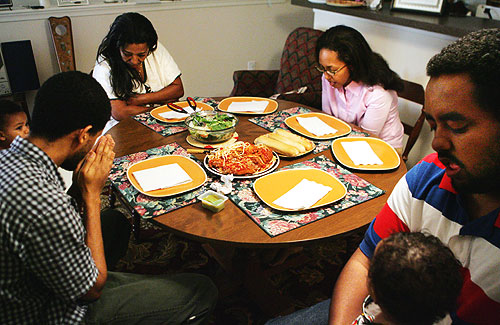
Amanuel Mengistu, 30, from left, Tegist Hailemariam, 58, Seyenie Yacob, 31, and Sefonias Yacob, 23, pray before dinner, thanking God for the release of their father and husband, Yacob Hailemariam. ANDREW HENDERSON PHOTOS | THE VIRGINIAN-PILOT
|
Former Norfolk State University professor Yacob Hailemariam had spent 21 months in an Ethiopian prison, been branded a traitor to that country, threatened with the death penalty, and sentenced just five days ago to life in prison.
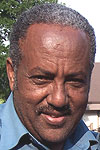
Yacob Hailemariam |
But when his wife and daughter, hearing he may have been freed unexpectedly, phoned him 7,000 miles away on Friday, he answered with, “Hi, how are you guys?”
“He said don’t worry, he’s healthy, he’s fine,” his daughter, Seyenie Yacob, said about the brief call early Friday morning, barely an hour after he was released by prison officials. “I think he wanted to reassure us.”
Today, his first full day of freedom, he celebrates his 63rd birthday.
Hailemariam was among 38 high-ranking opposition politicians and activists that the Ethiopian government pardoned and released, The Associated Press reported Friday.
Hailemariam returned to his homeland, Ethiopia, in late 2004 to run for parliament in what were called that country’s first democratic elections. He won a seat in 2005, but voting results were disputed, violence flared, and he and scores of others were arrested later that year and charged with treason and other crimes.
Many of those who went to trial, including Hailemariam, called the proceeding a political sham and declined to defend themselves.
Amnesty International called them “prisoners of conscience.”
Friday, Hailemariam’s wife, Tegist, who lives in Virginia Beach, heard his voice for the first time since October.
“Yes, I am very delighted,” she said. She said she didn’t know when he might return to the United States.

Tegist Hailemariam hangs a homemade banner Friday with a little help from her grandson, Biruk Mengistu, 2, commemorating the freeing of her husband from an Ethiopian prison. |
She thanked those who supported her husband and the family, and looked ahead.
“We are very hopeful that this will be an era of peace and hope… for Ethiopia,” she said.
Seyenie Yacob said she expected her father’s release “because of the atrociousness of the charges and the case.”
“We knew from the very beginning that there was nothing that he had done wrong,” she said.
Among Tegist Hailemariam’s first calls was to countryman and family friend Berhanu Mengistu, a professor at Old Dominion University. It was a happy call, he said.
“I’ve cried enough,” he said. “Today was a day to laugh.”
Mengistu, who visited Yacob Hailemariam three weeks ago during a trip to Africa, believes his friend might return to Ethiopia to continue trying to build a democracy.
The pardon restored his rights to vote and run for office, The Associated Press reported.
“He’s not doing this because he needs the job – he’s doing this because he’s committed to the cause,” Mengistu said.
Yacob Hailemariam taught business law for 18 years at Norfolk State and served as a U.N. special envoy.
His former college colleagues and students wrote letters, held rallies and set up a Web site pushing for his release.
“The university is just elated that he’s out,” said Larry Curtis, vice president for student affairs.
U.S. Rep. Thelma Drake, whose district includes Virginia Beach, said in a statement that Yacob Hailemariam’s ordeal “has reminded all Americans of the true cost of freedom” and that “we must remain committed to those who continue this noble fight today for others across the globe.”
Matthew Bowers, (757) 222-3893, [email protected]
By Aweys Osman Yusuf
Mogadishu 21, July.07 (Sh.M.Network)- One person was killed and number of other people has been wounded after Ethiopian [Woyanne] troops opened fire at a crowd of Somalis in Yaqshid neighborhood, north of the capital, Mogadishu, on Saturday.
Witnesses said the incident happened after unknown gunmen hurled a grenade at the Woyannes passing around Arafat Hospital in the neighborhood. The blast occurred at 1: 30 p.m. local time.
“A Woyanne convoy was moving along the street and suddenly a grenade was thrown at them and the explosion sparked confusion among the troops. They opened fire at every direction,” said Mohammed Aden, a witness.
He said a civilian, who was selling Khat was killed by the crossfire, while unidentified number of others were wounded.
The Woyanne troops sealed off the area and began searching the houses near by for the insurgents and weapons, witnesses said.
Also two civilians have been killed and three others have been wounded after three grenade explosions targeting government soldiers based in Mogadishu’s Bakara market occurred minutes of one another on Saturday.
Witnesses said the blasts occurred minutes of one another.
A government official killed overnight
Unknown gunmen killed the chairman of Hodan district in Mogadishu, the Somali capital, last night. The victim was in his drugstore doing his private business when unknown gunmen shot him dead.
Abdirahman Hussein was shot eight times by the gunmen, according witnesses in the district.
Mohammed Hassan, Shabelle reporter who lives in the district, told Shabelle that at least three men armed with pistols and one AK 47 gun made their way into the victim’s pharmacy and started shooting.
“Abdirahman Hussein, Hodan district commissioner, was selling medicine to his customers, when the gunmen shot him dead at 8: 10 p.m. local time. The attackers steadily walked away without confronting the government soldiers in the area,” he said.
Several district commissioners have been assassinated in the capital since the Ethiopian led massive military offensive ousted the Union of Islamic Courts that ruled swathe of southern Somalia, including Mogadishu, and enabled the Western backed transitional government to move in to the capital.
On Thursday, six civilians were killed after insurgents fired several mortar bombs at neighborhoods closer the venue of the country’s national reconciliation congress. Witnesses told Shabelle that the venue was not hit.
Abdiwahab Ogli, a resident in Shibis neighborhood, told Shabelle that five young boys were killed in the blast while they were playing football in the neighborhood.
“One mortar bomb hit our residence, killing five young boys, three brothers and their two friends. They were right outside their home when the bomb hit there. The family members and the neighbors were busy collecting the bodies of their loved ones,” he said.
He also stated that number of other people has been wounded.
Also the capital’s biggest open-air market, Bakara, has been closed for 17th day despite traders’ appeal to U.S. and the international community to interfere the situation and to talk to the interim government in order that the embargo on Bakara be lifted.
The Somali government believes that the market was a hideout and financial source for the suspected Islamist insurgents.
Source: Shabelle Media Network Somalia
.
Press Release
The Ethiopian Women for Peace and Development (EWPD) is delighted about the release of the political prisoners in Ethiopia and the restoration of their political rights. We commend the political prisoners and the government for taking a positive step towards solvng the political problems of the country. Negotiation, dialogue and compromise are the route towards a lasting peace in our country.
We thank the elders who have worked hard and negotiated the release of the political prisoners. We also thank the international community and the different human rights organizations that have spoken strongly against the imprisonment of the opposition leaders, journalists and human right activists.
Building on this momentum, dialogue for serious political reconciliation with all opposition parties and organizations should begin. We appeal to the Ethiopian government to release all other political prisoners. The political tensions have to ease. The past should be behind us and we should focus to avoid political turmoil, war and famine that damaged our country for decades.
So much has to be done to bring Ethiopia to the 21st century. As we celebrate the end of our 2nd millennium in September 2007, let us commit ourselves to work together to establish a peaceful and just society. The beginning of the third millennium should be years of progress towards good governance, democracy and development.
Executive Committee of EWPD
July 21, 2007
EWPD is a non-partisan Ethiopian women’s organization created in 1991 in Washington, DC.
Ethiopian Women for Peace and Development (EWPD)
5505 Connecticut Avenue, #259, Washington, DC 20015
www.ewpd.info * [email protected]
The United States House of Representatives
Committee on Foreign Affairs
Press Release
Washington, DC (July 20, 2007) – U.S. Congressman Tom Lantos, Chairman of the House Committee on Foreign Affairs, today welcomed the release by the Ethiopian government of 38 of the country’s parliamentarians and leaders of the opposition Coalition for Unity and Democracy (CUD), journalists and civil society activists. The group was arrested in connection with demonstrations protesting the conduct and outcomes of the Ethiopian national elections of November 2005.
“While Ethiopia made enormous strides in laying the groundwork for the 2005 elections, many of these gains were wiped out by the subsequent police attacks on civilians and arrest of opposition leaders,” Lantos said. “The international community celebrates their rightful release. But let us remember that the crackdown, convictions and sentencing never should have taken place, and that the nearly 200 people who lost their lives in the protests will never be forgotten.”
In announcing the pardons, Prime-Minister Meles Zenawi assured the restoration of the detainees’ rights to vote and to participate fully in the political sphere in Ethiopia. At least 36 more activists remain in detention because they either refused to sign a required letter of remorse or because they signed the letter but their cases remain undecided. Another five have been sentenced, in absentia, to life in prison.
“I call on Prime Minster Zenawi to authorize the unconditional release of the remaining prisoners,” said Lantos, who is the founding co-chairman of the Congressional Human Rights Caucus. “And to raise the world’s estimation of Ethiopia as a nation that values justice, the government must take concrete steps towards establishing and respecting the freedom of press, assembly and rule of law.”
.



