(AFP) GODINO JITU, Ethiopia: Former US president Bill Clinton on Friday pledged more support to combat HIV/AIDS in Ethiopia, where he started a four-nation African tour.
His Clinton Foundation announced the Horn of Africa nation will receive five million dollars over three years to help prevent the spread of AIDS, which kills around 370 Ethiopians each day, according to UN figures.
“I want to personally make sure that every baby born here will not be HIV-positive,” Clinton said on a visit to a health centre in Godino Jitu, 70 kilometres (43 miles) south of Addis Ababa.
“This centre is one of several hundred that have received help from the foundation, but will soon be one of thousands,” Clinton told hundreds of residents.
The Clinton Foundation launched an anti-AIDS initiative in 2002 and this month has reached an agreement with several pharmaceutical companies to slash the price of the top anti-malaria treatment by 30 percent.
Clinton will also visit Rwanda, Liberia and Senegal, as part of a trip to promote his foundation’s efforts to tackle AIDS and malaria.
Former President Shines Light on AIDS, Povery in Support of Clinton Foundation
By KATE SNOW and DANA HUGHES
DEBRA ZEIT, ETHIOPIA —Nearly eight weeks after his wife dropped out of the presidential race, the former president has returned to Africa on what has become an annual pilgrimage to check in on the work of his Clinton Foundation.
“Oh yeah, I love this stuff,” he told ABC News with a grin, as he visited a new health clinic in Debre Zeit, Ethiopia.
Leaving Presidential Politics Behind
Ethiopia is a long way from New York or South Carolina. People here might know his wife ran for president, but few know much about the controversies and criticisms that haunted the former president during the primary season back home.
Here in Africa, they tend to focus less on Bill Clinton’s politics, and more on things like money and much-needed AIDS medicines and health clinics. They know the Clinton name because his foundation has invested in things that help people.
And so it was no surprise that Clinton’s visit to see the new clinic Friday drew a crowd.
AIDS Devastates Ethiopia
In Ethiopia, health care clinics are few and far between.
There is one clinic for every 120,000 people. The roads are so bad and transportation so limited, that many people who are HIV-positive simply can’t access life-saving antiretroviral drugs.
The clinic the former president visited Friday has just nine workers on staff, and sees 60 patients a day, many of whom walk several hours to get there.
To improve the situation in this region, Clinton announced that the Clinton Foundation would spend $5 million over three years to refurbish 50 new clinics.
“You deserve to have a healthy life,” Clinton told a crowd of hundreds.
“It’s a big deal. It’s a big deal,” said Kassahun Mogus, one of the nurses at the Debre Zeit clinic. “He was the leader of the world. Then he comes here, in a small village, poor and uncomfortable place to visit, to see us, to help us our problems. I don’t know how I can tell you (how I feel). I have no words.”
The Future of Solar Power in the Third World
In the tiny village of Rema on Thursday, Clinton and daughter Chelsea sipped Ethiopian coffee in a small hut.
The village runs entirely on solar power — a project funded under the auspices of Clinton’s Global Initiative. For about $10 a house, families who live way off the electric grid have power.
The local school teacher told Clinton that before solar power her students couldn’t study at night. Now she’s opened up a night school for children and adults.
“This is the real future of solar energy,” Clinton said.
Bill Clinton: First Tourist
It hasn’t been all work. As one aide reminded us, some of the former president’s trip is like a vacation.
Clinton and his delegation spent Wednesday touring one of the world’s most famous Christian landmarks. For years, he said, he wanted to see the carved stone churches of Lalibela. With time on his hands, he finally had his chance.
Removing his shoes — in keeping with Orthodox Christian tradition — Clinton and his daughter admired frescos and ancient symbols carved into the rock. Some of the churches date back 900 years.
“All these churches are still in use,” Clinton said in awe.
He apologized that he couldn’t stay longer.
By Suzanne Muchnic, Los Angeles Times
The J. Paul Getty Museum has added a rare Ethiopian Gospel book to its collection of illuminated manuscripts. Created around 1504-05 with five full-page paintings and many ornamental touches, it is one of the few such volumes to have survived wars and a Muslim purge of early Christian imagery in Ethiopia.
Purchased at an undisclosed price from a private collection in France, the new acquisition will go on view Aug. 12 in “Faces of Power and Piety,” an exhibition of portraiture in illuminated manuscripts at the Getty Center.
“This is a wonderful addition to the collection, visually and culturally,” said Thomas Kren, the Getty’s curator of manuscripts. “It’s a great and beautiful object. And it belongs to the classic tradition of Gospel books, one of the greatest vehicles for Christian art. Within that context, it’s a completely distinctive variation.”
The book — which measures 13 5/8 by 10 1/4 inches — contains full-page illuminations of the Virgin and Child and evangelists Matthew, Mark, Luke and John. The portraits are painted in a bold style that Kren described as “almost modern.” Ethiopian illuminators favored blocks of vivid color and strong patterns, including zigzag motifs on textiles and clothing. In the Getty’s example, architectural borders enhance an eight-page concordance, or index, of Gospel stories; abstract designs frame other sections.
The area now known as Ethiopia had become a great power by the 3rd century. Christianity was introduced there in the 4th century, and a distinctive visual arts style emerged in the 6th century. But Ethiopian-illuminated manuscripts are few and far between outside their native land. The Walters Art Museum in Baltimore, which claims the largest collection of Ethiopian art outside Ethiopia, has eight.
At the Getty, the recently acquired Gospel book has joined a single Ethiopian leaf from the 14th century, depicting St. John.
“In theory,” Kren said, “our collection is European, but we have a range of Gospel books. To have an Ethiopian example adds a whole dimension to this form of medieval Christian art.”
– – – – – – – – – – –
The writer can be reached at suzanne.muchnic@latimes .com
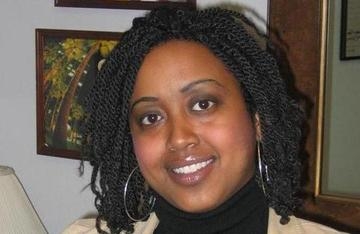 (Tadias Magazine) New York – The presidential campaign of Senator Barack Obama has hired Selam Mulugeta, an Ethiopian American who formerly served as a Congressional Staffer and Special Assistant to Rep. Mike Honda (D-Calif.), founder and Chair of the Congressional Ethiopia and Ethiopian American Caucus.
“I will be a Field Organizer in the Northern Virginia region”, Mulugeta told Tadias Magazine. She joined the Obama for America campaign in Virginia.
“This means that I would be doing community organizing at the grassroots level to increase the number of registered voters, and most importantly, to increase voter turn-out in November.”
Members of the Democratic support group Ethiopians for Obama (E4O), which is active in Virgina, often say that the November election may be decided by a few thousand votes, and the robust Ethiopian American presence in the state may end up being a deciding factor. Mulugeta agrees.
“In states like Virginia, Ethiopians are in a unique position to swing the vote. If all of us who are eligible to vote do so, then we could potentially win the state. The responsibility is tremendous, but doable. We can accomplish this by investing more time in the campaign and fully extending the reach of our influence”, Mulugeta says.
“I am a member of the steering committee for E40. I have always supported the organization, even from its days as a loose discussion group formed in someone’s living room. I am so proud of the work that has already been done, and even while I was on the Hill I was quite adamant about engaging its leaders. My role in E4O will be to empower Ethiopians to realize that they can support the Obama campaign by volunteering.”
ADDIS ABABA (Reuters) – Ethiopian soccer authorities said on Thursday a suspension by FIFA was illegal and that they would take their case to the Court of Arbitration for Sport (CAS).
FIFA suspended the Ethiopian Football Federation (EFF) on Tuesday after it repeatedly failed to comply with a February 2008 agreement aimed at restoring its officially recognised leaders.
“The ban imposed by FIFA is illegal and EFF will take its case to the international Court of Arbitration for Sport,” the body said in a statement.
Unless the suspension is lifted, Ethiopia will not be able to play their next international match, a 2010 World Cup qualifier against Morocco on Sept. 7.
The statement urged FIFA and the Confederation of African Football (CAF) to send a delegation to Ethiopia to investigate the problem. (Reporting by Tsegaye Tadesse; Editing by Sonia Oxley)