(Colbinski Chronicles) — I am sitting on an outside patio of a small café enjoying my afternoon macchiato. I am gazing southward down the street for no real reason. As my eyes turn back in front of me I see a few oxen loping slowly down the middle of the street. A few feet behind these lead animals are a whole lot more oxen. They take up the entire street and in their measured ambling they separate themselves around the parked cars on either side, occupying the sidewalk. If I was inclined to do so, and with a bit of effort, I could almost reach out and touch one as it passed by. There must have been 30 – 40 in total. One lone man, brandishing a short, stout stick was running loudly behind them from one side to the other. I imagine him like a gymnastics coach of young girls. Cajoling them to do something they don’t really see the sense of doing and something they normally would never do. The oncoming traffic stops in the face of these beasts although they don’t seem the least bit perturbed by the honking and yelling they are causing. They walk slowly past these metal machines. Behind them traffic is snarled. I crane my neck and can’t see the end of the stopped cars and minibuses. I briefly wonder where these cattle came from and where they are going. But then they are gone from my sight. I return to my macchiato. A few minutes later a donkey comes careening down the sidewalk with a different man in pursuit. Just as they pass the café the man thrusts out an errant hand and grabs hold of the harness and slows the donkey down. With a smile on his face he leads the donkey back in the direction it had come. I figure the oxen scared the donkey into running, as that was the fastest donkey I have seen in Ethiopia. By now my macchiato is finished and so is any animal related excitement. I pay my couple Birr and return to the office.
Fast Food Metamorphosis
(Colbinski Chronicles) — Smaller than cafes and occupying their own niche throughout Addis are the Snack, Juice or Burger places. These places, of which there are a rash of in certain neighborhoods, claim to serve snacks or fast food: juices, burgers, French fries. But everything is made fresh in front of you and, in the laidback Ethiopian way, it takes some time before you receive your order. Not exactly fast.
I found one little place, Cocoon Juice and Burger, that is great. I went there after my first bout with traveler’s illness for a fresh fruit juice and have been a regular customer since. They make a mean fresh juice. Mainly I was I just ordering fruit juice there. This caused me to be exhorted by the manager (possibly owner) to actually eat food. They make a “humburger” which is a burger with a slice of ham added. Really. Not to be confused with their beefburger. So it’s a hamburger with bad English translation but still taken literally. They place a homemade mayonnaise on it, add a grilled bun, along with the typical toppings (no pickles thanks goodness) and you are in business. A friend, who lives on the other side of Addis, recently told me that he heard the best burgers in Addis were made at Cocoon. Making a good burger is rare in Addis and they do make a good one.
It is a small shop, painted with pink trim inside and outfitted with tall tables and uncomfortable blue swivel chairs. It seems to be doing good business. The girls who work there are great and friendly and one, who seems to always be there, has a wonderful smile that greets me every time I enter. (This smile also made me think she was making fun of me for my pronunciation of mango. During my last visit there the power went out just as I arrived. That meant no juice but they still made me a “humburger” as the stove is natural gas. So by candlelight I watched as she prepared my food, smiling wonderfully, the whole time.
Café City Blues
One thing that Ethiopia does not lack is restaurants. They are all over the place, around every bend, and run from small ramshackle to large ramshackle. Actually, there are a lot of good and nice eateries here. Many of differing cuisines and of varying quality. One thing they all share is a distinct lack of napkins. For a culture that eats with its hands, it is certainly chintzy with the napkins.
The traditional or national food places have a more homey and rustic feel and usually include a large outdoor patio area where hungry patrons spill out into the sunlight to enjoy their fare. More modern are the cafes. Addis is rotten with these European style establishments and the Ethiopians have readily adapted the European café culture in that they sit around for hours enjoying a small cup of macchiato or coffee. Oftentimes they just sit in their car in the small parking lot or by the street side curb and drink their coffees. These cafes all seem to be named after cities. Just off the top of my head I have been to or seen London Café, Café Paris, Beirut Snack, and Café Cincinnati. And I keep hearing talk of one named The Parisian Café as the café to visit while in Addis (supposedly this place has the largest parking lot and many days the café is empty inside while the parking lot is full of people drinking coffee in their vehicles.). I can understand London and Paris, possible even Beirut, as it is a capital city of a country, but naming a café after Cincinnati stymies me. The Paris café has pictures of the Eiffel Tower on display, the London Café has some English paraphernalia, (and an aeroplane, for some reason) and the Beirut café has bullet holes (not really). I haven’t seen anything in the Cincinnati Café that reminds me of Cincy. No Venus Flytrap, no Jerry Springer. (Actually, there is a nice framed picture of a steam ship navigating a river by an old stone bridge on a perfect sky blue day. The picture is captioned “Cincinnati” although, having never visited the place I have no idea if that is what Cincy looks like.)
These café’s do have a few national food items on their menu but mostly serve up western style dishes. By western I mean they all serve sandwiches, pasta, a variety of egg dishes, and depending on the size, maybe pizza. The sandwiches are all similar, hamburger, club, etc. but not the same. A huge fluffy roll or small white bread is what is found surrounding modest helpings of whatever has been ordered. Twice, in two different places, I ordered a club sandwich and twice I was given an egg sandwich. At a third place I ordered a club and was served something between three slices of bread but I’m not sure what it was. I am very interested in what constitutes a club sandwich in Ethiopia. (I think it is a mixture or combination of egg salad or chicken salad.) While sitting in a café you see some people just with a coffee or tea drink, others eating national food, others eating western, and others eating western food but like they are eating national food. This is to say that they were eating with their hands.
I observed an Ethiopian family dive into a platter full of spaghetti with nothing but their right hand, which occasionally held some bread. Either they brought the strands straight into their mouth or scooped it up with the bread. Watching this brought back fond memories of me as a youngster, taking the Italian bread from the table, loading hearty amounts of spaghetti on it, making a spaghetti sandwich, and stuffing it into my gaping yaw. I did this over the repeated protestations of my parents. To this day I still enjoy me some spaghetti sandwiches.
 By Groum Abate, Capital Ethiopia
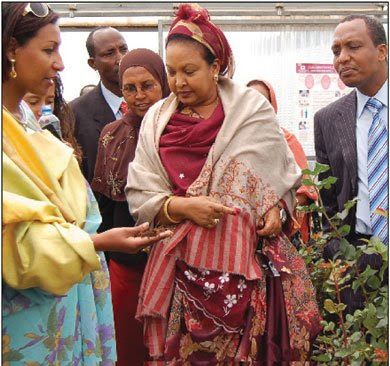
Khadra Mohammed, First Lady of Djibouti, has received the 20 hectares of land in the Sebeta area for a flower farm, on Tuesday July 22, 2008, from Alemu Sime, Investment Bureau Head of the Oromia Regional State [another Woyanne donkey].
The First Lady received the plot on behalf of her son, Ayinashe Omar Guelleh, whom it was learnt, plans to engage in the booming flower sector.
Floriculture already earns Ethiopia over 150 million dollars annually. The Ethiopian government Meles regime is keen to encourage investors political allies, offering them a five-year tax holiday and duty-free import of machinery.
The area, 30 minutes south of Addis Ababa with green hills and lush valleys, is ideal for cultivating the country’s fastest growing export – flowers.
Ethiopia exports more than 80 million stems a month to 40 countries. 70% percent is to the Netherlands, from where they are sent around the world. It also exports to Germany, Britain, Russia and, in smaller amounts, to the United States and the Middle East.
Five years ago, Ethiopia made just $159,000 from exports of cut flowers, cuttings and summer flowers. Last year that had grown to $63.5 million and this year it is expected to hit $166 million.
Last week, President Ismael Omar Guelleh of Djibouti obtained 10,000 hectares of land around Bale, Oromia Regional State for investing in the agriculture sector. The multi-million dollar investment is expected to commence in the coming few weeks. The plot is mainly slated for growing wheat.
The president also visited the 10,000 meter square plot on Babogaya Lake in Bishoftu (Debre Zeit) town 45 kilometers south east of Addis Ababa and received a title deed for the plot to construct his vacation home.
Khadra, during the ceremony on Tuesday July 22, 2008 also visited the plot, which her son is going to invest. The title deed for a 20 hectare flower farm was also presented to the first lady last week on Friday July 18, 2008 during the ceremony that also presented President Guelleh with his title deed for both sites in Bishoftu and Bale.Warda A. Graham, owner of Wajag Gas and Alemayehu Ketema a businessman prominent in the construction sector facilitated the investment opportunity.
EDUCATION INTERNATIONAL (EI), world’s largest teachers union, has written to Ethiopian Prime Minister dictator Meles Zenawi to deplore that the Charities and Societies Proclamation, a draft law, is a covert means of placing civil society organisations under government control. EI joined Human Rights Watch and Amnesty International in their criticism of the proposed legislation.
Ethiopia’s federal government dictatorial regime claims it is attempting to promote financial transparency among NGOs and enhance their accountability to stakeholders. In fact, the new law will provide mechanisms to control and monitor civil society groups while punishing those whose work displeases the government. It could also seriously restrict much of the development-related work currently being carried out with international organisations, such as EI.
The law would apply to every NGO operating in Ethiopia except religious organizations and those foreign NGOs that the government agrees to exempt. Many of the key provisions of the draft law would violate Ethiopia’s obligations under international human rights law and fundamental rights guaranteed in its own constitution, including the rights to freedom of association and freedom of expression.
The new draft bill may have consequences for EI’s member organisation, the Ethiopia Teachers’ Association registered in 1949. This ETA has almost de facto ceased to exist now that the Court of Cassation has upheld prior court decisions ordering EI’s ETA to hand over property, other assets and its name to the ETA established in 1993. In order to continue to exist, EI’s member organisation needs to register under a new name, likely ETNA, Ethiopian Teachers’ National Association.
Among the most damaging provisions of the proposed bill are articles that would:
Impose stiff criminal penalties for anyone participating in unlawful civil society activity. The draft law would accord government agencies nearly unfettered discretion in deciding whether to register individual NGOs, and then defines as unlawful any civil society group that is not registered. The draft law would impose fines and prison sentences of up to 15 years for a range of new offenses including participation in any meeting held by an unlawful organization. It would also make dissemination of any information in the interests of an unlawful charity punishable by imprisonment.
Subject all civil society groups to intrusive government control and surveillance. The draft law would set up a Charities and Societies Agency (CSA) with extensive discretionary powers to refuse to accord legal recognition to NGOs, to disband associations that have already been legally recognized, and to interfere in the management and staffing of associations up to the point of altering their organizational missions. The CSA would also have broad powers to monitor all activities of every organisation covered under the law. No association could hold any meeting without notifying the CSA in writing at least one week in advance, and the CSA and other government agencies would then be empowered to send police officers to attend and report on those meetings. (Actually, this would not be a big change for EI’s ETA, whose meetings have regularly been forbidden or disbanded over recent years.)
Prohibit all activities carried out by non-Ethiopian NGOs that relate to human rights, governance, protection of the rights of women, children and people with disabilities, conflict resolution and a range of other issues.
Strip Ethiopian NGOs that work on human rights issues of access to foreign funding. The draft law defines as foreign any Ethiopian NGO that receives more than 10% of its funding from foreign sources or has any members who are foreign nationals, and then bars foreign NGOs from working on human rights and governance issues.
Should this law be passed, Ethiopia’s already-limited civil society space would be further narrowed. Over the years, the government of Ethiopia has demonstrated a pattern of repression, harassment of human and trade union rights activists which creates an atmosphere of fear prejudicial to independent trade union activities in Ethiopia.
Larry Derfner, THE JERUSALEM POST
In the photograph his mother keeps of him, Skinder Germay, born in Sudan, is smiling widely, unguardedly. His mother thinks he was 20 when he was killed, but she’s not sure of his exact age. The yellow slip of paper she received when she and her four other children were released from Ketziot prison says Skinder was buried on March 26 in the cemetery at Kibbutz Hatzor. During her time in prison, the mother was taken to see his grave. She fell on it sobbing and wailing. “Anonymous” read the marker.
The mother, Yirgalem Beyene, who thinks she is 40, now lives with her four children in a typically, horribly overcrowded hostel for some 50 African refugees, roughly half adults and half children, in a South Tel Aviv slum. Speaking in Arabic through a translator, she says that since her husband wasn’t with them, Skinder, her oldest child, was the family’s protector on their way across the Sinai desert to the Israeli border. “He was very strong,” she recalls.
Guided by their Beduin smugglers, the family was in Sinai for about 10 days, moving at night, hiding in the day from Egyptian soldiers who are under orders to stop people from crossing into Israel. On the night of about March 23, the family got within a few hundred meters of the border. It was only a low fence. With Skinder cradling his two-year-old sister Rosa, they ran as fast as they could over the sand. The Egyptian border guards heard or saw them and began shooting.
“Right after he climbed over the fence, he got shot in the back,” says Beyene. A bullet or bullets also struck Rosa; she has a scar on her buttock and one of her fingers is permanently bent.
“My boy was laying on the ground,” Beyene remembers. “He said to me, ‘We’re in Israel, mother. Don’t worry, we’re in Israel. We’re safe.'”
Soon soldiers arrived. They called a helicopter to take Skinder to Soroka Hospital in Beersheba, where he died a few days later. Beyene and her four other children were taken to Ketziot, where they stayed in tents for two months until the prison became too overcrowded with refugees, and they were driven to Tel Aviv’s Central Bus Station to be picked up and cared for by the country’s network of refugee aid workers.
Volunteers at the hostel, run by the nationwide African Refugees Development Center, say Beyene, a round-faced woman in a long, faded orange dress, does little now but talk obsessively of her son. She still hasn’t received his belongings — a cellphone, some documents, some money — so she isn’t absolutely sure it’s him who’s buried in that anonymous grave.
“I dream about him,” she says. “I can’t find any peace.”
SKINDER GERMAY was one of at least 18 refugees, nearly all from Sudan and Eritrea, who were killed this year by Egyptian soldiers as they tried to dash across the border, says Amnesty International. Three of the dead were younger than 18. In late June, Egyptian border troops shot to death a seven-year-old Eritrean girl and arrested her mother. Refugees caught in Sinai trying to sneak into Israel receive automatic one-year prison sentences in Egypt, says local Amnesty official Ilan Lonai.
These shootings have been on the increase since February, Lonai says, when Prime Minister Ehud Olmert asked Egyptian President Hosni Mubarak in Sharm e-Sheikh to do more to stem the flow of African asylum-seekers coming over the border. They’ve been coming this route for four years, in flight from Egyptian racial discrimination, brutality and deportations back to their hostile homelands. During these four years, says Lonai, “the first real increase in shootings, the first time we’ve seen more than sporadic cases, has been since the Sharm e-Sheikh meeting.”
Compared to the 18 killings in the first seven months of this year, there were only six in all of last year, said Lonai.
The shootings plainly have had a deterrent effect. The monthly number of African refugees reaching the country peaked in February at 1,600, prompting Olmert’s request to Mubarak. The result: By May, the monthly total had dropped to 400, according to border control officials who briefed a Knesset hearing on the refugee situation last month.
During the hour-long hearing, the shootings on the Egyptian side of the border did not come up. Asked afterward what he thought of the practice, MK Zevulun Orlev, co-chairman of the hearing, said, “Oh, I don’t know anything about that.”
Mark Regev, a spokesman for Olmert, acknowledged that the prime minister “did talk to Egypt about improving control of the border.” But he wouldn’t address the shootings, focusing instead on “real security concerns” about people “just wandering into Israel illegally without any [security] checks. I don’t think any country would tolerate that.”
When I pressed Regev for a response to the shootings, he replied: “There is a good relationship between Jerusalem and Cairo, and when we want to raise issues with the Egyptians, we do it directly.”
The Egyptian Embassy had no comment whatsoever.
With about 10,000 African refugees now in this country and a great many more languishing in Cairo, there’s no debate that Israel has to get control of its border. Unfortunately, there’s no debate, either, over how this is being achieved – by Egyptians shooting at the refugees and Israel apparently turning a blind eye.
Aside from at least 18 refugees getting killed this year, there’s no telling how many have been wounded, captured and left to the mercy of Egyptian border troops. IDF soldiers, who are seen by the refugees as angels of mercy, have told how they watched and listened helplessly as Africans unlucky enough to be captured by the Egyptians on the other side of the border were beaten, at times to death.
Government officials do not refer to the Africans as refugees, rather as “infiltrators” or “job-seekers.” Whatever one wants to call them, they risk their lives – and, if they take their children, their children’s lives, too – to escape Egypt for this country.
‘THERE WERE 30 of us. When we were crossing the border, the Egyptians were shooting at us,” said “J.S.,” a 22-year-old man from the Ivory Coast, in an interview with Amnesty International last month.
“I had to leave everything behind. We had to make three attempts to cross the border. First, the police found us and started to shoot, so we had to come back. Second, we were in the pickup and a police car was chasing us. One guy was shot in the leg. The third time two people were killed. Some were captured and are in prison. Some are in prison here in Israel.”
The danger to the refugees, though, comes not only from Egyptian troops – it also comes from the Beduin smugglers they contact and pay off in various parts of Africa, and to whom they entrust their lives.
“I was alone with Beduin smugglers who took me from Eritrea to Sudan. When we started walking it was dark, almost midnight. They threatened me with a knife when I crossed. Two raped me,” said “H.,” a 25-year-old Eritrean woman, in a May interview with Amnesty.
In Sinai, she rode with 16 African men and another woman in the back of a smuggler’s pickup truck covered with tarpaulin and wood to hide the human cargo. Running across the border ahead of Egyptian bullets, she eventually made it to a Tel Aviv refugee hostel, but she was pregnant by one of the rapists. She tried to hang herself, but was rescued by a countryman who arranged for an abortion. “H.” is cleaning houses in Tel Aviv now.
In the refugees’ saga, there is one seeming contradiction: Egypt does not want them, yet Egyptian border guards shoot at them when they try to flee the country. The explanation for this, according to an Israeli refugee aid worker, is that the Egyptian guards will look the other way when a group of refugees crosses the border only if the group’s Beduin smugglers have paid them the requisite baksheesh. If the smugglers haven’t paid, the Egyptian guards will teach them a lesson for next time.
“I’ve heard this from refugees and from Israeli soldiers on the border, especially from Israeli Beduin soldiers,” says the worker.
The most recent killing near the border was of an Eritrean man two weeks ago. This new method of border control is making no waves here, and certainly not in Egypt. Amnesty International doesn’t even have representatives in Cairo because of the vagaries of Egypt’s dealings with NGOs.
“Our headquarters in London has been trying to create some sort of dialogue with the Egyptian Interior Ministry, to tell them that this must stop,” says Lonai. Nothing has come of this though. Amnesty has also tried to raise the issue with Israel’s Interior Ministry, the Knesset Interior Committee, the attorney-general and the prime minister. Nothing has come of that either.
IN THE SOUTH Tel Aviv hostel run by the African Refugees Development Center, there is one survivor’s story after another. “On the last night, we went through a valley. We had to climb over steep rocks, and we couldn’t see because there was no moon,” recalls Rim, 16, who made the trek with her mother and five brothers and sisters. She remembers the sound of gunfire and the sight of dead bodies in the sand. “A lot of people died on the way,” she says. I ask what happened to her father. “We tried to call him in Sudan,” she says, “but there was no answer.”
The youngest kids in the hostel are playful and outgoing, but the older ones are quiet. Inside the rooms is the familiar jumble of refugee hostels around the Central Bus Station – bags of clothing and other belongings are piled in every available space, the trash stays a step or two ahead of the broom and the windowless bedrooms with their unmade bunk beds are suffocating. “The rent here is NIS 12,000 a month,” says ARDC director Johannes Beyn, adding that it’s paid by heiress Shari Arison.
On one of the bunk beds sits a pretty, pregnant Eritrean woman, Mulu Brahan. Her two barefoot sons, Natnael, nine, and Johannes, five, are playing on the other beds. Her daughter, Melat, 11, moves in and out of the room without a word.
Mulu, 31, made the journey here with Johannes a few months ago. Her husband, Michael Tustaselassie, 39, set out a few weeks later with the two older children.
He didn’t make it.
“They were in the Sahara Desert for 50 days,” says Mulu. “The Beduin kept the children with them in the front of the pickup truck, and they packed all the adults in the back. There wasn’t nearly enough water for everyone, and they kept the water containers in the back, away from the children. They put a little gasoline in the water so people wouldn’t be able to drink too much and it wouldn’t run out so fast.”
Along the way the smugglers would stop to rest or search for water, which isn’t easy to find in the Sahara. “Whenever the stopped and people got out, Michael would take water from the containers when no one was looking and give it to Natnael and Melat,” continues their mother.
Along the way Michael became ill. He stopped eating. On the last leg of the journey, when the smugglers let the refugees out of the truck to make the rest of the way on foot, Michael gave his son and daughter a container of water he’d hidden. He told them to go on ahead. “He died somewhere in the sand,” says Mulu.
Melat and Natnael kept walking with the other refugees, and when they got near the border, the Egyptian guards began shooting. The brother and sister hid in the sand for three hours. When the shooting stopped and the troops were gone, they ran to the border fence, climbed over and soon were picked up by Israeli soldiers. Later they were reunited with their mother.
Says Mulu: “They saw their father die.”
There is no happy ending to the family’s story, and the five-year-old, Johannes, is the only one who doesn’t know it yet. “When we first got here, Michael used to call from Sudan and tell Johannes that he would be in Israel soon,” says Mulu. “Now the boy sees me crying, and I tell him his father won’t be coming anymore. But he doesn’t understand. He’s still waiting for him.”

