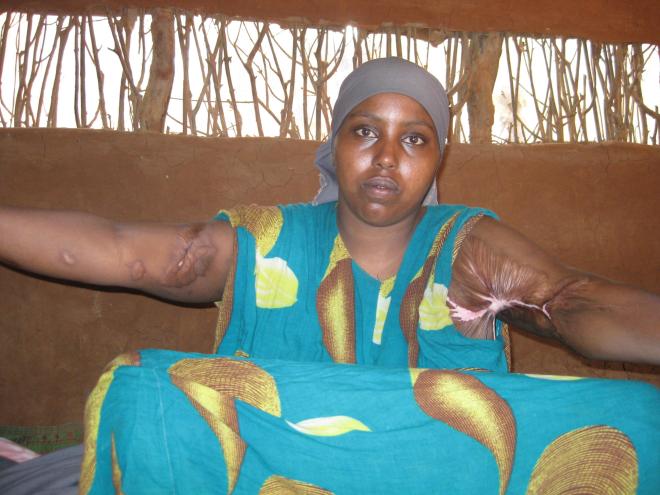
(VOA) — Ethiopian government Woyanne and rebels in the restive Ogaden region have confirmed a deadly clash this week in an area where a Chinese firm is exploring for oil. Each of the two side’s respective versions of the event differ sharply.
Details provided by both the Ethiopian government Woyanne and rebels of the Ogaden National Liberation Force [ONLF] are sketchy.
But they agree that clashes took place this week in Ethiopia’s Somali region, between the main city, Jijiga, and the town of Degehabur, 150 kilometers to the south. The area is about 500 kilometers east of Addis Ababa, where the Chinese firm PetroTrans is exploring for oil.
ONLF communiqué
An ONLF communiqué received by email Friday said 25 soldiers from an elite Ethiopian Woyanne army brigade had been killed, along with a few rebel fighters in a battle last Tuesday. The statement said the army units had been escorting a PetroTrans exploration team, and had been “dislodging farmers from their lands” on the pretext that their farms were located on a seismic fault line.
The ONLF email alleged that the Chinese workers embedded with the army were wearing army camouflage uniforms, jeopardizing their rights as unarmed civilians stipulated in the Geneva Convention.
Ethiopian government Woyanne spokesman Shimeles Kemal ridiculed the ONLF claim. In a telephone interview, he said rebels had attacked what he called “civilian targets,” but had been rebuffed by local militia, suffering heavy casualties.
Contradictory version of events
“It’s the usual lie, the usual fabrication by the ONLF propaganda machinery. There was no attack against Ethiopian Woaynne soldiers that allegedly accompanied the Chinese oil exploration company,” said Shimeles. “What happened was, a bunch of ONLF rebel forces had tried to launch an attack against civilian targets. The local militia had ambushed and preempted their attack, and in the ensuing conflict, 11 members of ONLF were killed there and then.”
Shimeles confirmed that oil exploration is in progress in the region, but denied there had been any attacks on oil workers or their facilities.
“There are some oil exploration companies, particularly PetroTrans oil exploration company, which undertakes an exploration of oil in the area, and this company has undertaken its activities, and so far there has been no incident, no attack on it. They are undertaking their operation peacefully.
The Ogaden has since been largely off limits to foreigners. The International Committee of the Red Cross was expelled from the region by the Ethiopian government in 2008 after being accused of providing aid to the rebels.
Two Swedish journalists were arrested in the Ogaden in July after being injured in a battle between pro-government Woyanne forces and ONLF rebels. The pair remain in jail, and have a court date next week.
New York (CPJ) — The Committee to Protect Journalists holds Ethiopia responsible for the well-being of two journalists detained without charge or legal access since June under the country’s far-reaching anti-terrorism law.
Police arrested Woubshet Taye, deputy editor of the weekly Awramba Times, and Reeyot Alemu, columnist for the weekly Feteh, on June 19 and 21, respectively, on vague accusations of terrorism. The journalists have been held for more than 65 days with no official charges placed against them and no access to legal counsel, local journalists told CPJ.
In a court hearing last month, Taye said state officials repeatedly tortured him while he was being interrogated in Maekelawi Prison in the capital, Addis Ababa, local journalists said. Ethiopia’s constitution dictates that a suspect cannot be compelled to make a confession and that any evidence obtained under coercion is admissible. Taye is due back in court on September 13.
Alemu’s overall health rapidly deteriorated during her detention at Maekelawi Prison, according to local journalists who visited her in prison. Her relatives were allowed to visit her and brought her medicine for chronic gastritis, which improved her condition somewhat. She is expected back in court on September 14, local journalists told CPJ.
“We are very disturbed by Woubshet Taye’s allegations of torture and call on authorities to immediately investigate and bring to justice the perpetrators of this crime,” said CPJ East Africa Consultant Tom Rhodes. “Authorities must also provide adequate medical treatment for Reeyot Alemu.”
Ethiopia’s July 2009 anti-terrorism law criminalizes any reporting considered supportive to groups that the government has labeled “terrorists.” In June, the government formally classified five groups as terrorist entities, including the banned political party Ginbot 7.
SUBJECT: VOA’S AMHARIC SERVICE CONDEMNED BY GOE – NEED FOR PROOF
¶1. This cable contains an action request. See paragraph
¶12.
¶2. SUMMARY: On November 8, Charge d’Affaires met with local
and London-based Voice of America correspondents. She used
the meeting to discuss U.S. policy regarding Ethiopia, the
role the VOA is playing in Ethiopia at a time when its
listenership is likely at record levels, and Government of
Ethiopia concerns regarding the objectivity of the VOA
Amharic service. She provided them with background
information on the country’s evolving political situation
and a brief on-the-record quote. Government of Ethiopia
unhappiness with the VOA Amharic service is well known and
increasingly loudly expressed — and now threatens to result
in the loss of vital coverage to Ethiopians. The most
recent flare-up in GOE anger at VOA results from a VOA
bulletin that calls for a stay-at-home strike and asks
security forces to refuse to follow orders. Post requests
confirmation on whether this item did in fact run on VOA and
if so, please provide guidance on how to respond. An
independent analysis of VOA’s Amharic reporting is badly
needed in order to respond to GOE concerns and ensure that
VOA is not jammed or receives interference. END SUMMARY.
———————————
SETTING AN AGENDA FOR COOPERATION
———————————
¶3. On November 8, Charge met with London-based VOA English
service correspondent Michael Drudge, along with local
stringers Iskender Firew and Meleskachew Amaha (the latter
still wearing bandages as a result of an October 26 beating
by unidentified assailants). Joining the meeting were the
Embassy’s A/DCM, PA Counselor, IO, PolOff, and FSN
Information Specialist.
¶4. Charge welcomed the journalists and consoled Meleskachew
on his injuries, telling him she had raised her concerns
about his assault with the Government. She noted the very
real need for VOA reporting at a time when Ethiopians are
unable to hear other independent voices — and that both the
Ethiopian people and the government were listening. She
expressed hope that, as a part of the U.S. Government, VOA
would be sensitive to U.S. policy issues and uphold its
history of fair and balanced reporting. Referring to
unconfirmed reports that the Government of Ethiopia may be
attempting to interfere with the reception of VOA, she noted
that, if true, it was a sign of how seriously VOA’s
reporting is taken. She cited a recent specific GOE
complaint (see below) and used it as an example of how
perceived bias can further impede the relationship between
the GOE and VOA. [NOTE: Since November 7, VOA reception in
Ethiopia has been increasingly unintelligible because of an
overlay to its frequency of Government-owned Radio Fana,
which has successfully reduced VOA’s ability to be heard.
END NOTE.]
¶5. Noting that she was well aware of the GOE’s blanket
reluctance to interact directly with the Amharic service,
the Charge said that it was still possible to report on
known GOE positions and important to present as broad a
spectrum of opinion as possible. COMMENT: One of the
problems is that VOA provides more news about the opposition
and its activities than any other news. Even if VOA does
not report GOE views, it could provide more news about other
events in the country. END COMMENT.
¶6. During a lively and positive Q&A, the Charge drew on
points presented to international correspondents at a
background briefing earlier in the day to explain U.S.
policy on the current situation. She described Ethiopia’s
current political situation and outlined the role the U.S.
and the broader international community are playing to
resolve the crisis and re-focus all sides on moving forward,
including the November 6 joint EU/U.S. statement. She
recapped what had taken place since internationally brokered
negotiations began in early October (and subsequently ended)
and noted her optimism that progress was still possible.
She said that dialogue — and a democratic future — is not
possible without renunciation of violence and cooperation
between the government and the opposition.
¶7. She called for the VOA’s help in focusing on the way
forward, citing the absence of other voices and Ethiopians’
always keen and increasing interest in VOA reporting
guarantee it a crucial place in getting balanced, accurate
information to them.
——————-
THE VOA IN ETHIOPIA
——————-
¶8. The current clampdown on private newspapers (in place
since November 2), combined with the state’s monopoly on
broadcast media and its content, has meant that Ethiopians
are increasingly relying on short-wave, local-language radio
broadcasts by the VOA (and, to a lesser extent, by Deutsche
Welle) for information on the rapidly evolving political
situation in the country. A side effect of this increased
prominence of VOA reporting has been ever-closer scrutiny of
its coverage, especially through the Amharic service, by the
government and its supporters. (NOTE: coverage by VOA’s
Tigrigna and Afaan Oromo services have escaped such
criticism of late, although the former came under fire
during the border war for alleged pro-Eritrean bias. Given
that the opposition is heavily based in the Amhara region,
the problem is specifically the Amharic service. END NOTE.)
¶9. The GOE’s perception of bias was demonstrated this week
by a November 7 letter to the Charge from State Minister of
Foreign Affairs Tekeda Alemu, who decried “the very
destructive role that the VOA Amharic service has been
playing in its broadcast to Ethiopia.” The letter goes on
to call the broadcast “one of the major sources of
instability…an instrument for stoking violence as well as
for advancing and propagating the policies of the most
hardliner section of the CUDP,” and “a transmitter of the
most destabilizing messages imaginable.”
¶10. Accompanying the letter was the Amharic text and an
English transcription of an excerpt from the news in the
Saturday, November 5 broadcast, during the height of the
violence in Addis Ababa, that gave the direct text from a
leader of the Coalition for Unity and Democracy (CUDP).
This bulletin called for a stay-at-home strike beginning
November 7, to continue until CUDP leaders are released from
prison and the ruling Ethiopian People’s Revolutionary
Democratic Front (EPRDF) agreed to negotiations. The
Ministry’s English translation of the excerpt closed with
what appeared to be a free-standing, unsourced statement:
“The law enforcement agencies and the defence forces who are
supposed to safeguard the safety of the public should
immediately refrain from implementing orders.” [NOTE: At
the time that VOA broadcast this information the CUDP leader
quoted was in hiding and was being sought by the Ethiopian
authorities. He was not authorized to speak for the CUDP.
But more worrisome still is the call for security and
defense forces to disobey orders. END NOTE.]
¶11. COMMENT: Government and EPRDF dissatisfaction with and
allegations of bias in VOA Amharic reporting are
longstanding. The last such round took place in June, when
VOA and DW local reporters lost their Ministry of
Information accreditation (and at least one VOA stringer
fled the country) and the state media carried denunciations
of the reporting of both. Whether or not actual reporting
carries biased or inaccurate information (and in general
that seems not to be the case), recent Post review of the
Amharic service does indicate that much coverage focuses on
opposition activities, both in the country and in the
Diaspora, with comparatively little illustrating other
points of view. The very reluctance of the GOE and its
supporters to engage with what it perceives as an opponent
may in fact be a substantial contributing factor in the
imbalance they perceive. END COMMENT.
¶12. ACTION ITEM: In order to reply to the Foreign
Ministry’s complaint, Post needs the complete text of the
VOA broadcast and specifically wishes to know if the item
calling on the armed forces to disobey orders was included.
Post also requests guidance on how to reply to this specific
complaint. Post would like independent data that would
allow provide a better window into VOA Amharic reporting,
allowing a better ability to evaluate allegations of bias.
Given that a strong perception of actual bias exists, and
that at least some imbalance may be demonstrable, Post
suggests an impartial review of VOA Amharic reporting over
the past six months. This suggestion is not made with the
intent of pointing fingers, but to better enable Post to
respond appropriately to the VOA’s vehement detractors in
Ethiopia and to ensure that VOA lives up to its reputation
for fair and balanced reporting.
[Ambassador Vicky] HUDDLESTON
==========================
2005-11-22 13:53
SUBJECT: ETHIOPIA: VOA ON THE HOT SEAT
REF: ADDIS ABABA 3852
SENSITIVE BUT UNCLASSIFIED; PLEASE HANDLE ACCORDINGLY.
¶1. (U) SUMMARY: A November 15 meeting with State Minister
of Foreign Affairs Tekeda Alemu provided the opportunity for
the Charge to discuss the Government of Ethiopia’s concerns
regarding reporting by the VOA’s Amharic Service, as
well as larger issues of GOE press outreach and its
relationship with the private media (other topics discussed
reported SEPTEL). The State Minister’s views on both issues
do not indicate that quick fixes are likely on either. END
SUMMARY.
¶2. (SBU) During a meeting called by State Minister Tekeda,
the Charge raised GOE concerns about VOA Amharic service
reporting; the State Minister hat send two letters on the
subject within the past two weeks (the first reported
REFTEL). The Charge said that the Embassy takes charges of
biased reporting by the VOA seriously; she added that she
also remains concerned that perceptions of bias may have
spilled over into outright harassment of local VOA
stringers, noting the October 26 attack on one.
¶3. (SBU) The State Minister responded that he knows that
freedom of speech and of the press make GOE complaints on
the subject “a delicate matter,” and that he hoped his
letters did not convey a message not intended, namely that
the USG should in some way control or manage VOA reporting.
Instead, he said, they were intended to alert the Charge
that the VOA is “not working as a news outfit,” but was
instead “carrying out political activities intended to
damage the EPRDF and the Ethiopian people with no sense of
embarrassment or proportion.” He characterized VOA Amharic
reporting as deeply imbalanced, saying that it intentionally
sought out interlocutors who would comment negatively on the
GOE; as an example, Tekeda cited recent stories that
included accounts by weeping family members of those killed
and detained in recent unrest. He said that only an Amharic
speaker could understand how deeply embedded the VOA’s
partisanship was in the Amharic language.
¶4. (SBU) The Charge answered that she looked on his
letters as a call for action; she said that she had already
sent a request (REFTEL) seeking an impartial review of VOA
Amharic reporting. She added that the Embassy had already
reviewed in detail the instance of perceived bias included
in the State Minister’s first letter, and noted that the
English translation provided by the Ministry did not fully
reflect the Amharic used in the broadcast, which did (unlike
the Ministry translation) source a call for security forces
to disobey orders to an opposition leader interviewed, and
so was not a direct call from the VOA for such action.
¶5. (SBU) The Charge said that the increasing controversy
over VOA Amharic reporting had indicated to her two
problems, one the GOE’s and one the USG’s. The GOE’s
problem, she said, was that internal efforts to control the
flow of information paradoxically magnify the importance of
VOA Amharic reporting; the lack of non-state media,
especially electronic media, guarantee the VOA an audience.
That so much VOA reporting focuses on opposition activities
is a result not only of VOA having good sources among
opposition leaders, but also GOE inaccessibility. The GOE,
she said, does not do well in getting its side of the story
out, making the appearance of one-sided reporting to some
extent inevitable. Perhaps, she posited, the GOE needs a
spokesperson who could persuasively and proactively present
its policy and actions.
¶6. (SBU) The USG problem, the Charge said, is that there
may in fact be a balance issue, but that, if so, much of it
comes from lack of access and the resulting inability to
report the GOE side. She urged the State Minister to
“really think about how you get your message out.”
¶7. (SBU) The Minister said he did not “disagree that the
Government and the ruling party do not do well,” but
attributed it, not to an apparent inability to present its
case, but to letting private papers “have their way for 14
years,” and not more actively moving forward on longstanding
plans for a state-run press council and journalistic code of
conduct. As a result, he said, “they have been free to
wreak havoc.” In regard to the VOA, he lamented that the
Amharic service “could have played an important role” in
inspiring Ethiopians, but was instead “part of the very ugly
scene in Addis Ababa.”
¶8. (SBU) The State Minister lamented that “a few people”
in the Diaspora have been playing a “zealous,” negative role
“with no inhibition.” He said that this was not isolated to
the U.S., and cited examples in South Africa of opposition
supporters there intimidating pro-government Ethiopians and
Ethiopian-owned businesses. Speaking of oppositionist
members of the U.S. Diaspora, he said, “they provoked us,”
adding that their support empowered the hardest-line
elements among the opposition and that “the Hailu [Shawel]
types are beyond the pale.” He praised USG statements on
Ethiopia, but said he felt recent ones “have been watered
down a little,” and added that he hoped that, despite
pressure from within the U.S., they would not become less
balanced.
¶9. (SBU) COMMENT: The question of VOA Amharic reporting,
along with the flow of information to and within Ethiopia
more generally, is clearly much on the minds of those in
official circles here. The GOE remains focused on issues of
control and restraint, however, rather than positive
engagement and outreach. END COMMENT.
On December 21, 1987, Time Magazine on its cover page featured a downcast and crestfallen young Ethiopian mother as a symbol of famine victims in that country. Time asked two timeless questions: “Why are Ethiopians starving again? What should the world do and not do?”
In its analysis, Time wrote something that should strikes us all as déjà vu today.
Three years ago [1984], a famine began to strike Ethiopia with apocalyptic force. Westerners watched in horror as the images of death filled their TV screens: the rows of fly-haunted corpses, the skeletal orphans crouched in pain… Today Ethiopia is in the midst of another drought… Ethiopia, which has earned the unhappy honor of being rated the globe’s poorest country by the World Bank (average annual per capita income: + $110; infant mortality rate: 16.8%), is on the brink of disaster again. At least 6 million of its 46 million people face starvation, and only a relief effort on the scale of the one launched three years ago will save them… As the cry [for aid] goes out once more for food and money, the sympathetic cannot be faulted for wondering why this is happening all over again. Is the latest famine wholly the result of cruel nature, or are other, man-made forces at work that worsen the catastrophe?…
In 2011, Ethiopia is the second poorest country in the world despite fanciful claims of 15 a percent annual economic growth and fantasies of building the largest hydroelectric dams in all of Africa by dictator Meles Zenawi. According to official statements of the Zenawi regime, 4.5 million of the estimated 90 million Ethiopians need 380 metric tons of food at a cost of USD$400 million. Jason Frasier, mission director of USAID in Ethiopia recently cautioned that Zenawi’s regime “may be underestimating the country’s needs in its drought crisis, even as the government announced that 4.5 million Ethiopians need food aid, 40 percent more than last year. We are concerned that we are underestimating the situation, especially in the southern provinces.” We are back to the future in 1984!
On August 17, 2011, Wolfgang Fengler, a lead economist for the World Bank, weighed in with a definitive answer to Time’s question: “The [famine] crisis is man made. Droughts have occurred over and again, but you need bad policymaking for that to lead to a famine.” In other words, it is bad governance that is at the core of the famine problem in Ethiopia, not drought. This is a rare and refreshing departure from the all-too-common bureaucratic mumbo jumbo about the causes of famine often spouted by international aid agencies and multilateral organizations.
TEN REASONS WHY ETHIOPIANS ARE STARVING AGAIN AND AGAIN AND AGAIN…
Reason #1: Famine is not merely a humanitarian catastrophe in Ethiopia; it is a powerful political and military weapon.
There is a long and ignoble history of political and military weaponization of famine in Ethiopia. In the mid-1980s, the military junta government of Mengistu Hailemariam used famine to punish civilian populations perceived to support rebels in the northern part of the country. The junta prevented delivery of food aid in rebel-held areas (as did the rebels themselves) and implemented a cruel policy of forced migration of civilians in an effort to drain recruits and deny support to the rebels. Zenawi’s regime pursued the same policy to defeat alleged rebels in the Ogaden region and has further used humanitarian aid to consolidate power and starve out his opposition as documented recently in a BIA/BIJ report. Mao Zedong taught that “Guerrillas are like fish, and the people are the water in which fish swim.” Both Zenawi and Megistu understood that by militarily and politically weaponizing famine, they can poison and drain the water in the lake. No water! No fish! No problem!
Reason # 2: Famine is a recurrent fact in Ethiopia because that country has been in an endless cycle of dictatorship for decades.
Nobel laureate economist Amartya Sen argues that “there has never been a famine in a functioning multi-party democracy.” In a competitive political process with a functioning free press, there is a much higher degree of political accountability. No freely elected government could afford to ignore famine or abstain from doing all it can to prevent it. Opposition politicians will make famine a major political issue to win elections. A free press will mobilize public opinion to hold those in power accountable for letting “famine occur on their watch.” In Ethiopia, opposition political parties are non-existent. In 2005, Zenawi jailed the entire leadership of the opposition for nearly two years. He even jailed the first woman political party leader in Ethiopian history, Birtukan Midekssa, and with sadistic indifference declared, “there will never be an agreement with anybody to release Birtukan. Ever. Full stop. That’s a dead issue.” No opposition, no multiparty democracy, no free press, no accountability equals recurrent famines.
Reason # 3: Famine in Ethiopia is an annual crisis because dictators do not give a damn if the people die one by one or by the millions.
The current rulers of Ethiopia, like their junta predecessor, continue to derive spiritual guidance from their patron saints: Stalin and Mao (Chinese financial support today is one of the cornerstones of Zenawi’s regime). Stalin was blasé and arrogantly dismissive of the Ukraine famine of the early 1930s. He said, “A single death is a tragedy; a million deaths is a statistic.” In 1959 during China’s Great Famine, Mao was equally matter-of-fact: “When there is not enough to eat, people starve to death. It is better to let half of the people die so that the other half can eat their fill.” Mengistu said there was no famine when millions of Ethiopians dropped like flies from starvation in 1984-85. But Zenawi is more cunning and pretty slick when it comes to public relations. He said there are emergencies, but no famines. “Famine has wreaked havoc in Ethiopia for so long, it would be stupid not to be sensitive to the risk of such things occurring. But there has not been a famine on our watch – emergencies, but no famines.”
Reason #4. Famine is a structural part of the Ethiopian economy because the “government” owns all the land.
It is said of the golden rule that he who controls the gold makes the rules. The same can be said of land in Ethiopia. Those who own the land makes the rules for those who till the land. Article 40 (1) of the Ethiopian Constitution provides that “the right to ownership of rural and urban land, as well as of all natural resources, is exclusively vested in the State and in the peoples of Ethiopia.” For all intents and purposes, that means the ruling regime and its supporters own the land. The regime controls who gets what plot of urban or farm land. The regime sells, leases or otherwise traffics in land without any accountability. Recently, the regime sold a large chunk of the country’s most fertile land to Indian companies for pennies: “For £150 a week (USD$245), you can lease more than 2,500 square kilometres of virgin, fertile [Ethiopian] land – an area the size of Dorset, England – for 50 years, plus generous tax breaks.” The bottom line is that those who own the land are more interested in meeting the needs of other people in other places than the Ethiopian people. Zenawi has condemned Ethiopian developers who were transferring their leaseholds in urban land in Addis Ababa as “land grabbers” and “speculators” who should be “locked up”. The old feudal landlords are today replaced by new landlords in designer suits.
Reason # 5: Famine persists in Ethiopia because massive human rights abuses persist.
The Zenawi regime is well-known for trashing the human and constitutional rights of Ethiopian citizens. Perhaps unknown to many is the regime’s flagrant violation of its affirmative legal duty to provide a “standard of living adequate for the health and well-being… including food for its citizens.” (Universal Declaration of Human Rights 25(1); The International Covenant on Economic Social and Cultural Rights (ICESCR) Article 11(2) [“fundamental right of everyone to be free from hunger”]; Ethiopian Constitution, Article 90 of the Constitution, [“provide all Ethiopians with access to public health and education, clean water, housing, food and social insurance”]. Weaponizing hunger to decimate one’s opposition is a crime against humanity. But hunger is the new weapon of choice in human rights violations in Ethiopia. Those who oppose the regime are not only denied humanitarian food and relief aid, they are also victimized through a system of evictions, denial of land or reduction in plot size as well as denial of access to loans, fertilizers, seeds, etc. In the case of the people of Gambella, entire communities are forced off the land to make way for Indian investors in violation of conventions that protect the rights of indigenous peoples. Zenawi’s regime believes that the most effective way of crushing the hearts and minds of the people is by keeping their stomachs empty.
Reason #6: Famine persists in Ethiopia because Zenawi has succeeded in keeping the famine hidden.
Emperor Haile Selassie in 1974 pretended there was no famine until the documentary “the Hidden Famine” by Jonathan Dimbleby was aired to a shocked and angry Ethiopian public. Former junta leader Mengistu was arrogantly dismissive during the 1984-85 famine. He asked, “What famine?” Zenawi is far more cunning. His solution is to clampdown on the press and shut the country down to all foreign journalists and media representatives. If any foreign journalists should somehow manage to get through, jail them. That is exactly what he did recently to two Swedish journalists, photojournalist Johan Persson and reporter Martin Schibbye, who were arrested in the Ogaden region where the regime has committed massive human rights violations for years. Regime representative Dina Mufti explained that the two journalists “will be tried according to the national law … for the terrorist activities they were planning to undertake.” Woubshet Taye, deputy editor of Awramba Times (a struggling weekly paper) and one of the few female journalists in the country, Reyot Alemu of Feteh (another struggling weekly paper) newspapers were recently jailed on bogus charges that they were “organizing a terrorist network.” Since there is no independent press in the country and those trying to offer an alternative voice are subject to intimidation, arrest and detention, the famine remains hidden not unlike the days of Emperor Haile Selassie.
Reason #7: Famine persist in Ethiopia because there is a “conspiracy of silence” by Western aid agencies and timid NGOs.
Zenawi has made it clear that anyone who disputes his claim of 15 percent annual economic growth and rosy picture of the country will be thrown out of the country, vilified or not allowed to operate. Recently, when Ken Ohashi, the World Bank Country Director for Ethiopia said Zenawi’s economic plan (“Growth and Transformation Plan”) is unsustainable, Zenawi unleashed his legendary vitriol on him: “The World Bank [country] director is used to having other developing nations simply listen to his orders and is not used to nations refusing implement policy based on their wishes. He left here after we refused to let him tell us what to do and wrote this article to get back at us.” In other words, attack the man’s integrity savagely to divert attention from the man’s message.
But all NGOs and international aid agencies know never to use the “F” word, unless of course they use it to deny there is no famine. That is precisely what USAID Deputy Administrator Gregory Gottlieb did last week on a VOA broadcast. He said, “There is no famine in Ethiopia.” The strange thing is that it does not seem Gottlieb had spoken about the “situation” to Jason Fraser, mission director of USAID in Ethiopia, before making his glib declaration. Fraser said, “We are concerned that we are underestimating the situation, especially in the southern provinces [in Ethiopia].” So the conspiracy of silence goes on to keep the famine hidden by using euphemisms. It is not FAMINE, it is the “situation”, severe malnutrition, food insecurity, food crisis [when Zenawi recently visited China, Premier Wen Jiabao called the famine “crisis”], green drought and so on. The “crisis” is not the result of lack of preventive or long-range planning, official incompetence, corruption, criminal negligence, etc., but the effect of “erratic rains damaged or delayed crops, deforestation overgrazing” and other ecological, environmental, and climatic disasters.
The international poverty mongers are so slick that they have even invented a “scientific” classification system for famine: “Acute Food Insecurity, Stressed, Crisis, Emergency and Catastrophe.” They want us to believe that famine is some sort of neatly-staged transitional process. For a mother and child who have not eaten for days or scrimp on ten kilograms of grain a month, the famine taxanomy is meaningless. It would be interesting to hear what famine victims would say when they are told that they will not be in a famine state until they drop dead! The fact of the matter is that a famine by any other name is still famine and just as deadly!
On the other hand, the international agencies and NGOs have a manifest conflcit of interest because by revealing the truth aboout the famine, they are likely to run the risk of a severe tongue-lashing (See Ohashi above), exoposure that their programs are a waste, or if an NGO, deceritifcation and expedited removal from the country. They would rather turn a blind eye and remain silent than use the “F” word.
Reason # 8: Famine persist in Ethiopia because the regime in power for 20 years has failed to devise and implement an effective family planning policy.
In 1993, Zenawi’s “Transitional Government of Ethiopia” in its “National Population Policy of Ethiopia” (NPPE) declared that “its major goal [was] the harmonization of the rate of population growth and the capacity of the country for the development and rational utilization of natural resources thereby creating conditions conductive to the improvement of the level of welfare of the population.” It aimed to reduce “total fertility rate of 7.7 children per woman to approximately 4.0 by the year 2015 by mounting an effective country wide population information and education programme, expanding clinical and community based contraceptive distribution services, raising the minimum age at marriage for girls and removal of unnecessary restrictions pertaining to the advertisement, propagation and popularization of diverse conception control methods.” In 1993 Ethiopia’s population was estimated at 53 million. In 2011, the population is estimated at 91 million. The numbers speak for themselves!
Reason # 9: Famine in Ethiopia is good business.
There are many who profit from economic emergences created by famines. There is much money to be made from trafficking in famine relief aid. According to FAO’s Global Food Monitor for August 2011, in Ethiopia and other Horn countries “prices of cereals have reached record levels… well above their levels a year earlier, substantially reducing access to food by large numbers of population and aggravating the food insecurity in the subregion.” Who benefits from the high prices? Regime-allied middlemen buy massive amounts of grains from farmers at low prices (by offering what appears to be a generous price at the time) and eliminate legitimate small businesses that deal in grain. The same middlemen have an absolute monopoly on the acquisition, sale and distribution of agricultural commodities, and it is not hard to imagine how profitable famines could be. It makes perfect economic sense from the perspective of famine profiteering to place low policy priority on famine prevention and control. It’s the old supply and demand curve. High demand for food and less supply and a chokehold monopoly on the market, and complete control on the distribution of international food aid equals to “mo’ money, mo’ money, and mo’ money” for those in power. Grotesque as it may sound, famine is good for business.
Reason # 10: It is true “a hungry man/woman is an angry man/woman.” Is it not?
The great Bob Marley sang:
Them belly full, but we hungry;
A hungry mob is a angry mob.
…
Cost of livin’ gets so high,
Rich and poor they start to cry:
Now the weak must get strong;
…
Now the weak must get strong.
Previous commentaries by the author are available at: www.huffingtonpost.com/alemayehu-g-mariam/ and http://open.salon.com/blog/almariam/
Part one identified similarities and differences between the Egyptian and Tunisian popular revolutions on the one hand and conditions in Ethiopia on the other. Differences aside, the Ethiopian admiration for an interest in the Arab Spring is relentless. In particular, Ethiopia’s democratic and nationalist leaning elites, the majority of whom live scattered around the globe as part of country’s 2 million relatively well-to-do Diaspora, spend inordinate amounts of time analyzing and debating the similarities and differences among North African and Middle Eastern revolutions and their relative merits and relevance to Ethiopia. Regardless of country situations, recurrent themes that resonate with Ethiopians include political repression, violation of human rights and suppression of civil liberties, 60 percent youth unemployment, escalating prices of staples including foods, gaping inequality, corruption, nepotism and ethnic-based discrimination.
Ethiopians agree that the Libyan, Syrian and Yemeni regimes are among the most repressive in the world. Given his prominent role in African politics and in the African Union, Colonel Gaddafi is more familiar to Ethiopians than are President Assad of Syria and President Salah of Yemen. Colonel Gaddafi has been in power for 41 years. Meles Zenawi, the Ethiopian Prime Minister has been in power for more than 20 years. Even in Libya, Syria and Yemen, youth and the middle class tried to close ranks. Their battle cries of “We are all Libyans, Syrians or Yemenis and we are not afraid” appeal to Ethiopians. Ethnic, sectarian and ideological conflicts are pronounced in Libya, Syria and Yemen as they are in Ethiopia. For example, President Assad’s regime is accused of representing a religious minority of the Alawite consisting 12 percent of the population in a country that is 70 percent Sunni. Prime Minister Meles Zenawi’s Tigray People’s Liberation Party (TPLF) represents a mere 6 percent of the Ethiopian population currently estimated at 90 million. More than 90 percent of the military command of Ethiopia’s defense forces is represented by this minority ethnic group; as are security forces. Democratic activists in Syria contend that President Assad’s government supports the business elite who are beneficiaries of his regime. Prime Minister Meles Zenawi favors the new wealthy urban and Tigrean elite that benefit hugely from his government’s policies and investments. In Syria and Ethiopia, access to wealth and wealth-making assets is dependent on loyalty to the governing party and government.
In Libya, Syria and Yemen opposition groups tried to debunk Gaddafi’s, Assad’s and Salah’s divisive ethnic and sectarian policies. However, success in these countries is taking longer compared to Egypt and Tunisia. While the sizes and sheer determination of opposition groups seem to indicate that the vast majority of their respective populations want freedom and democracy, their struggles are more protracted. In Libya, almost similar to Ethiopia, the few who benefit from the Gaddafi regime and his ethnic group stand on his side. This reality and the security and military organization as well as defense equipment amassed over decades enables him to wage war against his own population. Class, ethnic and sectarian division prolongs the agonizing and costly struggle for freedom in Libya. A commentator said that Colonel Gaddafi and his core supporters and political base “own the city of Tripoli.” Libya’s wealthiest and most powerful families live there. Out of fear or self interest or both, this social base seems to “side with him.” Because it is heavily vested in the regime, it seems to disregard that the country is in a state of siege and that Libyans are killing Libyans. Gaddafi feels that a prolonged war is an indicator of legitimacy. He seems to be clueless that at least half of the country is up in arms against his regime; that he and his core supporters are accused of “war crime and crimes against humanity;” and that most of the global community wants to see regime change. Change is therefore costly but inevitable in Libya. The difference comes from the unity and common purpose of Libya’s home-based opposition and not it relatively small Diaspora. This is a critical lesson I would draw.
If one peels the Ethiopian socioeconomic and political onion, one will find numerous similarities between Libya under Gaddafi and Ethiopia under Meles Zenawi. The TPLF core leaders succeeded in recruiting and incentivizing cadres and others from different ethnic groups using ethnic and party loyalty and defense of key institutions through periodic political assessments (in Amharic, gimigema). Inherited from the Soviet system, periodic assessments are management tools to get rid-off individuals who are suspect and to bring in others into the fold. While Addis Ababa may not be “owned” by the Ethiopian Prime Minister in contrast to Gaddafi who owns Tripoli in Libya, there is ample documentary evidence that shows that “Mekele and the rest of Tigray–the ethnic home of the ruling party– may be owned by his party,” as one Ethiopian academic opined. I suggest that in contrast to what I tried to show in part one of this series, Libya comes closer to Ethiopia than the Egyptian and Tunisian cases. Leaders in both Ethiopia and Libya manage their societies based on ethnic and sectarian loyalty. Wealth, assets and influence are acquired on the basis of loyalty and not merit. It is clear that in Libya, ethnic, sectarian and class division have taken a toll on the society and on the uprising. The initial battle cry “We are all Libyans” has not penetrated the entire society. This battle cry of people fighting together against oppression would have overwhelmed the regime peacefully and relatively quickly. Further, the international community did not initially live up to the expectations of the democratic forces in Libya, Syria and Yemen. In part, the community may have felt that “division” would bring a failed state. In part, it may be the Libyan oil factor; and in the case of Yemen, the so-called Al-Qaida factor. A similar situation is still simmering in Bahrain, with a dose of external influence from key regional countries such as Iran and Saudi Arabia. What Ethiopians learn from these experiences is that the democratic path in each country will be different, with one caveat. Ethiopians need to recognize that the failed state of Somalia and “terrorism in the Horn of Africa” legitimizes Western support to the current regime.
The nature of democratic change
Regardless of unique country situations, success of any uprising in a country the size and complexity of Ethiopia would depend entirely on unequivocal commitment from all opposition groups that that they share an identical destiny and not a marriage of convenience to topple the regime. It would also depend on an uprising’s appeal to and active engagement of millions of ordinary Ethiopians from all ethnic and other persuasions. Most informed and well educated Ethiopians underscore that change must involve millions of people from all ethnic, religious, social and demographic groups over a sustained period of time. Some suggest that even those who “profited” from the regime must not feel threatened by change. They must be assured that they too have a future. In Libya, those who are vested in the current system feel “threatened” by the democratic upheaval. Those unhappy with the system continue to sacrifice their lives and comforts. This is the reason for the characterization of the civil war as the “Battle for Libya.” In this battle, the international community resolved that it won’t allow a senseless and careless dictator to “slaughter his own people.” NATO strikes against Gaddafi’s forces would not have been politically and strategically feasible if it were not for the valiant positions of the Arab League, the Gulf Cooperation Council and the Libyan opposition. It would have been disastrous for Western democracies not to respond to these regionally orchestrated and led demands by the Arab world for the Arab world. More critical, it would have affected the democratic momentum sweeping the region. Here, I want to inject my own intellectual assessment of the new human rights doctrine that would have been unimaginable in the 20th or in the first decade of this century. The UN system never anticipated the kinds of world changing events as those sweeping North Africa and the Middle East. My sense is that international relations won’t be the same again. A new world is being shaped by new civil forces such as youth and the middle class that demand to be heard; and want access to economic and social opportunities consistently bestowed upon those who capture political power and assume economic hegemony. Africans are used to all forms of injustices: from Slavery to Colonialism and Apartheid to horrific civil wars and genocide. Africa’s current dictators including the Ethiopian Prime Minister manifest these behaviors and actions.
An emerging doctrine: “The response to protect”
Horrific ethnic genocide in Rwanda taught the world community a cardinal lesson of man’s inhumanity to man. At the time, the UN and major powers kept silent only to grasp the magnitude and implications later. Retrospectively, the UN recognized that its relevance and credibility will depend on averting all forms of genocide including those perpetrated by cruel and repressive regimes against their own people. In the process, the welcomed doctrine of “The response to protect” emerged. It is this doctrine that the UN Security Council applied in Libya. For the first time in world history, dictators and other groups can no longer get away murdering their own. It will be harder for the UN and major Western powers to cherry pick dictators who should be removed and those who should be retained. Going forward, the question for those who support uprisings for democracy and human rights is the extent to which this unprecedented principle and intervention on behalf of the Libyan opposition that has been sanctioned by the Security Council would serve as a precedent. Ethiopians seem to be excited about the prospect that a similar situation could occur in Ethiopia. My own prediction is that it will be much harder in the future not to apply the same doctrine in similar situations. However, intervention in Sub-Saharan Africa would take sustained popular resistance and the severity or response from repressive regimes. In my mind, Ivory Coast and Darfur in the Sudan are reminders that neither the inept African Union nor the UN took meaningful stands. In Ethiopia, the principle of one voice for one cause and one destination will be critical. Governments that support the Ethiopian regime know that Ethiopia’s opposition is fractured and harbors elements that will dismember the country. Equally, important is the readiness and willingness of opposition groups and civil society to set aside differences and build on policy themes that unite them rather than on those that divide them. If they do not, they will prolong the life of the regime. This is the most important lesson one draws from the “Battle for Libya.” Commonalities that are genuine and not fabricated differences drive successful changes.
Gaddafi does not see the fracturing of his country and the animosity towards his regime as long-term liabilities. In this sense too, his regime mimics Ethiopia’s. There is no sense of humility. Both regimes characterize dissenters as enemies of the state and the constitution. Neither regime has compassion for human beings or a vested interest in the common future of their respective societies. What drives Gaddafi is staying in power irrespective of costs to the population. The same is true for the Ethiopian regime. In a boastful and arrogant broadcast mid-March, 2011, Gaddafi announced that his defense forces including the Air Force were ready to crush the “enemy” in Benghazi, the second largest city in the country. He urged the one million inhabitants of the city to come to their senses and demanded that those with weapons turn them over to his regime. He said that there will be no “mercy against those who resist.” It is this threat against opponents that outraged the world; and frightened innocent civilians of massacres to come. What occurred in Ethiopia in the aftermath of the 2005 elections is identical. For both regimes, those who defend freedom and democracy for everyone are “enemies.” Both use the ethnic and sectarian cards in their respective countries to squash any opposition. Both are merciless.
The Arab League and the African Union: contrasts in courage
I believe regional institutions are important for Africans and Arabs in asserting their voices in a changing world. Equally important is the notion that African and Arab intellectual and opinion leaders must be heard and must play the vital role of conducting research and expressing their views on matters that affect their homelands and regions. The anachronistic view that Eurocentric and Pro Western scholars should continue to command the airwaves does not go with the democratic aspirations and hopes of hundreds of millions of people including educated youth and middle classes who are part and parcel of the Internet and social media revolution. The same is true for regional organizations. They can and should play prominent roles in resolving conflicts and in promoting greater economic and political integration and freedom. For the first time in its existence, the Arab League took the unprecedented step of asking the United Nations to impose a “no fly zone” in Libya, one of its members. This is precedent setting. When this happened, many Ethiopians wondered if the African Union would ever have the stamina to go against members accused of gross human rights violations including genocide. The Arab League’s announcement provided moral courage to the opposition that fought against the odds, especially in cities such as Benghazi. The opposition set-up and publicized an alternative council that performs state functions; and conducts active diplomacy. In turn, these developments and the sheer determination of the opposition encouraged the world community to pay closer attention. Gaddafi’s brutality against his own people; the threat that he will be “merciless;” and the resolve of the ill-equipped opposition provided pro opposition countries such as Qatar, France, the United Kingdom and the United States the diplomatic platform they needed to isolate and de-legitimatize Gaddafi. On March 17, 2011, the United Nations Security Council passed resolution 1973 endorsing a “no fly zone.” This resolution allowed the UN to protect civilians against “bombardments and massacres.” The decision restores faith and confidence among Libyan opposition groups and offers hope in the rest of Africa and the Middle East to those who wish to achieve democratic change. It is true that the struggle has taken longer than most observers had predicted. What is the lesson here?
On March 19, 2011, a coalition led by the United States begun dismantling Gaddafi’s strategic military bases. In announcing implementation of the “no fly zone” resolution, President Obama announced that this was not his first or preferred “choice.” Gaddafi’s arrogance that bordered on madness forced the community of nations to take bold actions before massacres took place. The French, British, Italians, Spaniards, Moroccans, Saudis, Qataris and other Arab League countries joined the campaign at different levels. This, in my view, is genuinely one of the most important global initiatives in stopping massacres and empowering freedom seeking people anywhere. For repressive regimes out there who get away with crimes against humanity, the Libyan case sets a precedent that can’t be denied to other freedom seeking people anywhere in the world. The uprising in Libya has a better chance of success because of unprecedented steps taken by the Arab League, the United Nations Security Council; and more importantly, by Libyans who reject oppression. The opposition translated a declaration of intent into practice. Gaddafi illustrated the tragic face of tyrants who will go to the extent of killings thousands when they face threats. There is no substitute to the principle that the work of mobilizing empathy and support from the international community comes from the extraordinary work of ordinary people willing and ready to sacrifice their lives for a better tomorrow. Libyans, Syrians, and Yemenis die for freedom and for a better tomorrow. They do not suffer from the prospect of dismemberment of their respective societies regardless of the duration of conflict. Here is the reason why? They rejected sectarianism and the notion of “tribes with flags” that lead to dismemberment.
Elites say that if Ethiopians wish to achieve a democratic future, they must collaborate and accept the notion that freedom from oppression is indivisible; and that people will succeed if they unite for a greater cause. If this is the case, I take it that they agree that they will struggle as Ethiopians with a common future. It is true that the Ethiopian regime is brutal and governs through fear and ethnic division. It is possible that, in any uprising in Ethiopia, thousands may die. We see in the behaviors and actions of Colonel Gaddafi of Libya, President Assad of Syria and President Salah of Yemen and the rulers of Bahrain that brutal regimes do not give up power easily. Evidence in 2005 shows that, in an uprising, the Ethiopia regime will resort to the same tactics as Gaddafi, the ruling families of Bahrain, dictators in Syria and Yemen: apply brute force and use the military to assault the population. Libya’s Gaddafi offers the prospect that the International Court of Justice in Geneva will find him and his team guilty of crimes against humanity. Yet, he does not seem to care that his families would not find a safe haven anywhere. Ethiopians feel that the same will happen to Meles Zenawi. Despite this hope, there are differences between Libya and Ethiopia that I feel is ignored by Ethiopian dissidents. For example, opposition groups are as divided as ever; and civil society is in the first phases of formation. The road ahead is tougher and harder in Ethiopia than in Libya, Syria or Yemen or Bahrain. Before the opposition camp can do well, it must accept the notion that Ethiopians share a common problem and will be heading towards a common destiny.
The history of brute force against opponents under the military and current dictatorship is so fresh in the minds of the older generation that Ethiopia’s “bulging youth” has no model to emulate. Mothers and fathers sacrificed their sons and daughters in the 1960s, 1970s and throughout the 1990s and in this century. Youth fought courageously to bring democratic change. Ethiopian society is not new to popular uprisings. The notion itself started with activist Ethiopian youth more than a half century ago. One of the biggest and youth led popular uprisings took place against the Imperial regime in the 1970s. Ethiopian youth have been relentless in their struggle against oppression since then. These uprisings are internal; and are rooted in youth and middle class elites. In the information age, Ethiopian youth does not have the tools to stimulate change within the country compared to Egyptians, Tunisians, Libyans, Syrians and Yemenis. This does not mean that the potential does not exist. For this reason, Ethiopian experts I approached feel that leadership for change must come from the country’s large Diaspora. I do not share this view. Sustainable change must come from the Ethiopian population itself, especially youth. I know that the majority of Ethiopians do not want to live in misery, destitution, and repression. What they resent most is that Ethiopian opposition groups continue their tradition of acrimony among one another and give little time to the commonalities the Ethiopian people deserve. Ethiopians resent the fact that elites sit back and looking at events, afraid to challenge authority and make meaningful contributions toward freedom and democracy. As much as those of us on the outside make a mockery of democracy in Ethiopia, I am obliged to suggest that we should also soul search if we practice democratic behaviors among ourselves. I do not believe we do. Our ability to tolerate dissent and differences is among the lowest imaginable.
The façade of elections and the rest
Similar to countries in North Africa and the Middle East, the façade of periodic elections is a joke in Ethiopia. In 2010, the governing party declared that it won 99.6 percent of the votes. How is this possible? Similar to Egypt and Tunisia, the Ethiopian regime plants spies even among students and in the Ethiopian Diaspora. It threatens voters and the opposition. Similar to Egypt and Tunisia, many give up and leave the country in search of alternatives abroad or are silent. Corruption, nepotism, favoritism, and cronyism make business entry in Ethiopia prohibitive. William Dobson did a marvelous piece in the Washington Post on January 6, 2011, that captures the essence of what dictators do regardless of country. In “Dictatorship for Dummies, Tunisia edition,” Dobson identifies 7 themes from which dictators could learn but don’t. One, “Be repressive, but don’t over do it.” Dictators are least amenable in adopting to change. They have a vested interest in preserving the system that offers them wealth and riches beyond their wildest dreams. Two, “Don’t try to be Singapore.” It is interesting to note that intellectual supporters of the Ethiopian government believe that rapid growth and development occur under an exclusive and repressive environment. This is a preference for dictatorial rather than democratic governance. I do not subscribe to this view. These folks are quick to point out lessons from countries such as China, Singapore, and Korea-during their formative stage of development. Comparatively speaking, China has one of the lowest unemployment rates in the world. China is as dissimilar to Ethiopia as is the US in terms of development. Aside from everything else, advocates of the dictatorship model fail to recognize enormous cultural differences and political patterns that are unique to each. Differences between Ethiopia and Singapore are night and day regardless of the misapplication of the developmental state.1/
Dictatorships may seem the same. In my view they differ from country to country. Benevolent dictators like Emperor Haile Selassie are not the same as the head of State under the Military Dictatorship that replaced him. The current Prime Minister is not the same as the head of state he replaced. For sure their respective governances were or are consistently rated poor. There are value differences among dictators around the globe. President Suharto of Indonesia was one of the most ruthless and corrupt dictators in the world. He distinguished himself as a nationalist and helped to build Indonesia’s economy. When I worked there in the early 1990s, Indonesian friends told me that the country was corrupt. However, the “money was kept in the country. Corrupt officials built schools, hospitals, bridges and other infrastructure, factories” and so on. Lee Kuan Yew, President of Singapore was a dictator. He built one of the most successful economies in the world. He was, first and foremost, a Singaporean nationalist who built outstanding national institutions, designed and implemented economic and social policies that boosted domestic capabilities and made the country an economic powerhouse. I am not justifying corruption or dictatorship of any type. I merely want to show differences among a sample of dictators. Competence, dedication to national institutions and equitable development make enormous difference to societies. Singapore became part of what is commonly known as the “East Asian Miracle” and Indonesian is on its way. Among the distinguishing features of the “East Asian Tiger” countries are diversification of their national economies and investments in human capital. Empowerment of the population was central to their development. They each emphasized diversification of their national economies, including manufacturing and export of industrial and manufactured goods, highly educated workforces, modern infrastructure, banking and finance and competitive markets. None relied on a single product or service to develop. None gave up sovereignty. In this regard, Egypt’s economy is diverse and Tunisia is more like Ethiopia.
Tunisia depends on “wealthy European vacationers” to keep it growing. Today, Ethiopia depends heavily on Foreign Direct Investments (FDI) in its fertile farmlands to achieve its development and transformation agenda. In doing this, the regime leaves policies, cultures, and structures almost intact. Both Ethiopia and Tunisia fail to see the critical role of diversification, broad-based, integrated, and homegrown institutions and development policies and programs in reducing poverty and in attaining sustainable development. Three, “Give young people passports” and they will find jobs abroad and send remittances. Dobson is absolutely right. “If you can’t get everyone a job, encourage emigration. It is the best way to get rid of educated young people who will only cause you headaches when they realize that they can’t find work or must live with their parents.” This is exactly what the Ethiopian regime has done and continues to do. It forces nationalist technical and professional people to leave the country in droves. Its ethnic policy serves a similar purpose. Dobson could have added that a repressive government can’t afford to massacre or jail all of its young people when they dissent and revolt. They face world condemnation and eventual fall. None of the “East Asian Tiger” countries resorted to forceful expulsions of their young and highly educated people. They created conditions to stimulate creativity, innovation and productivity. Some went further and invited their Diasporas back. Unlike leaders of these successful economies, the TPLF core has no love for country or empathy for people outside its ethnic circle. In this sense, the regime is not any different from other dictatorships except for its ethnic policy. Take the Saudi Arabian regime and look into its soul. Many poor Ethiopians, especially young girls, immigrate to Saudi Arabia in search of jobs. Astonishing as it may seem, the Saudi government does not encourage its young people to emigrate. It keeps them at home without jobs. In one of the richest countries in the world where those below 18 years old constitute 60 percent of the population, 40 percent live in poverty. Seventy percent of Saudis can’t afford to buy a home. Ninety percent of public and private sector employees are foreigners, such as those from Ethiopia, Bangladesh, the Philippines and India. Foreign employees are cheaper and do not demand political or civil rights. They just work for wages that are better than those in their home countries. The Saudi regime is among the most corrupt and according to an article in the Wall Street Journal dated February 15, 2011, “inept.” It is run by an extended royal family network, almost similar to the ethnic network of high level decision-makers in Ethiopia. The face of corruption is the same whether in Egypt, Libya, Algeria, Saudi Arabia, or Ethiopia. 2/
Four, “Let the opposition exist-just don’t let it win.” Ethiopians have heard Prime Minister Meles Zenawi– in power for close to 21 years– opine repeatedly that a strong opposition is good for the country. He says that he welcomes peace and reconciliation. Evidence shows that both have to be done under his terms and conditions. The All Ethiopian Unity Party (AEUP) was humiliated because its leaders accepted a Code of Conduct dictated by the governing party. It lost public confidence and suffered in the elections in 2010. The governing party squashed opposition parties in 2005 and made them totally non-existent by the next election in 2010. In the early 1990s, the TPLF had vowed that it will never allow opposition parties to win “even once.”So, the rhetoric of wanting a strong opposition is a sham. I agree with Dobson that when faced with challenge, a dictatorial regime “faces a choice-retreat or lash out.” In Ethiopia, the regime prefers to “lash out.” In Egypt, President Mubarak lashed out and caused an untold number of deaths and injuries. In the end, he lost with disgrace. 3/
Five, “Give them newspapers.” The Ethiopian press is largely government owned and run. The few independent news organizations operate within strict boundaries. There is no free and independent press. The media propagates government propaganda. Unlike Egypt or Tunisia, dissidents are not allowed to conduct investigative reports. The regime intimidates websites, news organizations and even individuals who live and work abroad. It bans foreign broadcasts critical of the regime. It uses information technology to spy and to intimidate. The case of Ethiopian Review, one of the most consistent and passionate critics of the governing party comes to mind. Not only is the Ethiopian government committed to cyber warfare against this media, it encourages Sheikh al-Amoudi, one of the biggest beneficiaries of the Ethiopian political system, to bring a civil suit against the Editor. This audacity to intimidate Ethiopian free and independent press abroad would not have been possible without encouragement from the regime and tolerance from Western countries. The West fails to see that its long-term interests reside in its willingness and readiness to support the democratic aspirations of the majority and not the dictatorship in power. President Obama’s–post-Egypt protests at Tahrir Square that is changing political thinking–repeated comments that people have fundamental rights to peaceful protest, access to information and political organization. These are most encouraging for those who seek freedom. I hope this positive posture will repeat itself in Africa too. 4/
Six, “Never negotiate with an angry mob,” reminds me of what happened in the aftermath of the 2005 elections in which hundreds of Ethiopians, mostly youth, were massacred. The regime never entertained to seek forgiveness from the families of the victims or from the Ethiopian people. Its ethos is to blame others and stay in power at any cost and by any means necessary. Innocent lives do not matter. They are just numbers and not human beings. This leads me to Dobson’s most important seventh point, namely, “The people actually matter.” I have always argued that development is about people. It is their effective and consistent participation that would move mountains. Growth happens for a variety of reasons, including pumping billions of dollars in foreign aid. As a recipient of generous aid to the tune of over $3.2 billion in 2010 and more than $30 billion over the past 20 years, the regime had to show concrete results on the ground. It had to build roads and other infrastructure; increase school enrollments; provide better access to health care; and reduce poverty. Donors won’t lend or grant large sums of money each and every year unless they see some results. They are accountable to tax payers. It is their business. For those who claim that the Ethiopian economy is changing, I say yes. However, who benefits the most from growth? What is its depth and breadth? Has the fundamental structure changed? Has hunger become history? Is there substantial diversification? Have the lives of the vast majority improved dramatically? Why is there another famine that is killing an untold number of children and mothers in the Ogaden and other locations? Have girls achieved equity? Why are 46 percent of fairly well educated Ethiopians interested in emigrating? It is ordinary Ethiopians who must be asked whether growth has changed their lives materially or not. The fact that the regime is an ally of the United States or the United Kingdom or China does not change the dire picture on the ground. 5/
I am obliged to add an eighth theme namely, ‘Justify income inequality as the price of pursuing growth’. I like to start with a positive note. Conceptually, I share the regime’s goal of transforming the Ethiopian economy into middle income status over the coming five years or so. I support investments in infrastructure and endorse substantial investments in irrigation and hydroelectric power generation. Transforming the Ethiopian economy is a noble objective. The problem is that this growth strategy is top-down and does not involve the population. It is growth by elites and for elites. I also differ substantially how these goals could be achieved without radical structural and policy changes. The Ethiopian people deserve to be at the center of the growth and development process.
I would go further than Dobson. In Tunisia, Egypt, Libya, Bahrain and Yemen, ordinary people are telling regimes that they can no longer accept oppression and socioeconomic exclusion. They seem to say that people and not elites at the top are the motive forces for investments, growth and development. FDI that does not recognize national aspirations and interests of ordinary people is exploitative–even when invited by a regime such as in Ethiopia. It is broad–based participation of people that distinguishes a competent and nationally oriented regime such as Singapore from Egypt, Tunisia, Saudi Arabia, Libya, Yemen and Ethiopia. Without people, growth expands opportunities only for elites and a few loyalists who are willing to trade conscience and principle for wealth. Without people, regimes invite foreigners to exploit their natural resources. These models of economic development leave the rest of the population out of the growth process. Without people, powerful elites eventually fail, as the Egyptian and Tunisian cases illustrate. The current socioeconomic and political system in Ethiopia is not sustainable for one simple reason. The population is outside the development process entirely. This non-participatory, discriminatory, and exclusionary process will contribute to an uprising in Ethiopia. How this plays out is not the purpose of this article. 6/
Part III of this series will unravel the contending positions of Egypt and Ethiopia concerning the development and use of the Nile or Abay River. It is one the most explosive policy matters of the 21st century on which Ethiopian opposition groups should discuss and present alternative positions in support of the Ethiopian people.
(The writer, Aklog Birara, PhD, is an Adjunct Professor at Trinity University, Washington DC, and Senior Advisor at the World Bank, retired)
Notes:
1. Dobson, W. “Dictatorship for dummies.” The Washington Post. January 6, 2011.
2. Ibid.
3. Ibid.
4. Ibid.
5. Ibid.
6. “African Presidents and Prime Ministers: performance index for 2010-2011.” East African Journal. January, 2011.