Skip to content

Addis Ababa

Hailemariam Desalegn moves to consolidate power

Boosted by a call from U.S. President Barack Obama on Thursday, the acting prime minister of Ethiopia, Hailemariam Desalegn, is taking steps to assert his authority, according to Ethiopian Review sources in Addis Ababa.

The ruling TPLF junta is intending to make Hailemariam a figurehead prime minister. The real power still rests solidly in the hands of Seyoum Mesfin and the TPLF Politburo. However, Hailemariam is encouraged by the U.S and European governments, as well as his own supporters, to start exercising real authority even before the rubber-stamp parliament formally appoints him as prime minister.

Hailemariam’s real challenge to his authority as prime minister comes from none other than the wife of the late dictator Meles Zenawi.

According to Ethiopian Review sources, Azeb Mesfin is organizing discontented TPLF member against the acting prime minister, paving the way for herself to assume that position. It is Azeb who pushed the date when Hailemariam to be formally appointed as prime minister until after the burial of Meles Zenawi on September 2.

Concerned by growing opposition within the TPLF rank, Hailemariam has beefed up security around him, and the U.S. Gov’t has promised to provide him additional security. It is reported on Friday that U.S. security specialists on contract from the Africom have started to provide Hailemariam with intelligence and advise on how to protect against possible coup d’etat.

Hailemariam is also secretly reaching out to Ethiopian opposition groups. His communication with at least two opposition leaders was leaked to the VOA on Friday by a faction in the TPLF that opposes Hailemariam.

Barack Obama hold talks with Hailemariam Desalegn

EDITOR’S NOTE: The Obama Administration continues to push the TPLF junta to accept Hailemariam Desalegn as the new “prime minister.” President Obama’s call to Hailemariam yesterday was part of the U.S. effort to strengthen Hailemariam’s position. However, the mid- and lower-ranking TPLF members are revolting against the decision to make Hailemariam the new prime minister, fearing that power could slip away from them.

U.S. President hold talks with Ethiopia’s new leader

ADDIS ABABA (AFP) — Ethiopia’s new leader Hailemariam Desalegn, expected to assume power following the death of the country’s longtime prime minister dictator, readied for the post Friday after holding talks with US President Barack Obama.

But Hailemariam, 47, a relatively little known politician overshadowed by his mentor Meles Zenawi, who died on Monday, faces tough challenges both internally and across the wider volatile Horn of Africa region.

Obama, who telephoned Hailemariam late Thursday, urged him to “use his leadership to enhance the Ethiopian government’s support for development, democracy, human rights and regional security,” the White House said.

Hailemariam has also met with South Sudan’s foreign minister and his Kenyan counterpart, who were in Addis Ababa on Thursday to pay their respects to Meles, who died aged 57 after a long illness.

Official mourning continues for Meles, with crowds gathering for a third day in the grounds of the National Palace, where photos of the late leader are on display.

Scores of police and army officers alongside ordinary citizens, many weeping loudly, have gathered to pay their respects ever since his body was flown home following his death in a Brussels hospital.

But the political process continues behind doors. Government spokesman Bereket Simon has said Hailemariam is expected to be formally sworn in in a emergency parliament session at “any time.”

In a rare peaceful handover of power in Ethiopian history, former water engineer Hailemariam took over as interim leader on the death of Meles, who had ruled with an iron-fist since toppling dictator Mengistu Haile Mariam in 1991.

A close ally of Meles as deputy prime minister and foreign minister since 2010, Hailemariam was elected deputy chair of the ruling coalition Ethiopian Peoples’ Revolutionary Democratic Front (EPRDF) after the party’s fourth win, a landslide victory in 2010.

In a country long dominated by the major ethnic groups — most recently the Tigray people, like Meles — Hailemariam notably comes from the minority Wolayta people, from the Southern Nations, Nationalities and Peoples Region.

He served as president for the region — the most populous of Ethiopia’s nine ethnic regions — for five years.

But within the coalition, some of the most influential figures hail from the northern Tigray region, members of Meles’s ex-rebel turned political party, the Tigrayan People’s Liberation Front (TPLF).

Seen as a figurehead

Analysts have suggested that several others are still jostling for power behind doors in the often secretive leadership, even if in the open they may not take part in the running for the top job.

“Many see him as a figurehead, part of a gesture by Meles and the ethnic Tigrayans to give more prominence to other ethnic groups,” said Jason Mosley of Britain’s Chatham House think-tank.

He is also a Protestant, unlike the majority of Ethiopia’s Christians, who follow Orthodox traditions.

But others less critical warn that while outside the Tigray power base, that could in fact be a strength.

“His ethnicity is considered an advantage, because it is a minority in a multi-ethnic region and, most importantly, not from the numerically dominant Oromo or Amhara,” the International Crisis Group said in a recent report.

Critics also point to his relatively young age, lack of experience and the fact he was not part of the rebel movement which toppled Mengistu, unlike many in the ruling elite.

Instead, Hailemariam, who studied civil engineering in Addis Ababa, was completing his masters degree at Finland’s Tampere University when Mengistu fell.

Hailemariam, while a protege of Meles, is therefore seen as an outsider by some.

“He is a political novice, he has not been part of the old guard, he has not been in the bushes fighting with the rebels,” Berhanu Nega, an exiled opposition leader and former mayor of Addis Ababa, told the BBC.

“He is a Medvedev for a group of Putins in the ruling party with their own internal squabbles,” he added, drawing parallels with Russian political dynamics.

The government however has insisted Hailemariam will remain in the post until elections due in 2015, although he must first be formally chosen as head of the ruling EPRDF party, likely later this year.

“The secession issue has been settled for good,” said spokesman Bereket.

Meles Zenawi died of liver cancer – CPJ

* Meles died Monday of liver cancer
* In Ethiopia, Feteh editor jailed during trial

Ethiopian authorities must immediately release Temesghen Desalegn, editor of the leading weekly Feteh, who was ordered jailed today pending his trial on defamation, the Committee to Protect Journalists said today.

The High Court judge deemed Temesghen a flight risk during his trial, which resumes on September 3, according to local journalists. Police summoned the journalist for questioning on August 1 and told him they were charging him over his articles published in seven editions of the weekly Feteh that were critical of the administration of the late Prime Minister Meles Zenawi, local journalists said. Mastewal Publishing and Advertising PLC, the company that publishes Feteh, has also been charged, the same sources said.

Temesghen is being held at Kality Prison in Addis Ababa, the capital, local journalists said. Feteh has not been published since July 20, when the Ministry of Justice blocked the sale and distribution of 30,000 copies to suppress the paper’s coverage concerning the health of Meles, the sources said. Meles died Monday of liver cancer, according to international news reports… [read more]

The convening of parliament postponed because of TPLF internal revolt

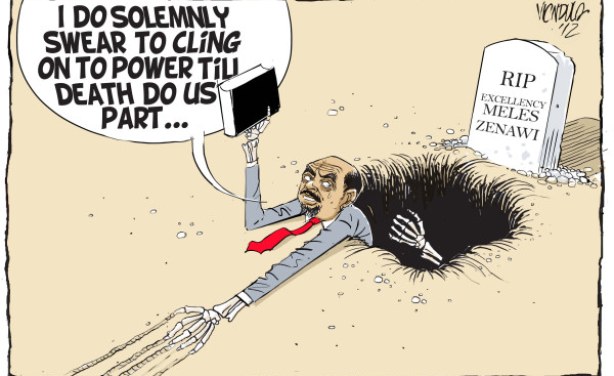
Meles Zenawi tries to cling to power after death
The rubber-stamp parliament in Ethiopia was scheduled to meet today to formally appoint Hailemariam Dessalegn as prime minister, but Ethiopian Review sources in Addis Ababa reported this afternoon that the meeting was abruptly canceled yesterday after Meles Zenawi’s wife Azeb Mesfin refused to leave the prime minister’s house. The mother of corruption dared any one to even suggest that she vacates “her house” until her husband is buried on September 2.

On top of that, it is reported that mid-ranking TPLF members have been confronting Seyoum Mesfin and other senior TPLF leaders since Tuesday over the selection of Hailemariam. Their complaint is that a position as critical as the prime minister should be reserved for the Tigray People’s Liberation Front. Our sources are reporting that Azeb Mesfin is behind the simmering revolt in the TPLF rank. A deadly clash among the various TPLF factions is becoming a real possibility.

The West’s dramatic hypocrisy in praising Ethiopian tyrant – Forbes

By Thor Halvorssen and Alex Gladstein | Forbes

With the dust beginning to settle on yesterday’s death of Meles Zenawi—ruler of Ethiopia since 1991—Western leaders have been quick to lavish praise on his legacy. A darling of the national security and international development industries, Zenawi was applauded for cooperating with the U.S. government on counter-terrorism and for spurring economic growth in Ethiopia—an impoverished, land-locked African nation of 85 million people. In truth, democratic leaders who praise Zenawi do a huge injustice to the struggle for human rights and individual dignity in Ethiopia.

U.S. Ambassador Susan Rice said Zenawi “leaves behind an indelible legacy of major contributions to Ethiopia, Africa, and the world.” Gordon Brown called Zenawi’s demise “a tragedy for the Ethiopian people,” while David Cameron remembered him as an “inspirational spokesman for Africa.” Bill Gates tweeted that he “was a visionary leader who brought real benefits to Ethiopia’s poor.” Abdul Mohammed and Alex de Waal took to the New York Times op-ed pages today in perhaps the most unspeakably sycophantic eulogy of Zenawi, declaring that the dictator’s death “deprives Ethiopia — and Africa as a whole — of an exceptional leader.”

For years, the diminutive Zenawi had been a fixture on the Davos circuit, charming Western leaders with statistics of human development and business expansion. Under his control, Ethiopia’s average annual GDP growth rate more than doubled to a gaudy 8.8 percent over the past decade, and trade and investment with the West boomed. He worked with the U.S. to capture terrorists—even invading Somalia to help oust an Islamist government—in return netting roughly a billion dollars a year in American aid. Ethiopia had been to hell and back in the 1970s and 1980s with famine, war, and genocide. For someone who came to power as a freedom fighter and liberator, who gave one of the poorest countries on earth China-esque economic growth, and who became a key ally of the U.S., what was not to like?

First off, many of the rosy development statistics given out by the Ethiopian government are simply fraudulent; independent sources still rank Ethiopia at the very bottom of poverty indexes. Second, what genuine economic and public health transformations Zenawi did bring to Ethiopia were achieved with a top-down model that mirrored the statist command he implemented over all other aspects of Ethiopian life.

Zenawi built a totalitarian state, guided by Marxist-Leninism, complete with a cult of personality and zero tolerance for dissent. Like Saddam Hussein or Bashar al-Assad, he filled the country’s top political and economic positions with men from his own Tigaray ethnicity. When elections did occur, he won them with Saddam-like numbers, most recently, 99 percent of the vote. Civil society organizations were harassed into submission or banned. His government only allowed one television station, one radio station, one internet-service provider, one telecom, one national daily, and one English daily—all churning out government propaganda. Zenawi used this information hegemony to heavily censor news available to Ethiopians, taking special delight in preventing them from hearing news from exile groups outside the country.

Zenawi’s critics were jailed, killed or chased out of the country: in fact, more journalists were exiled from Ethiopia in the last decade than any other country on earth. Let’s restate that: Zenawi kicked out more journalists than any other tyrant on the planet, thereby monopolizing control over information. His favorite tactic was labeling dissidents as terrorists. Journalists risked up to 20 years in prison if they even reported about opposition groups classified by the government as terrorists. The most emblematic case is that of Eskinder Nega, a PEN-award-winning author sentenced to 18 years in prison this July for questioning the government’s new anti-terrorism laws.

Many in the West like to credit Zenawi with “keeping Ethiopia together” despite ethnic differences, war, famine and regional instability. Dissidents, however, maintain that Zenawi was always at war with his own people. When towns and villages rose up against Zenawi’s military regime, they were put down brutally. There was, and still is, a climate of fear. With 85 million Ethiopians suffering under his thrall, Meles Zenawi constructed one of history’s most depraved states in terms of numerical human suffering.

So why is this monster being celebrated? Some, like Bill Gates and Ambassador Rice, choose to remain blind to Zenawi’s systemic human rights abuses. He was, undoubtedly, charming. Others, perhaps more worryingly, excuse his tyranny for his development and economic acumen. Foreign Policy’s managing editor illustrated this point of view while tweeting that “Meles Zenawi was a dictator but was better for his country than many democratically elected leaders.”

This kind of mentality is a dangerous one. There is no such thing as a benign dictator. Only those with a fascist mindset—who want to cut corners, who complain how messy and inefficient democracy can be, and who overlook two thousand years of political history—can believe in this chimera. From Cuba to Kazakhstan, the story is the same.

For instance, Pinochet took Chile from being a run-of-the-mill right-wing statist dictatorship to an economic success story with the same liberalization principles that the Chinese tyranny has employed to transform itself into a world power. Is the Pinochet-Beijing model of a police state with economic freedom, attempted by Zenawi for Ethiopia, an acceptable one in this day and age? The New York Review of Books reminds us that this sort of ideology brought Ethiopia “appalling cruelty in the name of social progress.” Anyone stating that they “like” the economic results from the Pinochet-Beijing model must accept thousands of tortured and disappeared in Chile and tens of millions dead in China (and 8 million political prisoners languishing in the Laogai as of today). Perhaps those admiring a strongman can accept such a condition with a John Rawls-type veil of ignorance without knowing what it is like to live under a dictatorship. It is easy to tolerate torture and disappearances if it isn’t happening to your daughter, your brother, your mother, or you.

Those in the West heaping praise on Zenawi—all living in societies that suffered so much to achieve individual liberty—are engaging in dramatic hypocrisy by praising this thug. Would Bill Gates live in a country that denies people basic political freedoms? Whose government arrests and kills its critics en masse? Would he trade places with an Ethiopian university student who believes in free expression and whose stance will lead to certain prison and possible execution?

Any arguments that Zenawi was mellowing (after 21 years in power!) are false. The past few years saw new sweeping “anti-terrorism” laws and stronger Internet censorship. In 2005, Ethiopia even saw its own Tiananmen Square. That year, Zenawi decided to hold freer elections, but the opposition won a record number of parliamentary seats, including all those in the capital, Addis Ababa. Throngs took to the streets to celebrate. In response, Zenawi lashed out brutally, arresting the opposition’s entire leadership and sentencing them to life in prison for treason; shuttering five newspapers and imprisoning their editors; murdering 193 protestors, injuring 800, and arbitrarily jailing 40,000 other men, women, and teenagers in a show of raw tyranny. According to The Telegraph’s David Blair, who was reporting from the scene, “a crackdown on this scale has not been seen in Africa for 20 years and the repression exceeds anything by President Robert Mugabe of Zimbabwe for the past decade at least. Apartheid-era South Africa’s onslaught against the black townships in the 1980s provides the only recent comparison.”

It is startling that so many consider Zenawi an “intellectual” leader, when he needed such bloody policy to enforce his rule. When Western leaders consider this dictator—who rapaciously treated Africa’s second-largest nation as his personal property—worthy of not just condolences, but pure adulation, something is very wrong with their value systems.

One politician, the Norwegian foreign minister, made a slight nod toward individual rights in his obligatory comments about Zenawi’s passing: “Norway and Ethiopia have an open and frank dialogue on political and social issues, including areas, such as human rights, where we have diverging views.”

Amen!

(ThorHalvorssen is the founder and president of the New York–based Human Rights Foundation. Alex Gladstein is HRF’s Director of Institutional Affairs.)

In Meles’ death, as in life, a penchant for secrecy, control

By Mohammed Keitha | CPJ Africa Policy Coordinator

August 21, 2012

Ethiopians awakened this morning to state media reports that Prime Minister Meles Zenawi, 57, the country’s leader for 21 years, had died late Monday in an over

The late Ethiopian Prime Minister Meles Zenawi, shown here in 2010. (AFP/Simon Maina)

seas hospital of an undisclosed disease. Within seconds, Ethiopians spread the news on social media; within minutes, international news media were issuing bulletins. Finally, after weeks of government silence and obfuscation over Meles’ health, there was clarity for Ethiopians anxious for word about their leader. Still, it was left to unnamed sources to fill in even the basic details. Meles died in a Brussels hospital of liver cancer, these sources told international news organizations, and he had been ill for many months.

“Death of yet another African leader highlights secrecy & lack of transparency when it comes to ailing leaders,” CNN’s Faith Karimi noted on Twitter, where the hashtag #MelesZenawi was trending globally.

After Meles failed to appear at July’s African Union summit in his own capital, Addis Ababa, spokesman Bereket Simon was forced to acknowledge that the prime minister was ill. Still, he asserted that Meles would be back to work soon, a claim does not seem to have been credible. The government went on to consistently play down reports that Meles had a life-threatening condition, even as it refused to disclose his exact whereabouts or the nature of his illness. Authorities blocked distribution of the one local newspaper, Feteh, that tried to publish more detailed information about Meles.

The government’s handling of Meles’ health situation reflects its culture of secrecy, as Bereket acknowledged last month, along with its heavy-handed tactics to control news and information. Yet for all its efforts, the government could not control the public’s hunger for information. The official secrecy merely fueled rampant public speculation and fears about the country’s future.

The government’s tactics are a product of its long-time leader. The paradox of Meles is that he was a formidable politician who nonetheless feared criticism in the Ethiopian press.

To the world, Meles projected the image of an engaging intellectual, a bespectacled bureaucrat who championed development and fought climate change. Meles had the “ability to understand what foreigners wanted to hear. He spoke their language,” said Ethiopian journalist Mohammed Ademo, referring to Meles’ mastery of the politics of aid, poverty, and the global fight against terrorism. “In English, he was soft-spoken and appeared to be willing to consider and tolerate and debate all arguments freely,” said another Ethiopian journalist who spoke on condition of anonymity.

But Meles adopted a very different tone domestically. He continued the Mengistu regime’s censorship of famine and drought coverage, and he ruthlessly stamped out dissent. “He was often arrogant and rude when speaking to Ethiopians. Threatening in parliament,” said Mohammed. In one of his last speeches, Meles lashed out at critics, real and imagined, and accused independent journalists of being “terrorists.”

The new prime minister, Hailemariam Desalegn, has an opportunity to break with this fear and embrace openness to the press. He can start with the unconditional release of at least eight journalists now behind bars, among them the independent blogger Eskinder Nega, who is serving an 18-year term on baseless terrorism charges.