TPLF founder Sebhat Nega speaks out against the transitional government idea
Members of the TPLF tribal gang are acting like a headless chicken these days.

Members of the TPLF tribal gang are acting like a headless chicken these days.
TEXAS (CBSDFW) – Facebook awards a grant to University of Texas at Arlington (UTA) to make the social media site faster.
“We are very excited to be part of Facebook,” says Dr. Dereje Agonafer from University of Texas at Arlington (UTA).
Agonafer says data centers account for roughly 2 percent of all U.S. energy use. That’s enough to power a couple of cities the size of Austin for most of a year.
“You are able to put more servers (online), which means you can get better information, or more information — more data,” says Dr. Agonafer.
What that translates into is a faster Facebook, and the savings for Facebook and other companies involved could be in the millions, Agonafer said.
“(On) Facebook there is a lot of downloading of pictures and uploading of pictures; this takes time,” says Agonafer. “It’s going to be maybe a thousand times faster.”
For the group of students at UTA who are part of the project, it’s a chance to influence the social phenomenon of their time. Their goal is to figure out a way to quickly cool massive data centers for Facebook and 14 other large-scale corporations.
On the social networking landmark, more than 800 million users interact with 900 million other pages, groups and events, uploading an average of more than 250 million photos each day. Those steep usage numbers have spurred the students to help match the site’s soaring demand.
Facebook is pledging $50,000 to the research. That pledge is renewable for up to five years.
The social networking company is one of 15 that UTA will be doing research for. Other data heavyweights include Microsoft, General Electric and Bloomberg.
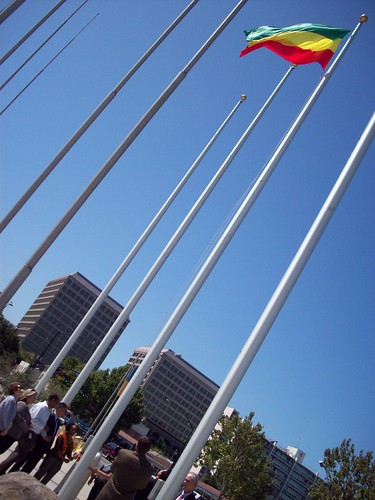 (MercuryNews.com) — An international incident of sorts arose over an Ethiopian flag raising at San Jose City Hall to honor the African country’s New Year, which begins on Sept. 11. And it wasn’t over the unfortunate coincidence with what is now a day of infamy and national mourning in the US.
Rather, the dispute was over whether or not the city raised the right green, yellow and red Ethiopian flag.
Yohannes Mesfine, an Ethiopian-American businessman who lives in Palo Alto, says it didn’t. The banner that went up lacked the national emblem — a light-blue disk with a yellow pentagram symbol — which the country adopted in 1996. That’s the flag that the U.S. State Department recognizes.
Nonsense, says Abebe Hailu, who represents the Ethiopian American Council in San Jose. He said the plain tricolor “heritage flag” that went up is just as acceptable, arguing it doesn’t change with the political winds in their native country. A city resolution allows San Jose to recognize that flag.
Mesfine — who attended the flag-raising ceremony on Monday, the day before Sept. 11, out of respect for the victims of 9/11 — was so put off that he alerted Mayor Chuck Reed and city Councilman Sam Liccardo, both of whom attended the ceremony along with Hailu and dozens of local residents of Ethiopian descent.
With no reaction from either city official, both of whom noted the city’s resolution, Mesfine contacted the Ethiopian Consulate General in Los Angeles. An email to Reed from the consulate general’s office thanked the mayor for honoring the occasion but pointed out that any flag that doesn’t contain the emblem is illegal under the Ethiopian constitution.
City officials say similar debates have surfaced involving the flag of the former Republic of Vietnam and the Pan African flag.
“My decision to support the flag-raising has nothing to do with any feeling that I have toward any regime or government,” said Liccardo, whose district includes the Ethiopian American Center and many of its members. “It has everything to do with our solidarity with a community of people living here in our city. What’s far more relevant to me is the identity chosen by our community, and not that chosen by any foreign entity.”
San Jose Public Works Director Dave Sykes said the city will evaluate the issue before whatever version of the Ethiopian flag goes up next year.
“We want to be respectful of the concerns and address them appropriately,” Sykes said.
With selection of Hailemariam Desalegn from Wolaita and Demeke Mekonnen from Amhara as prime minister and deputy prime minister, Meles Zenawi’s and TPLF’s dream of ruling Ethiopia for at least 50 years has ended today.
Meles Zenawi had never intended for this to happen. His intention was to retire in 2015, after making his wife the prime minister and continue to rule behind the scene while residing at the 100-million-birr residence he built inside the National Palace. The family dynasty he plotted to establish went into flames when he was hit with an ‘unknown’ illness some time in May or June this year.
Nevertheless, what has happened in Ethiopia today is a ‘miracle revolution,’ because for the regime’s two most visible figures, the prime minister and his hand-picked patriarch, to die in a period of two weeks is nothing short of a miracle. Their death is now creating opportunities for positive changes in the country. We will soon know if there are going to be changes by the kind of actions that Hailemariam will take in the coming few days and weeks — primary among them are the immediate release of all political prisoners.
In ceding power, the TPLF, the leading party in the 4-party coalition (Ethiopian People’s Revolutionary Democratic Front [EPRDF]), had been out-maneuvered and out-played by Bereket Simon in the absence of Sebhat Nega and other more experienced leaders who were purged by Meles Zenawi from the TPLF politburo in the TPLF in 2010. Their attempt to return to the TPLF leadership after Meles died was blocked by Bereket’s allies, paving the way for Hailemariam to assume power.
Most of what has transpired inside the regime since the death of Meles in July, including the 12-day zombified funeral, was managed and orchestrated by Bereket. He promoted Hailemariam from SEPDM and Demeke (his protege) from ANDM to save his own skin, because if the hardliners in the TPLF hold on to power, his fate could be ugly. Until the inexperienced Hailemariam is situated in his new position and develops leadership skills, he will depend on Bereket, who will remain the most powerful person in the regime for some time to come.
On the TPLF side, they all know Bereket, who is an Eritrean, is behind their demise, and the TPLF cadres are now saying that they have been pushed aside by the Eritrean wing of TPLF/EPRDF. They argue that without the Eritreans in the TPLF, namely Berhane Gebrekiristos, Teodros Adhanom, Neway Gebreab, Isayas Woldegiorgis (the deputy chief of security) and others, TPLF would have fought to keep the premiership for itself. Bereket was able to build a coalition of ANDM, SEPDM, some from OPDO and the Eritrean wing of the TPLF to get Hailemariam elected.
The U.S. Gov’t, particularly the Africom, also played a key role in the selection of Hailemariam. The Africom made sure that the corrupt TPLF generals remain quite, or else they will loose all the properties they bought in the US. The family of many of the TPLF generals, such as Seare Mekonnen and Tadesse Werede, live and attend school in the U.S. They are not in the mood to die for TPLF supremacy.
The influence of Eritreans in the TPLF/EPRDF cannot be discounted, but the TPLF presents an immediate threat to Ethiopia and thus it must be quashed and obliterated for there to be any chance of real change. Let’s not forget that it is TPLF that has been plotting to dismember Ethiopia and create ‘Greater Tigray.’
Ethiopia’s ruling junta, EPRDF, elected Hailemariam Desalegn as chairman and Demeke Mekonnen as vice-chairman
By William Davison
ADDIS ABABA (Bloomberg) — Ethiopia’s ruling party, EPRDF, confirmed acting Prime Minister Hailemariam Desalegn as the successor to the late Prime Minister Meles Zenawi.
Meles, who led Ethiopia for 21 years and who oversaw one of Africa’s fastest-growing economies, died on Aug. 20 from an infection contracted while he was recovering from an undisclosed illness. Hailemariam, Meles’s deputy in the Ethiopian Peoples’ Revolutionary Democratic Front and a former foreign minister, took over in an acting capacity the next day.
“Out of three candidates, Hailemariam has got the unanimous vote of council members and will serve as chairman of EPRDF and Demeke Mekonen will serve as well as deputy chairperson of EPRDF,” Communications Minister Bereket Simon said in the capital, Addis Ababa. “Whoever’s elected as chair and deputy chair of party will automatically be the nominees for the premiership and deputy premiership. So both Mr. Hailemariam and Mr. Demeke will represent the party and be candidates and be presented to parliament for approval when it starts its formal session in early October.”
Ethiopia, the continent’s second-most populous nation, is a key U.S. ally in its battle against al-Qaeda in the region. Ethiopian troops in December invaded Somalia for the second time in four years to join the battle against al-Shabaab, al-Qaeda’s Somalia affiliate.
The federal parliament, which has only one opposition lawmaker out of 547, is expected to swear in Hailemariam on Oct. 8, Bereket said.
At Meles’s funeral on Sept. 2, Hailemariam vowed to continue with his state-led development model that channeled loans, aid, investment and domestic revenue into infrastructure, industry and public services. The result was growth that averaged 10 percent in the past eight years, according to the government.
Human-rights groups criticized the government for cracking down on civil liberties and introducing anti-terrorism laws in 2009 that have been used to jail opposition politicians and journalists.
The EPRDF is a coalition of four parties representing the Amhara people, the Oromo, the Tigray and a collection of southern groups. Meles was leader of the Tigray People’s Liberation Front, which led the ouster of a military junta in 1991, while Hailemariam hails from the southern bloc. His deputy is from the Amhara National Democratic Movement.
The EPRDF’s council, which has 45 representatives from each bloc, chose Meles’s successor from the 36-member executive committee of the party. Ethiopia’s next parliamentary elections are scheduled for 2015.