Town-hall meeting on post-Meles EPRDF regime
Netsanet LeEthiopia Radio will hold a town hall discussion in Washington DC on post-Meles EPRDF regime in Ethiopia this coming Sunday, September 23, 2012. See the poster below for more info:


Netsanet LeEthiopia Radio will hold a town hall discussion in Washington DC on post-Meles EPRDF regime in Ethiopia this coming Sunday, September 23, 2012. See the poster below for more info:
By Alemayehu G Mariam
 It seems Ethiopia finally has a new prime minister. Two days ago, the leaders of the ruling EPDRF party approved Hailemariam Desalegn, the current deputy prime minister [DPM], to replace the late Meles Zenawi as party chief and prime minister. But Hailemariam will not be sworn in until early October according to Bereket Simon. No explanation was given for the two-week delay. Prior public statements by Bereket indicating that Hailemariam will be sworn into office following a special session of parliament have proven to be false. Whether Hailemariam will indeed be sworn into office in October remains to be seen.
Hailemariam’s approval has been shrouded in secrecy and mystery fueling speculations that the shadowy kingmakers were in some turmoil over his selection and in disagreement on whether he is the right man for the job. Conspiracy theorists were having a field day divining the secretive selection process. But there was manifest constitutional crises in the country as it became increasingly clear that Meles was not in charge between late May and the official announcement of his passing on August 21. That confusion was compounded by conflicting official statements characterizing Hailemariam not just as “deputy prime minster” as designated in the Ethiopian Constitution but alternatively as “interim prime minster” and “acting prime minster”, offices that are not authorized by the Constitution. As of now, Hailemariam remains a prime-minister-in-waiting.
Hailemariam’s Personal Challenge
Hailemariam faces extraordinary challenges when he begins his term as prime minister. The first formidable challenge will be to his credibility and perceived lack of independence. In one of my weekly commentaries in July, I predicted that Hailemariam will succeed to the prime ministership despite sticky constitutional questions. I argued that the appointment of Hailemariam, as a member of one of the country’s minority groups, guarantees the power brokers behind the scenes the only opportunity to maintain their power and influence by proxy. I suggested that a DPM from an ethnic minority would be unable to maintain an independent base of support and must necessarily rely on the military-police-security-economic complex created over the past twenty one years to survive. I speculated that the DPM as PM will prove to be no more than puppet in the hands of the power brokers.
I believe there are many doubting Thomases today, particularly in the opposition, who are likely to be dismissive of Hailemariam because he was Meles’ protégé and the unanimous choice of the shadowy and secretive group of kingmakers. Some will likely perceive him or portray him as a “Meles’ Clone” and a puppet who could be easily manipulated and blindly and unquestioningly do the bidding of the powers that be who made him prime minister. His detractors will likely argue that Hailemariam can only be a figurehead since true power will remain with those who control the military, the police and security forces and the elites who have a chokehold on the economy. Others will opine that Hailemariam’s appointment is all a trick and a scam by the powers that be to get themselves out of a constitutional jam and hoodwink the people and con the international donors into continuing to dole out billions in aid. Still others will argue that Hailemariam is just a seat warmer installed until the power brokers could buy more time and appoint one of their own. If push comes to shove, they can kick him out of office at any time and replace him with another puppet; and if need be impose martial law just to cling to power. There will be some who will cynically predict the kingmakers will use him and lose him. I suspect there will be umpteen reason given to discredit and dismiss Hailemariam.
At this time, I am not inclined to be dismissive of Hailemariam’s potential to become a good and sensible leader. I reserve judgment not out of naiveté or because I do not have constitutional questions about his succession or political misgivings about the secretive process that led to his appointment. I shall give him the benefit of the doubt because I believe fundamental fairness requires that he be given a chance to prove or disprove himself as a capable and effective leader. When one is gnawed by an overwhelming sense of doubt not based on facts, it is important to strive and keep an open mind and make informed judgment. I do not believe in guilt by association, and will not hold against Hailemariam the fact that Meles was his mentor. I also aim to avoid the “soft bigotry of low expectations”. I do not know what Hailemariam is capable of doing in the future. I do not have evidence that Hailemariam has an atrocious record of human rights violations individually or in concert with others. Nor do I have evidence that he flouts the rule of law, is hostile to press freedoms or schemes to suppress democratic institutions.
Fairness requires that I judge him by his deeds and words. I shall reserve judgment. I trust Hailemariam will be wise enough to refrain from and avoid the inflammatory rhetoric of Meles as he begins his new office. I hope he will show humility and not display the belligerence, arrogance and hubris of his predecessor. I hope he will do more to reach out to his opposition and try to work with them, and not trap himself in a bubble surrounded by sycophants. I trust he will be more conciliatory than confrontational; more understanding of the opposition and their frustrations and less condemnatory of those who may disagree with him. I hope he will have the wisdom to understand the inebriating power of power and the absolutely corrupting nature of absolute power and learn to use power wisely by tempering it with justice and compassion. I hope he will listen more and lecture less; under promise and over deliver and show respect for institutions, his opposition and his compatriots. On a personal level, I hope he will be able to share my unshakeable belief in the sanctity of human rights and commitment to upholding the rule of law. But I also have a special wish for him: He has a long walk to make and he can get to his destination if he walks and strives to help his compatriots walk in Mandela’s shoes than anyone else’s.
Hailemariam as Meles’ Successor
Napoleon Bonaparte once said, “I am the successor, not of Louis XVI, but of Charlemagne.” King Louis XVI of France was a symbol of the ancien regime [old order”] in contrast to the new order of the French Republic. Charlemagne [Charles the Great] is regarded to be the founder of France and Germany and the leader credited for uniting Western Europe for the first time since the Roman Empire. I am not sure what it means to be Meles’ successor. But Hailemariam has the choice of continuing the “ancien regime” of Meles or lead in the invention of a new democratic Ethiopia. He can choose to clone himself as Meles II and crush human rights, dissent, press freedom and civil society institutions, expand the toxic ideology of ethnic politics, steal elections just to cling to power and like his predecessor become the overlord of a police state reinforced by a massive security network of spies and rule by spreading fear and loathing throughout the country. In other words, he can choose to become as tyrannical as the tyrant he had succeeded. But Hailemariam also has the choice to learn from Meles’ mistakes. He has the choice to come out of Meles’ shadows and become his own man. He can be more tolerant, ethical, accommodating and democratic than his mentor.
Regardless of whether he regards himself as Meles’ successor, I would like to help Hailemariam fulfill one of Meles’s dreams. Such a statement coming from Meles’ severest critic in life might surprise many. Meles expressed the “hope that [his] legacy” would be not only “sustained and accelerated development that would pull Ethiopia out of the massive deep poverty” but also “radical improvements in terms of good governance and democracy.” If Hailemariam genuinely wants to honor and pay homage to his mentor and teacher and not just pay lip service to Meles’ memory, he should make the task of improving good governance and democracy job one. These improvements must necessarily begin with the immediate release of all political prisoners, repeal of anti-terrorism, civil society and other oppressive laws and a declaration of allegiance to the rule of law. Tackling these issues will not diminish or condemn the memory of Meles. It will actually enhance his image and prestige post-mortem. Keeping political prisoners jailed and continued implementation of the repressive laws will only serve as constant reminders of Meles misdeeds and arbitrary rule.
Hailemariam as a Peacemaker
It would be a wise move for Hailemariam and the invisible power brokers to take this transitional opportunity to extend an olive branch to the opposition and invite them to a dialogue on the future of the country and go the extra mile to engage them in discussions that could lead to power sharing and a smooth democratic transition. Meles played a “zero sum game” for the last twenty one years. He won all the time and everyone else lost all the time. In the end, Meles lost. Hailemariam can play a win-win game and win in the end.
Ethiopia for the past 21 years has been a one-man, one party state. In May 2010, the ruling party claimed it had won 99.6 percent of the seats in parliament reducing the opposition from 174 to only two seats. In 2008, the ruling party won all but a handful of 3.6 million seats. Such electoral victories make a travesty of democracy and a mockery of electoral politics. That is why the ruling party should engage its diverse opposition in power sharing talks. To be sure, power sharing could come in many formulations. I employ the idea in its simplest formulation, namely a political arrangement or forum in which opposing groups in a society have an opportunity to genuinely participate in democratic governance. I understand that power sharing is not a cure all to the longstanding political ills of Ethiopia. It will not magically resolve ethnic polarization and divisions in society or create peace, stability and an efficient system of governance overnight. But power sharing talks and arrangements in Africa have often facilitated the transition to democratic rule and peace-building by providing opportunities for contending and even warring parties to cooperate in searching for nonviolent conflict resolution. In countries where power sharing arrangements have been successful, they have led to compromises, moderation, democratic governance and durable peace.
In the past few years, power sharing arrangements have reduced tensions and stabilized volatile political situations in Kenya and even Zimbabwe. In 2009, a “grand coalition government” among bitter political enemies was established in Kenya. Subsequently, they were able to write a new constitution which was approved by an overwhelming 67 percent of Kenyans in 2011. In 2008, President Robert Mugabe and opposition leader Morgan Tsvangirai signed a power sharing deal. They are now vigorously debating adoption of the draft constitution prepared by the Select Committee of Parliament on the New Constitution. Both countries face serious political challenges and have a long way to go before achieving full democratization. But the power sharing arrangements have placed them on the right track.
Nigeria has a long history of power sharing dating back to independence. Despite endemic corruption and political mismanagement of the country, there is a power-sharing agreement between the dominant party and smaller parties aimed at promoting inclusiveness and political stability in the country. Two decades ago, Mandela was able to hammer out a power sharing agreement which facilitated South Africa’s transition from Apartheid to democracy. Power sharing arrangements have been tried in Burundi, Guinea, Madagascar and the Ivory Coast with different outcomes. I believe such an arrangement could offer a peaceful way out of the current political stalemate in Ethiopia. It is a sensible option. I hope Hailemariam and his leadership group will follow Nelson Mandela’s prescription and seriously consider a power sharing arrangement: “If you want to make peace with your enemy, you have to work with your enemy. Then he becomes your partner.” There is no shame or harm in making a peace offering to the opposition and engaging them in power sharing discussions. It is the new way in Africa.
Hailemariam as a Political Leader
Hailemariam’s political challenge will be whether he will do what it takes to uphold the rule of law and reverse the arbitrary rule of his predecessor. Meles often talked about “our Constitution” and the “rule of law” but rarely followed either. He was the object of relentless criticism by all international human rights organizations for disregarding Ethiopia’s Constitution and international human rights treaties and conventions. Every year, the U.S. State Department Human Rights Report documented massive human rights violations as did so many other international human rights organizations. But he was dismissive of such reports. Hailemariam cannot afford to alienate all international human rights and press freedom defenders.
Meles was a man with a mission. Hailemariam can be a man of vision. The country has enormous problems that require massive efforts and resources to resolve. Talking about an “Ethiopian Renaissance” will not deal with the chronic food crises in the country or rein in the galloping inflation, improve the poor health care and educational system or alleviate the grinding poverty that afflcits the majority of the people. Building shiny structures, roads and dams will make for great public relations and impress donors to dole out more aid. But there are enormous human costs associated with such ventures. Just last week, the International Monetary Fund urged Ethiopian officials to reconsider their plans to construct “Africa’s largest hydropower plant” because that project could siphon away much needed funds from other critical needs areas. According to IMF country representative Jan Mikkelsen, “there’s a need to rethink some of those projects a little bit to make sure that they don’t absorb all domestic financing just for that project. If you suck in all domestic financing to just a few projects that money will be used for this and not for normal trade and normal business.” Hailemariam should be more practical and envision a new Ethiopia where the state stieves to meet the basic needs of the people, and not invest precious resources in quixotic white elephant projects.
Hailemariam should maintain vigilance for political minefields. He could learn valuable lessons from the experiences of former Ethiopian president Negasso Gidada’s treatment by the ruling party documented in his book “Negasso’s Way”. According to Negasso, he was roped into becoming president by Meles who convinced him to accept the position even though he resisted it. After he became president, Negasso recounted how he was tricked into doing things that he did not agree with, including signing a proclamation that denied corruption suspects their right to bail in violation of the Constitution and allowing Meles to use that law to neutralize and persecute his opponents. “There are people who ask me why I signed that bill. However, I want people to understand that I signed the bill because of my strong stand against corruption. I thought EPDRF had the same stand. It was too late for me to understand it was all scam.” After Negasso left office and sought to engage in opposition politics, the ruling party drafted a special proclamation to divest a former president of his privileges, security protection and retirement benefits if he returns to politics. Negasso’s experiences may offer instructive lessons to Hailemariam.
Hailemariam can choose to become not just a leader but the best leader; but he must know what it takes to be one. As Lao Tsu instructed, “To lead people, walk beside them … As for the best leaders, the people do not notice their existence. The next best, the people honor and praise. The next, the people fear; and the next, the people hate … When the best leader’s work is done the people say, ‘We did it ourselves!’” Hailemariam should aim for leadership which will allow the people to say, “We did it ourselves!”
Hailemariam as a Man With an Appointment With Destiny
Meles Zenawi was a man who had an appointment with destiny; and he missed it! I believe Hailemariam has his own appointment with destiny. Cynics may be quick to say Ethiopia’s leaders are condemned to never miss an opportunity to miss an opportunity. I hope that will not be the case for Hailemariam. He will determine his own destiny as a leader. If he is able to summon the courage, integrity and fortitude to put the peoples’ interest above his party’s interests, he could become a role model for a new breed of Ethiopian leader. But if pursues absolute power, prefers revenge over mercy, confrontation over conciliation and continues the politics of ethnic fragmentation and division like his predecessor, he too will miss his appointment with destiny.
Ethiopia at the Crossroads of Democracy and Dictatorship
Ethiopia today stands at the crossroads. It can march forward into democracy by taking confident steps that begin radical improvements in good governance and democracy. It can continue to slide backwards and deeper into the vortex of dictatorship. It can take free fall into chaos and civil strife. What Ethiopia needs at the crossroads is not finger-pointing, teeth-gnashing, eye-rolling or bellyaching. There is enough blame to go around. Condemning the memory of Meles and reincarnating Meles in the person of Hailemariam will not help us march to a democratic future. It will only continue the tradition of grievance and victimhood and culture of antagonism and hypercriticism. What Ethiopians need to realize is that this is the right time to join hands to heal the open wounds of fear, loathing and antagonism in our hearts, minds and souls. This is the time to be creative about alternative futures built on a solid foundation of the rule of law, respect for human rights and democracy.
Since the beginning of 2012, I have been writing about “Ethiopia’s inevitable transition from dictatorship to democracy”. I have outlined various scenarios on what could happen during the transition. Today the question is not whether a one-man dictatorship in Ethiopia is over, but if dictatorship will reinvent itself and rear its ugly head once more. The “future” Meles spoke of is now. We should all work collectively to implement his aspirations for “radical improvements in terms of good governance and democracy”. With the Ethiopian new year upon us, we can all begin afresh on the road to “radical improvements in good governance and democracy”.
In one of my weekly commentaries in April, I expressed my full confidence and optimism in Ethiopia’s future:
We need to plan for the inevitable, inescapable and unstoppable transition of Ethiopia from dictatorship to democracy. Dictatorship will end in Ethiopia. It is only a matter of when. Democracy will also rise in Ethiopia. It is a matter of how and what type. The point is that it necessary to begin a purposeful dialogue and plan ahead about the prerequisites for an effective and smooth transition to democratic governance now, not when the dictatorship falls. I believe dialogue needs to begin now on at least four major issue areas: 1) how to engage and increase the capacity of key stakeholders in identifying potential triggers of violence during political transitions and preventing them; 2) identifying and devising strategies and opportunities for reducing ethnic, religious and communal tension and conflict in anticipation of a transition; 3) enhancing the role of civil society institutions in facilitating public engagement and interaction during the transitional period, and 4) anticipating critical constitutional issues that could significantly impair the transitional process.
I stand by my views. I believe there is a way out of the darkness of dictatorship. Nelson Mandela paved that two way road in South Africa and called it “Forgiveness and Goodness.” We should all prepare ourselves and the people to travel that two-way road. It is time for national dialogue!
Amharic translations of recent commentaries by the author may be found at: http://www.ethiopianreview.com/amharic/?author=57
Previous commentaries by the author are available at: http://open.salon.com/blog/almariam/ and www.huffingtonpost.com/alemayehu-g-mariam/
Members of the TPLF tribal gang are acting like a headless chicken these days.
TEXAS (CBSDFW) – Facebook awards a grant to University of Texas at Arlington (UTA) to make the social media site faster.
“We are very excited to be part of Facebook,” says Dr. Dereje Agonafer from University of Texas at Arlington (UTA).
Agonafer says data centers account for roughly 2 percent of all U.S. energy use. That’s enough to power a couple of cities the size of Austin for most of a year.
“You are able to put more servers (online), which means you can get better information, or more information — more data,” says Dr. Agonafer.
What that translates into is a faster Facebook, and the savings for Facebook and other companies involved could be in the millions, Agonafer said.
“(On) Facebook there is a lot of downloading of pictures and uploading of pictures; this takes time,” says Agonafer. “It’s going to be maybe a thousand times faster.”
For the group of students at UTA who are part of the project, it’s a chance to influence the social phenomenon of their time. Their goal is to figure out a way to quickly cool massive data centers for Facebook and 14 other large-scale corporations.
On the social networking landmark, more than 800 million users interact with 900 million other pages, groups and events, uploading an average of more than 250 million photos each day. Those steep usage numbers have spurred the students to help match the site’s soaring demand.
Facebook is pledging $50,000 to the research. That pledge is renewable for up to five years.
The social networking company is one of 15 that UTA will be doing research for. Other data heavyweights include Microsoft, General Electric and Bloomberg.
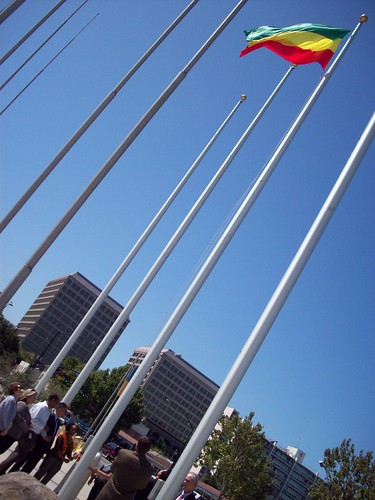 (MercuryNews.com) — An international incident of sorts arose over an Ethiopian flag raising at San Jose City Hall to honor the African country’s New Year, which begins on Sept. 11. And it wasn’t over the unfortunate coincidence with what is now a day of infamy and national mourning in the US.
Rather, the dispute was over whether or not the city raised the right green, yellow and red Ethiopian flag.
Yohannes Mesfine, an Ethiopian-American businessman who lives in Palo Alto, says it didn’t. The banner that went up lacked the national emblem — a light-blue disk with a yellow pentagram symbol — which the country adopted in 1996. That’s the flag that the U.S. State Department recognizes.
Nonsense, says Abebe Hailu, who represents the Ethiopian American Council in San Jose. He said the plain tricolor “heritage flag” that went up is just as acceptable, arguing it doesn’t change with the political winds in their native country. A city resolution allows San Jose to recognize that flag.
Mesfine — who attended the flag-raising ceremony on Monday, the day before Sept. 11, out of respect for the victims of 9/11 — was so put off that he alerted Mayor Chuck Reed and city Councilman Sam Liccardo, both of whom attended the ceremony along with Hailu and dozens of local residents of Ethiopian descent.
With no reaction from either city official, both of whom noted the city’s resolution, Mesfine contacted the Ethiopian Consulate General in Los Angeles. An email to Reed from the consulate general’s office thanked the mayor for honoring the occasion but pointed out that any flag that doesn’t contain the emblem is illegal under the Ethiopian constitution.
City officials say similar debates have surfaced involving the flag of the former Republic of Vietnam and the Pan African flag.
“My decision to support the flag-raising has nothing to do with any feeling that I have toward any regime or government,” said Liccardo, whose district includes the Ethiopian American Center and many of its members. “It has everything to do with our solidarity with a community of people living here in our city. What’s far more relevant to me is the identity chosen by our community, and not that chosen by any foreign entity.”
San Jose Public Works Director Dave Sykes said the city will evaluate the issue before whatever version of the Ethiopian flag goes up next year.
“We want to be respectful of the concerns and address them appropriately,” Sykes said.
With selection of Hailemariam Desalegn from Wolaita and Demeke Mekonnen from Amhara as prime minister and deputy prime minister, Meles Zenawi’s and TPLF’s dream of ruling Ethiopia for at least 50 years has ended today.
Meles Zenawi had never intended for this to happen. His intention was to retire in 2015, after making his wife the prime minister and continue to rule behind the scene while residing at the 100-million-birr residence he built inside the National Palace. The family dynasty he plotted to establish went into flames when he was hit with an ‘unknown’ illness some time in May or June this year.
Nevertheless, what has happened in Ethiopia today is a ‘miracle revolution,’ because for the regime’s two most visible figures, the prime minister and his hand-picked patriarch, to die in a period of two weeks is nothing short of a miracle. Their death is now creating opportunities for positive changes in the country. We will soon know if there are going to be changes by the kind of actions that Hailemariam will take in the coming few days and weeks — primary among them are the immediate release of all political prisoners.
In ceding power, the TPLF, the leading party in the 4-party coalition (Ethiopian People’s Revolutionary Democratic Front [EPRDF]), had been out-maneuvered and out-played by Bereket Simon in the absence of Sebhat Nega and other more experienced leaders who were purged by Meles Zenawi from the TPLF politburo in the TPLF in 2010. Their attempt to return to the TPLF leadership after Meles died was blocked by Bereket’s allies, paving the way for Hailemariam to assume power.
Most of what has transpired inside the regime since the death of Meles in July, including the 12-day zombified funeral, was managed and orchestrated by Bereket. He promoted Hailemariam from SEPDM and Demeke (his protege) from ANDM to save his own skin, because if the hardliners in the TPLF hold on to power, his fate could be ugly. Until the inexperienced Hailemariam is situated in his new position and develops leadership skills, he will depend on Bereket, who will remain the most powerful person in the regime for some time to come.
On the TPLF side, they all know Bereket, who is an Eritrean, is behind their demise, and the TPLF cadres are now saying that they have been pushed aside by the Eritrean wing of TPLF/EPRDF. They argue that without the Eritreans in the TPLF, namely Berhane Gebrekiristos, Teodros Adhanom, Neway Gebreab, Isayas Woldegiorgis (the deputy chief of security) and others, TPLF would have fought to keep the premiership for itself. Bereket was able to build a coalition of ANDM, SEPDM, some from OPDO and the Eritrean wing of the TPLF to get Hailemariam elected.
The U.S. Gov’t, particularly the Africom, also played a key role in the selection of Hailemariam. The Africom made sure that the corrupt TPLF generals remain quite, or else they will loose all the properties they bought in the US. The family of many of the TPLF generals, such as Seare Mekonnen and Tadesse Werede, live and attend school in the U.S. They are not in the mood to die for TPLF supremacy.
The influence of Eritreans in the TPLF/EPRDF cannot be discounted, but the TPLF presents an immediate threat to Ethiopia and thus it must be quashed and obliterated for there to be any chance of real change. Let’s not forget that it is TPLF that has been plotting to dismember Ethiopia and create ‘Greater Tigray.’