Sunday’s running of the Buffalo Marathon had a definite Ethiopian flavor to it. The men’s and women’s winners were both from that African country. Habtamu Bekele won the men’s race in 2 hours, 26 minutes and 5 seconds. Meserte Kotu took the women’s race in a course-record time of 2:43:10; the previous mark was 2:44:57 set by Beth Anne De- Ciantis in 1991.
Kotu was far too good for the field, taking the victory by more than 10 minutes over defending champion Jessica Allen. Kotu has a personal best of 2:30:02, so she figured to be a top contender Sunday. Kotu finished an impressive eighth overall.
“She was great. I’m honored to even share the same turf,” said Allen, who finished in 2:54:48 –almost two minutes faster than her winning time in 2007. “That’s pretty cool. It’s pretty prestigious for Buffalo to get such a runner from so far away.”
Allen said it took Kotu a while to get ahead, but there was no catching her once she moved in front around the 11-mile mark.
“She broke away right after Tifft Farms –pretty much at the bridge coming back into the First Ward,” said Allen, of Hampton Bays, L. I. “That’s where I started to be by myself.”
Allen held off Jennifer Boerner (2:58:14) of Amherst for second place.
Kotu does not speak English and thus was unavailable for interviews. She had the most profitable day of any of the participants, earning $2,000 for the victory plus $1,000 for the course record.
Bekele, who runs out of Marietta, Ga., won by a a relatively comfortable 16 seconds. Jason Lokwatom, a Kenyan running out of Troy, Ohio, was second at 2:26:21.
Bekele has raced throughout the world. He ran the 26-mile, 385-yard distance in an impressive 2:10:43 during the 2003 Rome Marathon. Bekele was second in the Bermuda Marathon earlier this year, finishing in 2:31:26. He ran a 2:26:19 in Atlanta early in April.
Bekele speaks little English, but he did say that he was “very, very happy about winning” and that the Buffalo course was “very good.”
Andrew Carnes of Canton, Ohio, had the lead in the race through the 10-mile mark, but went out too fast then faded under some persistent pressure of the lead pack. Carnes was fourth in 2:33:28. Darrin Pocza of Bemus Point was the top Western New York runner at 2:51:18, placing 12th.
In the masters division, James Derick of Big Flats was the men’s victor in 2:40:40. Gina McGee of Johnstown, Pa., won the women’s division in 2:59:28.
Mackey Tyndall of Panama City, Fla., was the fastest wheelchair competitor in a time of 2:06:59.
“It was a great day,” he said. “The roads were a little rough, but it was a flat, smooth course. I had a pretty good pace. I got a little bit fatigued at the end, but it was a good time overall.”
Tyndall is a retired Air Force captain whose injuries led to doctors doing two total hip replacements and the placement of a metal rod and some screws in his back. This was his sixth marathon of the year, and he says wheelchair athletes have gotten plenty of exposure in events like the Boston Marathon.
“It’s gotten a lot bigger, especially because of the military factor,” he said. “Last year at the Marine Corps [race in Washington], there were double the amount of hand-cycles. The hand-cycles are getting more popular, because of the ease of going from an injury to hand-cycle as opposed to a push-chair.”
In the half-marathon, Fernando Cabada showed why he is considered one of the top distance runners in America. He ran the 13.1-mile course in 1:08:52 to win. Cabada, running out of Boulder, Colo., ran his first-ever marathon in 2:12:26 in 2006. On the women’s side, Natasha Filliol won in 1:22:59. A native of Paris, Ont., she is one of Canada’s top triathletes.
By almost any definition, it was about a perfect morning for running, with sunshine and temperatures in the 50s. Some wind may have kept the times down just a bit.
Race director John Beishline said the final total of entrants was more than 3,000. That’s a big jump from last year’s 2,200.
Men’s Marathon
1. Habtamu Bekele 2:26:05
2. Jason Lokwatom 2:26:21
3. Paul Simboli 2:27:06
4. Andrew Carnes 2:33:28
5. Samson Mulli 2:33:49
6. Gerardo Avila 2:34:26
7. James Derick 2:40:40
8. Benson Osoro 2:44:16
9. Nelson Chavez 2:45:42
10. John Piggott 2:49:46
11. Mark Looney 2:51:11
12. Darrin Pocza 2:51:18
13. Gary Cattarin 2:54:12
14. Daniel Garrett 2:54:18
15. Derek Dunstan 2:54:22
16. Adam Bross 2:58:47
17. Christopher Ciamarra 2:58:54
18. Doug Hall 2:59:07
19. Craig Rudzinski 2:59:41
20. Christopher Occhino 2:59:46
Women’s Marathon
1. Meserte Kotu 2:43:10
2. Jessica Allen 2:54:48
3. Jennifer Boerner 2:58:14
4. Katherine Danner-Aldri 2:58:34
5. Gina McGee 2:59:28
6. Jill Skivington 2:59:35
7. Tammy Slusser 3:01:41
8. Jennifer McNutt 3:05:37
9. Michele Chille 3:18:32
10. Lisa Benzer 3:18:40
11. Emily Johnston 3:19:23
12. Katherine Fredlund 3:22:26
13. Mary LeBrun 3:22:37
14. Jackie Horvath 3:25:39
15. Kimberly Schenk 3:25:52
16. Kim Whitaker 3:26:00
17. Danielle Harmon 3:26:07
18. Kristin Winiewicz 3:26:16
19. Laura Richenderfer 3:26:59
20. Rosemary Wedlake 3:29:04
BERLIN, May 26 (Reuters) – A deal to market Ethiopia’s staple cereal, teff, to health-conscious Westerners may provide a model for ensuring the benefits of biodiversity are shared between local people and firms exploiting natural resources.
Teff, which looks like wheat and has a sour taste, is free of the protein gluten and research shows it can boost the body’s vitality and reduce fat production.
Realising its potential, Dutch entrepreneur Hans Turkensteen set up a company in 2002 to introduce the crop to the West.
But, aware of concern about “biopiracy” under which foreign companies have been accused of plundering foreign plants or animals, he worked out a deal to give some of the profits to Ethiopia, one of the world’s poorest countries.
The case illustrates one of the most difficult issues at a May 19-30 United Nations conference in Bonn where delegates are discussing ways to protect the diversity of life on earth.
Nearly 200 countries are trying to thrash out a framework for a 2010 deal on binding rules on access to genetic resources and the sharing of their benefits.
Developing nations want to reap financial rewards from natural resources which firms in sectors from pharmaceuticals to horticulture and cosmetics are keen to tap.
“We understood teff was not ours and wanted Ethiopians, who have cultivated, conserved and refined it for centuries to benefit from its use elsewhere,” Turkensteen told Reuters.
Health and Performance Food International (HPFI) signed a deal with the Ethiopian government in 2004 allowing the firm to bring the iron- and calcium-rich cereal to the West, to sell and promote it and to help develop teff-based foods.
HPFI gives 5 percent of its net profits to job-creation projects in Ethiopia, which also gets royalties from the profits on teff seed sales and cash for land cultivated by the firm.
Apart from teff, other deals have been made giving companies access to flowers in South Africa or micro-organisms in Kenya.
DAUNTING TASK
“The complexities of the issue are absolutely enormous,” said Rachel Wynberg, co-author of a report on the subject comissioned by the U.N.’s Convention on Biological Diversity.
For example, the pharmaceuticals branch spent about $55 billion on research and development in 2006 but only a small, and unknown, part went on natural products, said Wynberg.
Wynberg says industry should get more closely involved in the U.N. talks on global rules and on compliance mechanisms.
Compounding the problems are ideological differences between firms and governments over “access and benefit sharing”.
“The negotiations are seen as a proxy for addressing huge disparities in income across the world,” Wynberg told Reuters.
Developing countries put a very high value on their genetic resources but often fail to recognise that hefty investment is needed to develop products — and often leads nowhere.
HPFI, which had 2007 turnover of 1 million euros ($1.57 million), has invested 3 million euros and four years of work in researching teff.
It is trying to breed teff seeds outside Africa and is working on gluten-free recipes for bread, cake and beer for consumers allergic to the protein, as well as food for athletes.
All sides agree on the daunting task they face but activists say getting at least a roadmap for the way ahead is crucial.
“We need to send a signal to developing countries to make sure they are respected,” said Greenpeace’s Christoph Then.
By Madeline Chambers, Reuters
Editing by Catherine Evans
(Agence France Presse) — ADDIS ABABA, Ethiopia – Ethiopia’s exiled former dictator Mengistu Haile Mariam, who was sentenced to death Monday, oversaw the 1977-78 “Red Terror” when tens of thousands were tortured, murdered and disappeared.
Now 71 and living a comfortable life in exile in Zimbabwe, the man who came to be known as the Red Negus (“emperor” in Amharic) was convicted in December 2006, after a marathon trial, of genocide, homicide, illegal imprisonment and illegal confiscation of property.
The purge of politicians, intellectuals and other perceived foes came as his regime began trying to transform imperial Ethiopia with its ancient Christian heritage into a Soviet-style workers’ state.
Mengistu, a lieutenant colonel in the army, was a member of the Derg, the military junta which ran the country after the fall of emperor Haile Selassie in 1974.
Three years later he became head of the Marxist regime in a bloody coup which saw head of state General Teferi Bante assassinated.
Mengistu became the de facto ruler, running the cabinet and the military council, and instituted the Red Terror, which saw numerous arrests and thousands of killings across the Horn of Africa nation.
Already chief of the armed forces and secretary general of the Workers’ Party of Ethiopia (WPE), Mengistu was in September 1987 officially confirmed president of the People’s Democratic Republic of Ethiopia.
Seriously threatened from February 1991 by a coordinated offensive by the separatist Tigre People’s Liberation Front and the Eritrean People’s Liberation Front, Mengistu fled to Zimbabwe the following May.
Zimbabwe’s President Robert Mugabe, an old ally of Mengistu, offered him political asylum and has since refused to extradite him to Ethiopia. In 1996, he escaped an assassination bid in the Zimbabwean capital Harare.
Born in 1937 at Wallayata, Mengistu Haile Mariam became a career soldier like his father, graduating from the officer training college at Holetta in 1966 and doing a brief spell of further training in the United States.
After taking part in an uprising against Haile Selassie in 1960, he was a delegate in the armed forces coordinating committee at the time of the February 1974 revolution.
Many Ethiopians still remember Mengistu, with his dark skin and big moustache, haranguing crowds at Revolution, now Meskal, Square, in the heart of Addis Ababa, along with the interminable military parades he organised.
Considered as the brain behind the revolution and a leading member of the Derg from the start, Mengistu in seven months put an end to the world’s oldest surviving empire.
In his rise to power, he showed considerable political skills and was brutally intransigent regarding his opponents.
As well as the Red Terror, Mengistu and his former top aides were also accused of the murders of Haile Selassie and Orthodox Patriarch Abuna Tefelows.
Backed by the pro-Soviet socialist movement during a conflict with Somalia over the eastern Ogaden region, then faced with a nationalist rebellion in Eritrea, Mengistu signed an alliance with the Soviet Union in 1978 and created the Marxist-Leninist WPE in 1984.
He held the rotating presidency of the Addis-Ababa based Organisation of African Unity (today’s African Union) in 1983-84.
In May 1989, Mengistu crushed a coup attempt and executed 12 generals. The following year, he announced more liberal policies aimed at pulling Ethiopia out of economic disaster and civil war. He took accompanying steps to woo the West after renewing diplomatic ties with Israel.
As a boy growing up in a small village in Ethiopia, Tamiru Atraga felt called to do God’s work. But he couldn’t have imagined it would take him halfway around the world.
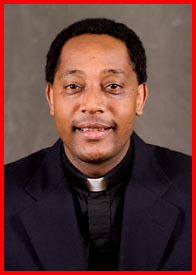
Atraga was one of seven priests ordained yesterday in a Mass at The Cathedral of the Holy Cross. He is the first Ethiopian priest to be ordained in the 200-year-old Boston Archdiocese, Cardinal Sean P. O’Malley said during the service.
“It is a very historic event,” O’Malley said, prompting applause from the crowd of several hundred that gathered to witness the ordination.
Ethiopians from across the region attended the event, clearly delighted to see one of their own become a man of the cloth. A small group of Ethiopian Catholics attends Mass each week at the cathedral and many of them live in the Boston area.
“Everyone has been wanting to have a priest from our community,” said Bisrat Abebe, who came to Boston with Atraga from Ethiopia’s capital city of Addis Ababa in 2000 as a fellow seminarian. “Tamiru will be a great priest. He’s very prayerful and easy to interact with.”
Fiori Hailemaram traveled to Boston from Washington, D.C., yesterday with her mother to see Atraga ordained.
“This is a blessing,” she said after the service. “I’m very proud of him, very happy. It’s another confirmation of the unity of the church.”
Less than 1 percent of the population in Ethiopia is Catholic. Most Ethiopians are Muslim or Orthodox Christian. In 1993, the country’s northern province of Eritrea declared independence and became a sovereign nation.
“The countries are broken up, but the Church has remained the same,” Hailemaram said.
The youngest of 11 children, Atraga was raised in a devout Catholic family in the southern part of Ethiopia. He felt God’s calling early and entered seminary when he was just 14.
“The voice inside was killing me,” said Atraga, who is now 30. “It was a constant ache.”
In 1996 he met a visiting priest who asked whether he wanted to come to the United States to finish his studies. The pair corresponded for years, and in 2000, Atraga left his homeland to fulfill his destiny. He has not been home since.
But after growing up in a village without any roads or street lights, Atraga had a hard time adapting to life in Boston. Driving was scary. It was cold. The cultures were completely different.
“The most difficult thing was getting to know people in terms of spirituality,” he said. “Yes, you might go out and enjoy a dinner with someone, but it was very difficult to get to know them.”
Over the next eight years, Atraga set about establishing his life in Boston, studying at St. John’s Seminary and working at St. Ann Parish in Neponset as a deacon.
“He’s a very humble and a very joyful man,” said the Rev. Daniel Hennessey, director of vocations for the archdiocese.
With his story of immigration and perseverance, Hennessey said he sees Atraga as a bridge to bring people facing adversity back to the church.
“He’s a man who has asked serious questions about life and faith,” he said.
He has been assigned to Immaculate Conception Parish in Malden and will assume his new responsibilities in the next few weeks.
At a session on African development a couple decades ago I spoke about the damage Ethiopia suffered from having imported a Marxist-Leninist ideology. One colleague, a respected Africanist anthropologist, objected: “We are not here to engage in paradigm-bashing.” Like so many American academics, my colleague simply had no idea of the enormity of the bloodshed, political repression, economic regression, and cultural derangement that that misguided Western ideology brought to a country that had been modernizing in ways congruent with its longstanding national traditions.
The wholesale adoption of a Leninist creed by so many progressive Ethiopians of the late 1960s continues to have deleterious repercussions, much as the slaughter of a generation of modern-educated Ethiopians by the Fascist Italians had repercussions for the generation after Liberation. It meant that all militant progressive forces of that Generation took cover behind a worldview that considered itself scientifically corroborated, thus legitimating the forceful imposition of collectivist values by an “enlightened” elite. Besides the Derg, many have noted, most dissident movements of the time subscribed to such a doctrine, the difference being that they extended it to a derision of Ethiopia’s national history on behalf of Eritrean, Tigrayan, Oromo, Somali, and other irredentist claims.
The present regime in Ethiopia is the hapless heir of those days. This means that however much they would like to implement a liberal democratic regime-and I am convinced that many EPRDF members want very much to do so-they are stuck with certain policies and procedures that derive from their Leninist origins.
(And to make matters worse, although many who oppose them are now committed to a liberal
democratic ethos, the rhetoric and tactics used by a vocal minority recall the arrogance, Manicheanism, and ruthlessness of the Leninists who indoctrinated them years ago.)
Some of this is all too familiar to those of us who have lived in the United States during the Bush administration. In place of Marxist-Leninist certainty, read right-wing ideological certainty. In place of the messianic vision of a classless society, read the messianic vision of a world made safe for American-business-led democracy (if not the vision of the grand Apocalypse of the Second Coming.) In place of harassment of opposition parties, read what many regard as the theft of the presidency in 2000 and possibly in 2004. In place of the imprisonment of journalists, read anxious self-censorship. In place of the wanton assassination of innocents and brutal tortures in out-of-the-way prisons, read the
monstrosities of Abu Ghraib and Guantanámo.
In place of an invisible inner politburo, read an invisible White House clique. Yet it is easy to focus on miscarriages of liberal democracy in the United States in order to deflect attention from Ethiopia’s failure to move faster toward liberal democracy and then, after a glorious springtime of freedom, to regress in crucial respects afterward. Or else, to give up all hope. When I spoke in Addis Ababa in January of this year, in a talk entitled “The Promise of Ethiopia: Public Action; Civic Forgiveness; Creative Power,” a group of journalists I met with asked, “Is there any promise for Ethiopia?” Since
then, leaders of parties who sincerely wanted to conduct themselves as a loyal opposition felt constrained to withdraw from local elections due to a parade of harassments and worse affecting their
followers. Meanwhile the EPRDF leaders, in some respects like the Bush regime, find themselves
embattled at home as well as mired in a war against perceived terrorist enemies. In this worsening political situation, can we find the Audacity to Hope?
Barack Obama’s message has appealed awesomely to a majority of Democrats and numerous Republican voters in the U.S. and to citizens all over the world. Ethiopians in the U.S. responded with enthusiasm to calls to action from the likes of Mike Endale and Yohannes Asssefa, Emebet Bekele and Teddy Fikre. Like other nationals, they resonate with Obama’s call to stop endless rounds of animosities old and new, of blame and counter-blame, and get on with solving the world’s compelling problems: poverty;
disease; famine; overpopulation; environmental damage; gender violence; loss of species; wars; terrorism.
Ethiopian culture includes many ways to move toward inclusiveness, open communication, and consensual action. Perhaps these ways can be invoked to consider items like the following.
. Diaspora Ethiopian doctors, like the many hundreds in Dr. Ingida Asfaw’s Ethiopian North American Health Professionals Association, go regularly to Ethiopia to offer medical services, provide advanced
training, and improve maternal and child healthcare.
. Dr. Sisay Assefa has initiated an organization of social science professionals-from ye-bet agar, ye-wutch agar, and ye-cyber agar-to develop and exchange critically tested ideas regarding Ethiopia’s development potential.
. The Government has undertaken big initiatives on long-standing issues like expanded schools, health clinics in each village, vast road projects, expanded power generation, and now, forced marriage of young girls.
. Opposition political parties are taking a long view and rebuilding their strength.
. The quest for a free press and fair elections has suffered severe setbacks but still goes on.
. After decades of abuse and decay, Addis Ababa University is striving to regain and surpass its the high quality it achieved as HSIU. Under the leadership of Dr. Abye Tasse and Prof. Tsige Gebre-Mariam, AAU has just embarked on a multi-national initiative, directed Dr. Abye Tasse to provide highest-level training for new cohorts of Ethiopian academics.
. The millennium celebrations stimulated some serious initiatives. In Addis, the InterAfricaGroup organized two symposia on ways to promote communication among Ethiopia’s different constituencies. In DC, Abiyu Berlie and Samson Teffera organized a video conference on Information and Communication Technology for many kinds of IT professionals in Ethiopia and the United States.
You tell me more.
Tadia, yagere sewotch, min zefan yishalal:
Al-chalkum! weynim menalbat, YICHALAL?
The winners of Sunday’s Buffalo Marathon were a long way from home.
The men’s and women’s champion were from Ethiopia in the annual race held throughout the city. Habtamu Bekele won the men’s division in 2 hours, 26 minutes and 5 seconds. Meserte Kotu took the women’s title in a course-record time of 2:43:08; the old mark was 2:44:57 set by Beth Anne DeCiantis in 1991.
Kotu was far too good for the field, taking the victory by more than 10 minutes over defending champion Jessica Allen. Kotu has a personal best of 2:30:02, so she figured to be a top contender Sunday.
Kotu had the most profitable day of any of the participants, earning $2,000 for the victory and $1,000 for the course record for a total of $3,000.
Bekele, who runs out of Marietta, Georgia, won by a a relatively comfortable 16 seconds. Jason Lokwatom, a Kenyan running out of Troy, Ohio, was second at 2:26:21.
Bekele has raced throughout the world. He ran the 26-mile, 385-yard distance in an impressive 2:10:43 during the 2003 Rome marathon.
For more details on the race, see Monday’s editions of The Buffalo News.