Video: Ethiopians in DC demand freedom for Teddy Afro
Ethiopians in Washington DC held a protest rally on Friday, August 29, 2008, demanding freedom for popular artist Teddy Afro who is currently languishing in Ethiopia jail on trumped up charges.

Ethiopians in Washington DC held a protest rally on Friday, August 29, 2008, demanding freedom for popular artist Teddy Afro who is currently languishing in Ethiopia jail on trumped up charges.

Approaching 9:35 pm in the Letzigrund Stadion on Friday night, Kenenisa Bekele picked up the pace at the front of the field with four laps remaining in the men’s 5,000m at the Weltklasse meeting. He pulled clear with seemingly effortless ease, much to the delight of the crowd jammed into the compact Swiss arena.
By the time the bell sounded, they had whipped themselves into a state of frenzy, shouting, screaming and banging their palms on the metal advertising hoardings skirting the track. In Mexican Wave fashion, they followed the Ethiopian’s progress around the last lap by raising both arms and bowing like 26,000 unworthy Wayne Campbells paying homage to an awesome Alice Cooper.
They know a class act when they see one in Zurich, and no one in the opening show on the post-Olympic European track-and-field circuit got the locals going quite like the breathtaking Bekele. Not even the headlining Usain Bolt, who performed all of his gallery-playing moves either side of coasting to victory in the men’s 100m in 9.83sec. Or the 18-year-old Kenyan phenomenon Pamela Jelimo, who crossed the line in the women’s 800m in 1min 54.01sec, a time that has been bettered only by the great Czech hulk of a woman Jarmila Kratochvilova (1:53.28) and the Russian Nadezhda Olizarenko (1:53.43).
No, Bekele was the show-stealer in the penultimate meeting of the season’s Golden League programme. And with good reason. Just six days previously he had been on the track in the Bird’s Nest in Beijing, running away from the field in the men’s 5,000m final.
In doing so, he became only the fifth man to complete an Olympic 5,000m and 10,000m double, following in the spike marks of Hannes Kolehmainen, Emil Zatopek, Vladimir Kuts and his fellow countryman Miruts Yifter – or “Yifter the Shifter,” as David Coleman rechristened the balding Ethiopian when he took his leave of Steve Ovett on the final scorching lap of the 5,000m at the Gateshead Games in 1977.
Quite apart from his Olympian exertions in China, before arriving in Zurich in the early hoursof Thursday Bekele had spent most of Wednesday back home in Addis Ababa receiving the kind of welcome that even Jamaica will struggle to match when the Lightning Bolt returns home with his three gold medals a week tomorrow. “The prime minister and the president were at the airport to meet myself and the rest of the Ethiopian team,” Bekele said. “On the road from the airport and in the main square in Addis there were so many people to greet us. One million,at least.
“It was an 11-hour flight from Beijing to Addis on Wednesday and then seven hours from Addis to here overnight, arriving Thursday morning. I am feeling a little bit tired but I am happy to win here and run the fastest time in the world this year [12min 50.18sec]. I have one race left now. I will concentrate on winning and not on the time.”
That race is the 3,000m in the Aviva British Grand Prix at Gateshead this afternoon. The organisers might not have the Lightning Bolt on the bill but they have the 5ft 4in Bekele, as giant a phenomenon in the distance-running world as the 6ft 5in Jamaican has become in the sprinting fraternity. At 26, Bekele has put the 5,000m and 10,000m world records beyond the reach of his contemporaries, and like Bolt he has three Olympic gold medals in his possession now, having pocketed the 10,000m in Athens four years ago.
“It does not upset me that Bolt is taking the spotlight,” he insisted. “Like everyone else, I enjoyed watching his performances in Beijing. They were very special. He broke three world records and I think nobody is going to do this again. He is a very special athlete.”
So, for that matter, is Bekele. He has yet to losea 10,000m race. He haswon the main race at the World Cross Country Championships on a record six occasions. With his smooth, gliding gait he covers the ground on track, road and country with the ease of a Sunday-morning club runner.
In his private life, too, Bekele has found a serenity. In January 2005 he was training in woods outside Addis Ababa with his fiancée, Alem Techale, when she collapsed and died in his arms. In November last year he was married to Danawit Gebregziabher, an Ethiopian film actress. “For me right now, life is good,” the diminutive king of distance running reflected.
By Simon Turnbull, Independent.co.uk
By Anne Szustek
Somali students comprise only 6 percent of the Minneapolis school system, but one-quarter of the children in the city’s early childhood autism programs. Health officials are baffled.
Somali Children in Minneapolis Racked with Autism
Rates of childhood autism among Minneapolis’ Somali community have been slowly rising over the past several years, say local health authorities. In 1999, there were 1,773 Somali-speaking students in the Minneapolis public school system—none of whom were in autism programs. But last year, 43 of the 2,029 Somali-speaking students, or about 2.1 percent of those in the school district, were enrolled in special education programs for the condition.
The Star Tribune reports that some 3.6 percent of Somali students were participating in autism-related programs as of July, around twice the Minneapolis school system’s average.
Statistics reported by the MinnPost show a graver prognosis for Minneapolis Somalis, with more than 12 percent of autistic students in district preschool and kindergarten programs said to speak Somali at home. The paper writes that more than 17 percent of those in the district’s early childhood autism program are Somali speakers.
Whatever the exact number of Somali autistic children in Minneapolis, “We’re definitely seeing it, and something is triggering it,” Dr. Chris Bentley told the MinnPost. Bentley is the director of Fraser, a Minneapolis-based nonprofit organization that provides assistance to families with autistic children.
Anne Harrington, autism specialist for the Minneapolis Public Schools, told Twin Cities CBS affiliate WCCO that the Somali students “are showing the more severe forms of autism, not the broad spectrum of autism that we see in our general population,” which includes Asperger’s syndrome, a milder type of autism in which social development is more delayed than cognitive development.
Opinion & Analysis: Culture, health, history are all factors
A lack of awareness of the disorder as well as social taboos are hampering efforts to determine whether the high rate of autism among the Somali population is a statistical anomaly or if there are genetic or other risk factors at stake. Amelia Santaniello, reporter and anchorwoman for WCCO, asked Huda Farah, a Somali woman who works on refugee resettlement issues with the Minnesota Department of Health, “Is there autism in Somalia?” Farah answered, “Not many, not many.”
An unnamed Twin Cities Somali woman told the Star Tribune that she had contacted politicians, government officials and the media to raise awareness of the large number of Somali students in her son’s autism programs. Nevertheless, stigmas have forbidden her from telling her relatives about her son’s disorder.
Farah told WCCO, “Many things attracted Somalis to Minnesota to stay. Good health cover and good education.”
The Somali community began arriving in Minnesota in 1993 after the first phase of that country’s civil war. The MinnPost reports that estimates as to the Somali population number anywhere from 15,000 to 40,000—the largest population outside of East Africa. Some 67 percent of them arrived in 2000, however, primarily settling in Hennepin County, where Minneapolis is located. St. Paul and Rochester also have significant Somali communities but there is little data on autism rates for those cities.
Given the lack of formal research, Twin Cities doctors have not been able to confirm if there is indeed a higher rate of autism among local Somalis. Dr. Stacene Maroushek, a pediatrician at the Hennepin County Medical Center, was quoted as saying in the MinnPost, “the impression that there’s an increasing rate of autism in the Somali community is definitely there. And people are wondering what’s going on.” The Minnesota Department of Health is assembling a “pre-pilot program” to help measure rates of autism among the state’s immigrant populations. University of Minnesota researchers are conducting similar studies with the department.
Genetics have been listed as one possible reason for the high incidence of autism. Cousin marriage is common in the Muslim Somali community. A study that was published in Science Magazine in July showed evidence suggesting a link between autism and family intermarriage.
A lack of vitamin D has been suggested as another cause. Sweden’s Somali population has seen similarly high incidences of autism—so much, in fact, that the community there has dubbed the disorder “the Swedish disease.” Two doctors, Susanne Bejerot and Mats Humble, suggested in the Swedish newspaper Dagens Nyheter that due to the lower levels of sunlight, those with dark complexions do not build up the vitamin as easily when living at more northerly latitudes. According to the doctors, “With current knowledge we can not rule out that Vitamin D deficiency is a strong factor behind the so-called autism epidemic.”
Somali immigrant Farah Osman told WCCO that she blames immunizations for her son’s autism. “In rural Somalia, there’s no immunizations.” Harrington told the MinnPost, “They’re given more [vaccines] then we get, and sometimes they’re doubled up. Then their children are given immunizations. In Somalia, their generations have not received these immunizations, and then suddenly they’re getting just a wallop of them in the moms and then in the babies.”
Plus, some refugees staying at camps in Kenya and Ethiopia received the same vaccinations three or four times due to poor record-keeping.
Related Topic: The debated link between autism and vaccinations
The U.S. Centers for Disease Control and Prevention maintains that no link has been determined between vaccinations and autism. Some parents of autistic children, like Jon and Terry Poling, disagree. In March the Polings won a lawsuit against a federal vaccine oversight body alleging their daughter Hannah became autistic after receiving a large dose of vaccine after she had fallen behind in her immunization schedule.
Thimerosal, a mercury compound used as a preservative in some pharmaceuticals such as vaccines, has been blamed for causing autism on the grounds that it allows toxins to leak into the nervous system.
A study published in 1998 in British medical journal The Lancet suggested a connection between the Measles-Mumps-Rubella (MMR) vaccine and an increased risk of autism on such grounds. Many of the study’s co-authors withdrew support from the study when it was discovered that the rates of autism diagnoses increased in areas where there was a lower rate of MMR vaccination, however.
Fears over autism are dissuading some parents from vaccinating their children. Some doctors are linking lower rates of MMR vaccinations with a sharp rise in the number of measles cases diagnosed in the United States. So far this year, more than 130 cases have been reported, compared to 42 for all of last year.
The supposed link between autism and heavy metals sparked a push by National Institute of Mental Health researcher Dr. Thomas Insel for a federally funded study of chelation as a cure for the disorder. “So many moms have said, `It’s saved my kids,’” he said. Chelation, traditionally used to cure lead poisoning, washes out heavy metals. Critics counter that it is unsafe and can cause the leaching of essential minerals such as iron and manganese from the body. Safety concerns have put Insel’s proposed study on hold for the time being.
Source: findingdulcinea.com
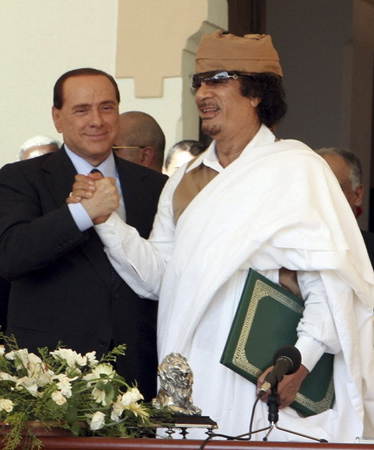 BENGHAZI, Libya (AFP) — Italian Prime Minister Silvio Berlusconi on Saturday apologised to Libya for damage inflicted by Italy during the colonial era and signed a five-billion-dollar investment deal by way of compensation.
Berlusconi made the apology during a visit to the Mediterranean city of Benghazi for a meeting with Libyan leader Moamer Kadhafi to seal a cooperation accord with the oil-rich north African nation.
“It is my duty, as a head of government, to express to you in the name of the Italian people our regret and apologies for the deep wounds that we have caused you,” said Berlusconi, whose comments were translated into Arabic.
He and Kadhafi then signed a “friendship and cooperation agreement” aimed at recompensing Libya for damage incurred during the colonial era.
“The accord will provide for 200 million dollars a year over the next 25 years through investments in infrastructure projects in Libya,” Berlusconi said.
“This agreement should put an end to 40 years of discord. It is a concrete and moral acknowledgement of the damage inflicted on Libya by Italy during the colonial era,” he earlier told reporters.
The signing ceremony took place in the garden of a palace occupied by the Italian governor in colonial times.
Berlusconi then bowed before the son of the hero of Libyan resistance against the Italian occupiers, Omar Mokhtar, in a symbolic gesture.
“This is an historic moment when two brave men acknowledge the defeat of colonialism,” Kadhafi said, raising his arms in a sign of victory.
“The Libyan people endured injustice and were attacked in their homes and they deserve an apology and compensation,” he added before a crowd which included diplomats and the children and grandchildren of Libyan resistance heroes.
Formerly part of the Ottoman Empire, Libya was occupied by Italy in 1911 before becoming a colony in the 1930s. The country gained its independence in 1951 after a brief period under a UN-mandated Franco-British administration.
Italy and Libya have spent years negotiating a wide-ranging treaty to cover compensation for Rome’s military occupation and colonisation.
An association representing Italians expelled from Libya in 1970 denounced Rome in a statement on Saturday for compensating Libya and not repatriated Italians.
It said Berlusconi should have “a sudden burst of dignity, humanity and respect so as to finally give satisfaction… to the 20,000 Italian citizens who are still waiting for fair compensation from their government.”
US Secretary of State Condoleezza Rice is set to follow in Berlusconi’s footsteps next week, for the first visit by such a high-ranking US official to Libya since 1953.
Berlusconi, on his second trip to Libya since June, said that among the major projects to be financed by Italy will be a coastal motorway from the Tunisian border to Egypt.
Rome will also fund house construction, scholarships for Libyan students to study in Italy and pensions for those mutilated by landmines laid by the Italian military.
The agreement will also cover cooperation on the fight against illegal immigration, which Berlusconi termed a battle “against slave traders.”
Funding for the coastal highway — previously estimated to cost three billion euros (4.65 billion dollars) — was promised by Berlusconi on a visit to Tripoli in 2004, when he headed a previous administration.
When the two leaders met in June, Berlusconi was pushing for the rapid implementation of a December 2007 accord on joint maritime patrols to curtail the flow of thousands of illegal immigrants from Africa to Europe.
Italian shores, especially the small island of Lampedusa south of Sicily, are a favourite destination for those making the crossing from North Africa in the hope of a new life in Europe, despite the perilous journey.
Also on Saturday Italy returned a Roman statue of the goddess Venus dating back to the second century which was found in 1913 by Italian troops near the ruins of the Greek and Roman settlement of Cyrene, on the Libyan coast.
Berlusconi’s visit to Benghazi 1,000 kilometres (650 miles) east of Tripoli coincides with the anniversary of the coup that brought Kadhafi to power on September 1, 1969.
By Chris Turner, The IAAF
Zürich, Switzerland – Ethiopia’s World 5000m and 10,000m Olympic champion and World record holder made a demonstration out of Friday’s 5000m at the Weltklasse Zürich, ÅF Golden League meeting, in front of a capacity 26,000 strong Letzigrund stadium crowd.
Eight Kenyans (not counting the two pace makers), two Ugandans, and one Qatari, the vast majority of whom had not even raced in Beijing, had no answer to the relatively fatigued limbs of Kenenisa Bekele.
The Ethiopian maestro said before the race he was “a little tired” after his three races, two golds and two Olympic records in China. But even at 90% capacity Bekele is a match for the rest of the world. His virtually solo run this evening ended in a 12:50.18 world season lead, nine seconds ahead of his nearest rival (Moses Kipsiro of Uganda 12:59.48). Enough said!
Jelimo in on historic mark
Pamela Jelimo’s latest improvement of the senior African and World Junior 800m records, and Usain Bolt’s first outing since Beijing were the undoubted highlights of
Bolt electrifies but provides no shocks
“Lightning Bolt” electrified us again but there was to be no storming finish in Zürich. While not quite as extravagantly coasting to victory as he did in the Beijing 100m final, Jamaica’s Usain Bolt was smoothness personified as he made up for an appalling start. His 0.193 reaction time to the gun was the slowest of the entire nine man line-up, but he effortlessly cut through the field from about 30 metres out to take a comfortable victory in 9.83 sec (-0.5m/s wind).
Has anyone run such a time in cruise control, without hitting top gear? Bolt brilliance again and we were served up the now customary “Lightning Bolt” posing after the race which sent the crowd wild.
In second, USA’s Walter Dix, the double Olympic bronze medallist, produced 9.99, with Olympic silver medallist Richard Thompson third in 10.09.
“It was good, nice track, great crowd,” said Bolt who spoke with a noticeable cold. “My start was not too good. I concentrated on winning, and as I’m starting to get a cold I was not able to think about any faster time. My coach told me that I should make sure to end the season healthy.”
Jelimo and Vlasic remain in the $1 Million hunt
With only one more meeting to go, Pamel Jelimo and Blanka Vlasic successfully completed the fifth of six stages in their quest to at least share the ÅF Golden League $1 Million Jackpot by the conclusion of the series in Brussels next Friday (5 Sep).
Jelimo improves Area senior and World Junior record again!
There is no stopping the 18-year-old Pamel Jelimo. The Kenyan Olympic 800m champion improved the Area senior and World Junior records jointly for the fourth time this season (the junior mark for a fifth) with a 1:54.01 run. This puts the phenomenal teenager who has only been racing 800m for the first time this season into third place on the all-time list, with just World record holder Jarmila Kartochvilova (TCH 1:53.28 – 1983) and Nadezhda Olizarenko (URS 1:53.43 – 1980) ahead.
The race was taken through 400m by Svetlana Klyuka in 55.66sec. The Russian who was fourth in Beijing had been specially contracted to pace the race given there are few athletes who have the strength to set the necessary tempo for Jelimo. Klyuka continued down the back straight for quite a way before stepping aside for the Olympic champion, who is learning race by race a more balanced approach to two lap running. What will another winter’s training and a year’s more competitive experience bring the world we can only guess, and there are still at least two more opportunities for Jelimo to stun us in 2008.
Bahrain’s World 1500m champion Maryam Jamal, a heavily legged fifth at her specialist distance in Beijing, showed a lot more spark in the Kenyan’s wake tonight, setting a national record of 1:57.80. 1:58.66 back in May was Jamal’s previous national best.
Well beaten in third was World 800m champion Janeth Jepkosgei in 1:58.26. What a difference a year makes. A year ago, Jepkosgei was the season’s great find and won here in 1:59.03, with the Kenyan record at the time standing to her at 1:56.04. There is no argument that we have witnessed a seismic change in women’s 800m running in 2008.
“I can tell you I’m so tired,” said Jelimo. “The World record is now closer but I’m not sure I can do it this year, maybe next.”
Maria Mutola, who has taken twelve victories in Zürich, made her final farewell to the crowd in great style finishing fourth in 1:58.71, while a newcomer to the two laps, Olympic 1500m champion Nancy Lagat, was ninth in 2:05.84.
Vlasic resumes control
With Olympic champion Tia Hellebaut exceptionally heavy legged following her first time clearance 2.05m victory in Beijing – the Belgian would finish eighth here with 1.90 – it was left to World champion Blanka Vlasic to overcome a shaky moment at 1.98. With two poor attempts at that height the Croatian sailed clear on her last effort, and being the only athlete to successfully scale the next height of 2.01 (with her second jump) she confidently kept herself on path to the $1 Million Jackpot.
Russia’s Olympic bronze medallist Anna Chicherova was second at 1.98 beating USA’s Beijing sixth placer Chaunte Howard, at the same height on count back.
“Everybody was so tired,” said Vlasic. “So it was good to win and remain in the Jackpot race. I must say that the track surface was soft for me. When I pushed hard I could not find my technique.”
Thorkildsen emphasises who is boss
If breaking Jan Zelezny’s Olympic record in Beijing with a 90.72m release to become only the fourth man in history to retain an Olympic Javelin Throw title wasn’t enough, Andreas Thorkildsen of Norway hit another 90m mark in Zürich to emphasise once again who is the boss with a spear.
All but one of Thorkildsen’s series of four valid efforts – 86.29, 90.28, 88.15 and 89.05, pass, foul – would have taken the victory tonight. While Finland’s World champion Tero Pitkämäki is slowly rediscovering his top form (87.26m for second), compatriot Tero Järvenpää also threw long again (86.45), and 2004 Olympic silver medallist Vadims Vasilevskis of Latvia was also over 85 metres (85.97 – season’s best), the Norwegian was once again in a different class.
“I threw really well today,” said Thorkildsen. “I made only very small technical mistakes, otherwise I could have thrown even further.”
Wariner bounces back
Jeremy Wariner was blown away by LaShawn Merritt in Beijing who was all but a full second ahead of his season long rival. Tonight the double World champion was the one in charge, winning in 43.82 from the Olympic gold medallist who finished in 44.43. Wariner took control from the midway point and Merritt, who was running in lane 3 immediately inside him, had no response.
Wariner’s time was his season’s best. Notably only Merritt’s win in Beijing of 43.75 is faster in 2008, but that will be the one that lives in the memory such is the ultimate reality of all post Olympic comebacks even when as impressive as the one Wariner produced today.
Robles pushed all the way by Oliver
There was none of the expected dominance by Cuba’s World record holder and newly crowned Olympic champion Dayron Robles. It’s not that he ran a bad sprint hurdles race, it’s just that David Oliver, the only other man under 13secs this year, suddenly rediscovered his top form. The American had beaten Robles in their opening outing of the season in Berlin (1 June) but by the time Beijing was reached Oliver had no answer to the fluency of the Cuban. Tonight Oliver was back to very near his best clocking 12.98 in lane 4 with such a drive that Robles, outside him in 5, only just held him off, winning in 12.97.
Jones back to winning ways
Lolo Jones made no hurdle error in Zürich, as had cost her the Olympic title last week. The experience which will probably haunt the World Indoor 60m Hurdles champion for the rest of her career, was put to the very back of her mind tonight. The American won the 100m Hurdles in a tight finish (12.56; -0.2m/s) from Spain’s Josephine Onyia (12.62), with Australia’s Olympic silver medallist Sally McLellan in third (12.63).
USA’s surprise Olympic winner Dawn Harper was back in sixth in 12.73. But like the few other defeated Beijing winners tonight, I doubt the 24-year-old who won in China in a PB of 12.54 will lose much sleep, as unlike Jones and the other successful avengers she no longer needs to dream about owning an Olympic gold medal.
Taylor holds off Clement
Angelo Taylor, was well aware that the 2007 and 2005 World champions, respectively Kerron Clement and Bershawn Jackson, who had finished behind him in the 400m Hurdles in Beijing in that order, were intent on gaining revenge here.
Taylor, who also won the Olympic laurels in 2000, was not about to give them that satisfaction. Taylor bravely took on the field from the gun, blasting the first 200m, and still had a sizeable advantage on Clement entering the final straight. Clement was closing fast but just as we thought the Olympic champion had shot his bolt, he dug deep and in the run off the final hurdle to the line had enough strength to prevail – 48.07 to 48.20.
Also challenging hard down the home straight was Jamaican Danny McFarlane who closed out just behind these two protagonists in 48.40. Jackson was never in the race finishing in seventh in 49.19.
Isinbayeva takes straightforward victoryWhy ever doubt Yelena Isinbayeva in the women’s Pole Vault? In trouble at 4.75m, her doubts if she ever experienced any, which is unlikely, were soon dispelled at her next height. Game over and no surprise!
The Russian, who has taken everything that there is to be won during the last Olympiad and set her 24th World record in Beijing while defending her Olympic title, celebrated with a first time clearance at 4.88.
In second position after a third time success at 4.75 behind American Area record holder Jenn Stuczynski, who had taken that bar in her second attempt, the peerless Isinbayeva flew well clear over 4.88, while the American had three failures at 4.93 in response, after passing what was ultimately Isinbayeva’s winning height.
Isinbayeva made no attempts at any further heights, ending her day with the straightforward victory, still fatigued after Beijing.
Season’s best for Richards, redemption also for Felix
Her recent extravagant racing tactics were slightly subdued tonight. After her heavily legged run into the line in China, Sanya Richards produced a more conservatively paced race even though after the first 150m she was already up on the stagger on the athlete immediately outside her in lane five. Shericka Williams of Jamaica, who had taken silver ahead of Richards’ Olympic bronze, was that athlete, and she had no answer (finished fourth in 51.28) this evening to the former Golden League Jackpot winner who came home easily in a season’s best of 49.74.
The American was most of a second ahead of her nearest opponent, Russia’s Tatyana Firova (50.70). Confidence restored for Richards? Perhaps yes but oh what might have been in Beijing!
Allyson Felix was another Olympic disappointment by her own illustrious standards. Like Richards, the double World champion at 200m made up in sorts for her silver behind Veronica Campbell-Brown in Beijing with a confident run in 22.37. Felix was probably surprised to find she was not in the lead with 90m to go, as in front coming out of the bend was Lauryn Williams. Felix took little time to settle that attack and crossed in 22.37, with Williams second in 22.68, and Marshevet Hooker completing a USA sweep in 22.74.
Koech off sub-8 form
It was a brave bid to become the first sub-8min steeplechaser of 2008 but Paul Kipsiele Koech, the world season leader with 8:00.57 couldn’t quite manage the effort needed when alone at the front with three laps to go. He crossed in 8:04.26.
Well beaten but setting the European lead for 2008 in second place was Mahledine Mekhissi-Benabbad of France in 8:08.95. There was a PB for Kenyan Michael Kipyego in third (8:09.05). Olympic bronze medallist Richard Matelong was eighth in 8:28.38.
Ramzi surprised
Running in the first track event of the main programme this evening, Rashid Ramzi, one of the large group of Beijing Olympic champions who had assembled in Zürich, was beaten in the run into the line in the men’s 1500m. The Bahraini who took the Olympic crown in style was upstaged by African champion Haron Keitany in a PB of 3:32.06 to Ramzi’s 3:32.86, which was his season’s best.
Third and fourth places were also taken by Bahrain via Belal Mansoor Ali and Yusuf Saad Kamel, respectively 3:33.06 (SB) and 3:33.11 (PB). In 8th was 2007 World 800m champion and Beijing 800m bronze medallist Alfred Kirwa Yego, who set a PB of 3:33.69.
Very heavily legged was Asbel Kiprop, the Beijing 1500m silver medallist, who was in the lead at the bell (behind the pace maker) but faded badly in the last 400m to finish 13th in 3:36.68.
Long Jump taken by Al-Saba, and relay by USA
The men’s Long Jump was won by Saudi Taher Al-Saba, who was eleventh in Beijing, with a PB equalling 8.35m. Back into some form was European champion Andrew Howe of Italy, with 8.06 for second place. The Italian who was injured earlier in the season, had been one of the major casualties of the Beijing qualification round. These two were the only athletes over 8m tonight.
The evening was closed out by the Zürich Trophy, a 4x100m relay race which went to the USA thanks to a dip finish which denied a quartet from Trinidad and Tobago – 38.01 to 38.03.