UNITED NATIONS (AP) — The U.N. humanitarian office said Monday that food shortages in Ethiopia have reached alarming levels following widespread drought in the country.
Relief organizations are grappling with a “considerable shortage of supplies,” with the U.N. World Food Program in need of $136 million for its operation in the Horn of Africa nation, U.N. spokeswoman Michele Montas said.
The U.N. Office for the Coordination of Humanitarian Affairs reports “that the food security situation in Ethiopia has deteriorated to alarming levels in the wake of drought conditions throughout much of the country.”
Last week, U.N. humanitarian chief John Holmes visited Ethiopia and said the southeast, scene of a long rebellion, is the most worrying of all the regions affected by severe food shortages. He urged aid agencies to help ensure that Ethiopia’s devastating food crisis does not become a famine.
The U.N. says more than four million Ethiopians need emergency assistance and a further eight million need immediate food relief.
Severe floods hit Ethiopia last year, destroying most of the food crops. This year, drought has worsened the situation.
Montas said Monday that flooding in Gambela in southwestern Ethiopia has reportedly displaced nearly 35,000. The World Health Organization has provided emergency drugs and supplies for 10,000 people there, she said.
I’ve been cogitating about how best to continue my series of posts on Ethiopian music. Why all the worry? Well, I fear that some people (heck, maybe most people) will be so unused to the sounds of Ethiopian music that if I start with something too unusual sounding, they might not give it a chance.
Case in point: my normally very musically-open-minded husband. I had loaded some Ethiopian music on the ol’ iPod, and one day an Ethiopian song came up on shuffle that sounded pretty “out there” (even to me). Unfortunately, this was my husband’s very first exposure to any Ethiopian music, and it kind of left a sour taste in his mouth. It has taken weeks of me sneakily absconding with his iPod and stuffing it with Ethiopian tunes to get him to give Ethiopian music another try. Thankfully, it’s been a success. In fact, he commented just the other day about a song in the Ethiopiques series that he really liked.
All that to say that I don’t want to get off on the same kind of rocky footing on my blog! So I’ve been trying to find some ferenji-friendly music (read: music that won’t sound too off-the-wall to everyday Americans) to get the musical ball rolling. And I had been drawing a blank…until I ran across an artist named Minyeshu.
Right about now I might be provoking the ire of some Ethiopian folks who would argue against this choice! For starters, Minyeshu, though born and raised in Ethiopia, no longer lives there. She lives in western Europe and married a Belgian man, so strictly speaking this is diaspora music rather than music made in Ethiopia. Second, this is hardly classical Ethiopian music; it’s very contemporary stuff (her most recent album was released in 2008), clearly influenced by Western music. All in all, perhaps not the most “authentically” Ethiopian choice.
However, for those leery of Ethiopian music, Minyeshu’s music remains a great entry point. Sure, it’s westernized, but it retains elements of classical Ethiopian music–the minor keys, some traditional sounding vocal styles, and lyrics sung in Amharic. Plus, Minyeshu was born and raised in Ethiopia, and at a young age, she began performing with the National Theater of Ethiopia. While on a musical tour in 1996, Minyeshu visited Europe and, because of political instability in Ethiopia, decided to stay in Europe and make it her home.
In 2002, she released her first solo album, Meba, which–alas!–I have not been able to find a copy of. But I have discovered her second album, 2008’s Dire Dawa, and have thoroughly enjoyed it. It is (in brief) lovely, laid-back music brimming with quiet joy. And while it appeals to my Western ear, it simultaneously maintains a distinctly Ethiopian vibe. One review describes it particularly well:
“Like Aster Aweke and Gigi Shibabaw before her, Minyeshu Kifle has subtly adapted Ethiopian music for European and American sensibilities and…has added a soft-rock veneer and modern pop production to the characteristic asymmetrical rhythms and pentatonic scales of Ethiopian tradition….
[L]istening to the opener ‘Halafi Nen Kealem’ [sic]…, you can’t help thinking that if Sheryl Crow lived in Addis Ababa rather than California, she might sound a little like this.
If that sounds critical, it isn’t meant to be. The marriage of Ethiopian forms and Western pop motifs is effected with an easy panache and potency so that Minyeshu manages to sound both accessible to a wider audience yet still authentically — and proudly — Ethiopian at the same time.”
But hey–why not judge for yourself? You can buy Minyeshu’s Dire Dawa CD at Amazon. Unfortunately, because it’s an import CD, it’s kind of pricey: $29. So, in the interest of informed consumerism, I’ve taken the liberty of tracking down a couple mp3s from this album. If you choose to download them, please listen to them and then buy the CD if you like it.
CAMBRIDGE — The Ethiopian Community Mutual Assistance Association (ECMAA) of the Boston area is celebrating “Enkutatash,” the Ethiopian New Year, Saturday, Sept. 13, from 4 to 11 p.m. at the St. Paul AME Christian Life Center at 85 Bishop Allen Drive.
The 2001 New Year celebration will include a talent show that will allow children and teenagers to share their cultural talents with dance and music performances and highlighted by a fashion show presenting the newest styles in Ethiopian attire. There will also be music, dancing, and an Ethiopian coffee ceremony served by volunteers. Ethiopian food specially prepared by Ethiopian chefs will be for sale.
Based on the Orthodox Julian Calendar, different from the Western or Gregorian calendar, the Ethiopian year of 2001 begins Sept. 11, 2008. The Ethiopian calendar consists of 12 months of 30 days and the 13th month, called pagume, has only five or six days depending on leap year. The Ethiopian calendar is seven years and eight months behind the Western calendar. Enkutatash, which means “gift of jewels,” occurs in September with the clearing of the skies following three months of heavy rains. The highland fields, covered with Meskal daisies, become golden. Meskerem (September) is a month of celebration in which Ethiopians transition from the old to the new expressing their hopes and dreams of the future.
Established in 1986, ECMMA was founded by a group of Ethiopian refugees as a means of organizing and assisting their people. Its mission is to provide culturally appropriate social services, educational opportunities, and cultural programs to the growing population of approximately 12,000 Ethiopians now living in the Greater Boston area. ECMMA works to develop and maintain a support network for the Ethiopians and other African refuges, helping newcomers to the United States to become self-sufficient, contributing members of their community while preserving their cultural heritage.
Tickets are $20. ECMAA is at 552 Mass. Ave., Suite 202, in Central Square. For tickets or more information, call Binyam Tamene at 617-492-4232.
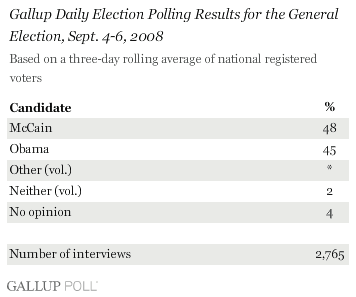
PRINCETON, NJ — The latest Gallup Poll Daily tracking update shows John McCain moving ahead of Barack Obama, 48% to 45%, when registered voters are asked for whom they would vote if the presidential election were held today.
These results are based on Sept. 4-6 interviewing, and include two full days of polling after the conclusion of the Republican National Convention last Thursday night. McCain has outpolled Obama on both Friday and Saturday, and is receiving a convention bounce just as Obama did last week.
Tomorrow’s report will be the first in which all interviews were conducted after the conclusion of the convention. Gallup measures convention bounces by comparing candidate support in the last poll done entirely before a party’s presidential nominating convention begins with the first polling conducted entirely after its conclusion.
McCain’s 48% share of the vote ties for his largest since Gallup tracking began in early March. He registered the same level of support in early May. This is also McCain’s largest advantage over Obama since early May, when he led by as much as six percentage points. Obama has led McCain for most of the campaign, and for nearly all of the time since clinching the Democratic nomination in early June. (To view the complete trend since March 7, 2008, click here.) — Jeff Jones
(Click here to see how the race currently breaks down by demographic subgroup.)
WordPress now has support for Gears, which adds new features to your web browser. More information…
After you install and enable Gears most of WordPress’ images, scripts, and CSS files will be stored locally on your computer. This speeds up page load time.
Don’t install on a public or shared computer.
Gears Status
Gears is installed on this computer but is not enabled for use with WordPress.
To enable it, make sure this web site is not on the denied list in Gears Settings under your browser’s Tools menu, then click the button below.
However if this is a public or shared computer, Gears should not be enabled.
Gears Status
Gears is installed and enabled on this computer. You can disable it from your browser Tools menu.
If there are any errors, try disabling Gears, then reload the page and enable it again.
Local storage status: Please wait! Updating files:
For the Gallup Poll Daily tracking survey, Gallup is interviewing no fewer than 1,000 U.S. adults nationwide each day during 2008.
The general-election results are based on combined data from Sep. 4-6, 2008. For results based on this sample of 2,765 registered voters, the maximum margin of sampling error is ±2 percentage points.
Interviews are conducted with respondents on land-line telephones (for respondents with a land-line telephone) and cellular phones (for respondents who are cell-phone only).
In addition to sampling error, question wording and practical difficulties in conducting surveys can introduce error or bias into the findings of public opinion polls.
Among several of the Ethiopian online journals, it is not an exaggeration to state that Ethiopian Review is the only one that understands the implications of Woyanne’s infiltration of the Ethiopian Orthodox Tewahdo Church (EOTC). This is due to its keen understanding that to dismember Ethiopia and build its own empire, Woyanne first must neutralize the 2000 year old institution — THE ETHIOPIAN ORTHODOX CHURCH.
This 13-page article (Amharic, pdf, click here to read) explains in detail how Mahebere Kidusan was created and what it is doing currently.
This document (click here) shows how Mahebere Kidusan achieved an unprecedented power within the Ethiopian Orthodox Church.
Meles Zenawi was awarded an MA degree in Business Administration by the Open University in 1995, and an MSc in Economics by Erasmus University in 2004, while perpetrating egregious crimes against humanity. Rumors abound now he has given orders to scholars in the country to provide feedback on a thesis that he is working on for an advanced diploma in tandem with his relentless efforts to promote a policy of genocide by mass starvation [1], and to suppress basic human rights through systematic imprisonment, harassment and killings of innocent civilians [2].
Although dictators are generally known for the extreme measures they take to project a false impression of grandeur and to disguise their crimes and inferiority complex through absurd propaganda, Zenawi’s obsession with the ivory tower as a cover for his vices has no parallel in the annals of despots in power. It might come as a surprise that a leader of a country like Ethiopia, which is in the lowest ranks with respect to every conceivable measure of human development, could make time for advanced study. However, time is no constraint for an autocrat, who has no allegiance to the country he rules, who does not abide by any laws, and who subjects the constitution to the service of his selfish interest and those of his cronies.
Institutions of higher learning may not be held accountable for future actions of their graduates. However, it is contrary to reason for a university to claim it upholds the principles of fairness and justice while consciously admitting to its programs of study tyrants and despots with proven records of human rights violations and crimes against humanity.
Ironically, a stated mission of the Open University, one of Zenawi’s preferred institutions of erudition, is to promote “educational opportunity and social justice” [3]. His other alma mater, Erasmus University, declares that its “… driving forces are academic curiosity, critical reflection and social engagement”[4].
The lofty ideals of these universities are in sharp contradiction to their decisions to have an association with a despot with well-established records of anti-academic and anti-intellectual campaigns, which include the suppression of freedom of speech and other fundamental rights enshrined in the Universal Declaration of Human Rights.
The world first witnessed Zenawi’s viciousness against the academic establishment when in January of 1993 he ordered his police to shoot and mutilate hundreds of Addis Ababa University students for peacefully exercising their freedom of expression. Subsequently, Zenawi fired over 42 professors from the same university when the academics expressed opposition to the brutal force the dictator used against the students. On April 18, 2001 Zenawi’s special forces police opened fire on a peaceful protest organized by students of the university, and killed at least 41 people and wounded hundreds [5]. More recently, in the aftermath of his infamous defeat in the May 2005 elections, Zenawi unleashed his special forces to mow down 193 unarmed civilians, and sent thousands of university students to concentration camps [6].
Since he assumed power, Zenawi has used economic deprivation as a tool of repression, and has subjected the vast majority of the people to immeasurable suffering. As the following facts suggest, no dictator in history has so blatantly and effectively utilized mass starvation for the purpose of propagating authoritarian rule to the same degree as Zenawi has done so.
According to a July 28, 2003 report of the New York Times, in 2003 more than 12 million Ethiopians were at risk of starvation, half of those children under 15.
Based on a recent report of the UN Children’s Fund (UNICEF), eight million Ethiopians are chronically food insecure and at least 3.4 million Ethiopians are in need of emergency food relief.
The Centre for Research on Globalization disclosed that several million people in the most prosperous agricultural regions have been driven into starvation [7].
On June 23, 2008, the Boston Globe reported: “People have become so desperate for food that they are eating seeds that were meant for their next harvest. 4.5 million Ethiopians are in need right now”[8].
Meanwhile, Zenawi has taken effective measures to perpetuate the famine for political ends, i.e., to penalize ethnic and political groups that did not vote for him, and to send a macabre message to others who may dare challenge his authoritarian rule in the future.
Remarkably, in a March 18, 2008, address to his rubber-stamp parliament, he unabashedly denied the veracity of drought-related deaths [http://www.mcclatchydc.com/226/v-print/story/39021.html].
Recently, he ordered his Deputy Prime Minister to denounce reports of the current famine [10].
According to the June 13, 2008 issue of The Economist, “he has banned photographs of the starving and has told field workers not to give information to foreign journalists”.
As the Edinburgh Evening News (26th July 2008) correctly observed: “The catastrophe is not an accident of nature. The squalor and folly of the Addis Ababa regime needs to be corrected.”
On the political front, Zenawi has virtually incapacitated opposition parties with brazen use of torture and imprisonment.
Following his defeat in the May 2005 elections, he incarcerated leaders of the opposition and clung to power illegally[11].
As recently as last April, he conducted sham elections, excluding viable opposition through systematic intimidation, harassment and coercion. According to a Human Rights Watch report, candidates allied with his party were allowed to “… run unopposed in the vast majority of constituencies across Ethiopia. Local ruling party officials systematically targeted opposition candidates for violence, intimidation, and other human rights abuses since the registration period began. Particularly in areas with established opposition support, local officials arbitrarily detained opposition candidates, searched their property without warrant, and in some cases physically assaulted them”[12].
With regard to crimes against humanity, the charges leveled against Ratko Mladic and Radovan Karadzic by the International Court of Justice pale in comparison to the crimes committed by Zenawi against the various ethnic groups in Ethiopia:
In the Gambella area, the Anuaks have been subjected to a government-sponsored genocide, and many more have been displaced from their homes [13].
In the Ogaden region, Zenawi has committed war crimes, burning homes and property, and firing upon and killing fleeing civilians [14, 15, 16, 17].
In other regions, including Oromia and Amhara, Zenawi has been waging covert and overt attacks against the inhabitants creating an atmosphere of siege and terror [18].
Zenawi has suppressed freedom of speech and the press, while giving a deceptive impression of an open society to the outside world.
In a recent report, the Committee to Protect Journalists found Ethiopia at the top of a list of 10 countries where press freedom has deteriorated over the past five years [19].
The present incarceration of Tewodros Kassahun (a.k.a. Teddy Afro) on trumped up charges is a glaring example of the policy of the dictator to stifle the voices of musicians and singers from reflecting the misery of the people [20].
John Dewey once wrote: “When men think and believe in one set of symbols and act in ways which are contrary to their professed and conscious ideas, confusion and insincerity are bound to result.” Thus, it is a travesty of scholarship for an institution of higher learning, that professes social justice, to open its doors to despots and tyrants with crimes so egregious as those committed by Zenawi. Irrespective of the source, the money the tyrants pay to these institutions for their diplomas is money tainted with the blood, sweat and tears of millions of helpless people. The credentials these institutions bestow upon the tyrants are potent weapons used to legitimize the authoritarian rules of the despots and to perpetuate their regimes through terror and repression.
Copies of this article are sent to:
1) Professor Brenda Gourley, Vice-Chancellor, The Open University
(http://www.open.ac.uk/vice-chancellor/Contacts.html)
2) Dr. A van Rossum, Chairman, Supervisory Board, Erasmus University
([email protected])