The situation on the Djibouti-Eritrean border remains volatile after a flaring of tensions on the border in June left over 35 dead and dozens wounded, a United Nations fact-finding mission reported today.
The mission concluded that Djibouti is being drawn into a crippling and expensive military mobilization to deal with a situation that may threaten national, regional and international peace.
In early June serious clashes were reported between the Djibouti Armed Forces (DAF) and the Eritrean Defence Forces (EDF) along the undemarcated border between the two Horn of Africa countries in an area known as Doumeira. The armed combat followed several weeks of military build-up and growing tension between the two sides since April.
The team also noted that Eritrea refused to receive the UN fact-finding mission, and consequently only Djibouti’s version of events was made available to them.
“If not addressed in a timely and comprehensive manner, the Djibouti-Eritrea issue could have a major negative impact on the entire region and the wider international community,” the report stated.
“The possible destabilization of Djibouti and the militarization of the Bab el-Mandeb Strait [connecting the Red Sea to the Gulf of Aden and a strategic link to the Mediterranean] do not augur well for peace in the region or for international shipping and investment. Solutions must therefore be found as a matter of the utmost priority.”
The report placed the onus on Eritrea, which has alleged aggression by Djibouti, to cooperate with the UN and establish the facts to support its allegations.
The UN should persuade Eritrea and Djibouti to demilitarize the border and return to the “status quo ante as at February,” according to the report.
“The Djibouti army has since pulled back. It is only logical that the Eritrean forces do the same, as was demanded by the Security Council. No country should be allowed to disregard the decisions of the Security Council with impunity.”
The fact-finding mission also drew attention to the need for both parties to agree on which of the colonial treaties and protocols should be accepted as the basis for defining their common border – the 1897 Abyssinia-France treaty, the 1900-1901 France-Italy protocols, or the 1935 France-Italy treaty.
“It is tragic that the two countries have been on the verge of war over treaties and protocols negotiated when they did not exist as independent States.”
Haile Menkerios (left) talking
to Secretary-General Ban Ki-moon
UN News Service – Haile Menkerios, Assistant Secretary-General for Political Affairs, briefed Security Council members on the details of the deal, signed in Harare on Monday, which aims to end the political crisis that has gripped the Southern African country since the first round of national elections in March.
“This is a delicate compromise,” Mr. Menkerios later told reporters, stressing that the accord between President Robert Mugabe and opposition leaders Morgan Tsvangirai and Arthur Mutambara is not designed to immediately solve all of Zimbabwe’s problems.
Zimbabwe’s economic recovery will take time, he said, and international donors must remain engaged to help the country back on its feet, especially in priority areas such as agriculture, health care, and water and sanitation.
But the Assistant Secretary-General said he was confident that the main political forces in Zimbabwe can reach a compromise on the outstanding issues left remaining after the agreement.
He also said that the deal, even though it will be painful to fully implement, offers thousands of ordinary Zimbabweans the chance for a much better life.
Mr. Menkerios served as the UN representative on a reference group backing the efforts of the Southern African Development Community (SADC) to mediate between Zimbabwe’s political forces, and he attended Monday’s signing of the agreement.
EDITOR’S NOTE: This is a good example of how the Meles regime is full of village idiots. The new doctors will leave the country as well if conditions in the country remain the same. The root cause of the economic crisis in Ethiopia is the repressive regime that doesn’t allow the people of Ethiopia to live and work in their own country freely.
ADDIS ABABA, ETHIOPIA (APA) – Ethiopia will train 1,000 medical doctors as of this academic year (2008) in four universities in the country to tackle the ever increasing doctors’ exodus from the country, APA learns here on Friday.
Ethiopia is among few African countries that are highly affected by the migration of doctors to various countries, particularly in the United States.
The Ethiopian ministry of Health said in its report that the government decided to increase the enrolment of students to train as medical doctors in various universities of the country to minimize the problem.
“Even though the government made a 70% wage increase for the doctors during the past few years, the problem still remains. Now, the government has decided to enrol 1000 students to study as medical doctors,” the ministry said.
According to the ministry, two years ago, the government enrolled only 100 medical students while the number increased to 250 last year, and the ministry is planning to increase the number in the coming years.
Even in big towns in Ethiopia, it is difficult to get qualified doctors to treat patients.
Now, the government is also training over 200,000 health extension workers to tackle the problem.
HARARE – The first meeting between the three leaders who signed Zimbabwe’s power-sharing agreement ended in a stalemate Thursday. The three failed to agree on the composition of a Cabinet for the new government. Tendai Maphosa in Harare has this report for VOA.
President Robert Mugabe, Prime Minister-designate Morgan Tsvangirai and deputy Prime Minister-designate Arthur Mutambara met for the first time after the signing of the power-sharing deal earlier this week. It was hoped they would announce the members of the 31-member Cabinet at the end of their meeting but that did not happen.
Eddie Cross, policy coodinator general of the main Movement for Democratic Change faction led by Morgan Tsvangirai says agreement could not be reached because the ruling ZANU-PF is insisting on retaining control of all key ministries including defense and finance.
“They’ve got nobody who can really put the ministry of finance back together again, they’ve got nobody who is acceptable to the international community, anybody they that they might put up for the ministry of finance is still subject to international sanctions against the individuals so we are saying the ministry of finance has to come to the MDC and we don’t think that’s really negotiable,” Cross said. “They want defense and we are saying if you take defense we want home affairs, it’s only fair; they still want to hold on to home affairs, hold on to the police and we are saying absolutely not.”
Cross added that the ministry of local government is also a bone of contention. According to him, 80 percent of the councils in Zimbabwe are run by the MDC so the party must control the ministry.
He said the matter has now been referred to the three party’s mediation teams to try to reach a compromise. The teams are slated to meet Saturday. But even if the teams reach an agreement, Cross said, Zimbabweans will have to wait for Mr. Mugabe’s return from New York where he is going to attend the U.N. General Assembly until a government can be formed. Cross, however, dismissed media reports describing the lack of an agreement as a deadlock.
“It’s not a deadlock as such; it’s simply procrastination on behalf of ZANU-PF refusing to get to grips with the fundamentals,” he said. “We’ll sort this out and have a government hopefully by next Friday.”
The signing of the agreement follows seven weeks of talks that followed the June 27 run-off of the presidential election in which Mr. Mugabe was the sole candidate. Mr. Tsvangirai who had outpolled Mr. Mugabe in the first round election but failed to get the necessary majority to avoid a run-off, pulled out of the run-off citing violence against his supporters.
Analysts see the composition of the government as key to unlocking the assistance the international community has promised Zimbabwe to get its economy, once one of the strongest in the sub-Saharan region, working again.
More than 80 percent of the workforce is unemployed, inflation is the highest in the world and basics foodstuffs, fuel and power are in short supply.
The international community has cautiously welcomed the power-sharing agreement but stopped short of making any commitments to help pending the formation of the new government. They also want to see a tangible shift of power from Mr. Mugabe, Zimbabwe’s ruler of 28 years, to Mr. Tsvangirai.
In Ethiopia, 57 percent of girls are forced to get married before they reach their 18th birthday. In this short documentary, Tiringo, married at age 6, explains how early marriage prevented her from attending school.
– Kim Haughton, photojournalist
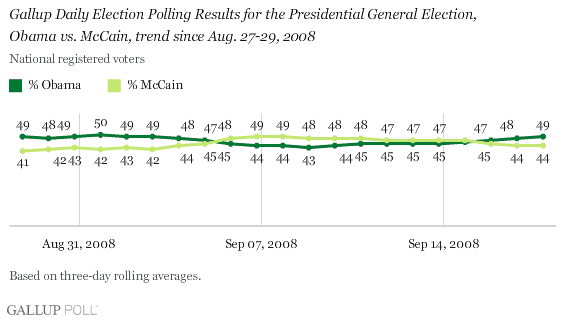
At 49%, support for Obama is near his record high for the year
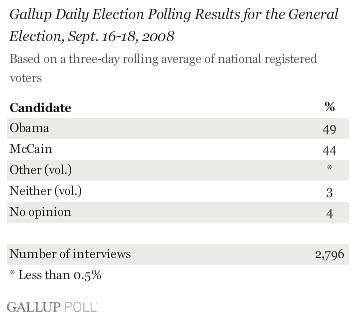
PRINCETON, NJ — Gallup Poll Daily tracking from Tuesday through Thursday finds Barack Obama with a five percentage point lead over John McCain in the presidential preferences of registered voters, 49% to 44%.
This is the fourth consecutive day that Obama has inched forward in voter preferences since the start of the Wall Street financial meltdown beginning with the announcement on Sunday, Sept. 14, that Lehman Brothers was headed for bankruptcy. The overall effect has been to shift the lead back to Obama after McCain had moved ahead following the Republican National Convention.
Obama enjoyed one of his widest advantages over McCain of recent weeks in Thursday night’s interviewing. It will be important to see whether the stock market’s reaction today to aggressive government intervention in the crisis has an impact on the direction of the presidential race over the next few days.
(To view the complete trend since March 7, 2008, click here.) — Lydia Saad
(Click here to see how the race currently breaks down by demographic subgroup.)
Survey Methods
For the Gallup Poll Daily tracking survey, Gallup is interviewing no fewer than 1,000 U.S. adults nationwide each day during 2008.
The general election results are based on combined data from Sept. 16-18, 2008. For results based on this sample of 2,796 registered voters, the maximum margin of sampling error is ±2 percentage points.
Interviews are conducted with respondents on landline telephones (for respondents with a landline telephone) and cellular phones (for respondents who are cell phone only).
In addition to sampling error, question wording and practical difficulties in conducting surveys can introduce error or bias into the findings of public opinion polls.