
Newsweek special report on U.S. elections 2008 (must read)
This is PART I of a seven-part in-depth look behind the scenes of the campaign, consisting of exclusive behind-the-scenes reporting from the McCain and Obama camps assembled by a special team of NEWSWEEK reporters who were granted year-long access on the condition that none of their findings appear until after Election Day.
Barack Obama had a gift, and he knew it. He had a way of making very smart, very accomplished people feel virtuous just by wanting to help Barack Obama. It had happened at Harvard Law School in the mid-1980s, at a time when the school was embroiled in fights over political correctness. He had won one of the truly plum prizes of overachievement at Harvard: he had been voted president of the law review, the first African-American ever so honored. Though his politics were conventionally (if not stridently) liberal, even the conservatives voted for him. Obama was a good listener, attentive and empathetic, and his powerful mind could turn disjointed screeds into reasoned consensus, but his appeal lay in something deeper. He was a black man who had moved beyond racial politics and narrowly defined interest groups. He seemed indifferent to, if not scornful of, the politics of identity and grievance. He showed no sense of entitlement or resentment. Obama had a way of transcending ambition, though he himself was ambitious as hell. In the grasping race for status and achievement—a competition that can seem like blood lust at a place like Harvard—Obama could make hypersuccessful meritocrats pause and remember a time (part mythical perhaps, but still beckoning) when service to others was more important than serving oneself.
Gregory Craig, a lawyer in Washington, D.C., was one of those Americans who wanted to believe again. Craig was not exactly an ordinary citizen—he had served and worked with the powerful all his life, as an aide to Sen. Edward Kennedy in the 1980s, as chief of policy planning at the State Department in the Clinton administration and as a lawyer hired to represent President Clinton at his impeachment trial in the U.S. Senate in 1999. He had seen the imperfections of the mighty, up close and personal, and by and large accepted human frailty. But, like a lot of Americans, he was tired of partisan bickering and yearned for someone who could rise above politics as usual. A 63-year-old baby boomer, Craig wanted to recapture the youthful idealism that he had experienced as a student at Harvard in the 1960s and later at Yale Law School, where his friends included Bill Clinton and Hillary Rodham. In the late fall of 2003, he was invited to hear a young state senator from Illinois who was running for the U.S. Senate. Craig was immediately taken with Barack Obama. “He spoke 20 to 30 minutes, and I found him to be funny, smart and very knowledgeable for a state senator,” Craig recalled. Craig was so visibly impressed that his host that evening, the longtime Washington mover and shaker Vernon Jordan, teased him, saying, “Greg has just fallen in love.”
It was true. Craig read Obama’s book “The Audacity of Hope,” which, Craig said, “floored me,” and later chanced to ride with Obama on the Washington shuttle. He read Obama’s earlier autobiography, “Dreams From My Father,” and was “blown away,” he recalled. “In my judgment, he showed more insight and maturity than Bill Clinton at the age of 60 in terms of understanding himself.” In November 2006, Craig sat next to George Stevens, an old friend of the Robert Kennedy clan, at another Obama speech. Stevens leaned over to Craig and said, “What do you think of this guy for president? I haven’t heard anybody like this since Bobby Kennedy.” Craig instantly replied, “Sign me up.” Stevens and Craig approached Obama coming out of the speech and asked, “What are you doing in 2008?” Obama gave them a big grin and said, “Oh, man, it wasn’t that good.” But before long Craig and Stevens were raising money for Obama’s political-action committee, the Hope Fund. Obama was amused by the devotion of the two old Kennedy hands. After a while, every time he saw the two men he would say, “Here come the Kool-Aid boys.”
That December of 2006, Obama told Craig and Stevens, “Lay off me for a while. I’ve got to talk to Michelle.” Obama went off to Hawaii with his wife and two girls for the holidays. “I thought, ‘We’re dead’,” recalled Craig. “He’s not going to be able to do it.”
Craig was not wrong to be pessimistic. Obama could marshal a lawyerly set of arguments about how he could win, that the country was at a “defining point” and that Obama was the best hope to bring change. “I, I, I actually believe my own rhetoric,” Obama stammered, uncharacteristically, in an interview with NEWSWEEK in the spring of 2008. But Michelle was not eager to subject her family to a process that was dangerous and ugly—uplifting and history-making, maybe, but also a potential family wrecker. Her kids would be given cute names by the Secret Service (“Radiance” and “Rosebud,” as it turned out), but their lives would never be the same.
Obama had been warned. That November of 2005, at dinner at a fancy Italian restaurant in Washington, former Senate majority leader Tom Daschle had reminded Obama that he had never really been attacked before. “I told him he should think about how he might react if his wife was attacked—the emotional discipline it takes,” recalled Daschle. At about the same time, with his fellow Illinois senator, Richard Durbin, Obama had talked about the physical risks. At a political event at the Union League Club in Chicago before Thanksgiving, Obama told Durbin that many of his African-American friends were advising him not to run, some of them because they were afraid he would get killed. (Durbin shared their fears and began lobbying to get Obama put under Secret Service protection. In May, eight months before the first primary, the Secret Service would begin standing watch over Obama, the first time such protection had been extended to a candidate so early in the process.)
Michelle Obama was worried about her husband’s safety, but was also seized with a kind of free-floating anxiety, recalled Durbin. Even after she said yes, she asked Durbin, “They’re not setting him up, are they?” The “they” was all the people who were urging Obama to run. Michelle wondered at their motives.
Obama understood his wife’s fears and even, to some degree, shared them, but he had a way of turning empathy into persuasion. “Her initial instinct was to say no,” Obama recalled. “She knew how difficult it was for me to be away from the girls, she feels lonely when I’m not around, so her initial instinct was not to do it. And I think she also felt that, you know, the Clintons are tough, and that I would be subject to a lot of attacks.” So that […continued on page 2]
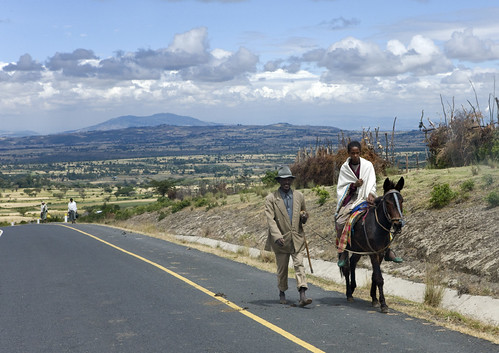 The regime in Ethiopia [with money borrowed from World Bank and others] is building highways everywhere, even in the south, to connect with Kenya. But while brand new roads are open, people still walk bare feet, or on horses, like in ancient times. –
 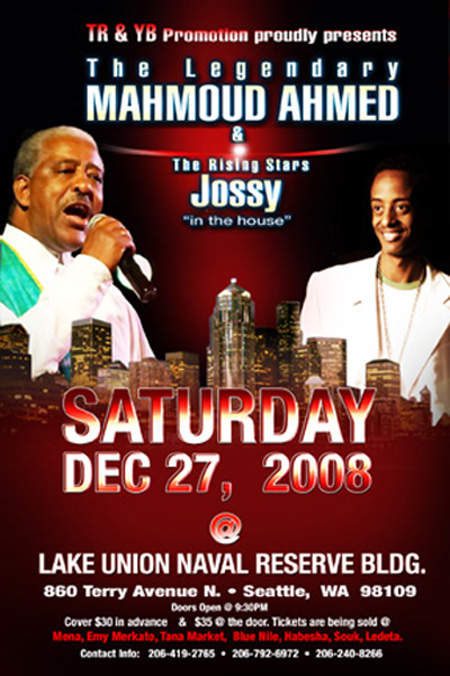 Legendary signer Mahmoud Ahmed and Ethiopian pop music sensation Jossy will perform in Seattle on Saturday, Dec 27, 2008 at the Lake Union Naval Reserve, 860 Terry Ave. N, Seattle. More info: 206 419 2765