Best of Michael Jackson – videos
Rest in Peace
Billie Jean
Beat It
Thriller
You Rock My World
The way you make me feel
Bad
Smooth Criminal
Black or White
Jam
Don’t Stop ‘Til You Get Enough
In the Closet

Rest in Peace
Billie Jean
Beat It
Thriller
You Rock My World
The way you make me feel
Bad
Smooth Criminal
Black or White
Jam
Don’t Stop ‘Til You Get Enough
In the Closet
PRESIDENT OBAMA APPOINTS 2009-2010 CLASS OF WHITE HOUSE FELLOWS
 WASHINGTON, DC – The White House announced today the appointment of 15 outstanding men and women to serve as White House Fellows. The 2009-2010 class of White House Fellows represents a diverse cross-section of professions including medicine, business, media, education, non-profit and state government, as well as two branches of the U.S. military. The 2009-2010 class of Fellows and their biographies are included below.
“We are thrilled that these exceptional men and women will be joining us here in Washington for the next year,” said First Lady Michelle Obama. “The program not only allows for a variety of perspectives to come together, offering expertise and experience to benefit the administration’s efforts, but these Fellows in turn carry what they’ve learned to their own communities to benefit Americans far beyond the walls of the White House.”
The White House Fellows Program was created in 1964 by President Lyndon B. Johnson to give promising American leaders “first hand, high-level experience with the workings of the Federal government, and to increase their sense of participation in national affairs.” This unique position in our nation’s government encourages active citizenship and service to the nation. The Fellows also take part in an education program designed to broaden their knowledge of leadership, policy formulation, military operations, and current affairs. Community service is another important component of the program, and Fellows participate in service projects throughout the year in the Washington, DC area. Since 1964, over 600 outstanding American men and women have participated in the White House Fellows program, each chosen because of their extraordinary leadership ability and service to others.
Selection as a White House Fellow is highly competitive and based on a record of remarkable professional achievement early in one’s career, evidence of leadership potential, a proven commitment to public service, and the knowledge and skills necessary to contribute successfully at the highest levels of the Federal government. Throughout its history, the program has fostered leaders in many fields including Admiral Dennis Blair, Director of National Intelligence, former Secretary of Labor Elaine Chao, retired U.S. Army General Wesley Clark, former Secretary of State Colin Powell, CNN Chief Medical Correspondent Dr. Sanjay Gupta, U.S. Senator Sam Brownback, U.S. Representative Joe Barton, writer Doris Kearns Goodwin, former Travelocity CEO Michelle Peluso, former CNN Chairman and CEO Tom Johnson, former Univision President Luis Nogales, and U.S. Court of Appeals Judges M. Margaret McKeown and Deanell Tacha.
Additional information about the White House Fellows program is available here: www.whitehouse.gov/fellows.
2009-2010 Class of White House Fellows
Mehret Mandefro, 32. Hometown: Alexandria, VA. Mehret Mandefro is a primary care physician and HIV prevention researcher. She most recently was a Robert Wood Johnson Health and Society Scholar at the University of Pennsylvania and a Senior Fellow at the Leonard Davis Institute of Health Economics. Her research addresses the intersection of violence prevention and HIV prevention and the application of digital media in translating research. She completed a Primary Care internal medicine residency at Montefiore Hospital where she founded a nonprofit called TruthAIDS that is focused on health literacy efforts among vulnerable populations. Mehret is the managing editor for www.truthaids.org and conducts workshops on HIV prevention, health disparities, and the public health uses of media nationally and internationally as part of TruthAIDS’ outreach efforts. Her ethnographic work about HIV positive women’s lives in the South Bronx and Ethiopia is the subject of a full-feature documentary film entitled All of Us, which premiered on Showtime Networks for World AIDS Day and is used nationwide by community-based organizations and universities as an educational tool. Mehret received a BA cum laude in Anthropology and a Medical Doctorate from Harvard University, and a Masters of Science in Public Health from the London School of Hygiene and Tropical Medicine as a Fulbright Scholar.
Laura Bacon, 29. Hometown: Weymouth, MA. Laura Bacon is a recent graduate of Harvard Kennedy School, where she studied political and economic development on a Reynolds Fellowship for Social Entrepreneurship. While at Harvard, Laura served as a Technical Advisor and Researcher for Liberia’s Women’s Legislative Caucus, helping draft gender parity legislation. As a Cultural Bridge Fellow, Laura worked at Liberia’s Ministry of Gender and Development, where she closely advised the Minister, wrote speeches for Ministry leadership, and designed leadership workshops for senior management. Laura was a Research Fellow at Harvard’s Center for Public Leadership, where she co-authored several works, including the National Leadership Index: A National Study of Confidence in Leadership and a chapter in Women and Leadership: The State of Play and Strategies for Change. Laura has also conducted research for US News & World Report’s “America’s Best Leaders” project. Laura was a Peace Corps Volunteer in Niger, where she was the National Coordinator of the Young Girls’ Scholarship Program and founded a community-run grain bank. A cycling enthusiast, she has completed AIDS rides from New York to Boston and across Niger. Laura performed as a cellist in the Boston Philharmonic Orchestra and her photography has been featured in several exhibitions, publications, and calendars. She graduated with honors from Harvard College, Phi Beta Kappa, with an A.B. in Psychology.
Nicole Campbell, 30. Hometown: Brooklyn, NY. Nicole Campbell is Vice President of the Deutsche Bank Americas Foundation where she has developed and executed the Foundation’s education investment strategy. In her role, Nicole attracted new, external financial support and created innovative ways for the Bank to meet its Community Reinvestment Act obligations. She created College Ready Communities which facilitates partnerships between housing developers, local education advocacy organizations, and public schools to improve academic outcomes in low-income neighborhoods. Nicole has recruited partners ranging from the Bill & Melinda Gates Foundation to the New York City Department of Education. Her prior experience includes work with the New York City Department of Education as well as with government and nonprofit organizations in the Dominican Republic, Zimbabwe, and South Africa. Nicole is a founding board member of Achievement First Brownsville, a charter school in Brooklyn, New York. She received a Masters in Public Policy from the Harvard Kennedy School where she founded the annual Harvard Black Policy Conference and received the Julius E. Babbitt Alumni Award for Service. Nicole received her B.A. from Amherst College where she received the John Woodruff Simpson Fellowship and was a two time NCAA Division III National Triple Jump Champion in Track & Field.
Jonathan Finer, 33. Hometown: New Haven, CT. Jonathan Finer was a correspondent for The Washington Post. He has reported on conflicts in Iraq, Gaza, Georgia/Russia and Israel/Lebanon. He spent more than 18 months based in Baghdad, and was embedded with the U.S. Marines during the 2003 invasion of Iraq. He also covered the 2004 U.S. presidential campaign. Prior to the Post, Jon spent a year reporting and editing for the Far Eastern Economic Review, a Hong Kong news magazine, as a Henry Luce Foundation Scholar. He received the 2002 Young Journalist Award from the Society of Publishers in Asia. While on leave from the Post, Jon earned his J.D. in 2009 from Yale Law School, where he founded the Iraqi Refugee Assistance Project, an organization that advocates on behalf of civilians who fled the war. A Rhodes Scholar, he earned an M.Phil in International Relations from Oxford in 2001 and an undergraduate degree from Harvard in 1999. He is a term member of the Council on Foreign Relations and a Truman Security Fellow. Jon was raised in Norwich, Vermont, where his parents still live, and has three younger siblings.
Zheng Huang, 32. Hometown: San Jose, CA. Zheng Huang is a co-founder of Business Connect China, a provider of expert consultation, market intelligence, advisory services, and investments for the China market. Prior to that, he was a Managing Director at Intel Corporation, responsible for Intel’s telecommunications business in China. Under his leadership, Intel struck a number of collaborations and partnerships in China that successfully charted a new path for long term technology standards cooperation and intellectual property resolution between US and China. He holds a MBA with distinction from Harvard Business School, as well as a M.S. in Computer Science (elected President of Tau Beta Pi National Engineering Honors Society), a B.S. in Industrial Engineering, and a B.A. in Economics from Stanford University. While at Stanford, he founded the Stanford Society of Asian American Engineers, sending Stanford students to Asia to work with their university counterparts on entrepreneurial projects and selecting student leaders to participate in week-long summits to discuss high technology trends across the Pacific. Today, offshoots of SSAE have established chapters in 15 universities across ten countries. He has lived and worked in Germany (for Bosch), Japan (for Hitachi), India (for Infosys), and China and traveled to over 40 countries.
Kellee James, 32. Hometown: Chicago, IL. Kellee James is an Economist at the Chicago Climate Exchange (CCX). Her responsibilities include research, state-level public policy outreach and business development at the United States’ first greenhouse gas emissions exchange and cap-and-trade system. Prior to joining CCX, Kellee worked for the World Bank as part of its technology group, as well as for the Inter-American Foundation where she evaluated agriculture, tourism and microfinance projects in Brazil, Mexico and Honduras. Kellee is a co-founder and Board member of Levantamos, a non-profit that works to develop partnerships between Americans and Brazilians of African descent. She also currently serves on the Board of Net Impact, a membership organization of over 12,000 MBA professionals committed to sustainability through corporate responsibility; and is a Fellow with the Truman National Security Project, a leadership training institute. Kellee is a lifelong equestrian, and has trained in the discipline of show jumping under the direction of a former U.S. Olympian. She received her MBA and MA in International Development from American University in Washington, D.C., and completed a BA in Spanish and International Studies from the University of Kentucky.
Sarah Johnson, 29. Hometown: Lexington, KY. Sarah Johnson is a Junior Fellow in the Harvard Society of Fellows, where she pursues research at the nexus of biology and planetary science. For the past two years, Sarah has helped develop a life detection instrument for a future mission to Mars; prior to that, she completed field seasons in Antarctica, Australia and Madagascar, conducted research at the Niels Bohr Institute in Copenhagen, and worked at mission control for the NASA Opportunity and Spirit Mars Rovers. Her publications address topics ranging from global warming on early Mars to biodiversity in inaccessible ecosystems on Earth, and in 2007 she published a paper announcing the discovery of the world’s oldest living organism. Sarah also co-founded Common Hope for Health, a non-profit organization dedicated to alleviating healthcare deficiencies in Kenya, and she serves as a consultant at United Nations climate change negotiations. She is a Goldwater, Truman and Rhodes Scholar, and a National Science Foundation Graduate Fellow. She holds a B.A. in mathematics and environmental studies from Washington University in St. Louis, a second B.A. in philosophy, politics and economics and an M.Sc. in biology from Oxford University, and a Ph.D. in planetary science from the Massachusetts Institute of Technology.
Rob Lyman, 38. Hometown: Walkersville, MD. Rob Lyman is a Lieutenant Colonel in the United States Air Force. His sixteen year career includes a tour as a squadron commander, plus deployments throughout Southwest and Central Asia. He has served at the U.S. Central Air Forces Combined Air Operations Center supporting Operations IRAQI FREEDOM and ENDURING FREEDOM in Afghanistan and as the Director of Communications for a deployed Joint Special Operations Task Force. As a Captain he was selected for the Air Force Intern program, where he received his master’s degree in organizational management from George Washington University. Rob has been a consistent community volunteer with youth leadership organizations and has supported scholarships for technical education. He has received the Military Outstanding Volunteer Service Medal twice, and was presented the 2008 Leadership Award by the Armed Forces Communications and Electronics Association, International. A graduate of the U.S. Army Command and General Staff College, he holds additional qualifiers as a Strategist, Joint Planner, and Air Operations Officer. He was an Air Force ROTC cadet at Rensselaer Polytechnic Institute, where he received his bachelor’s degree in electrical engineering. His military decorations include three awards of the Bronze Star Medal.
Anish Mahajan, 34. Hometown: Poughkeepsie, NY. Anish Mahajan is an internist and health services researcher. He was a Robert Wood Johnson Clinical Scholar and completed a Master of Science in Health Services at UCLA. Dr. Mahajan is committed to the ideal that health policy formulation should be informed by scientific evidence and stakeholder engagement. He has led innovative research collaborations between academic, government, and relevant stakeholder organizations on an array of domestic and international health policy issues. He has given presentations and published numerous peer-reviewed articles on topics including HIV/AIDS prevention and treatment, the private sector response to the South African AIDS epidemic, high-deductible health plans, and adherence to medications for chronic illnesses. His work has addressed health care challenges in the U.S., India, and South Africa and he has previously served as a consultant to The Ford Foundation and RAND Corporation. Dedicated to public service, he is currently serving a 2-year term as a publicly elected council member on a City of Los Angeles neighborhood council. He is Vice-Chair on the council’s Public Policy Committee. Anish received a B.A. in Public Policy and M.D. from Brown University. He also earned a M.P.H. in International Health from Harvard School of Public Health.
Annie Maxwell, 30. Hometown: Santa Barbara, CA. Annie Maxwell is the Chief Operating Officer of Direct Relief International, a nonprofit that through humanitarian assistance improves the quality of life for people affected by poverty or disasters in 59 countries including the U.S. Annie joined Direct Relief in 2002 and now oversees the day-to-day activities of the organization. From 2005 to 2006, Annie was seconded to the United Nation’s Office of the Special Envoy for Tsunami Recovery, led by Special Envoy President Bill Clinton. She served as Partnerships and Outreach Officer, focusing on environmental issues and the role of NGOs in the recovery effort. Annie served as chair and vice chair of the Alumni Board of Governors at the University of Michigan’s Ford School of Public Policy and as a member of the founding Board of Directors for the nonprofit Wizzy Digital; she also volunteers as a youth volleyball coach. In 2007 she was selected for the Marshall Memorial Fellowship. Annie received her Master’s in Public Policy and B.A. in English and Political Science, Phi Beta Kappa and Magna Cum Laude, from the University of Michigan. She attended the university on a full athletic scholarship and was captain of the university’s Division I volleyball team.
Emil Michael, 36. Hometown: Miami Beach, FL. Emil Michael is Founder and President of Venture Consulting. He works with promising technology start-ups on their business strategy, corporate development activities and executive recruiting. Prior to that, he was Senior Vice President of Field Operations at Tellme Networks where he led various departments throughout his tenure including account management, business and corporate development, legal, procurement, project management and sales. Starting with Tellme while operating out of a garage in 1999, he helped grow the company to over 350 employees and $100 million in annual revenue through its acquisition by Microsoft in 2007. He was also an investment banker with Goldman Sach’s Communication, Media and Entertainment Group from 1998 to 1999. Emil is the Founder of Twin Lakes Investments, a not-for-profit organization whose mission is to teach families how best to save for college by providing individualized mentoring and matching funds. Leveraging his experience as an immigrant from Egypt, Emil counsels immigrant families on how best to assimilate to America. He speaks Arabic and passed both the New York State Bar Exam and the NASD Securities License 7 exam. Emil received his B.A. in Government cum laude from Harvard University and his J.D. from Stanford University where he graduated with honors.
Kendric Robbins, 38. Hometown: Albion, ME. Kendric Robbins is a Major in the United States Army. He has held a variety of staff and command positions throughout his fifteen year career. Most recently, he served as the operations officer and later executive officer of Task Force 2-6 Infantry while deployed to Iraq. Prior to that he commanded a cavalry troop serving as part of the NATO Stabilization Force in Bosnia, and as a platoon leader, he operated a remote observation post on the Macedonian and Serbian border conducting UN peacekeeping operations. Ken also served as an assistant professor and executive officer in the Department of Social Sciences at West Point, were he taught courses on American politics and mentored future officers. In addition to his professional pursuits, Ken ran the Boston Marathon twice to bring attention to the plight of homeless veterans and is a 4th Degree member of the Knights of Columbus, a Catholic charitable organization. He earned a B.S. in American Politics from the United States Military Academy and an MPA from Harvard’s Kennedy School of Government where he was recognized for academic and leadership excellence. Ken and Heidi Robbins are the proud parents of two girls.
Marc Sternberg, 36. Hometown: New York, NY. Marc Sternberg is the Founder and Principal of the Bronx Lab School. Bronx Lab is a non-selective college preparatory high school that serves 430 students from the Bronx and upper Manhattan. Founded in 2004, Bronx Lab has been called one of New York’s high profile new schools by The New York Times, and has earned praise from, among others, the Gates Foundation, The Economist, and Education Week Magazine. The school graduates its second class of students in June 2009. In a borough with a graduation rate of less than 40%, more than 90% of the Bronx Lab Classes of 2008 and 2009 have graduated having earned more than $4 million in scholarship dollars and nearly four college acceptances per graduate. Bronx Lab graduates attend Middlebury, Brandeis, Connecticut College, Syracuse, SUNY Binghamton and scores of other colleges and universities. After earning a B.A. from Princeton University in 1995, Marc served as a Teach for America corps member in the South Bronx where he taught for three years. He then earned a joint MBA and Masters in Education from Harvard University, after which he returned to New York City as Vice President of Victory Schools, an organization that launches and manages charter schools.
Adam Taylor, 33. Hometown: Washington, DC. Adam Taylor is the Senior Political Director at Sojourners. He is responsible for leading the organization’s advocacy, coalition building, and constituency outreach. He formerly served as the Executive Director of Global Justice, an organization that educates and mobilizes students around global human rights and economic justice. Before co-founding Global Justice, he worked as an Associate at the Harvard University Carr Center for Human Rights and as an Urban Fellow in the Department of Housing Preservation and Development in New York City. Adam served as the co-chair of the Jubilee U.S.A. Network and on the Advisory Board of the Global Interdependence Initiative. He currently serves on the boards of Micah Challenge USA and Africa Action. Adam serves as an Associate Minister at Shiloh Baptist Church in Washington DC. Adam graduated Magna Cum Laude with a Masters in Divinity from the Samuel Proctor School of Theology at Virginia Union University in 2009. He received a Masters in Public Policy from the JFK School of Government, Harvard University in 2001. He graduated Cum Laude with a BA in international studies from Emory University in 1998, where he was the recipient of the Marion Luther Brittain Award, the University’s highest student honor.
Presiliano (Raúl) Torrez, 32. Hometown: Albuquerque, NM. Raúl Torrez is an Assistant Attorney General in the Special Prosecutions Division of the New Mexico Attorney General’s Office. He prosecutes complex felony cases including violent crimes, white collar, voter fraud, and Internet Crimes Against Children. He is also the only cross-designated Special Assistant United States Attorney assigned to the firearms section of the United States Attorney’s Office in Albuquerque where he prosecutes felons in possession of firearms and armed career criminals. Prior to his legal career, Mr. Torrez worked for an Internet startup company in New York and Silicon Valley, and he also served as the Development Officer for the César E. Chávez Foundation in Los Angeles. He is an American Bar Association / Young Lawyers Division Scholar, a Deputy Regional President of the Hispanic National Bar Association, and a board member of the Rio Grande Community Development Corporation. Mr. Torrez is also the founder of Albuquerque KIPP, a non-profit organization dedicated to the establishment of a premiere, college-prep charter school for Albuquerque’s low-income students. He received his A.B. in Government, Cum Laude, from Harvard University, his M.S. in International Political Economy, with Merit, from The London School of Economics, and his J.D. from Stanford Law School.
By Hillel Fendel | IsraelNN.com
Ethiopian Orthodox Church leader says Friday, June 26, marks the right time to unveil the Biblical Ark of the Covenant, which he says has been hidden in his church for centuries.
Abuna Pauolos Aba Gebremedhin (aka Aba Diabilos), the illegitimate Patriarch of the Ethiopian Orthodox Church, was in Rome this week to meet with Pope Benedict XVI. While there, he told reporters that the time had come to reveal before the world the Holy Ark. He said that the holy container has been in the custody of his church for hundreds of years.
Paulous Ato Gebremedhin said he would make the full announcement this Friday, June 26, 2 PM local time (3 PM Israel time, 8 AM New York time) at a press conference in Rome.
The claim that the Biblical Holy Ark has been kept at the Church, in the city of Axum, is an old one, but this is the first time that the Church plans to actually reveal the actual container, or news of it. It is not known whether the Church claims that the actual Tablets of the Law are inside it.
Copies of the alleged Ark are kept in many other churches in Ethiopia.
The news of the impending announcement was first reported by the Italian news agency Adnkronos. Pauolos Gebremedhin told the news outlet, “Soon the world will be able to admire the Ark of the Covenant described in the Bible as the container of the tablets of the law that God delivered to Moses, and the center of searches and studies for centuries.”
Pauolos Gebremedhin said “The Ark of the Covenant has been in Ethiopia for many centuries. As Patriarch, I have seen it with my own eyes, and only a few, highly-qualified persons could do the same – until now.”
By Abdiaziz Hassan
NAIROBI (Reuters) – Scores of Somali legislators have fled violence at home to the safety of other countries in Africa, Europe and the United States, leaving the nation’s parliament without a quorum to meet.
Violence from an Islamist-led insurgency has worsened this month, with a minister, the Mogadishu police chief, and a legislator all killed. The government, which controls little but a few parts of the capital, has declared a state of emergency.
With reports of foreign jihadists streaming into Somalia, Western security services are frightened Osama bin Laden’s al Qaeda network may get a grip on the failed Horn of Africa state that has been without central government for 18 years.
Needing two-thirds of legislators present to meet, Somalia’s 550-seat parliament has not convened since April 25.
Officials said on Wednesday that 288 members of parliament (MPs) were abroad, with only about 50 on official visits.
The rest were in neighbours Kenya and Djibouti, European nations such as Sweden, Britain, the Netherlands and Norway, and the United States, the officials said.
“I cannot be a member of a government that cannot protect me,” Abdalla Haji Ali, an MP who left for Kenya last week, told Reuters. “In Somalia, nobody is safe.”
Parliament speaker Sheikh Aden Mohamed Madobe has urged the MPs to return, and Somalia’s Finance Ministry has blocked the salaries of 144 legislators abroad, officials said.
In Nairobi on Wednesday, plenty of Somali MPs could be seen sipping tea and talking politics in various hotels and cafes.
“As legislators, we have responsibility and every one of us should perform his duty in Mogadishu,” one legislator who has stayed in Mogadishu, Sheikh Ahmed Moalim, told Reuters.
“Before you decide to flee, you have to resign officially if you realise that you cannot work in this environment.”
“GOVERNMENT FIDDLES, SOMALIA BURNS”
Islamist rebel leader Sheikh Hassan Dahir Aweys held a news conference in Mogadishu to denounce the government’s call at the weekend for foreign forces to come to its aid.
The African Union has a 4,300-strong force guarding government and other installations in Mogadishu, but has been unable to stem violence and has been targeted by the rebels.
Kenya has said it supports international efforts to get more troops into Somalia, but Aweys thanked Nairobi for declining to send its soldiers across the border. “If they deal with us well, we will deal with them well as a good neighbour,” he said.
Nairobi expatriate circles have been awash with rumours of planned attacks by Somali militants.
“The fighting will stop when the foreign enemy forces leave the country and Somalis come together for talks,” Aweys added.
“Nothing remains of the puppet Somali government.”
The United Nations and Western powers back President Sheikh Sharif Ahmed’s government, but are increasingly frustrated over how to help him stabilise Somalia.
Ahmed, himself a moderate Islamists, was elected by parliament at a U.N.-sponsored process in Djibouti in January.
“The situation has gone from bad to worse to worst, presenting the entire Horn of Africa with a security crisis of the first order,” U.S. analyst Peter Pham said in a paper.
“If the TFG (government) is ‘fiddling’ while Somalia burns, it is doing so with a full orchestral accompaniment provided by an international community that apparently lacks either the will or the imagination (or both) to do anything else.”
Gus Selassie, an analyst for IHS Global Insight think-tank, was equally pessimistic.
“There appears to be an extreme reluctance on the part of the international community, including neighbouring countries and friendly governments such as Ethiopia, to heed the TFG’s desperate calls,” he wrote in another analysis.
“Both the security and humanitarian situation will have to worsen considerably before anyone will aid the TFG.”

A Shot Heard Round the World
Most media coverage of the protests that greeted Iran’s widely disparaged presidential election results were already being captured and transmitted by cameraphone and text message, so it’s perhaps only fitting that the last moments of 26-year-old Neda Agha-Soltan’s life were captured on a grainy cellphone video. The 40-second clip, which has become an internet sensation, is a graphic testament to the protests’ brutal suppression: Neda, searching the camera with helpless eyes, struggles for life after being shot in the chest during a Tehran street demonstration, as bystanders crowd around desperately trying to help. Her name, which is Farsi for “voice” or “calling” has become a rallying cry for the growing opposition movement and a symbol of their resistance.
______________

The Ultimate Sacrifice
Sometimes an image has the power to change the world. On June 11, 1963, Buddhist monk Thich Quang Duc sat down crosslegged in the middle of a busy street in Saigon, his robes soaked in fuel, and set fire to himself; his body was quickly engulfed in flames. The haunting and horrifying protest against the persecution of Buddhists by the U.S.-backed South Vietnamese regime got results: as more monks began to emulate Thich Quang Duc’s example, President Ngo Dinh Diem fell from favor. In November 1963 he was removed from power by a coup d’etat and executed.
_________________

The Fall of Saddam
While the advisability of the U.S. invasion of Iraq will long be a matter of debate, the overthrow of one of the world’s most notorious dictators was inarguably a moment of jubilation for many Iraqis. On April 9, 2003, as U.S. troops moved into Baghdad, Iraqi citizens slipped a noose around the neck of a statue of Saddam Hussein in Firdos Square and dragged it from its plinth, with the assistance of a detachment of U.S. Marines and their armored vehicle. The towering statue subsequently beheaded and dragged through the streets. The effusive demonstration was a stunning symbol of the nation’s liberation from Saddam’s brutal regime.
__________________

Four Dead in Ohio
On May 4, 1970, a Vietnam War protest at Kent State University turned ugly. As students were dispersing, Ohio National Guardsmen fired into the crowd, killing four students and wounding nine. The dark day set off a nationwide student strike that shut down hundreds of colleges and universities and came to symbolize the sharp political and social divisions of the age. Among the most potent images to emerge from the incident is this photo of 14-year-old runaway Mary Vecchio wailing over the body of Jeffrey Miller, one of the slain students. Snapped by John Filo, an undergraduate photojournalism major, the shot appeared on the front pages of newspapers around the country and won a Pulitzer Prize.
_________________

A Concert on the Mall
Marian Anderson had a three-octave range and a voice that conductor Arturo Toscanini reportedly said was “such as one hears once in a hundred years.” Yet in the 1920s U.S.— where African-Americans were as unwelcome in famous concert halls as they were at the front of buses — she was an unlikely star. Her remarkable voice propelled her past barriers: in 1936 she became the first African-American to sing at the White House, and she regularly sold out her her shows. Anderson’s most lasting legacy, however, came out of a concert she didn’t give: in 1939, the Daughters of the American Revolution denied her request to perform in their Constitution Hall in Washington, D.C. Amid a public outcry during which First Lady Eleanor Roosevelt resigned from the D.A.R. in protest, the federal government gave Anderson permission to sing at the Lincoln Memorial instead. On Easter Sunday, 75,000 Americans gathered in person and millions more tuned in on the radio to hear Anderson perform. Her first song was “My Country ‘Tis of Thee.” She became a civil rights icon overnight.
__________________

Tear down this wall
Ever since the wall separating East and West Berlin was constructed in 1961, it was a symbol of the postwar rift between East and West Germany and the great power struggle of the Cold War. Yet on Nov. 9, 1989, a moment came that shaped Europe’s history: East Germany announced it would open borders with the West. In the celebration that ensued, tens of thousands poured across the boundary and began to dance and chisel away the wall — tearing down 28 years of deadly separation and ushering in a new era. The change would later come to represent the end of the Cold War and the eventual fall of the Soviet Union. The following October, Germany officially became one nation.
___________________

Standing up by sitting down
Even though African Americans constituted some 70% of total bus ridership in Montgomery, Alabama, Rosa Parks still had trouble keeping her seat on December 1, 1955. It was against the law for her to refuse to give up her seat to a white man, and her subsequent arrest incited the Montgomery Bus Boycott. One year later, the U.S. Supreme Court upheld a lower court’s decision that made segregated seating unconstitutional. Parks was known thereafter as the “mother of the Civil Rights movement.”
__________________

Fists in the Air
African-American track athletes Tommie Smith (first place) and John Carlos (third place) used their wins in Mexico City’s 1968 Olympic Games to show their opposition to the continued oppression of blacks in the U.S. They stood in black socks to represent black poverty; Carlos wore beads to symbolize black lynchings; together they raised their black-gloved fists in a cry for black unity. The second place winner on the podium, Australian Peter Norman, wore an Olympic Project for Human Rights badge on his track suit in solidarity. It cost him a hero’s welcome upon his return home. Both Smith and Carlos were removed from the Games and none of the three men ever recanted their stances.
_________________

The Unknown Rebel
After the death of pro-democracy leader Hu Yaobang in mid-1989, students began gathering in Beijing’s Tiananmen Square to mourn his passing. Over the course of seven weeks, people from all walks of life joined the group to protest for greater freedom. The Chinese government deployed military tanks on June 4 to squelch the growing demonstration and randomly shot into the crowds, killing more than 200 people. One lone, defiant man walked onto the road and stood directly in front of the line of tanks, weaving from side to side to block the tanks and even climbing on top of the first tank at one point in an attempt to get inside. The man’s identity remains a mystery. Some say he was killed and others believe him to be in hiding in Taiwan.
_____________________
Ethiopian Review Editor’s Note : The Western media may not want to remember, but Ethiopia has its own symbol of protest, Shibre Desalegn, who was gunned down by the U.S.-financed tribal junta in 2005. Here is her story:
A young heroine pays the ultimate sacrifice
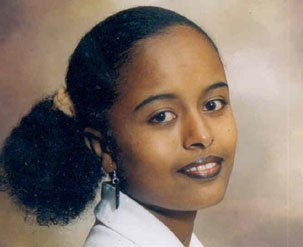 Addis Ababa — Her name is ShiBire Desalegn. She is the first person to be killed when Meles Zenawi unleashed his forces following a peaceful protest by Addis Ababa University (AAU) students on June 6, 2005. She was shot and killed by EPRDF troops as she and her friends tried to block the road in Kotebe that leads to the Sendafa torture camp. She helped escape several AAU students from torture by helping them jump from the trucks that were taking them to Sendafa. She didn’t have any weapon. But that didn’t stop the EPRDF troops from shooting her to death.
A high caliber bullet pierced through her neck.
Because of ShiBire’s actions, some AAU students escaped torture. But because of the action and inaction of others, thousands went through unspeakable brutality in the hands of the EPRDF security forces under the direct orders of Meles Zenawi. Thirty days later, Meles Zenawi was standing next to President Bush and Prime Minister Tony Blair at the G8 meeting in Scotland, looking proud of his barbaric actions.
Ethiopian Review spoke with ShiBire’s mother, Wzr. Ayelech Birkneh. She is devastated by her daughter’s sudden death. As the bread winner of the family, the 21-year old ShiBire was supporting her mother and six teenage siblings. The father passed away, leaving only a 50 birr monthly pension.
ShiBire could not continue her education, because there was nobody else to support the family. Her income was not enough to support the whole family even though she worked hard. The only choice she had to generate enough income was to go to a foreign country looking for a job.
People in ShiBire’s neighborhood appreciate what she did and died for. They think she is a heroine and a role model. They talk about her with a great deal of pride. She stood up for the students who only demanded respect for the people’s vote. She paid the ultimate sacrifice trying to save others.
By Anne Applebaum | Washington Post
Women in sunglasses and headscarves, speaking through megaphones, brandishing cameras, carrying signs: When they first appeared, the photographs of the 2005 Tehran University women’s rights protests were a powerful reminder of the true potential of Iranian women. The images were uplifting; they featured women of many ages; and they went on circulating long after the protests themselves died down. Now they have been replaced by a far more brutal and already infamous set of images: The photographs and video taken this past weekend of a young Iranian woman, allegedly shot by a government sniper, dying on the streets of Tehran.
I don’t know whether the girl in the photographs is destined to become this revolution’s symbolic martyr, as some are already predicting. I do know, however, that there is a connection between the violence in Iran over the past week and the women’s rights movement that has slowly gained strength in Iran over the past several years.
In the United States, the most America-centric commentators have somberly attributed the strength of recent demonstrations to the election of Barack Obama. Others want to give credit to the democracy rhetoric of the Bush administration. Still others want to call this a “Twitter revolution” or a “Facebook revolution,” as if zippy new technology alone had inspired the protests. But the truth is that the high turnout has been the result of many years of organizational work, carried out by small groups of civil rights activists and above all women’s groups, working largely unnoticed and without much outside help.
Since 2006, the One Million Signatures Campaign has been circulating a petition, online and in print, that calls for an end to laws that discriminate against women and the enactment of laws that provide equal rights for women in marriage, equal rights to divorce, equal inheritance rights and equal testimony rights for men and women in court. Though based outside the country, the Abdorrahman Boroumand Foundation, founded by a pair of sisters, translates and publishes online fundamental human rights documents; it maintains an online database of the names of thousands of victims of the Islamic Republic as well. In the past decade, Iranian women have participated in student strikes as well as teachers’ strikes, and in organizations of Bahai, Christian and other religious groups whose members are deemed “heretics” by the regime.
Not Obama, not Bush and not Twitter, in other words, but years of work and effort lie behind the public display of defiance and, in particular, the number of women on the streets — and their presence matters. Their presence could strike the deepest blow against the regime. For at the heart of the ideology of the Islamic Republic is its claim to divine inspiration: Its leadership is legitimate, as is its harsh repression of women, because God has decreed that it is so. The outright rejection of this creed by tens of thousands of women, not just over the past weekend but over the past decade, has to weaken the Islamic Republic’s claim to invincibility, in Iran and across the Middle East. The regime’s political elite knows this well: It is no accident that the two main challengers to President Mahmoud Ahmadinejad in the Iranian presidential campaign promised to repeal some of the laws that discriminate against women, and it is no accident that the leading challenger, Mir Hossein Mousavi, used his wife, a political scientist and former university chancellor, in his campaign appearances and posters.
The Iranian clerics know that women pose a profound threat to their authority, too: As the activist Ladan Boroumand has written, the regime would not bother to brutally repress dissidents unless it feared them deeply. Nobody would have murdered a peaceful, unarmed young woman in blue jeans — unless her mere presence on the street presented a dire threat.
The regime may succeed. Violence usually succeeds, at least in the short term, in intimidating people. In the long term, however, the links, structures, organizations and groups set up by Iranian women, not to mention the photographs of the past week, will continue to gnaw away at the Iranian regime’s legitimacy — and we should take note. I cannot count how many times I’ve been told in recent years that “women’s issues” in the Islamic world are a secondary subject: Whether the discussion is of the Afghan constitution or the Saudi government, the standard line among most commentators has always been that other things — stability, security, oil — matter more. But regimes that repress the civil and human rights of half their population are inherently unstable. Sooner or later, there has to be a backlash. In Iran, we’re watching one unfold.