“You can’t beat this, Taylor Dent said. And he proceeded to take a victory lap around the Grandstand court, slapping hands with fans who repeatedly were chanting, “Dent! Dent! Dent! Dent!” during his four-hour, nine-minute 6-4, 5-7, 6-7 (1), 7-5, 7-6 (9) second-round victory over Spain’s Ivan Navarro.
NEW YORK (AP) — After 4 hours, five sets and a match he won’t soon forget, Taylor Dent grabbed the umpire’s microphone and thanked the raucous U.S. Open crowd.
Really, though, they should have been thanking him.
Dent kept his inspiring comeback story on track with a crowd-pleasing victory over Spain’s Ivan Navarro.
The American won on his fourth match point, with a backhand return winner past Navarro that brought the fans at the Grandstand court to their feet. Really, they had been on their feet through most of this match, a tussle between a pair of serve-and-volleyers who played a lot of short points and high-risk, high-reward tennis.
Dent had a bigger game. He finished with 121 winners and 50 unforced errors, with his serve topping out at 147 mph. One of his serves, a 138-mph offering, broke the strapping on the net and caused a 7-minute delay.
None of this, of course, seemed possible two years ago when the 28-year-old, once ranked as high as No. 21, was bedridden with a back injury that some doctors said would never allow him to play tennis again.
He underwent delicate surgery and proved them wrong.
“When they told me I had the opportunity to play tennis again, how could I pass that up?” he said. “A select few get to play professional sports. It would have been naive and irresponsible of me to not try to capitalize and come out here and give it my best.”
Ranked 195th and playing in his first U.S. Open since 2005, Dent’s best has been good enough so far.
Next up, though, is a third-round match against No. 2 Andy Murray. He’ll be a huge underdog. He has overcome these kind of odds before.
“It’s going to be rough, there’s no way around it,” Dent said. “My execution is not where I want it to be, but that’s not going to stop me from battling. That’s how I won today. Even if it’s 6-0, 6-0, 6-0, I’m going to go out and hustle and give everything I’ve got.”
* * *
Taylor Phillip Dent (born April 24, 1981) is a tennis player from the United States.
He has won 4 ATP singles titles during his career: Newport (2002), Bangkok (2003), Memphis (2003), and Moscow (2003), and reached the finals of three other events on tour.
Dent’s most memorable performance of his career so far came at the 2004 Summer Olympics, where he made a push all the way to the semifinals, where he was defeated by eventual gold medalist Nicolás Massú of Chile. Even more memorable was his bronze medal match against Fernando González, also of Chile, which he lost 16-14 in the 3rd set.
Dent, paired with Lisa Raymond, won the 2006 Hopman Cup, defeating the Netherlands two rubbers to one in the final.
In 2006 Dent did not play very many competitive matches, due to the recurring back and groin problem. Dent had back surgery on March 19, 2007.
On May 26, 2008 Dent received a wild card and played at the Carson challenger in the United States. It was his first match since February 2006. He lost his first round match to Cecil Mamiit. In July 2008 Dent took a wild card into his first ATP tour event for two seasons at the Hall of Fame tennis tournament in Newport, Rhode Island. He lost in three sets to Canada’s Frank Dancevic.
On November 12, 2008 Dent won his first comeback match at the Champaign challenger against Frederic Niemeyer 6-3 7-6(3). He followed this win up by defeating number 2 seed and fellow American Robert Kendrick. In the third round Dent had to withdraw against Sam Warburg.
Using his protected ranking of 56, Dent played the 2009 Australian Open, where he was eliminated in the first round by Amer Delic.
As a qualifier, he reached the fourth round of the 2009 Sony Ericsson Open, defeating Nicolas Almagro and Tommy Robredo in the process. He lost to Roger Federer in the fourth round, 3-6, 2-6. Despite the scoreline, the first set was a very entertaining encounter, with Federer’s longest service game lasting just short of a quarter of an hour; Dent had 8 break point opportunities. He had a poor run of form following this, but reversed the poor form by qualifying for Wimbledon, having entered the qualifying via a wildcard. He won his way through to the main draw, where he lost to Daniel Gimeno-Traver in five sets in the first round.
Unusual for a contemporary tennis player, Dent favors a pure serve-and-volley style of play. He possesses a powerful serve and strong volleys. He is the owner of the fourth fastest serve in the world, at a velocity of 243 km/h. Andy Roddick, Ivo Karlović and Joachim Johansson are the only three players to have served faster.
Dent is the son of former ATP player and 1974 Australian Open finalist Phil Dent. Taylor’s mother, Betty Ann (Grubb) Stuart, who has remarried, reached the U.S. Open doubles final in 1977 with Renée Richards and was a former Top 10 player in U.S. His stepbrother, Brett Hansen-Dent (born July 2, 1972), played on ATP circuit briefly after reaching the NCAA singles final while representing the University of Southern California. His godfather is former top ten player, Australian John Alexander, who was also Phil Dent’s doubles partner when they won the 1975 Australian Open doubles title. His first cousin Misty May-Treanor is one of top pro volleyball players in the world and a gold medalist at both the 2004 Summer Olympics and the 2008 Summer Olympics.
Dent appeared in a US television commercial for insurer Genworth Financial as the opponent of a young boy playing the role of Jaden Agassi, the son of Andre Agassi and Steffi Graf.
Dent attended Corona del Mar High School in Newport Beach, California, whom he played for. He also attended Monte Vista High School, also in California. He has a tattoo of American and Australian flags on his right shoulder. On December 8, 2006, he married WTA Tour player Jennifer Hopkins. Wedding guests included Maria Sharapova, Nick Bollettieri, Jan-Michael Gambill, Tommy Haas and Mashona Washington.
The following is a 45-page report that is issued today by International Crisis Group on ethnic politics in Ethiopia
EXECUTIVE SUMMARY
The Ethiopian Peoples’ Revolutionary Democratic Front (EPRDF) [a cover organization for tribalist Tigrean People Liberation Front ({www:Woyanne})], led by its chairman and prime minister, Meles Zenawi, has radically reformed Ethiopia’s political system. The regime transformed the hitherto centralised state into the Federal Democratic Republic and also redefined citizenship, politics and identity on ethnic grounds. The intent was to create a more prosperous, just and representative state for all its people. Yet, despite continued economic growth and promised democratization, there is growing discontent with the EPRDF’s ethnically defined state and rigid grip on power and fears of continued inter-ethnic conflict. The international community should take Ethiopia’s governance problems much more seriously and adopt a more principled position towards the government. Without genuine multi-party democracy, the tensions and pressures in Ethiopia’s polities will only grow, greatly increasing the possibility of a violent eruption that would destabilise the country and region.
The endeavour to transform Ethiopia into a federal state is led by the Tigray People’s Liberation Front (TPLF), which has dominated the coalition of ethno-nationalist parties that is the EPRDF since the removal in 1991 of the Derg, the security services committee that overthrew Emperor Haile Selassie in 1974. The EPRDF quickly institutionalised the TPLF’s policy of people’s rights to self-determination and self-rule. The federal constitution ratified in 1994 defined the country’s structure as a multicultural federation based on ethno-national representation.
The government has created nine ethnic-based regional states and two federally administered city-states. The result is an asymmetrical federation that combines populous regional states like Oromiya and Amhara in the central highlands with sparsely populated and underdeveloped ones like Gambella and Somali. Although the constitution vests all powers not attributed to the federal government in them, the regional states are in fact weak.
The constitution was applauded for its commitment to liberal democracy and respect for political freedoms and human rights. But while the EPRDF promises democracy, it has not accepted that the opposition is qualified to take power via the ballot box and tends to regard the expression of differing views and interests as a form of betrayal. Before 2005, its electoral superiority was ensured by the limited national appeal and outreach of the predominantly ethnically based opposition parties. Divided and disorganised, the reach of those parties rarely went beyond Addis Ababa. When the opposition was able to challenge at local, regional or federal levels, it faced threats, harassment and arrest. With the opportunity in 2005 to take over the Addis Ababa city council in what would have been the first democratic change of a major administration in the country’s history, the opposition withdrew from the political process to protest flaws in the overall election.
The EPRDF did not feel threatened until the 2005 federal and regional elections. The crackdown that year on the opposition demonstrated the extent to which the regime is willing to ignore popular protest and foreign criticism to hold on to power. The 2008 local and by-elections went much more smoothly, in large part because the opposition Coalition for Unity and Democracy (CUD) was absorbed with internal and legal squabbles, and several other parties withdrew after their candidates experienced severe registration problems. The next federal and regional elections, scheduled for June 2010, most probably will be much more contentious, as numerous opposition parties are preparing to challenge the EPRDF, which is likely to continue to use its political machine to retain its position.
Despite the EPRDF’s authoritarianism and reluctance to accept genuine multi-party competition, political positions and parties have proliferated in recent years. This process, however, is not driven by democratisation or the inclusion of opposition parties in representative institutions. Rather it is the result of a continuous polarisation of national politics that has sharpened tensions between and within parties and ethnic groups since the mid-1990s. The EPRDF’s ethnic federalism has not dampened conflict, but rather increased competition among groups that vie over land and natural resources, as well as administrative boundaries and government budgets.
Furthermore, ethnic federalism has failed to resolve the “national question”. The EPRDF’s ethnic policy has empowered some groups but has not been accompanied by dialogue and reconciliation. For Amhara and national elites, ethnic federalism impedes a strong, unitary nation-state. For ethno-national rebel groups like the ONLF (Ogaden National Liberation Front; Somalis in the Oga den) and OLF (Oromo Liberation Front; the Oromo), ethnic federalism remains artificial. While the concept has failed to accommodate grievances, it has powerfully promoted ethnic self-awareness among all groups. The international community has ignored or downplayed all these problems. Some donors appear to consider food security more important than democracy in Ethiopia, but they neglect the increased ethnic awareness and tensions created by the regionalisation policy and their potentially explosive consequences. [… click here to read the full report]
(Strotty) — If you have been watching ESPN at any time over the past two weeks or so, you knew that yesterday marked the beginning of the 2009 NCAA Football season. I’m more of an NFL man myself but over the last couple of years have began to get into the college game as well. Marquette has no football team so I haven’t picked a school to root for (despite my man-crush on Tim Tebow), but I am starting to respect and enjoy the game more.
The year was kicked off on ESPN with a top-25 matchup between the 14th ranked Boise State Broncos and 16th ranked Oregon Ducks. The bordered rivals entered the game with BCS berth aspirations, full-well knowing that the loser of the game was pretty much out of the running with Boise State playing in a non-BCS conference and Oregon having USC in theirs, the Pac-10.
Much hype was made of the game, but a lackluster 19-8 Boise State win became a whole lot more exciting after the final whistle blew. As the two teams congregated on the field in a standard post-game handshake, Boise State sophomore defensive end Byron Hout ran by Oregon running back LeGarette Blount and said something. Blount then stared at Hout for a moment and delivered a sucker-punch, knocking Hout to the ground.
Blount then punched a teammate trying to hold him back as he attempted to get back to where Hout was. He was escorted off the field by a few teammates and security as he got into it with a group of fans who, Blount says, punched him and held up a chair as if to throw at him.
The melee was a mess and really took away from the start to what looks to be an excellent college football season. Blount will have repercussions from his actions, but the real question is this: is Byron Hout at fault as well?
The beginning of this story goes way back to last season, after Boise State had defeated the Ducks 37-22 in Oregon. Two late hits in the game by the Broncos were the talk of the town, and last month Blount told Sports Illustrated that Oregon owed Boise State “an ass-whooping”.
Here’s a lesson that young (OK, he’s older than me) Byron Hout needs to learn: bulletin board talk is supposed to psych you up before the game and during it, not after. How many times we seen players come out in the media and say something to rile the other team up before a huge rivalry? It’s part of sports and something that happens all the time.
Mature players speak with their actions on the field, something all but one Bronco did Thursday night. I played four years of high school football, and while I would never compare it to a meeting between a Pac-10 school and a WAC powerhouse, the jist of what goes on is the same.
Trash talk happens in every facet of the game during all minutes of the game. From the second the kickoff takes place to the final whistle, kids are hooting and hollering at the opposition to get their squad jacked up. In Hout’s case, he had 60 minutes to say anything and everything he wanted to Blount. Odds are he said quite a bit during the game, meaning he clearly got his point across enough that he could have shut up after the game.
The other aspect of all this is that Boise State won the game handily. Despite the score, Boise State controlled the game and never let Oregon back in it. Blount rushed for negative yards on eight carries and caught just two passes on the evening. He was shut up in every aspect as the Broncos delivered him his self-proclaimed “ass-whooping”.
The term “leaving everything on the field” does not just apply to work ethic and heart. It applies to the trash-talking and bitterness towards your opponent. After the game, Blount was seen shaking hands with Boise State players just as any normal player would do. The game was over and so was the trash-talking.
(LeGarrette Blount was extremely wrong for punching Byron Hout, but why did Hout talk in the first place?)
If Hout wants to hate Oregon and LeGarrette Blount for the rest of his life, that’s his prerogative and something I wouldn’t blame him for. After all, the rivals have had a battle of words but in the end, Boise State has two “W’s” that any Oregon Duck wishes they had. Those two wins in the last two years were enough for everyone on the Smurf Turf expect one Byron Hout.
For some reason he needed more than just a victory to settle the score with Blount. The Oregon running back had just started off his senior year in the worst way possible, had just blown any realistic chance at a BCS berth, and had one of the worst games of his football career. Hout taunted him like a child and basically kicked him while he was down. Hout does not deserve to be suspended, but some internal action needs to be taken so Hout knows he wasn’t just a victim in this incident.
As for Blount, the proverbial last straw has been taken from his and his days in an Oregon uniform need to be over. First year head coach Chip Kelly suspended Blount in the off-season for “failing to fulfill team obligations” before being re-instated for the start of the season. Out of high school, Blount did not qualify academically and had to jake the JUCO route before winding up at Oregon.
If Kelly wants to make a statement with his new program, he will sacrifice his starting running back to show that Oregon is not full of punks. It’s true that Hout is at fault for talking after the game, but if a player can not show enough restraint to not sucker-punch a player, his own teammate, and go after fans after the fact of the matter, then he has no place on a respected Division-I football team.
It’s sad that the end of a game between two great football teams had to end in such a poor way, but don’t think that Blount is the only one at fault here. Hout had no place going and taunting, not talking to, Blount after the game. He was jumping around him, patted him on the back and said something that clearly angered Blount. It was immature and stupid of Hout, but Blount’s even dumber actions seem to be covering that up.
Whatever happens to Blount, likely a suspension of some sort, Hout needs to come out publicly and apologize for his words and actions to clean this act up. Not only will it make him look better, but it will remove some of the dark cloud that is being put over the heads of the poor winners of Boise State. Only one person took it too far, but every second Hout wears the Boise State blue, he represents the school and has to know that anything he does is a representation of the school.
Oregon running back LeGarrette Blount straight lost his mind Thursday night, sucker punching a Boise State player and requiring physical restraint to leave the stadium after the Ducks’ embarrassing 19-8 loss. Boise State’s Byron Hout appeared to tap Blount on the shoulder during postgame interactions, before turning away, only to take a Blount sucker punch to his jaw that floored him. Broncos coach Chris Petersen rushed in to separate him from further incident.
Blount then hopped away, only to get into another altercation with several Boise State fans seated near the field. At that point several people had to restrain him and forcibly drag him down the tunnel into an unknown but probably dark future. Its not unreasonable to speculate that his college career is over. Blount was particularly atrocious in Thursday’s game, netting negative five yards on eight carries including being on the wrong end of a safety.
Video after the jump.
Hout is not immune from criticism in his role in the affair, but Blount crossed a line in punching a player who had turned away from him. His inexplicable escalation after arguing with some Boise State fans while leaving the stadium only further condemns him to a severe fate.
Boise State coach Chris Petersen, who was witness to the sucker punch, was more diplomatic, telling ESPN’s Heather Cox that emotions had gotten the better of some players while turning attention to his team.
Its too bad, because, despite his bad game, Blount is a marvelous talent who would have done great things for Oregon this year. At this point he’s just as likely to face a lengthy suspension or outright booting from the Oregon football program as he is to play again this year.
Of no small irony — the American Football Coaches’ Association had recommended full-team pregame handshakes to build sportsmanship in the game during opening weekend.
BRUSSELS (AP) — Who is track’s greatest runner? Long-distance star Kenenisa Bekele of Ethiopia wonders what it would be like to race sprinting great Usain Bolt.
“If Usain agrees, if someone wants to organize this, I am ready,” Bekele said Thursday, a day before the Memorial Van Damme Golden League meet.
Bolt, of Jamaica, is the reigning world and Olympic champion and world record-holder over 100 and 200 meters. Bekele, of Ethiopia, is the reigning world and Olympic champion and world record-holder over 5,000 and 10,000 meters.
The idea would be to find a middle ground — between 600 and 800 meters.
“I think I am pretty good at 600 meters,” Bolt said last week. Above 800 meters, he said, “I have no chance.”
Bekele also thinks the two could meet at about that distance.
“Six-hundred meters is a good chance for him,” said Bekele, considering he would lose too much over the first lap. “I need some 800 meters, maybe 700 meters.”
A Bolt-Bekele showdown would be the biggest match race since 200 and 400 Olympic champion Michael Johnson raced 100 champion Donovan Bailey over 150 meters in Toronto after the 1996 Atlanta Games. Johnson pulled up lame halfway through that race and the legacy of the event is more a joke than anything else.
Bekele’s manager, Jos Hermens, realizes that Bolt dominates the sport to such an extent that even a superlative performance like Bekele’s 5,000-10,000 double at the Olympics and worlds became merely a footnote.
“I will have to think about it this winter,” Hermens said, referring to a potential matchup. He added that he will be in touch with Bolt’s manager, Ricky Simms.
Bekele is often overshadowed and he is still chasing the worldwide acclaim enjoyed by compatriot Haile Gebrselassie. Bolt’s showmanship and stunning performances have made him one of the most marketable athletes in any sport.
When it comes to official performances, the two get no closer than the 400 for Bolt and the 1,500 for Bekele.
Bekele set a personal best of 3 minutes, 32.35 over 1,500 two years ago, a time that would make him the 13th best performer of 2009. Bolt’s top mark over 400 is 45.28 in 2007, which would be the 28th fastest time of this year.
For decades, Ethiopia has been affected by famine and conflict. In 2009, there have been various reports of internal displacement resulting from conflicts and human rights violations perpetrated by the army and groups opposed to the government. It is difficult to establish the number of internally displaced people (IDPs) as neither the government nor any international organisation has undertaken a profiling exercise. The access of humanitarian and human rights organisations and the media to some areas of the country has been restricted.
The ongoing conflicts in Somali Region between the army and the Ogaden National Liberation Front, and in the south and south-west of the country with the Oromo Liberation Front, both pose serious security, humanitarian and protection challenges. The impact on civilians of the conflict in Somali Region has been likened to that of Darfur. Meanwhile, there are also conflicts in at least five of the country’s nine regions with causes ranging from competition over scarce water and pasture resources to disputes over administrative boundaries. In February 2009 alone, some 160,000 people were driven from their homes by conflict between the Garre of the Somali region and the Boran of the Oromiya region over a contested piece of land.
Displacement in Ethiopia is well documented but there is no evidence of durable solutions for IDPs. There is no agency or ministry mandated to respond to issues of forced internal displacement. Even though Ethiopia is actively involved in the drafting of the African Union convention on internally displaced people, there is growing evidence to suggest that conflicts in the country have far-reaching implications for protection and humanitarian assistance for internally displaced people. In a context of widespread impunity, no-one sanctioning violence that leads to displacement has been prosecuted.
The absence of political efforts to resolve internal conflicts and the continuing border dispute with Eritrea presents an ongoing serious risk of renewed conflict and displacement in the Horn of Africa. If the government does not improve humanitarian access, affected IDPs and other vulnerable people will continue to face a protection and humanitarian crisis.
Background: locations and causes of conflict and displacement
For decades, Ethiopia has faced severe famines and regional and international conflicts. From 1977 to 1978 it waged a war with Somalia in which the USA and USSR were involved, it fought a border war with Eritrea between 1998 and 2000, and from 2007 to early 2009 its army was pitted against insurgents (supported by Eritrea) and other nationalist groups in Somalia (The Enough Project, 9 February 2009).
Ethiopia was transformed from a unitary state to an ethnic federal state in 1994 by the new government led by the Ethiopian Peoples Revolutionary Democratic Front (EPRDF), which seized power from the Dergue government of Mengistu Haile Mariam in 1991. This new constitutional order was intended to redress the ethno-national grievances among the many ethnic groups in the country (International Journal on Minority and Group Rights, 2008).
However, despite this system of ethnic federalism under which the country is divided into ethnically-defined regions and zones, in almost all cases, displacement was triggered by conflict between different ethnic groups over access to political power or scarce resources such as water and pastoral or agricultural land. There are several conflict-induced displacement situations in Ethiopia, the largest occurring in the administrative regions of Somali, Oromiya, Gambella and Tigray. In addition to these, the government’s counter-insurgency activities in regions such as Oromiya, Somali, and Gambella have led to serious human rights violations which have also led to displacement of civilians (HRW, June 2008; ISS, May 2007).
In November 2008, a study undertaken by the Ethiopian NGO African Rally for Peace and Development (ARPD) showed internal armed conflicts in most of the regions of Ethiopia, including Oromiya, Tigray, Somali, Southern Nationalities and Peoples Republic (SNNPR), Afar, Gambella, and Benishangul-Gumuz (ARPD, November 2008). The US State Department’s 2008 Human Rights Report on Ethiopia reported that ethnically-based conflicts in western, eastern and southern areas had resulted in an increase in killings and injuries since 2007 and the displacement of tens of thousands of people (USDoS, 25 February 2009).
According to ARPD, the major causes of conflicts within Ethiopia’s regions are ethnicity, disputed border and administrative arrangements, the impact on the distribution of resources and power, large-scale spontaneous and planned migration, religious differences, and mineral extraction.
The Borena zone of Oromiya Region, Gambella Region and SNNPR have witnessed recent intra-ethnic and inter-ethnic conflicts (ARPD, November 2008; ISS, 1 May 2007). In August 2008, inter-clan conflict displaced almost 13,000 people in Gambella Region (interview with OCHA, 5 June 2009).
Even though numbers of people displaced by conflict and human rights violations are not easy to establish due to the restrictions that are placed on the activities of media reporters and humanitarian organisations wishing to profile populations in need, the UN and other international organisations estimate that over 300,000 people are displaced by conflict or violence in Ethiopia in 2009 (interviews in Addis Ababa, June 2009).
Somali Region
The conflict between the government and the Ogaden National Liberation Front (ONLF) in Somali Region has continued into 2009 (BBC, 9 March 2009; Garoweonline, 8 March 2009). In an August 2009 Al-Jazeera interview, Genocide Watch founder and president Gregory Stanton and the human rights activist Fowsia Abdulkadir described a “genocide-like” situation comparable to Darfur, with reports of killings and burning of villages despite the army’s severe access restrictions on the media and humanitarian organisations (Al-Jazeera, 9 August 2009).
These restrictions make it impossible to establish the number or situation of people displaced by the conflict in Somali region (The Christian Science Monitor, 26 February 2008; Reuters, 27 February 2008; VOA, 25 February 2009). However, many analysts talk of displacements of hundreds of thousands of people (interviews in 2009 in Addis Ababa, Geneva, and Nairobi).
According to a 2008 Human Rights Watch (HRW) report, the government’s counter-insurgency campaign against the ONLF, designed to cut off civilian support to the ONLF and concentrate its rural support base in designated larger villages and towns, had caused widespread forced displacement, particularly between June and August 2007. The government had ordered civilians to relocate from small villages and pastoralist settlements to designated towns throughout the conflict-affected zones, typically ordering the villagers and nomads to move within two to seven days. To secure compliance with the evacuation orders, the army had repeatedly implemented a phased system of terror involving the confiscation and killing of livestock, public executions, and the destruction of villages by burning (HRW, June 2008; p.33).
Oromiya Region
Another rebel group operates in southern Ethiopia and northern Kenya and claims to be fighting for the autonomy of the Oromo people. The Oromo Liberation Front (OLF) has fought the Ethiopian army since 1973. Little information is available on how this conflict has caused displacement due to government restrictions. In August 2009, the government summoned the Ambassador of Kenya, demanding that his government stop a private media company in Kenya airing an investigation on the OLF (Daily Nation, 6 August 2009).
Conflicts over disputed administrative borders
In October 2008, approximately 100,000 people were displaced as a result of conflict in the Filtu and Hudet areas over a disputed border between the ethnically-defined Oromiya and Somali Regions (IDMC interview, Addis Ababa, 9 June 2009). In the majority of cases, people sought shelter with host communities, while others scattered in the surrounding bush.
In early 2009, ethnic clashes between Somali and Oromo ethnic groups displaced tens of thousands of people. The conflict was triggered when the Oromiya regional authorities started drilling a borehole on contested land close to the dividing line between the Oromiya and Somali Regions, which has never been properly demarcated. When the Garre Somalis destroyed the rig, members of the Borana clan mobilised to take revenge, angry at what they saw as years of Somali encroachment. Some 300 people lost their lives during the conflict (BBC, 26 February 2009). Initial reports suggested 70,000 people were displaced (BBC, 13 March 2009), but regional government officials later put the figure at over 150,000 (interview with Somali and Oromiya officials in Moyale, 17 June 2008).
In October 2008, almost 18,000 people were displaced in Alaba district of SNNPR as a result of inter-ethnic conflict between the Arsi and the Alaba over a disputed administrative boundary (IDMC interview, Addis Ababa, 9 June 2009).
Physical security
HRW has reported that serious human rights violations have taken place in areas affected by conflict and displacement, and that the government has not investigated or brought to account the perpetrators (HRW, January 2009). A June 2008 HRW report on Somali region was very critical of the human rights records of both the Ethiopian government and army and the ONLF. According to HRW, violations included military attacks on civilians and their villages, while continuing abuses by both rebels and Ethiopian troops were posing a direct threat to the survival of people remaining in war-affected areas, and creating a pervasive culture of fear (HRW, June 2008).
HRW also reported a military campaign of forced relocations and destruction of villages in 2007 (HRW, June 2008). Villagers told HRW how the army killed herders and other fleeing civilians, and burned homes, property and food stocks (HRW, 3 October 2007). Reuters also reported that the burning of villages was forcing locals to flee to the bush where their basic needs were unmet (Reuters, 4 September 2007).
Similar allegations of the army committing human rights violations against the civilian population in the Somali Region were also documented by Amnesty International, the US Department of State and Genocide Watch (AI, 28 May 2009; USDoS, 25 February 2009; Al-Jazeera, 9 August 2009).
Satellite images have backed up reports that the Ethiopian army has burnt towns and villages in Somali Region. The American Association for the Advancement of Science says the images confirm the HRW report and show the army systematically ill-treating civilians in their counter-insurgency campaign (BBC, 12 June 2008).
Gender-based violence is also said to be widespread in Somali region, which is reportedly openly countenanced by the army. Several witnesses have reported that they were gang-raped to the point of unconsciousness by soldiers (Al-Jazeera, 9 August 2009; HRW, June 2008; Reuters, 27 February 2008).
In the February 2009 conflict between the Garre-Somali and the Oromiya-Boran, 300 lives were lost. The BBC reported that many of the displaced had had their villages destroyed and their property stolen (BBC, 13 March 2009).
Landmines continue to hamper the free movement of people in conflict areas. Ethiopia is one of the most heavily-mined countries in Africa. A Norwegian People’s Aid (NPA) survey found that 1.9 million people were at risk and identified almost 1,500 communities affected by landmines (Afrol News, 15 April 2009).
Humanitarian access
The activities of aid workers have been severely restricted in regions such as Somali. Humanitarian agencies have since 2008 been granted permission to deliver food but the military escorts still hinder full access (Daily Telegraph, 17 October 2008; BBC News, 19 September 2008; The Times, 18 September 2008). The army has maintained control over humanitarian aid by accompanying convoys, and determining whether it is safe for a delivery to go ahead. Médecins Sans Frontières (MSF) has been denied access to Somali Region, and has called on the government to immediately allow its teams to provide assistance to people in the region who are facing an increasingly desperate situation (MSF, 4 September 2007). In July 2008, the Swiss arm of MSF halted its operations in the Region, due to the obstacles put in its way. According to the organisation’s statement: “The authorities’ attitude towards humanitarian organisations has translated into recurrent arrests of MSF Switzerland staff without charge or explanation… Despite continuous attempts to improve the working relations with authorities, our organisation can only regret the absence of any room to bring independent and impartial assistance.” (IRIN, 10 July 2008)
Insecurity in some parts of the country has also hindered aid delivery. In September 2008, two aid workers working for an international organisation were kidnapped by gunmen in Somali Region (BBC, 23 September 2008).
National and international responses
The absence of political effort to resolve internal conflicts and the continuing border dispute with Eritrea presents an ongoing serious risk of renewed conflict in the Horn of Africa, with potential for large-scale displacement and severe humanitarian consequences. At a recent joint meeting between the House of the Federation and representatives of all nine regional governments in Benishangul-Gumuz Region, regional governments accused the federal authorities of not doing enough to help them contain conflicts in the regions (The Reporter, 15 August 2009).
The government’s strong control of humanitarian response mechanisms has left many of the disasters either unreported or played down. Responses have been fragmented, inadequate, late, and have left affected populations in an even worse situation (interview in Geneva, November 2008). For example, government food distribution policies have reportedly prevented assistance reaching people in need (AI, 2009); The Telegraph, 17 October 2008; BBC News, 19 September 2008; The Times, 18 September 2008, IRIN, 10 July 2008).
If the government does not improve humanitarian access, affected IDPs and other vulnerable people will continue to face a protection and humanitarian crisis (ICG, 17 June 2008). USAID reported in March 2008 that “literally hundreds of areas… have neither been assessed nor received any food assistance”, with “populations terrorised by the inability to access food” (The Times, 18 September 2008). The British Channel 4 reported that the army had withheld food from villages in Somali Region as part of a “scorched earth” policy against the ONLF (BBC, 19 September 2008; The Times, 18 September 2008). Before the British Minister for International Development toured a hospital in the town of Kebri Dehar during a visit to Somali Region in October 2008, local officials forced starving infants out of the emergency ward and on to the street (The Telegraph, 17 October 2008).
There is no dedicated government agency or office or a focal point that is known to be dealing with conflict-induced displacement. In August 2008, the government disbanded the Disaster Prevention and Preparedness Agency (DPPA) whose responsibilities were to be to anticipate and prevent disasters and build local capacities to do so as well and transferred its mandate to the Ministry of Agriculture and Rural Development. Ministry officials now charged with disaster risk management (DRM) anticipate the increased decentralisation of these DRM responsibilities. A proposed policy has called for the mainstreaming of disaster risk management throughout government and greatly strengthened disaster management capacity at the highest levels of government. Debates continue within the government regarding the policy and it is unclear if or when it will be adopted and to what degree this will deal with conflict-induced displacement (ODI, June 2009).
Government line ministries normally help UN agencies disburse food and sanitation assistance (OCHA Humanitarian Bulletin, 10 August 2009). In July 2009, the UN disbursed some $6 million towards helping the Ethiopian government help contain the rising challenges of food insecurity, malnutrition, and ensure health care and water and sanitation support, mostly in displacement-affected areas of Somali, Oromiya, and SNNPR (IRIN, 27 July 2009).
In August 2009, the Committee on the Elimination of Racial Discrimination (CERD) recommended to the government “to ensure that refugees and other vulnerable persons, such as internally displaced persons, enjoy their rights under national law as well as various international legal instruments to which it is a party…” The Committee further requested the State Party to “provide, in its next periodic report, detailed information on the human rights situation of refugees and internally displaced persons on its territory…” (CERD, 31 August 2009).


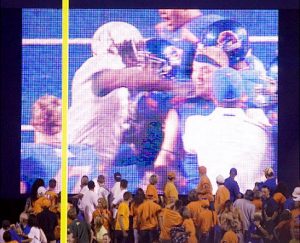 (LeGarrette Blount was extremely wrong for punching Byron Hout, but why did Hout talk in the first place?)