(APA) – Ethiopia is expected to export tens of thousands of kilos of honey and honey products to the European Union countries and this is expected to generate a huge amount of foreign currency to the country, Ethiopian Ministry of Trade and Industry, Tadesse Haile, said on Friday.
According to the ministry, Ethiopia managed to get certified after a year-long effort by the government and the Netherlands Development Programme.
Ethiopian State Minster of Trade and Industry, Tadesse Haile, said that investors who have been waiting to export their products can now start to export honey and honey products to the EU market.
“Investors can send the produces legally to the European continent,” Haile said.
The State Minister thanked the Netherlands Development Programme for its significant cooperation in getting the country certified to export the produces to Europe.
Accordingly, Ethiopia is expected to export tens of thousands of kilos of honey and honey products to the EU market.
Minister Haile said the government has given due attention to the sector by distributing modern hives in addition to organising them under associations.
“It is also ready to encourage investors, exporters, producers, raw material suppliers and processors create network,” he added.
SNV Ethiopia Director with the Netherlands Development Programme, Rem Neefjies, said on his part the government of Ethiopia has exerted utmost efforts to open the door to Europe and succeeded in reaping the fruits.
SNV Netherlands NGO is working in Ethiopia to support farmers in various fields, including honey products.
Ethiopia is known for its honey product. However, it is still unable to benefit from the sector, which involves tens of thousands farmers in the country.
This is a good idea for Ethiopian human rights groups.

Kagame’s fury at Spanish warrants
Rwanda’s President Paul Kagame has said a Spanish judge who issued arrest warrants for 40 Rwandan army officers can “go to hell”.
Mr Kagame described judge Fernando Andreu as “arrogant”.
Judge Andreu accuses the officers of carrying out killings during Rwanda’s genocide in 1994.
Mr Kagame said Judge Andreu had not distinguished between genocide perpetrators, and those who stopped it, such as his own forces.
The judge issued the arrest warrants in February, accusing the officers of genocide, terrorism and crimes against humanity.
He investigated the matter after a human rights group filed a complaint.
Under Spanish law, a court can prosecute alleged human rights crimes, even if they take place abroad.
Leadership indicted
Judge Fernando Andreu also indicted the Rwandan officers for the murder of nine Spanish citizens, including six missionaries.
He said he had evidence implicating President Kagame, who has immunity from prosecution.
“Imagine the arrogance involved – how can a Spanish judge sit in some town or village in Spain and sees it is his duty to indict the whole leadership of a nation,” Mr Kagame said in Kigali.
In February the Rwandan foreign ministry called the warrants “bogus” and “ridiculous”, and said the case was based on falsehoods, racist language and genocide denial.
The ministry said the judge had never visited Rwanda or the Democratic Republic of Congo, where some of the killings are alleged to have taken place.
Judge Andreu began considering the case in response to a complaint from a human rights group in 2005.
Diplomatic row
During a 100-day period in 1994, an estimated 800,000 Rwandans were killed, mainly ethnic Tutsis at the hands of radical Hutus.
The genocide came to an end when Tutsi-led rebels under Mr Kagame took control.
But the judge said that, after taking power, the army under Mr Kagame carried out mass killings of Hutus in Rwanda and in refugee camps in neighbouring DR Congo, then Zaire.
In 2006, a French judge, Jean-Louis Bruguiere, issued indictments against nine close aides of Mr Kagame, sparking a huge diplomatic row.
By Heidi Mehltretter
Wolaita, Southern Ethiopia — Ruth and I are sitting in her kitchen enjoying the music Shelley sent to us. There is so much to share about today that I don’t think it is possible to get it all said. We stayed up late, late last night talking about everything, then got up early to drive 1.5 hours with Dr. Mary to a Wolaittan village called Gadalla, where she practices medicine every other Thursday. It is like a county seat, but for a smaller area.
On the drive in, we saw a donkey cart carrying a pallet with a sick woman on it. Children chased us yelling “Mary, Mary.” When we arrived, we found the sick lined up outside the clinic. The first ones on homemade stretchers and the others sitting or standing in line. We handed out cards to those in line, which guaranteed they would be seen. Those who were late must return in two weeks. People traveled for hours and even days to get to the clinic.
The government buildings are constructed primarily of mud mixed with dried grass and are quite dark inside. I had to use my flash, which gives the photos a look that is not really accurate.
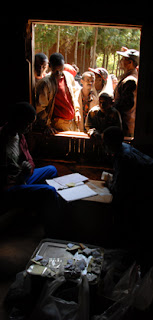 We set up in an empty room that is the clinic. Someone brought in a bench, two chairs and a small table, which later in the day became the pharmacy. We left all but one window closed to protect the medicines and food we brought, and make a place to get away from the people for a break once during the day.
Patients were seen outside by Dr. Ruth, who made notes on scraps of paper until the paper ran out, then used her hand. They really need packs of post-its or small pads of paper to write prescriptions on. Helping her was Sebastian, a German medical student and two boy translators, who are in a school Mary runs where they learn English. Also helping was a man that I suspect Dr. Mary hired because he is older and has trouble finding work. He carried the scale, and acted as sort of a guard; sometimes chasing people back with a switch he made from a corn stalk.
I took photos while holding the baby, but I will get to that later.
Cases that needed a second opinion were sent over to Dr. Mary and her young translator in the clinic. Dr. Mary speaks Wolaittan, and it appeared the boy would clarify, or translate into Amharic when needed. Dr. Mary saw these patients, organized medicines and handed out food to those in her food program.
 Next to this place was another small building that serves as a school. The children bring small stools or sit on the dirt. There is a chalkboard with the English alphabet on it. Wolaitan language uses the same letters we do, but the vowels are pronounced like they are in Spanish. When we arrived, sixty or so children were crammed into the room, doing lessons by chanting. I think the noise made it difficult for Mary, so it was good when they finished. Dr. Ruth also had challenges hearing the people outside because there were so many people gathering and talking around her. She often had to ask people to be quiet. Each time, some people would take it upon themselves to police the others. Men would smack the women, talking or not, who would in turn slap the kids. Five minutes later it would be noisy again. Relentless flies buzzing, kids playing on the donkey carts, cattle munching the banana leaves behind the clinic and donkeys yelling at each created a distinctly soundscape unlike any I’ve heard in South Carolina.

I’m trying to think of words to describe the problems we saw, but the words like “heart-wrenching” have been so overused, they don’t touch what we all felt. Here are some snippets of the conversations.
Ruth, “how often does he get to eat meat?”
“once, maybe twice a year.”
“any papayas or mangos, or vegetables?”
“no, just corn or bread or fake banana”
“well, with his condition, he needs some vitamins or he will go blind. Is it possible for him to buy some fruits and eat them on a regular basis?”
Ruth, “how long has she looked like this?”
This was about a woman who looked like she was nine months pregnant with twins.
“Ten months. She had a baby, but no blood came, then she swelled up like this.”
“The baby was born and looked normal?”
“yes.”
“did the baby live?”
“no”
“I will get a can, will you see if you can get her to urinate in it?”
Six people carry her stretcher behind the clinic and come back with the can.
There is no privacy. People gather all around the person being examined and watch everything. Maybe this is good as they may learn some methods of healing and prevention. One woman pulled her shirt aside to show me her breast. Most of it was gone and the remainder looked as if it had been horribly burned and blistered. At first glance Mary said cancer, then they made more observations and diagnosed her with localized TB in the breast.
Diagnoses in the field must be made without lab work, by observation and conferring with each other and medical books. Sometimes the people need to go to the hospital. If the case is dire, and Ruth refers them, they can be seen using the benevolent fund.
Ruth, “she needs surgery for this hernia, do you have bus money to get her to Soddo Christian Hospital?”
“no.”
“okay, well, she can wear a scarf tied tightly around it, then, when the pain gets very bad, which may take some time, you must try and find a way for her to come have surgery.”
To a girl, who for over one year had one eye horribly swollen and protruding from her face, “I will give you this card, and you go to the hospital with it, and they will see you.”
One boy we took home with us. He is ten, and had trouble breathing. He was bone thin and the skin sucked in and out of his lower ribs when he wheezed.
Ruth, “how long has he been breathing like this?”
“two years now”
“and what color is his spit?”
“it comes out with pus and is yellow.”
One look at his father’s ragged clothing and lack of shoes and I can see why they put off the trek to the doctor. I wonder what it cost them to not work for a day? I saw not one of the patients or family members eat or drink all day. They decided it was TB, confirmed on an x-ray even I could read when we got home to the hospital. Sweet boy was scared. I think he had never seen a “city” before. He liked my camera, though. We bought him a soda and gave him shoes and a shirt and will check on him again tomorrow. He is on oxygen and has an IV. I can’t imagine what he is feeling. (The boy dies a few months later. See below)
Dr. Ruth and Dr. Mary are amazing people. Dr. Ruth is in her element in this situation. Each person she meets must feel they are the most valuable person on earth when she talks with them in her sweet voice. Though outwardly calm, I can see her mental gears running hyper speed while she diagnoses, then tries to figure out what her patients have the means to do that will help. I saw her do this in the Dominican Republic, dispensing orders like these for diabetes, “if you can, you must try to drink three glasses of pure water each day,” and, “if I give you shoes, will you keep them on always and protect your toes?”
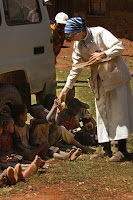 Mary’s love for the people is more evident in the many things she thinks to do to help them. She spends so much of her own money, I don’t know how she manages. One of the many things she does is make up vitamin packs. Each day’s dose is wrapped in a triangle of newsprint. The pack contains a malaria preventative, folic acid and vitamin b. She started just with the women, and found that men also really thrived on the folic acid/b combination.
She also had large milk cans filled with homemade Bisquick that she distributes to families that are malnourished. It can be mixed with water and baked traditionally to make nutritious bread and contains protein powder, and milk solids along with other vitamin enriched flours.
Today was the first time Sebastian had seen rural medicine in an area of extreme poverty. I felt for him. He is young, and I’m sure what he saw today will stay with him for a lifetime. He was very tired when we got home – I think emotionally. He did a wonderful job, too. In Germany, he was able to attend med school for around $800 a semester because it is governmentally subsidized (and, interestingly, there are no entrance exams), and he will have a job after taking this time off to do this work. His girlfriend is in Ghana working in an orphanage while he is here. She contracted a bad strain of malaria her first week and used up all her malaria meds treating it, so he is worried about her.
After they finished seeing all the patients, the people lined up to get their medicines at the makeshift pharmacy. Dr. Mary charges them a very small fee, which I think is a good idea because it maintains the value of her service.
35,000 people die each day from poverty

I wrote about him above.
And today, I learned he died.
He was a sweet boy, just one year older than my son. His dad was too poor to take him to the doctor, so hope leapt from his eyes when he learned we would take his son and cover the fees.
The barefoot boy traveled bravely, and sat stiffly in the back of the old pickup truck. I was a tall, pale woman he’d never seen before that day, and I smiled as I sat next to him. He jostled against me over the rutted roads, and when the busy “city” sites came into view, he allowed himself to lean on me a bit. I put my arm around him, mentally promising his father I would care for him while they were apart.
Each day we visited. His broad smile when I entered the room lit my days. When he was better, I carried his IV bag as we took short walks down the hall and onto the flowered sidewalks. Before I left Ethiopia, he was well enough to go back to his village.
A few months later, I got a note from Dr. Ruth, saying he was back in the hospital. I’m not sure exactly what happened next, but I believe some people spoke to his father and it was decided that, since the father had no means to care for him, and since the hospital was limited in it’s facilities, that he would go up for adoption in the hopes that a family abroad might give him what we rich Westerners have in order to share . . . hope.
But, the process it did not happen quickly enough for this young man and he spent his last days far from home. I bet he was brave. I can see him smiling at the other kids, and smiling at his nanny, and when he no longer had the strength to smile, I bet his eyes said, “don’t worry.” I picture that because it was the kind of boy he was.
And today, I hope Tadesse is looking down at his daddy in the Bombay village of Ethiopia and telling him he doesn’t have to cry because he feels much better now. His little chest no longer hurts, and he can run and play with the other kids.
For me, I want to gather all my photos of this brave young man and go find his dad to pay my respects.
———————
EDITOR’S NOTE
Food is in abundant supply for the vampire Woyanne leaders. And when they and their families get sick, they go overseas for treatment. This article is also an indictment against those thousands of Ethiopian physicians who are currently in the United States and other Western countries and have completely forgotten about the poor people they left behind, while an American doctor from North Carolina volunteers to help.
Woyanne over-fed vampires sucking the life blood of Ethiopia

–

By Jonathan Clayton, Africa Correspondent
Times Online
A power-sharing deal between President Mugabe’s Zanu (PF) and the opposition Movement for Democratic Change would be a very “African solution to an African problem”.
If, as was expected last night, a deal is struck that allows Robert Mugabe to remain in Zimbabwe, the 84-year-old will live out the rest of his life in luxury in the £8 million retirement home he built during his 28-year rule. He will be free to entertain acolytes in his splendid villa built at taxpayers’ expense within view of the people he has reduced to penury.
Some may not begrudge him such a retirement: they are prepared to pay any price to see him out of power.
Western countries, particularly Britain, will hate the deal, but Mr Mugabe has outfoxed them throughout his career. “Yes, it is an African solution to an African problem — but remember, most African leaders believe the Zimbabwe crisis is as much the fault of the United Kingdom as it is of Mugabe,” a source close to the negotiations told The Times.
The former colonial power is seen as having reneged on the Lancaster House agreement that gave Zimbabwe independence in 1980 by failing to help to end land inequality whereby 4,000 white farmers occupied 96 per cent of productive agricultural land.
Diplomatic sources said that negotiations were focusing on a power-sharing deal that would involve roles for both Zanu (PF) and the Movement for Democratic Change. Such a deal would be aimed at honoring Zanu (PF)’s historic role in “liberating” the country from British rule. It conveniently also means that while Zanu (PF) is still in government Mr Mugabe has de facto immunity from prosecution for “crimes” committed in office.Mr Mugabe was said to be emphasising in the negotiations the need to accord a former freedom-fighter “respect and dignity”. In Africa this argument still resonates and few people would want to see Mr Mugabe facing a humiliating show trial at The Hague similar to that being conducted against the former Liberian President Charles Taylor.
That means that Mr Mugabe’s clampdown, which some of his critics called a genocide, on opponents in Matabeleland in the 1980s will be overlooked, as will more recent human rights abuses.
For his part, Mr Mugabe is expected to live out his days in the sumptuous 25-bedroom retirement home that for years he sought to avoid. The three-story mansion is reported to have four acres of floor space, with Italian marble and ceilings decorated by Arab craftsmen. It sits in 44 acres of woodland in the exclusive Harare suburb of Borrowdale.
One of Mr Mugabe’s neighbors will be Mengistu HaileMariam, the former dictator who killed thousands of people during Ethiopia’s Marxist revolution. He was granted sanctuary in Zimbabwe in 1991 and has subsequently fought off all attempts to make him face justice before international tribunals.
Such compromises are seen as the only way to ensure that African leaders, no matter how reluctantly,do eventually relinquish power.
That may not be to the West’s taste but it is a reality of life in Africa and one that the victims of such regimes accept.
Kenya’s former dictator Daniel arap Moi stole billions and now lives the life of a grand old statesman in western Kenya, often offering to mediate in the region’s seemingly intractable disputes, among them Darfur.
“Even many of Mugabe’s opponents would not want to see him vilified before foreign courts seen as being in the hands of colonial oppressors. It may be nonsense but it is a sign of the strength of lingering hostility from colonial days,” the diplomatic source added.
َ(ST) NAIROBI – Ethiopia’s Ogaden rebels who carried out a raid against a Chinese-run oilfield last year denied the arrest of eight of their members in connection with that attack as it was announced by the government.
The Ogaden National Liberation Front (ONLF), in a statement published on Monday, dismissed the arrest, saying that the government claim intends to “divert attention from its ongoing genocide against the Ogaden people.”
The rebel statement added that all its members who participated in the last year attack are safe.
“Members that dislodged the Ethiopian army and the Exploiters from Obole are safe and not in the custody of Ethiopia.” The ONLF said.
74 people were killed in the rebel attack against a Chinese oil field in eastern Ethiopia on Tuesday April 24, 2007 — Nine Chinese workers of Zhongyuan Petroleum Exploration Bureau (ZPEB) and 65 Ethiopian. It was the first attack against a foreign company in Ethiopia.
Ethiopia is not an oil-producing country. But companies such as the Chinese one and Malaysia’s state-owned oil giant Petronas have signed exploration deals.
The rebel front reiterated its determination to stop “any attempt to steal the natural resources of the Ogaden people until they institute a genuine democratic government that represents them.”
The Ogaden National Liberation Front began armed resistance against the government of Ethiopia in 1994, creating a separatist war pitting impoverished, guerrilla nomads against one of the biggest armies in Africa.
——————–
Woyanne claims it arrested 8 suspects in oilfield attack
By Peter Martel
(Reuters) – Ethiopia Woyanne said on Sunday security forces had arrested eight men suspected in connection with a deadly rebel raid last year on a Chinese-run oil field.
The state-run Ethiopian News Agency said the detainees belonged to the separatist Ogaden National Liberation Front (ONLF), which killed 74 people during the April 2007 attack in the remote eastern Ogaden region.
It said they were also accused of taking part in a grenade attack in the regional capital, Jijiga, where two people died.
“These suspects in the terror acts had roles ranging from serving as accomplices to coordinating the atrocities committed against civilians,” the report said.
It listed eight names and said investigations were continuing, but did not say when or where they were arrested.
The ONLF say they are fighting for autonomy for their ethnically Somali region. Both the government and rebels accuse each other of grave rights abuses, and aid workers say nearly a million people there need humanitarian help.
————————
(Reporting by Tsegaye Tadesse; Writing by Daniel Wallis)

