A 20-year-old Ethiopian woman is recovering at a St. Paul hospital after having a massive tumor removed from the base of her brain and face. Her case is remarkable because of the disfigurement the tumor caused. As the mass slowly grew over many years, it forced its way out of the woman’s head through her right eye socket. Numerous doctors declined to treat her because her case was so severe and complicated. But a fortuitous meeting between two doctors at a Twin Cities synagogue last fall changed her fortunes.
St. Paul, Minnesota — Dr. Rick Hodes first met Merdya Abdisa a year ago, when she wandered in to the Catholic Mission where he works on behalf of the American Jewish Joint Distribution Committee in Addis Ababa. Hodes is an internal medicine doctor who has lived in Ethiopia for 20 years.
His practice is filled with patients suffering from ailments that have gone untreated for far too long. But he had never seen anything like Merdya’s tumor.
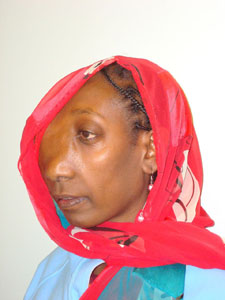
“It’s deformed her face. She has to cover half of her face. Her eye is popped all the way out. It’s really quite unnerving to see it,” said Hodes. “And for the last three years she’s basically been inside, because she doesn’t want to walk on the street because people are afraid if they see her.”
Even Hodes’ description doesn’t quite capture the way Merdya’s face was deformed. A cone-shaped mass of skin protruded from her right eye socket. Her eyeball rested at the tip of the cone. She was unable to close the eye because her eyelid was too stretched out.
Hodes was deeply moved by Merdya’s plight. He immediately began sending photos of her to brain specialists, asking if they could help. He contacted at least six world-renowned neurosurgeons without success.
“They all throw up their hands and say, ‘Oh my gosh, I’ve never seen anything like it.’ And that’s it. That’s like the end of the story,” sayd Hodes. “It was very frustrating for me, knowing we could potentially save her life. But it was a great challenge because nobody was interested in helping her.”
During a fundraising trip to Minneapolis last November, Hodes said God led him to a doctor who could help Merdya.
An observant Jew, Hodes intended to wake up early and attend morning prayers before his fundraising meeting. But his alarm clock didn’t go off. So he delayed his prayers and went to the synagogue after his meeting.
It was so cold outside that he brought his laptop with him into the synagogue. That’s where he ran into Dr. Eric Nussbaum, who was studying with a rabbi.
“When I heard this guy’s a neurosurgeon I said, ‘Oh, let me show you the type of neurosurgery that I deal with. These are my challenges.’ And I opened up the computer and I showed him these pictures of Merdya,” Hodes recalled. “And he said, ‘Oh my gosh. I’ve never seen anything like this.’ But then he said one sentence that nobody else has said. He said, ‘I’d love to try to help this lady.'”
Nussbaum directs the National Brain Aneurysm Center at St. Joseph’s Hospital in downtown St. Paul. Merdya’s case is exciting for doctors in the U.S. because they never see this kind of extreme deformity, Nussbaum says. That’s because even patients with no money would have access to care long before a tumor could inflict this kind of damage.
Nussbaum was willing to attempt what many other doctors had declined to do, because he knew he could assemble a top-notch team of specialists to help him with the surgery — including some doctors who are competitors from other hospitals.
It’s doubtful that one neurosurgeon alone could have handled a tough case like Merdya’s because her tumor formed in a tricky area at the base of her brain, Nussbaum says.
“Problems with the tumors in that location, or any abnormality in that location, is that it tends to cross disciplines between physicians of different sub-specialties,” said Nussbaum.
For Merdya’s surgery, Nussbaum recruited a cranial-facial plastic surgeon from nearby Region’s Hospital, and a neuro-opthamologist from the University of Minnesota to reconstruct the area around her right eye.
All of the surgeons agreed to do the work for free and St. Joseph’s Hospital didn’t charge for time in the operating room.
Money never factored into the decision of whether or not to help Merdya, Nussbaum says. She would have died without the surgery as the tumor put more pressure on her brain.
“In addition to the potential medical issues, you just look at a young woman who is so disfigured and have to kind of feel for her, and what it must have been like growing up with that,” he said.
Merdya Abdisa’s life has not been easy. She is an orphan with no job. She depends on the good will of others to survive.
Her trip to America has been exciting, but also overwhelming at times. She took her first plane ride, stepped on an escalator for the first time, and is now recovering in a hospital where almost no one but the interpreter speaks her native Oromo language.
The day before her surgery, Merdya sat quietly in a chair in her hospital room. The soft-spoken woman hid half her face with a scarf as hospital workers filtered in and out of her room. She cooperated and even smiled, but tears would occasionally fill her good eye.
She wanted the surgery and was grateful to get it, Merdya explained. But she also felt alone being so far away from home. It’s a feeling she has felt many times even in Ethiopia because of her deformity.
She spoke through Oromo language translator, Fowzi Hassan, before her surgery.
“(I was) unable to go to school because of this problem; shame and not going out in public without me covering (my head), a lot of questions.”
She wasn’t able to marry because of her tumor, Merdya says. She will leave it in God’s hands to determine what her life will be like once she returns home, she says.
From her surgeon’s perspective, her life should be much better. The tumor turned out to be cancer-free and the reconstruction went “spectacularly well,” Dr. Nussbaum said the day after the procedure.
“It was very dramatic. The people who were working in the recovery room, the interpreter who was working with her immediately before surgery and then was back with her after surgery, people were really just shocked, which was great,” said Nussbaum.
Merdya’s result should not only alter the way others perceive her, Nussbaum predicts it will change the way she perceives herself.
Merdya will spend several more weeks in Minnesota recovering from her operation. She will stay with an Oromo family until she is well enough to return home to Ethiopia.
(Reuters) –Ethiopian Olympic champion Kenenisa Bekele will attempt to break his 10,000m world record at next month’s Prefontaine Classic in Eugene, Oregon, organisers said today.
The race will take place at the University of Oregon’s Hayward Field on June 8. The stadium is also the site of the June 27-July 6 US Olympic trials. Bekele set his current record of 26 minutes 17.53 seconds on August 26, 2005 in Brussels.
“The record is not easy,” Bekele’s manager Jos Hermens said in a statement. “But this is an absolutely serious attempt. His training is going well, and he is 100% ‘go’ for the record.” It will be the 25-year-old Bekele’s first outdoor appearance in the United States.
Bekele, who also holds the world 5 000m record, will run in the morning ahead of other events at the 34th annual grand prix meeting to take advantage of what should be more favourable wind conditions.
“We compiled 20 years of data about wind conditions, humidity, temperature – you name it,” meet director Tom Jordan said. “The conditions are slightly better during the morning than the evening.”
ADDIS ABABA (AFP) — Ethiopia’s dictator said Monday that his regime has the means to secure its vital trade corridor with the Gulf of Aden in the event of conflict between Djibouti and Eritrea.
Tensions have grown between the two Horn of Africa nations since Djibouti accused Eritrean military forces of trench-digging along their common border and infiltrating Djiboutian territory by several hundred metres (yards).
Djibouti denies the allegation.
“They do act silly sometimes, but I don’t think they would go totally insane,” said Ethiopian Prime Minister Meles Zenawi at a meeting with trade officials, referring to the Eritrean government.
“Even so, Ethiopia has a capacity of protecting the safety of the Ethio-Djibouti trade corridor,” added Zenawi, who was quoted by Ethiopia’s state-run news agency ENA.
Eritrea — which has twice clashed with Djibouti over their common border — broke away from Ethiopia and won independence in 1993 after three decades of conflict. A second, two-year war broke out in 1993.
Ethiopia depends on Djibouti’s seaport for its international trade.
By Alain Lallemand, lemonde
(Translated from the French)
No less than 80 percent of weapons and munitions sold today in the Somali black markets are transported by commanders of the Ethiopian Woyanne Army and the Transitional Federal Government (TFG), although the chiefs of staff of the former are interested in ceasing the traffic. The gun-running represents millions of dollars. More surrealist yet: while they purport to be there to stabilize the sub-continent, the Ugandan commanders of AMISOM (African Union Mission in Somalia) engage with abandon in the small but lucrative suicidal business; instead of destroying them, they resell arms seized during raids against the Islamist militia known as Shabaab in the clandestine market. One recent transaction alone has fetched 20,000 dollars.
When the UN Security Council has taken note of the latest report of the Monitoring Group on Somalia, Le Soir has received leaks of some of those disclosures in the report to New York. One of the most disquieting elements in that report is the extent of compromise of principle that Ethiopian Woyanne forces have gone to; the level and volume of arms trafficking implies very high level involvement of the high command in the Ethiopian capital. In the first instance, Ethiopian Woyanne commanders sold –- instead of destroying -– weapons seized from their enemies: the Shabaab militia, the ex-Islamic Courts and the Classic National Resistance (“Muqawama”). Then, they sold weapons from their own arms arsenals (warehouses) to the bafflement of the general headquarters in Addis Ababa who did not understand where the large quantities of weapons and munitions had disappeared to. Lately, the situation has further deteriorated: containers laden with weapons and munitions have been spirited away from the arms depots of the regular army in Addis Ababa to be resold directly on the Somali back markets.
Such a level of massive interception of Ethiopian arms is not possible without complicity hatched within the armed forces high command, although the Ethiopian Woyanne Minister of Defense has not apparently been implicated.
And then officers of the regular Somali troops are not immune either. Arms belonging to their troops fallen on the battle field find their ways into the black markets within hours of skirmishes. The chief of national security of the transitional federal government himself is said to be one of the three big arms dealers in the black market.
This arms bazaar has taken such a looming twist in the last six months that it has developed not one but seven markets — six in Mogadishu and one in Afgoi. From the latter location, weapons find their way to neighboring Kenya for the purpose of not only cattle herding, but also to feed the growing insurrection there. Weapons so traded include AK 47 assault rifles, RPGs (rocket propelled grenades), PKMs (heavy Kalashnikovs mounted on tripods).
The collusion of these regular armed forces (Ethiopian Woyanne, Somali and AMISOM) in these criminal activities explains why arms circulating in Somalia have become more and more sophisticated. However, other forces are at work too. Eritrea continues to be the principal platform of arms supply to the Shabaab militia, and through them, to the ONLF (Ogaden National Liberation Front) of Ethiopia. This is why SA-7 and SA-18 surface-to-air missiles have been captured. One of these weapons bearing a Russian serial number has been acknowledged by Moscow to have been sold to Eritrea in 1995. At least one French Milan missile has equally been captured and Paris has confirmed without much ado that it had sold it to “a [Persian] Gulf nation”. The high point of this sophistication was attained when Shabaab fired an American TOW missile on Somali troops two weeks ago. It goes without saying that every time one of these missiles is fired in Somalia, there is behind it an insurgent who has inevitably been trained in operating it by a foreign army.
According to one of the UN regional specialists in the matter, the connections among the Somali, Iraqi and Afghan conflicts have become even more disturbingly close with the combatants moving from one theatre of operation to the other. Palestinian fighters continue to support Shabaab militants, as do the Yemenis and Sudanese — or even native Americans and Britons. In this context, the UN Monitoring Group on Somalia reaffirms its accusations contained in a previous report which implicates Iran and Hezbollah. Just like in south-east Iraq at the beginning of 2006, Somalia has become the scene of sophisticated explosives with the uncanny mark of Iran developing on its territory: the device is more and more compact; its fire is GSM remote-controlled; it is equipped with a homing device that can slam into armor plating of heavy duty equipment that was used with devastating effects in Iraq and, a few months later, in Afghanistan.
The U.N. refugee agency reports the number of people arriving on the coast of Yemen after being smuggled across the treacherous Gulf of Aden from the Horn of Africa has more than doubled this year. At the same time, the UNHCR says the number of deaths has gone down by half.
The United Nations High Commissioner for Refugees says that by the latter part of April, more than 15,300 people reportedly arrived in Yemen. About 360 were reported killed or missing during the hazardous voyage.
UN refugee agency spokeswoman Jennifer Pagonis says records show that during the same period last year more than 7,000 people had arrived in Yemen and about the same number had perished.
“Any reduction in the death toll is incredibly welcome. We do not really know whether this is a new phenomena that is going to continue or not. But, some new arrivals have mentioned receiving water and food during the crossing, which is quite new. And, the boats seem to be less crowded than in previous years,” said Pagonis.
The UNHCR says the surge in arrivals early this year was largely due to the continuing conflict in Somalia and the use of new smuggling routes from Somalia to Yemen and across the Red Sea from Djibouti. Many of the asylum seekers also said they were forced to leave because of crop losses due to drought.
For years, the death toll has been mounting among Somalis and Ethiopians crossing the Gulf of Aden in rickety smugglers boats. People pay smugglers up to $150 to make the treacherous journey, which usually ends up being a nightmare and often fatal.
Pagonis says survivors tell horrific tales of brutality, about passengers being beaten, stabbed, and raped. She says many people have drowned after smugglers have forced them to jump into the sea before arriving on the coast of Yemen.
“What we have been trying to point out to people are the dangers of crossing. When you have refugees who are fleeing, it is one of these tricky situations,” added Pagonis. “You cannot say we do not encourage you to leave your own country because the risks are really great. People who are fleeing for their lives are going to take whatever means they can to get out of there. But, we just need to point out the risk to them that they may well lose their lives.”
Pagonis says the UNHCR has been calling for increased action to save lives in the Gulf of Aden and other waters. She says the agency is stepping up an information campaign to inform refugees of the dangers of traveling in smugglers’ boats.
And, she says, the UNHCR is expanding its work in Yemen to provide additional shelter and assistance, as well as protection for refugees and internally displaced people.
EDITOR’S NOTE: There is no food shortage in Ethiopia. The problem is caused by mis-allocation of resources, mismanagement, and extreme greed by the tribal Woyanne regime. Large quantities of food produced in southern Ethiopia is loaded up daily on thousands of trucks and sent to the northern region of Tigray by the ruling Tigrean People Liberation Front (Woyanne). As a result, in Tigray today food prices are about 50% lower than in other parts of Ethiopia. Food is also being stored in massive grain silos that are being built in Tigray, while the rest of the country is facing shortages.
——————
ADDIS ABABA (Reuters) – A lack of funds has forced the U.N. World Food Programme (WFP) to cut by more than half the number of districts in drought-hit Ethiopia it serves, the food agency said on Monday and appealed for $76.4 million in aid.
WFP said shortages would prevent it from providing food supplements to malnourished mothers and children.
“Due to a funding shortfall, WFP has less food in its warehouses and as of the end of last month, it was forced to cut back food assistance operations … from 342 districts to 163 districts,” WFP said in a statement.
“Despite evidence of malnourishment in some drought-affected areas, a food deficit will prevent the agency from providing nutritious, life-saving food supplements to acutely malnourished children and mothers.”
WFP said it needed $76.4 million to feed mothers and children under five and to support the government’s emergency relief programme.
WFP said that in 2007 it provided supplementary food to over 1.1 million Ethiopians.
A U.S.-based early warning system, FEWSNET, had said that up to nine million Ethiopians may need food assistance due to drought in 2008.
(Reporting by Tsegaye Tadesse; Editing by Giles Elgood)

 His practice is filled with patients suffering from ailments that have gone untreated for far too long. But he had never seen anything like Merdya’s tumor.