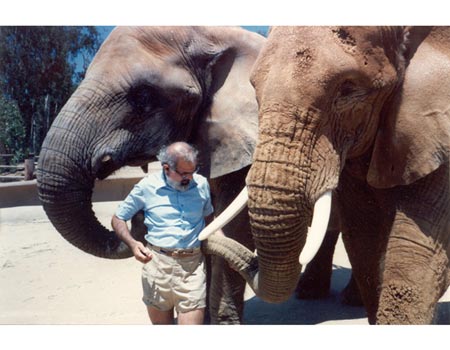
Addis Ababa, Ethiopia – Israeli Professor Jeheskel Shoshani, a world-renowned researcher of elephants at Addis Ababa University, was among the victims of Tuesday’s minibus explosion in the Ethiopian capital’s downtown area.
The Israeli Foreign Ministry said it remains unclear whether the explosion was terror-related and if Shoshani was aboard the minibus when it exploded.
The transfer of Shoshani’s body is being handled by the US consul general in Addis Ababa, as the professor also holds American citizenship.
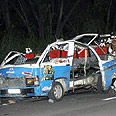
Minibus after blast [Photo: AFP
Three people were killed and nine others were injured in the explosion, which occurred as the minibus was traveling on the road which runs between the Hilton Hotel and the Ethiopian Foreign Ministry.
Mogadishu – At least two Ethiopian Woyanne soldiers were killed and five others wounded on Thursday in a roadside bomb explosion in southern Mogadishu, witnesses said.
“A heavy explosion hit the Ethiopian Woyanne soldiers as they were inspecting suspected mines off Maka Al Mukarama road,” eyewitness Mohamed Farah said.
“I saw two dead soldiers and five others wounded. The soldiers then sealed off the area and civilian movement was restricted,” he added.
“One of the soldiers was inspecting the roadside with a stick when the explosion went off. He was torn to shreds and several other soldiers were wounded by the shrapnel,” said Ali Yare, another witness.
On Wednesday, three aid workers — a Somali and two Italians — were kidnapped by gunmen south of Mogadishu, the latest in a spate of attacks and kidnappings targeting humanitarian workers.
In an interview to Britain’s The Guardian published on Thursday, Eritrea-based Islamist leader Sheikh Hassan Dahir Aweys vowed to continue the armed struggle until Ethiopian Woyanne troops leave Somali territory.
Talks between the Islamist-dominated political opposition and the Western-backed transitional government were launched in Djibouti earlier this month, under the aegis of the United Nations. But Sheikh Aweys dismissed the UN as a partial mediator, leaving opposition ranks divided ahead of the resumption of talks later in May.
Somali rebels attack the parliament building in the southwestern town of Baidoa, killing five guards amid more blasts in the town.
Somali lawmakers were shocked as they found anti-government militias shooting mortars at parliament compound, also known as ADC Building, Press TV correspondent said.
Five parliamentary guards were killed in the crossfire that followed and continued for less than an hour.
Meanwhile, many civilians have left their homes to go to safe places outside Baidoa since hundreds of insurgents entered the town and targeted the parliament premises.
The attack marked a rare incident among the usual hit-and-run skirmishes between the Ethiopian Woyanne-backed Somali soldiers and anti-government gunmen.
The clashes are still going on in Baidoa while the insurgents have vowed to drive the foreign troops and their ‘puppets’ out of Somalia.
The International Federation of Red Cross and Red Crescent Societies (IFRC) has this afternoon announced the appointment of Mr Bekele Geleta as its new Secretary General. Mr Geleta will replace the current Secretary General, Mr Markku Niskala, who is retiring after a long and successful Red Cross Red Crescent career.
“It is my pleasure to inform you that today, 21 May 2008, during its 17th session, the Governing Board of the IFRC appointed Mr Bekele Geleta as the new Secretary General,” said Juan Manuel Suàrez del Toro, president of the IFRC, in a letter to all Red Cross and Red Crescent societies, and to all IFRC delegations and staff.
Mr Geleta was born in Ethiopia on 1 July 1944 and has a Masters degree in economics from Leeds University in the United Kingdom.
He has worked as general manager of the Franco-Ethiopian Railway Company, as urban development officer for Irish Concern International, and as a programme manager for Kenya and Somalia for Care Canada. He was Ethiopia’s ambassador to Japan, and its vice-minister of transport and communications.
From 1984 to 1988, during one of the most challenging times in recent African history, he served as Secretary General of the Ethiopian Red Cross. From 1996 to 2007, Mr Geleta was head of the Africa department at the IFRC secretariat in Geneva, deputy head of the IFRC’s delegation to the United Nations in New York and head of the IFRC’s regional delegation in Bangkok, Thailand.
His appointment came while he was General Manager of International Operations for the Canadian Red Cross at its headquarters in Ottawa.
“I wish the new Secretary General of the IFRC success in his new position,” said Mr Suàrez Del Toro.
“I also want to express my thanks and appreciation for the solid work done by Markku Niskala, now Secretary General Emeritus, for his commitment and leadership in guiding the IFRC secretariat through some of the most challenging times in humanitarian history.”
ADDIS ABABA (Reuters) – Ethiopia will import 150,000 tonnes of wheat to stabilise grain prices amid rising world commodity costs, the prime minister said on Wednesday.
Higher prices for staple foods and fuel have hit developing nations hard as government of some food-growing countries impose export curbs because of worries about domestic shortages.
“The government has signed an agreement to import 1.5 million quintals (150,000 tonnes) of wheat within the next one and half months to stabilise food grain prices,” Prime Minister Meles Zenawi told parliament.
“Food grain price stability was not achieved in some communities due to illegal practices by traders operating outside the law,” he said.
The leader of sub-Saharan Africa’s second most populous country did not say where the grain would come from nor how much it would cost.
The Ministry of Finance says inflation stands at 19 percent, mostly due to high petrol prices.
Meles said the government will take action against black market operators. Last week, police arrested 45 traders.
Food shortages are worse in sub-Saharan Africa because per capita production has fallen in recent years. Drought-prone Ethiopia was one of the most-affected African countries.
The International Monetary Fund (IMF) said on Monday that Ethiopia should tap low-interest loans or grants to help it deal with rising food prices.
A U.S.-funded early warning system, FEWSNET, has said that up to nine million Ethiopians may need food assistance in 2008 due to drought.
(Reporting by Tsegaye Tadesse, editing by Jack Kimball and Peter Blackburn)
(For full Reuters Africa coverage and to have your say on the top issues, visit http://africa.reuters.com/). ([email protected]; +254 20 2224 717)
ADDIS ABABA (Reuters) – An Ethiopian [kangaroo] court sentenced eight people to death for a grenade attack that killed five people last year in the Horn of Africa nation’s restive Somali region, local media reported on Thursday.
The assault at a packed ceremony in 2007 was blamed on the Ogaden National Liberation Front (ONLF), a separatist movement in the remote eastern area. A stampede after police fired over the crowd killed another six people.
“The Somali state high court sentenced to death the eight people after evidence presented by the prosecution proved that the accused killed and wounded civilians,” the state-run Ethiopian News Agency (ENA) quoted the court as saying.
The eight have a right to appeal to higher courts under Ethiopian law. Death sentences must also be approved by the state president.
The ONLF says it is fighting for autonomy of the ethnic-Somali region. Both the government and the rebels accuse each other of human rights abuses.
On Wednesday, Prime Minister Meles Zenawi told parliament that the rebel group has been largely “neutralised” by a military offensive going on for the past year.
The ONLF denies this, saying it still has operations in the countryside. Addis Ababa says its neighbour Eritrea is training and supplying the ONLF, but Asmara denies that.