The kangaroo court in Ethiopia today sentenced the elected leaders of Ethiopia to life in prison.
Among those who were sentenced were chairman of the Coalition for Unity and Democracy Party (Kinijit) Ato Hailu Shawel, vice-chair Bertukan Mideksa, secretary general Muluneh Eyoel, and mayor of Addis Ababa Dr Berhanu Nega.
Additionally, Aby Gizaw, Andargachew Tsige, Elias Kifle (Ethiopian Review publisher), Mesfin Aman, and Zelalem Kifle — who were charged and convicted in absentia — are sentenced to life in prison.
The following journalists and Kinijit supporters received lower sentences: Mesifn Jebesa, Berhanu Alemayehu, Wudeneh Jedi, Melaku Oncha, to 18 years each. Abyot Wakjira and and Daniel Berihun to 15 years each. Wenackseged Zelleke (the deputy managing editor of Addis Zena) to 3 years. Dawit Fasil (Serkalem Fasil’s brother) to one year and 6 months.
The court ordered journalists Sisay Agena and Serkalem Fassil to pay upto 120,000 birr in penalty and and shut down their publishing firms.
Judge Adil Ahmed, on behalf of the three-judge panel, said that all those who were sentenced to life are banned from participating in Ethiopian politics in any form. Those who received 18-year or less were banned from politics for 5 years.
Last week, the prosecutor had recommended death penalty.
Adil said that the court decided to rule life in prison instead of death because the Kinijit leaders had only attempted the crimes they were charged with. Since they didn’t succeed, Adil said, they do not deserve death.
For some of the opposition leaders who are 70-year old or more and with poor health (including the 72-year-old chairman Ato Hailu Shawel), life in prison is as bad as a death sentence. Considering the terrible condition at the disease-infested Qaliti jail, even the younger and healthier prisoners will not survive for long.
The Woyanne regime media and Meles Zenawi’s backers at the U.S. State Department may try to spin the life in prison sentence as a better out come than death penalty. But those who have witnessed the suffering of Professor Asrat Woldeyes in jail, today’s court ruling is nothing less than condemning the elected leaders of Ethiopia to death.
Judge Adil said: “The accused have committed serious crimes, which caused the death of civilians and security forces and attempted to overthrow the government. The accused have also failed to present to the court mitigating evidences for the charges brought against them.”
While Adil was reading the decison, Dr Berhanu Nega stood up and started to walk out. Adil said Doctor, we are about to finish, come back. Dr Berhanu complied.
As Adil continued reading, Kinijit vice-chair, Bertukan Mideksa, started to flash “V” sign and the other leaders, including family members, followed suit.
The opposition leaders had refused to recognize the court and did not enter a plea, saying the trial was political.
The United States government is soon to erect perhaps its largest single structure in Africa, in the compound of its Embassy in Addis Abeba, which is also one of the three largest embassies it has on the continent. When the construction is completed in three years, the four-storey building is projected to consume a total investment of 140 million dollars.
This investment will be one of two such projects in the Horn of Africa; the US government also plans to build a brand new Embassy in Djibouti City, projected to cost 100 million dollars.
Clearing works inside the Embassy compound in Addis Abeba has already begun, although the construction contract is due to be awarded to an American firm in October 2007, according to senior diplomatic sources. The firm to be awarded the project is, however, expected to sub-contract much of the local component to local construction firms, and anticipated to offer job opportunities to over a 1,000 people, according to these sources.
“More than the employment opportunities, we at the Embassy are very excited for the technology transfer this project will bring to local companies,” Donald Yamamoto, US ambassador to Ethiopia, told Fortune.
The four-storey building, depicting a ship, will be erected right in front of his residence, on the vast green area. It will serve as offices to the various bureaus the Embassy has inside the compound.
The US Embassy in Addis Abeba was moved from its previous location in Mercato, a.k.a. American Gibe, to its current location in 1945. The white building that serves as the ambassadors’ residence, recently renamed after President Theodore Roosevelt, was first built in 1920 by the Japanese, who used it as their first legation before they were expelled from the country for their support of the Italian occupation of Ethiopia.
It was during President Roosevelt’s reign in the White House that the US started a diplomatic relationship with Ethiopia. Mr. Robert P. Skinner, the US’s consul-general in Marseilles, France, visited Emperor Menelik’s court in Addis Abeba in December 1903.
The Americans, however, took the Embassy compound and its buildings, which also incorporate two tukkals, after promising Emperor Haile Sellasie that the residence and the tukkals would always be preserved.
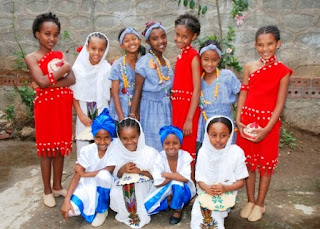
The Mesgana Dancers are returning for their second USA tour presented by Children of Ethiopia Education Fund (COEEF) and Ethiopia Reads. This year’s tour has been expanded to include many more cities and venues so more people can see these wonderful girls perform their stunning display of Ethiopian cultural dance and song!
Mesgana (an Amharic for gratitude), “represents the hope this tour will bring to the girls of Ethiopia”, says the press alert released by the Children of Ethiopia Education Fund, a non-profit organization based in Murray, Utah, and the tour’s primary organizer.
“If not properly educated, girls in Ethiopia will be faced with disease, prostitution and poverty.” According to the tour organizers, for two hundred to five hundred dollars a year sponsors can send a student to a private school in Ethiopia. Currently 800 students are enrolled in the program.
The tour also benefits Ethiopia Reads, another non-profit organization founded in 2003 by Yohannes Gebregeorgis and led by the celebrated children’s author Jane Kurtz. The group establishes libraries in schools in Ethiopia and has published many books in Amharic.
The tour will be from August to September 2007 and will include stops in Washington, DC, Columbia, MD, Evanston (Chicago), IL, Atlanta, New York City, West Orange, NJ Denver & Boulder, CO, Salt Lake City, Murray, & St. George, UT, San Jose, Palo Alto, Ontario/Upland, and Los Angeles (San Fernando), CA.
Ethiopia and Senegal had to pack their luggages for home after both suffered another defeat on Sunday in their respective group matches at the ninth All-Africa Games, being held in the Algerian capital.
In a Group A game with South Africa, Ethiopia swallowed a 1-3 fiasco and failed to make up for their 0-3 loss to defending champions Nigeria in an earlier match on Thursday.
In the 28th minute, South Africa’s forward Antonia Carelse found the net to help her team take a lead in the first half.
Ethiopia leveled in the 69th minute by Addis Feleke. But South Africa regained the lead two minutes later through defender Belinda Nkosi. The South Africans secured their three points in the 87th minute as forward Portia Modise struck the third goal.
Senegal, in a Group B match with Ghana on Sunday, were overwhelmed in a 3-0 defeat from the Black Princesses. Earlier on Thursday, Senegal had incurred a 3-1 defeat to hosts Algeria.
Both Senegal and Ghana were making their debut in the women’s soccer, which was first introduced at the eighth All-Africa Games held in the Nigerian capital Abuja in 2003.
After Sunday’s group elimination, Nigeria and South Africa ranked the top two in Group A, while Ghana and Algeria got into the semifinals from Group B.
The semi finals will be held on Wednesday, with Nigeria playing hosts Algeria while Ghana fighting South Africa.
NAIROBI, Kenya — For the workmen racing to spruce up a bullet-studded police garage in time for a critical peace summit beginning Sunday in Somalia, the work got a little tougher this week when insurgents launched mortars at the site.
The message was as clear as ever: Somalia’s transitional government is in trouble.
Diplomats say the conference on political reconciliation may be the government’s last chance to hold onto power against a growing Islamist insurgency and with one of its most powerful backers, the Bush administration, perhaps rethinking the military operation that brought the regime to power six months ago.
Since Ethiopian [Woyanne] troops, supported by U.S. training and intelligence, ousted an Islamist regime from the capital, Mogadishu, the government has been unable to control the city. Somali and Ethiopian forces face near-daily mortar attacks and assassination attempts by insurgents linked to the Islamists, who vowed Friday to disrupt the summit.
Public confidence in the government has plummeted further as security forces mount an offensive in insurgent neighborhoods, lobbing grenades into populated areas such as the busy Bakara marketplace. More than 50 people have been killed in the last two weeks, according to local hospitals, most of them civilians. Some eyewitnesses described the government strikes as indiscriminate.
The Bush administration linked the Islamist regime, known as the Council of Islamic Courts, to al-Qaida and said that its removal was necessary to keep the Horn of Africa from becoming a terrorist haven. Now administration officials appear to be reconsidering the wisdom of regime change.
A U.S. intelligence report sent to Congress on Wednesday painted a bleak picture of the future of the transitional government.
The government “is widely perceived by Somalis to be little more than a pawn of Ethiopia, yet its continued survival, certainly in Mogadishu, remains dependent on the support for the Ethiopian military,” said the report. “Continued turmoil could enable extremists to regain their footing and heighten inter-state tensions throughout the region.”
Last month, Jendayi Frazer, the State Department’s top Africa envoy, was quoted as saying about Somalia: “It’s hard to say whether it is better or worse off” since the Ethiopian invasion.
Referring to those comments, a Western diplomat in the region who helps formulate Somalia policy said, “They’re saying they got it wrong. But you can’t really recover from these mistakes.”
The official did not want to be named because of his criticism of U.S. policies. But he said Somalia was becoming the sort of magnet for foreign jihadists that the Bush administration sought to avoid.
“They’re getting guidance from outside Somalia, like Afghanistan or Pakistan. We’re in danger of seeing a re-emergence of an active African Somalia A.Q. (al-Qaida) cell,” the diplomat said, without elaborating.
Diplomats have been pressing the government to hold a reconciliation conference to begin building a stable, inclusive political system and ending the clan-based fighting that has plagued Somalia since 1991.
“This is the only scenario to avoid Somalia slipping back into civil war,” the official said. “We don’t have a Plan B.”
McClatchy special correspondent Mahad Elmi contributed from Mogadishu.
FAMILIES of the fallen soldiers killed during peacekeeping duties in Somalia have received $50,000 each as compensation from the African Union.
Payments to the relatives of Privates Ojok Kilama Lagole from Gulu, Julius Peter Ongu from Pader, Frederick Wanda from Kamuli, Osbert Tugume from Bushenyi and Corporal Rwegira Wilberforce, also from Bushenyi, were coordinated through the Ministry of Defence.
Four were killed in a bomb blast in Mogadishu on May 16, when their convoy was attacked.
Rwegira was killed by artillery fire on April 1 while guarding the presidential palace. Declared heroes by the Commander in Chief, President Yoweri Museveni, the dead soldiers were buried at their respective ancestral homes with full military honours, including gun salute.
Army spokesman Maj. Felix Kulayigye confirmed the payments.
He also revealed that the deceased have since been replaced in Somalia, while eight others injured in the attacks have returned to their bases after being treated in different hospitals in Uganda and Kenya.
Those treated at Nairobi hospital in May were Fred Ssentogo, Boaz Kasswala, Peter Mucunguzi, Simon Tumusime, Sulait Labu and Odong Okoth.
Another soldier injured in the eye by shrapnel is still recovering in Kampala. All the soldiers briefly visited their homes before rejoining the AU forces.
“All is well. Our soldiers are doing well. They have so far received the March and April AU allowances,” said Kulaigye.
On top of their salaries, each of the peace keepers serving under AMISOM, the African Union Mission in Somalia, receive $412 monthly in allowances.
The Ugandan contingent, deployed in Somalia since March 6, are commanded by Col. Peter Elwelu. The over-all commander of the AU mission is also a Ugandan, Maj. Gen. Levy Karuhanga.
Uganda is the only country that has sent 1,500 troops out of the needed 8,000-strong force.
The peace-keepers are expected to take over from the Ethiopians, who ousted the Islamic Courts in March. Burundi promised to send troops this month. Nigeria, South Africa, Malawi and Ghana, who also pledged troops, are yet to deploy.

 The
The 