BRUSSELS (Reuters) – The European Union called on Ethiopia [the Woyanne regime] on Tuesday to ensure that civilians in its troubled Ogaden region are protected and receive humanitarian aid.
U.N. investigators touring the impoverished, predominantly ethnic Somali region — where Ethiopian Woyanne soldiers have been fighting separatist rebels for months — urged Ethiopia last month to ensure food and aid agencies can get in the region.
Ethiopia Woyanne had said it would take action on that.
“The EU commends the Ethiopian Woyanne government for its reaction to the (U.N.) report and calls upon it to follow up all recommendations of the mission, including actions to protect civilians in conflict,” the bloc’s Portuguese presidency said in a statement.
“(The EU) welcomes its stated willingness to ensure that the humanitarian needs of the population in the Somali region of Ethiopia are properly addressed,” the statement said.
The statement noted “with concern … the (U.N.) report’s conclusion that humanitarian conditions within the conflict areas have deteriorated substantially over the past several months”.
Medecins Sans Frontiers and the International Committee of the Red Cross have accused the Ethiopian authorities in Addis Ababa of denying aid groups access to the region.
The Ogaden National Liberation Front (ONLF) rebels accuse Prime Minister dictator Meles Zenawi’s administration of blockading the region — the poorest part of Ethiopia — risking a “man-made” famine, along with burning down homes and summary executions.
Meles’ government denies all the accusations, and calls the ONLF terrorists funded by arch-foe and neighbour Eritrea.
Few places are more desolate than southern Ethiopia, where the barren plains suffer hunger and poverty even when the rains fall.
Yet one of Britain’s closest African allies is waging a brutal military campaign in this bleak region, burning villages and forcing thousands to flee their homes.
Ethiopia, the recipient of £130 million of British aid this year, is fighting a virtually unknown guerrilla war on the borderlands with Somalia.
Meles Zenawi, Ethiopia’s prime minister, is determined to crush Somali rebels from the Ogaden National Liberation Front (ONLF). In April, they raided an oil installation, killing 74 people including nine Chinese workers.
The response by Mr Meles, who was handpicked by Tony Blair in 2004 to serve on Britain’s Commission for Africa, was draconian.
Ethiopian troops have blockaded areas seen as rebel strongholds, halting the flow of goods and leaving some 600,000 people dependent on food aid to avoid starvation.
Soldiers have armed local militias to fight the ONLF, carrying out a divide-and-rule policy which could inflame the war. Moreover, the army has singled out civilians for collective punishment.
One 37-year-old woman, who was too fearful of government reprisals to be named, said the army had burned down her village of Fojdeh. “So many troops and trucks came and surrounded us. They said we have been giving food to the rebels. They made us move away from the village and then they burned down every hut,” she said.
After being left homeless and destitute, the woman fled southwards to the ramshackle town of Gode, in the centre of the war zone, where she lives with her six children in a shack fashioned from brushwood and cardboard. She knows of three other villages near Fojdeh which suffered the same treatment in August.
To disguise the consequences of its campaign, the government has prevented the creation of refugee camps. Instead, scattered groups of people who have fled their villages live on patches of wasteground across Gode. Others have fled over the border into Somalia.
Not all are victims of the army. Many have been displaced by the ONLF, whose own brutality is unequalled. The rebels routinely burn the homes of anyone who fails to offer food or shelter.
Ethiopia’s ‘secret war’ forces thousands to flee
Western diplomats acknowledge that Mr Meles had no choice but to deploy Ethiopia’s army to crush the ONLF’s challenge. But one diplomat in the capital, Addis Ababa, described the campaign as “counter-productive”. Thanks to the army’s “over-reaction”, support for the ONLF had probably risen, he said.
The 4.5 million people of this region, popularly known as the Ogaden, are largely Muslim Somalis. Many accuse Ethiopia’s ruling elite, drawn mainly from the country’s Christian Highlands, of neglecting the Ogaden and keeping its people poor.
The rebels recruit most of their fighters from the Ogaden clan, who account for about half of the region’s population. But the authorities are exploiting bitter clan rivalries and arming local militias to fight the ONLF.
A government official admitted that soldiers had supplied ammunition to militiamen recruited from non-Ogaden clans. “Many people hate the ONLF. They are the ones who have brought all this suffering down on us,” he said.
Turning clan against clan and encouraging them to kill one another is fraught with risk. By choosing to “divide-and-rule”, the authorities could escalate the war and stir more hatred.
Ethiopia will receive £130 million of British aid this year – more than any other African country. Critics say that Mr Meles is using his favoured position – and Ethiopia’s standing as a key Western ally in the war on terrorism – to avoid any protest over his behaviour.
“Everyone is scrambling to protect their own interests and their relationship with the Ethiopian government who they are petrified not to offend,” said Ken Menkhaus, an American expert on the Horn of Africa.
Aside from allowing the United Nations to assess the humanitarian situation, Ethiopia has tried to prevent outside observers from reaching the Ogaden. When the International Committee of the Red Cross voiced concern about the suffering, Ethiopia accused its staff of backing the ONLF and expelled them from Gode.
Privately, senior Ethiopian officials accuse western aid agencies of stirring up the fighting in order to raise money from donors.
Bereket Simon, the information minister, denied that Ethiopia’s army had targeted civilians. “We have never compromised our principles and attacked civilians. We know that would only push them towards the fold of the terrorists. So why would we do it?” he said.
In Gode, the suffering is unmistakable and a deep fear of the government prevents anyone from speaking openly. “The people are going through great pain,” said a local trader. “All we want is peace.”
Few places are more desolate than southern Ethiopia, where the barren plains suffer hunger and poverty even when the rains fall.
Yet one of Britain’s closest African allies is waging a brutal military campaign in this bleak region, burning villages and forcing thousands to flee their homes.
Ethiopia, the recipient of £130 million of British aid this year, is fighting a virtually unknown guerrilla war on the borderlands with Somalia.
Meles Zenawi, Ethiopia’s prime minister, is determined to crush Somali rebels from the Ogaden National Liberation Front (ONLF). In April, they raided an oil installation, killing 74 people including nine Chinese workers.
The response by Mr Meles, who was handpicked by Tony Blair in 2004 to serve on Britain’s Commission for Africa, was draconian.
Ethiopian troops have blockaded areas seen as rebel strongholds, halting the flow of goods and leaving some 600,000 people dependent on food aid to avoid starvation.
Soldiers have armed local militias to fight the ONLF, carrying out a divide-and-rule policy which could inflame the war. Moreover, the army has singled out civilians for collective punishment.
One 37-year-old woman, who was too fearful of government reprisals to be named, said the army had burned down her village of Fojdeh. “So many troops and trucks came and surrounded us. They said we have been giving food to the rebels. They made us move away from the village and then they burned down every hut,” she said.
After being left homeless and destitute, the woman fled southwards to the ramshackle town of Gode, in the centre of the war zone, where she lives with her six children in a shack fashioned from brushwood and cardboard. She knows of three other villages near Fojdeh which suffered the same treatment in August.
To disguise the consequences of its campaign, the government has prevented the creation of refugee camps. Instead, scattered groups of people who have fled their villages live on patches of wasteground across Gode. Others have fled over the border into Somalia.
Not all are victims of the army. Many have been displaced by the ONLF, whose own brutality is unequalled. The rebels routinely burn the homes of anyone who fails to offer food or shelter.
Ethiopia’s ‘secret war’ forces thousands to flee
Western diplomats acknowledge that Mr Meles had no choice but to deploy Ethiopia’s army to crush the ONLF’s challenge. But one diplomat in the capital, Addis Ababa, described the campaign as “counter-productive”. Thanks to the army’s “over-reaction”, support for the ONLF had probably risen, he said.
The 4.5 million people of this region, popularly known as the Ogaden, are largely Muslim Somalis. Many accuse Ethiopia’s ruling elite, drawn mainly from the country’s Christian Highlands, of neglecting the Ogaden and keeping its people poor.
The rebels recruit most of their fighters from the Ogaden clan, who account for about half of the region’s population. But the authorities are exploiting bitter clan rivalries and arming local militias to fight the ONLF.
A government official admitted that soldiers had supplied ammunition to militiamen recruited from non-Ogaden clans. “Many people hate the ONLF. They are the ones who have brought all this suffering down on us,” he said.
Turning clan against clan and encouraging them to kill one another is fraught with risk. By choosing to “divide-and-rule”, the authorities could escalate the war and stir more hatred.
Ethiopia will receive £130 million of British aid this year – more than any other African country. Critics say that Mr Meles is using his favoured position – and Ethiopia’s standing as a key Western ally in the war on terrorism – to avoid any protest over his behaviour.
“Everyone is scrambling to protect their own interests and their relationship with the Ethiopian government who they are petrified not to offend,” said Ken Menkhaus, an American expert on the Horn of Africa.
Aside from allowing the United Nations to assess the humanitarian situation, Ethiopia has tried to prevent outside observers from reaching the Ogaden. When the International Committee of the Red Cross voiced concern about the suffering, Ethiopia accused its staff of backing the ONLF and expelled them from Gode.
Privately, senior Ethiopian officials accuse western aid agencies of stirring up the fighting in order to raise money from donors.
Bereket Simon, the information minister, denied that Ethiopia’s army had targeted civilians. “We have never compromised our principles and attacked civilians. We know that would only push them towards the fold of the terrorists. So why would we do it?” he said.
In Gode, the suffering is unmistakable and a deep fear of the government prevents anyone from speaking openly. “The people are going through great pain,” said a local trader. “All we want is peace.”
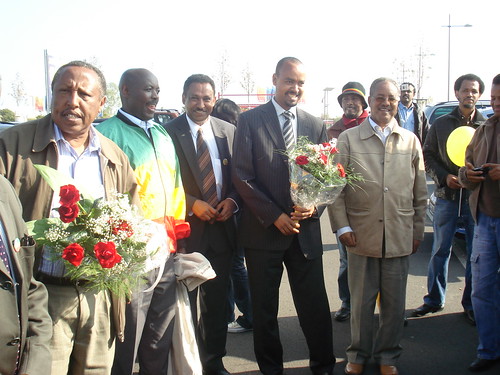
Kinijit European Delegation has arrived in Germany from Switzerland. They drove over 450 Km through the heart of Europe to Germany. After they arrived near the outskits of Frankfurt, large numbers of cheerful Ethiopians have made car chains to escort them from about 50 KM on German Highway to the center of Frankfurt. All cars waived Ethiopian flags with Kinijit stickers on their cars as they moved to the podium where many hundreds of Ethiopians have been waiting to greet the long awaited arrival of the leaders.
Kinijit delegation arrive in Germany [photo: Kinijit Germany]
Many people have emphasized that this has been a very spectacular and heroes’ welcome that no other Ethiopian leader received in the last 30 years. Some people said, it looked like a wedding. Many German citizens gathered wondering what was going on and German news broadcast has transmitted the speech and music ceremony from Frankfurt.
Dr. Yacob Hailemariam and and Ato Muluneh Eyuel expressed their appreciation for the very warm welcome. Ato Samuel Gugsa (Organizing committee chairman) and Dr, Assefa Nesbu ( KSGG Chairman) have made speeches including clear statements about the solidarty of Ethiopains in Germany with Kinijit movement.
After the ceremony in the city, invited guests and kinijit supporters headed to a dinner party outside Frankfurt which included a documentary Movie of the last 2 years struggle as organized by KSGG (Kinijt support Group Germany).
The leaders were able to witness what Ethiopians have done during the last 2 years to get Ethiopian people’s voices to be heard and to get them released. Videos from demonstrations in Strassbourg, Berlin, Brussels and Frankfurt were the most moving among others.
Itnerary in Germany:
Oct. 8-10, 2007 travel to Berlin to meet with German Govt. Officials. KSGG has organized a meeting wth Dr. Walter Steimeyer, Foreign Minister of Germany in Berlin as well as Parlamentarians.
Oct. 11: Visit to German Radio Station in Bonn
Oct. 12: Visit of industrialized zones in Germany
Oct. 13: Big Public Meeting and Fund Raising in Frankfurt including delicious Ethiopian Food, Music etc..
Oct. 14: Expected visit to Munich
Oct. 16: Return to Frankfurt.
To Africa Subcommittee Chair, Donald Payne (D-NJ) and
Representative Chris Smith (R-NJ)
“Throughout history, it has been the inaction of those who could have acted; the indifference of those who should have known better; the silence of the voice of justice when it mattered most; that has made it possible for evil to triumph.” Haile Selassie-I
Dear, Congressmen Donald Payne and Christopher Smith
Ethiopians are two weeks old in their third millennium. There is nothing gratifying than starting a new year and a new millennium with an unprecedented gift of HR 2003, the Ethiopia Democracy and Accountability Act of 2007 approved by the US House of Representatives today. Just two days ago Ethiopians lit the skies to celebrate the day of the finding of the true cross. Today that holy light has also helped Ethiopians find the true cross of democracy, good governance and respect of human rights in the people’s house of the land of the free.
Dear friends of Ethiopia,
We know that on behalf of Ethiopians you have traveled an arduous journey coupled by enormous challenges to get BILL HR2003 pass in the House. Among the many challenges were the senseless and greedy lobby firms hired by Meles Zenawai to kill the BILL. Pro Meles media outlets in and outside Ethiopia attempted to discourage your effort by attacking your integrity and insulting your conscience. Nevertheless, you remained resolute in your mission and steadfast in your resolution to stand behind Ethiopians and democracy. Congratulations for winning the battle that made truth and justice prevail over evil.
Dear friends of Ethiopia,
The passage of HR 2003 is historic because the decision of the House of Representative came two years after Meles Zenwai’s army gunned down 193 people, injured over 700, arrested all opposition leaders, sent thousands to concentration camps and filed genocide and treason charges. Thousands of opposition supporters were arrested in mass and taken to unknown destinations. God, EPRDF and the families of the victims are the only ones who know how many. Pressured by your BILL of rights, the Ethiopian Government granted amnesty to opposition leaders and released 18, 000 prisoners two weeks ago. The number of released political prisoners is reminiscent of the number of prisoners held behind bars by Meles’ regime.
Dear friends of Ethiopia,
No doubt this mundane act of savagery should have been stopped yesterday. However, we also recognize the international community‘s desire to give Mr. Zenawi ample time to redress his wrongdoing and protect the wishes of Ethiopians. Typical of a tyrant, Meles continued to deify the int’l community and his people. Now there comes HR 2003 with full force to guard the people of Ethiopia.
Dear friends of Ethiopia,
Through the passage of HR 2003 you have become the bacon of hope for 77 million Ethiopians who are gagged by a repressive regime for over 15 years. Millions in Ethiopia and around the world are joyous of the historic decision you have taken today. We applaud you for standing behind truth and moreover behind the core values of American democracy. Today’s decision will make US America proud, respected, trusted and supported by freedom loving people around the world. This is a milestone towards the universalization of democracy and human rights.
Dear friends of Ethiopia,
Please allow me to paraphrase Emperor Haile Selassie-I speech at the League of Nations in 1936 above: For many years the inaction of the United States and western nations who could have acted; the indifference of western powers who should have known better; the silence of the voice of justice at the United Nations when it mattered most has made it possible for evil to triumph in Ethiopia and Africa at large. Today you have demonstrated to Ethiopia and the rest of Africa that the American government and people will no more be indifferent, will no more be silent to let evil triumph in Ethiopia and Africa. Bill HR 2003 has laid the corner stone of democracy at the heartland of the African Union. It is vital for the establishment of a democratic system of governance in Ethiopia. If done correctly, Ethiopia will serve as a model for the rest of Africa.
In closing let me leave you with another quote of Haile Selassie “Outside the kingdom of the Lord thee is no nation which is greater than any other. God and history will remember your judgment.” Ethiopians who already owe you a great deal will remember your judgment and decision on HR 2003 for millennia. You two the most just men of the Africa Subcommittee and the rest of the House of Representatives will remain dear to Ethiopians forever. Congratulations.
(CIVICUS) – Anti-poverty activists Daniel Bekele and Netsanet Demissie today heard that they must wait in prison for at least another six weeks, as judges in Ethiopia’s Federal High Court again delayed the verdict until 22 November 2007, bringing their total detention to over two years. Both activists are recognised by Amnesty International as prisoners of conscience.
“The courts must stop delaying. It is unacceptable to force these courageous civil society leaders to spend any longer in prison. Justice delayed is justice denied,” said Kumi Naidoo, CIVICUS Secretary General and co-chair of the Global Call to Action against Poverty (GCAP).
Daniel and Netsanet were due to hear their verdict this morning, 9am local time in Addis Ababa, on charges of conspiracy to overthrow the government, specifically, “outrage against the constitution and constitutional order.” Both coordinators of GCAP, they are the last two accused in the high profile Ethiopian treason trial that originally charged 131 politicians, journalists, organisations and civil society leaders.
“Both are dedicated GCAP campaigners. They spoke out against injustice in their country, so it’s a double tragedy they won’t be able to take part in GCAP’s global Stand Up and Speak Out day of action on 17 October. When we stand up next week, we will be speaking out in solidarity with them too,” said Naidoo.
In delaying the verdict, the judges explained that the Prosecution, and subsequently the Defence, had submitted their final comments to the court later than expected, not allowing the judges adequate time to make a decision.
Aside from their work with GCAP, Daniel is also head of the policy department at ActionAid International Ethiopia. Netsanet is also the founder of local human rights group Organisation for Social Justice in Ethiopia. Both Daniel and Netsanet assisted in monitoring the May 2005 election, peaceful and legitimate civil society work for which they now stand trial.
At the start of the trial in May 2006, 131 opposition politicians, journalists and civil society leaders stood accused of a range of charges from genocide to treason. They were among thousands who were detained following protests accusing the government of rigging the 15 May 2005 presidential elections. Many of the accused were acquitted during the course of the trial. Others were convicted but pardoned in July and August 2007 – all of whom had allegedly signed a confession, admitting use of “unconstitutional means to change the constitutionally established government functions” following the 2005 elections.
Although they were asked to sign a similar statement, Daniel and Netsanet declined. They argued that their activities in 2005 were entirely legal and did not serve to undermine, but rather to protect and promote Ethiopia’s constitutional order.
_____________
For more information or interviews, please contact:
Julie Middleton, CIVICUS Civil Society Watch at +27 82 4036040, [email protected]
Micha Hollestelle, CIVICUS Media Manager at +27 76 6338525, [email protected]
Ciara O’Sullivan, GCAP Media Coordinator at +34 679 594 809, [email protected]
For more information on CIVICUS: www.civicus.org
For more information on GCAP Stand Up and Speak Out on 17 October: www.whiteband.org