(SA) 29/07/2005 11:41 – Addis Ababa – Ethiopia’s prime minister and opposition leaders met on Friday to discuss for the first time a disputed election that has dragged out for more than two months and left more than 36 people dead.
Prime Minister Meles Zenawi and leaders of opposition parties hoped to ease tensions and end the deadlock over who won the May 15 election, when 25 million people turned out to vote in what observers said was the most competitive election in the country’s history.
The two-hour meeting was the first the three major political parties have held since security forces shot dozens of protesters during demonstrations over alleged fraud.
Not all smooth talking
“This is a major breakthrough and hopefully a sign that things can get back on track,” said Tim Clarke, the head of the European commission in Ethiopia, who helped broker the talks.
But the talks were tinged by a threat from Meles, he added.
“The opposition were told by the prime minister they have to make a choice in the coming days on whether they are in or out of the process and face the consequences,” Clarke said.
Opposition leaders have rejected the results from 435 declared seats and said complaints must be re-examined or elections re-held in 299 constituencies.
So far in the 547-seat parliament, the ruling party and allies have 263 seats, the opposition Coalition for Unity and Democracy (CUD) has won 108 and the United Ethiopian Democratic Forces (UEDF) have 51, according to officials results.
Ethiopia’s ruling coalition and allied parties are now 11 seats short of a majority. Opposition parties held 12 seats in parliament after the last election, in 2000.
PM asks opposition asked to co-operate
The prime minister called on the two main opposition parties to stay in the election process and not to carry out their threat to pull out and boycott parliament in protest.
During the talks, an agreement was reached on allowing opposition parties access to state-run media and curbing “hate speech” in press coverage of the elections.
The elections, which European observers declared as the freest the country has ever held, descended into bitter accusations after allegations of fraud surfaced.
Opposition leaders were placed under house arrest and disturbances led to at least 40 protesters being shot dead by security forces and thousands rounded up in mass arrests.
Election violence has also hit eastern Ethiopia, where a series of bomb attacks killed five. Government officials said the attacks were linked to the delayed August 21 ballot, when 23 seats will be up for grabs.
Elections are also being repeated in at least 15 constituencies.
Ethiopian Review
July 26, 2005
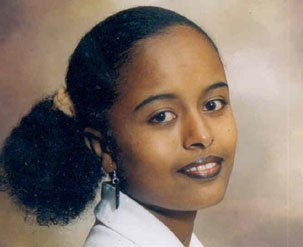
Her name is ShiBire Desalegn. She is the first person to be killed when Meles Zenawi unleashed his forces following a peaceful protest by Addis Ababa University (AAU) students on June 6. She was shot and killed by EPRDF troops as she and her friends tried to block the road in Kotebe that leads to the Sendafa torture camp. She helped escape several AAU students from torture by helping them jump from the trucks that were taking them to Sendafa. She didn’t have any weapon. But that didn’t stop the EPRDF troops from shooting her to death.
A high caliber bullet pierced through her neck.
Because of ShiBire’s actions, some AAU students escaped torture. But because of the action and inaction of others, thousands went through unspeakable brutality in the hands of the EPRDF security forces under the direct orders of Meles Zenawi. Thirty days later, Meles Zenawi was standing next to President Bush and Prime Minister Tony Blair at the G8 meeting in Scotland, looking proud of his barbaric actions.
Ethiopian Review spoke with ShiBire’s mother, Wzr. Ayelech Birkneh. She is devastated by her daughter’s sudden death. As the bread winner of the family, the 21-year old ShiBire was supporting her mother and six teenage siblings. The father passed away, leaving only a 50 birr monthly pension.
ShiBire could not continue her education, because there was nobody else to support the family. Her income was not enough to support the whole family even though she worked hard. The only choice she had to generate enough income was to go to a foreign country looking for a job.
People in ShiBire’s neighborhood appreciate what she did and died for. They think she is a heroine and a role model. They talk about her with a great deal of pride. She stood up for the students who only demanded respect for the people’s vote. She paid the ultimate sacrifice trying to save others.
Ethiopian Review
July 25, 2005
The Coalition for Unity & Democracy’s spokesperson Dr Hailu Araya said yesterday that in the event the Election Board fails to properly count the people’s vote and declares EPRDF the winner, his party will go to court to pursue a legal recourse.
Asked if CUD will participate in the next parliament that will convene in September, Dr Hailu said that a decision has not been made on this yet. But he said the parliament may not convene in September because of the continuing process to resolve the disputes.
In the one-hour teleconference with Ethiopian Review and Tensae Radio, Dr Hailu said that the people Ethiopia need to be prepared to take constitutional and peaceful measures to make sure that their choice is respected.
The teleconference was attended by over 100 Ethiopians from the U.S. and Europe. Many of them had forwarded questions to the interviewers in advance.
Originally, CUD Chairman Ato Hailu Shawel was scheduled to appear at the teleconference, but he could not make due to a health problem.
The audio version of the teleconference will be made available shortly.
Ethiopian Review
July 22, 2005
The Ethiopian pilots who sought political asylum in Belarus informed Ethiopian Review today that the Belarus Ministry of Interior informed them that their political asylum requested has been denied.
The Ministry of Interior officials told the pilots that the reason for denying them asylum is that there is a stable political situation in Ethiopia.
The officials returned to the pilots their passports and withdrew security protection. As of today, the pilots have no security.
They have also been given one month to appeal to the court.
The Meles regime buys from Belarus millions of dollars worth of weapons every year, the money that has been donated by Western countries for “humanitarian purposes.”
By Rob Crilly Special for, USA TODAY
ADDIS ABABA, Ethiopia — Regulars at the Crocodile, a coffeehouse in the Ethiopian capital, pored over copies of an independent newspaper called Nestanet, which means “freedom” in the local Amharic language.
“Everyone is waiting for the result of the election,” said Kebede Lema, as he sipped bitter coffee. “The feeling is not good.”
A tense calm has fallen over the city since police shot dead 36 political protesters on June 8. The fatalities came after demonstrations to protest what opposition parties say was vote rigging in parliamentary elections May 15.
Prime Minister Meles Zenawi’s governing party claims it won the poll. Two months after the vote, the final tally hasn’t been published. Results released July 8 for more than half the seats showed the ruling party and opposition in a virtual tie. The National Electoral Board said Tuesday that it would announce the full results Friday.
For now, the coffee drinkers wonder whether there is democracy here or if the government has erected a facade intended to divert international attention from the leadership’s hold on power.
Some expect more violence when the results are released. “The opposition parties may not accept the result, if they believe the appeals process has been unfair or unjust,” said Asrad Michael, who sat on a plastic chair outside the coffee shop. “People here are beginning to ask questions, and they will demonstrate again if they want to.”
International support
It is 14 years since Meles and his rebel army ended the 17-year reign of Mengistu Haile Mariam’s Soviet-backed junta. Afterward, the international community — including the United States — was quick to offer aid and liken Meles to African leaders such as Paul Kagame in Rwanda and Yoweri Museveni in Uganda. Both emphasized democratic change and good governance.
Ethiopia held its first multiparty elections in 1995. Progress was rewarded by warmer relations with the United States, says David Shinn, U.S. ambassador to Ethiopia from 1996 to 1999.
Last year, British Prime Minister Tony Blair appointed Meles to his Commission for Africa, a panel tasked with drafting a blueprint to lift the entire continent out of poverty. Also on the panel: campaigners on behalf of Africa such as Bob Geldof, orchestrator of the Live Aid and Live 8 benefit concerts.
Ethiopia’s elections in May, at first, seemed to enhance the country’s image as a flourishing democracy. The Carter Center and the European Union hailed the progress made there.
Provisional results gave the opposition parties, which shared a platform that promoted economic liberalization, sweeping gains. They claimed almost 200 out of the 524 contested seats. They won 12 seats in 2000.
Beyene Petros, first vice chairman of the opposition United Ethiopian Democratic Forces, says despite these gains, the election was not fair. He claims there was vote rigging at rural polling stations, beyond the gaze of international observers.
“The ruling party prevented our poll watchers from sitting in the polling stations. It meant they could use force on opposition supporters, arrest them and so on,” he says.
He says members of his party reported that ballot boxes were destroyed, pre-marked papers were distributed and counts were changed by officials of Meles’ Ethiopian People’s Revolutionary Democratic Front.
Carter Center monitors visited 36 disputed constituencies. A center statement confirmed some allegations of voter intimidation and improper transport of ballot boxes. The center was waiting for Ethiopia to conclude its investigation before releasing its report.
Opposition parties lodged complaints in 299 of the 524 contested constituencies. The Electoral Board investigated 139 of those complaints.
Violent protests
On June 6, students protested, hurling stones at police. Hundreds were arrested. The clashes brought more people onto the streets of Addis Ababa. Two days later, more than 30 people were killed when police fired on demonstrators. The shootings, Beyene says, showed the government didn’t have a real commitment to democracy. He says Western leaders have been taken in by a slick public relations campaign to secure aid and cement Ethiopia’s position as a key regional ally in the war on terror. “They want to present a picture of democracy, but at the same time, they don’t want to give anything away,” he says.
The government claims the protesters who were killed planned to storm government buildings. Lethal force was needed to prevent the country sliding into anarchy, Information Minister Bereket Simon says. He says 3,000 people were arrested. “This unfortunate incident took place, which we all regret. But I don’t think this must be the yardstick by which our move to democracy is measured,” he says. “We have come a long way in 14 years and created an irreversible process of democratization.”
After the protests, the two main opposition groups signed a deal with the government to resolve election disputes peacefully. Tuesday, opposition leaders complained that the government impeded a fair review of their complaints. “The investigation process was a complete failure,” Behanu Nega of the main opposition Coalition for Unity and Democracy told reporters.
“The investigations have been following proper procedures, and we are not biased in favor of any political group,” Electoral Board spokesman Getahun Amogne said.
Shinn, an adjunct professor at George Washington University in Washington, says it’s unclear whether Meles is truly a progressive African leader. “This is the key question, and the answer is not yet in,” he says. He says optimism in the first days after the election has been undermined by the heavy-handed policing of protests. The violence was “a very significant setback to the whole democratic process.”
Secretary of State Condoleezza Rice called Meles to express her concern over the violence. The British government has withheld a $36 million aid package to protest the unrest.
“It is time that Westerners revised their point of view,” says Arafat Abdulaziz, a student at Addis Ababa University. “This government has two faces: one for people here and one for people internationally.”
Contributing: Wire reports
DPA, Addis Ababa – 20 July 2005 – Poor rains and high crop prices have left more than 18-million people with serious food shortages in 10 African countries, a food-security monitoring group said.
Diminishing water supplies and dry pastures also are fuelling conflict among rival tribes, and child malnutrition is reportedly rising in parts the Greater Horn of Africa region, the United States-funded Famine Early Warning Systems Network said in a report released late on Tuesday.
The food shortages are concentrated in Ethiopia, where more than half of the 18-million affected people live, the report said.
At least half of neighbouring Eritrea’s population of 4,5-million is in peril, as well as 2,69-million in Uganda, the report said.
Other countries affected are Sudan, Djibouti, Rwanda, Tanzania, Kenya, Burundi and Somalia, it said.
“In agricultural areas, rainfall performance and crop prospects are mixed,” the report said. “Crop production in eastern and coastal areas of the [region] will be below average, due to insufficient and poorly distributed rainfall.”
Members of cattle-herding communities “continue to be the most food-insecure and vulnerable group”, according to the report. — Sapa-AP
