‘Cocktails for Reading’ is an event that is in between a cocktail party and networking event among readers, publishers, authors, writers and organizations involved with reading in Ethiopia.
The format is simple — a party promoting reading among Ethiopians with cocktails, speakers, books, and souvenirs thrown in the mix.
Speakers
Event hosted by Ellias Fullmore from burntface. Featuring keynote speakers to include recent CNN Hero, Yohannes Gebregeorgis of Ethiopia Reads; and Elias Wondimu, founder & publisher of Tsehai Publishers and Distributor.
Sponsors Bernos is an innovative clothing company that creates high-quality, eye-catching t-shirts featuring African themes.
Ethiopia Reads works to improve literacy and create a culture of reading in Ethiopia, in order to bring hope, vision and educational skills to this generation of Ethiopian children. We plant libraries for children to provide quality reading materials, publish books in local Ethiopian languages and train teachers and librarians to nurture a love of reading and books. Ethiopia Reads believes that education is the key to improving the lives of Ethiopians and books are key to fostering a genuine love of learning.
Tsehai Publishers and Distributors is a publishing company founded with the intention of spreading currently absent knowledge about underserved communities, such as the African Diaspora. Tsehai Publishers was established with the belief that works of literary fiction and serious nonfiction are both necessary and desirable, and that an innovative and aggressive model of publishing can fill a void in today’s marketplace, allowing works of quality to be published both profitably and well, especially for first time authors and those who come from an under-served community of writers.
Obama Leads McCain by eight percentage points, 50% to 42%
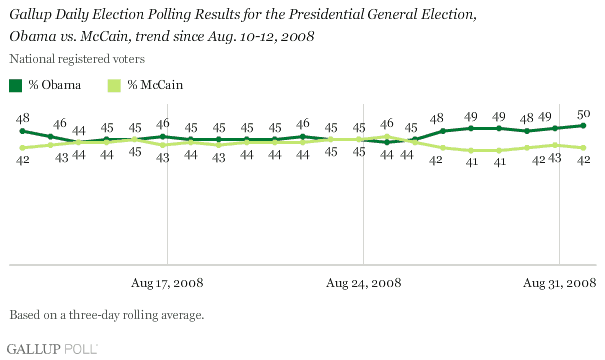
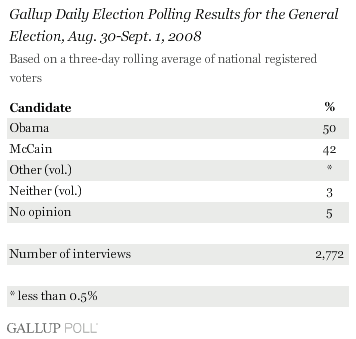
PRINCETON, NJ — Gallup Poll Daily tracking from Aug. 30 through Sept. 1, finds Barack Obama leading the race for president with his highest share of support to date. Fully half of national registered voters now favor Obama for president, while 42% back John McCain.
Prior to now, no more than 49% of registered voters supported Obama for president in Gallup Poll Daily tracking. Still, Obama’s eight percentage point lead over McCain in the new poll falls one point shy of the lead he attained in late July after returning from a well-publicized trip to Europe and parts of the Middle East. At that time, Obama led by nine points, 49% to 40%.
McCain’s 42% support is well below his 48% top support level, recorded in late April/early May. It is just slightly better than the 40% he received at several points in July, and the 41% favoring him just last week while the Democratic National Convention was underway. (To view the complete trend since March 7, 2008, click here.)
At 8%, the percentage of undecided voters is slightly lower than the 9% to 11% figures seen for most of August, and this is the lowest this figure has been since early June. This, in part, reflects movement of voters toward Obama over the course of the Democratic National Convention, a lead which has been sustained in subsequent days.
The field period for today’s results includes Monday (Labor Day), when the scaled down Republican National Convention received limited media attention while most news coverage either focused on the hurricane hitting parts of the Gulf Coast or Monday’s surprise announcement that the 17-year-old daughter of the soon to be Republican vice presidential candidate, Sarah Palin, is pregnant. The Republicans hope to start up a more traditional convention schedule today in St. Paul, with the goal of capturing the same kind of media and public attention the Democrats did last week in Denver. — Lydia Saad
(Click here to see how the race currently breaks down by demographic subgroup.)
Survey Methods
For the Gallup Poll Daily tracking survey, Gallup is interviewing no fewer than 1,000 U.S. adults nationwide each day during 2008.
The general-election results are based on combined data from Aug. 30-Sept. 1, 2008. For results based on this sample of 2,772 registered voters, the maximum margin of sampling error is ±2 percentage points.
Interviews are conducted with respondents on land-line telephones (for respondents with a land-line telephone) and cellular phones (for respondents who are cell-phone only).
In addition to sampling error, question wording and practical difficulties in conducting surveys can introduce error or bias into the findings of public opinion polls.
To provide feedback or suggestions about how to improve Gallup.com, please e-mail [email protected].
KEBRI DEHAR, Ethiopia (AFP) — UN humanitarian chief John Holmes on Tuesday urged Ethiopia to grant aid groups access to conflict zones in the southern Ogaden region where the army is battling a rebel group.
Ethiopian military launched a crackdown last year on the region after the Ogaden National Liberation Front (ONLF) attacked a Chinese-run oil venture, killing 77 people.
Aid workers say the military operation has caused a humanitarian crisis, displacing hundreds of thousands of people, many of them fleeing to lawless neighbouring Somalia.
“There are still some areas (in Ogaden) where access is more limited because conflict is more active. That’s where we want to press (the governement) for more free access,” he told reporters during a fact-finding mission to the country.
“We need to be allowed to work freely, do our assessments freely and be able to release data.”
But he conceded that aid agencies had unfettered access in one Ogaden region, Kebri Dehar. “It’s a lot better than it was when I was here last year.”
But he criticised inadequate civilian and human rights protection in Ogaden, a barren, impoverished region where the discovery of gas and oil has brought new hopes of wealth as well as new causes of conflict.
“We haven’t had a satisfaction that I would like on that and I have raised that question with the government,” he said.
Ethiopia has denied as exaggerated charges by aid groups that military operation has hampered delivery of aid to the region.
Holmes is on a three-day visit to Ethiopia, where 4.6 million people need emergency assistance and eight million others need immediate food relief due a severe drought, according to the UN humanitarian office (OCHA).
VENICE (Reuters) – A powerful new film chronicles the life of an Ethiopian intellectual who flees his country during the Marxist “red terror” in the 1980s, only to be viciously attacked in Germany by racist youths.
Actors (from left) Evelyn Arthur Johnson, Veronika
Avraham, Aaron Arefe and Abeye Tedla [Photo: AFP]
Anberber, the central character, returns to his homeland longing for peace, but life with his mother in a small village is disrupted by armed factions dragging boys away to fight and by prying locals wary of a man they consider to be an outsider.
“Teza”, by Ethiopian director Haile Gerima, is one of 21 movies in competition at the Venice film festival, and warm applause after a press screening suggested it would be a contender for prizes at the closing ceremony on Saturday.
The story jumps between multiple timelines, but in each Anberber struggles to fit in, be it in his native Ethiopia or in exile in Germany.
Gerima said “Teza” reflected his own experiences, and was based on a recurring dream.
“The dream is basically about intellectual displacement,” he told reporters in Venice on Tuesday.
“When I translated my dream it was about being displaced, unable to live up to your peasant life, your peasant family and at the same time reconcile (that) with your modern world.”
Anberber seeks refuge in memories of his happy childhood, something U.S.-based Gerima said he also did whenever he returned to Ethiopia which he described as “a nightmare for me.”
“Like Anberber in the film I like to drown (in) the past.”
“I go to Ethiopia and I dream my past but the present is so powerful it continues to hijack my sentimental journey to my childhood. I think it’s the idea that you want your childhood world to come back, I think that is universal.”
“In Africa the luxury to remember memory is hijacked by daily violence, either silent violence or obvious violence.”
DEATH AND DANGER
Some of the most striking scenes are set in the 1980s, with Ethiopia in the grip of purges, show trials, executions and mob lynchings under the leadership of Mengistu Haile Mariam, who seized power in 1974 after Emperor Haile Selassie’s overthrow.
Giant portraits of Marx, Engels and Lenin form the backdrop to the violence and fear, and Anberber’s revolutionary fervour quickly turns to disillusionment as he realises what the regime means for himself and his country.
Actor Abeye Tedla, who plays Anberber’s best friend and fellow idealist, recalled some of the horrors of that time which he lived through as a child.
“I’ve seen a few bodies when I was going to school and coming back. It wasn’t uncommon.”
“As you were walking by there would be a guard standing there so nobody removes the body. And if you look too closely … the person would say ‘Do you know this person?’ And I mean literally you could get shot if the person suspected you.”
He praised Gerima for what he said was a balanced portrayal of those times in Ethiopia.
“It (the story) just looks at what happens when people stop thinking constructively and start thinking destructively.”
By Mammo Muchie, Network of Ethiopian Scholars (NES)
Ethiopia, Like Libya, Must Also Be Compensated for Colonial Crime Against It: Italy and Other Colonizers Must Pay!
It is not enough to apologize for slavery and colonial occupation by the enslavers and colonizers. The former colonial powers must pay compensation for the wreckage, debris and havoc they left behind which still influences the ability of the colonized to emerge with freedom to pursue structural transformation.
Like Libya, Ethiopia has been under the Italian pernicious colonial direct and indirect occupation since the 19th century European Scramble for Africa. It has fought back this colonial encounter with heavy sacrifice including the loss of current day Eritrea to Italian colonial control for 60 years. The colonial curse has continued to fester on today continuing very sadly to cost Ethiopia hugely now with continued loss of peoples lives, constant threat of war, closing Ethiopia’s outlets to the Sea and internally ethnic-based division and instability in the country. It is Italy that used first the ethno-linguistic scheme to divide and rearrange the then existing Ethiopian geography based internal political boundaries using such names as ‘governo’ Oromo, ‘governo’ Amhara, and so on. Sadly this same scheme has been used by those reared from our own Ethiopian soil and they tell us or blackmail all by saying the only way Ethiopia can survive is by such crude imitation from the Italian division that Italy at the time used to fit the purpose of its colonial design of divide and rule on Ethiopia!
All Colonial Powers must Apologise to Ethiopia and Mean It!
We believe that the violation of Ethiopia’s dignity is not commensurable with monetary compensation indeed. But a monetary offer might make the apology a bit more real than just an empty rhetorical one.
So we urge all colonial powers to make serious apologies to Ethiopia- all those that have fought Ethiopia since the 15th century from Portugal, the Turks, Anglo-Egyptians, Italy, The British, the French must make at least together over 100 billion dollars worth of apology to Ethiopia. Even that amount will not suffice as Ethiopia still suffers from current external disruptors using the current ethnic division to undermine Ethiopia as a united national entity.
We hope the precedent of others paying for their crime may deter future crimes. Compensating for colonial crime can serve as the power of example for others to refrain from intruding and violating the peace, stability and integrity of an ancient nation that is badly in need of rapid transformation to feed itself, and indeed, for its citizens, to live in dignity irrespective of race, gender, language, ethnic origin and any other differences.
Ethiopia: The Most Generous Nation on the Planet!
Ethiopia today is the most generous nation on this planet. Due to the Anglo-Egyptian unequal treaty on the control and use of the Nile River, it has been contributing nearly 86 % of the waters of the Blue Nile to Egypt. We believe Ethiopia should continue to let Egypt share the waters of the Nile. If Egypt is fair- minded, it should also be the first to refuse to take the water alone without venturing to offer some compensation to Ethiopia. That means Egypt should be humble enough to compensate, at least in some form, for the free water it has been allowed to enjoy with the unequal treaty on the Nile executed under the British power and oversight. This took place at the time when right was might and might was right. In the 21st century we should move from might and power to justice and fairness in the equitable distribution of scarce resources gained through unequal treaties.
Any person who has been to Egypt would realise how important the Nile River Water is to Egypt, and would thus not want Egypt not to use the water. But what would be fair is for Egypt to acknowledge the generosity of Ethiopia and others and create a scheme where some form of compensation is given to them. The fair and just settlement of the use of the Nile Waters will also restrain all the regimes to play destructive games against each other. It will make politics more open and transparent and as much as possible as intrigue-free as it should be amongst them. The longer there is no fair settlement, the more the regimes are tempted to play games to weaken their opponents by supporting armed agitation and other forms of disturbances amongst each other. That is a wrong direction when there is a better alternative. It would be a shame to go with business as usual when there can be an honest way of settling differences with fairness, justice and genuine fraternity. We would say Ethiopia as the generous should remain generous and those who take without compensation like Egypt today to stop being mean, refrain from undermining the generous, and start learning to give and offer what they can and negotiate and establish fair-dealing!.
Concluding Remark
Most of us have lost loved ones, grandfathers, uncles and sisters in the Second World War. I grew up hearing stories of how heroically my grandfather died fighting Italian fascist aggression. I hope the current generation of Ethiopians will unite on getting Ethiopia compensated and not turn it into a political issue to divide across the existing internal rifts and fault lines of our current not so productive politics. And should Ethiopia be compensated through our combined efforts, let the resources be used to modernise agriculture, revamp education and health so that all Ethiopians starting from the bottom benefit through the resources that our forefathers sacrificed for with courage and selflessness.
As our national Olympic hero Abebe Bikila put it so well, Ethiopia made it through determination and heroic courage, united not divided, to defeat colonialism. It snatched its agency of colonial freedom through its united efforts from Adwa to the Second World War. It needs to confront the historic challenge of winning its agency back from receiving charity from donors to fighting to get the compensation it deserves to accelerate its development and transformation now! United we should all stand up for Ethiopia!
Mammo Muchie, Dphil, Professor,Coordinator of DIIPER
Research Centre on Development Innovation and IPER and
NRF/DST SARCHI chair holder, TUT, South Africa
Aalborg University
Fibigertraede 2, 9220-Aalborg East, Aalborg, Denmark
Tel. 00-45 9940 9813; fax 00-45 9815 3298
I was lucky enough to spend time with the physicians, nurses, and patients at the world-renowned fistula hospital this summer in Addis Ababa, Ethiopia. A socially stigmatizing condition, an obstetric fistula is highly operable and in most cases, completely curable. Therefore, after physicians Reginald and Catherine Hamlin moved from Australia to Ethiopia in the early 1970’s to work as missionaries where they encountered many fistula patients, they decided to open a facility solely serving the needs of women with obstetric fistulas.
A beautiful and pristine facility, one cannot help but sense a “medical utopia” as much of the staff is made up of previous patients and the women there not only get 24-hour medical care, but also benefit from physical therapy, literacy education, and other sorts of counseling. The hospital is well-thought out and well-supported. As I walked through the grounds of the hospital, I had to smile when I saw on one of the buildings, “Oprah Winfrey’s Center for Women.”
This place was far from usual, even by Western standards, and I began to wonder how in the world something so comprehensive could be replicated in all of the other developing countries where obstetric fistulas exist. Would someone be willing to set up a fistula hospital in say, Niger, or Tanzania? And if they could, would that be the best long-term solution? In most of those countries, Ethiopia included, thousands of women are still getting fistulas during childbirth. Whether they’re due to child marriage and hence pregnancy, lack of infrastructure, healthcare shortages, or a combination of all of the above, fistulas are preventable. These problems that interfere with safe childbirth lead to a plethora of other medical emergencies besides fistulas and if these aspects of health care and society could be addressed simultaneously and with the same vigor as the after-affects are sometimes addressed, there would be no need for a special fistula facility funded by Oprah and others.
Of course, today there are thousands of women who have already sustained injuries during childbirth and need the treatment and care offered by places like the fistula hospital, but over time, hopefully there would be so few women needing repair that they could obtain it in a regular public hospital. I am so grateful for the time I had at the fistula hospital and the skilled surgeries I was permitted to watch. I do not by any means want to belittle the work done there, only suggest that the time, effort, and love I witnessed being put into that facility be emulated in all areas of health services, especially that of prevention. One of the ways the Fistula Hospital is doing this currently is by beginning a Midwifery College. They actively recruit high school students in rural areas to train as midwives under the conditions that they return to their homes and work in a government-funded maternal health center. This is something I believe will make a lasting impact on the welfare of women in Ethiopia, and I hope that it continues and expands in its efforts.
Maybe it is more difficult to convince outside donors to give money to something that does not result in immediate change such as an annual large number of repaired women compared to an unidentified and vague number of ordinary women who escaped a fistula because of adequate emergency obstetric care. As future physicians, we should consider how to do this convincing.
– – – – – – – – – – –
Rachel Pope, a second year medical student, Medical School for International Health, Be’er-sheva, Israel, can be reached at [email protected]


 I was lucky enough to spend time with the physicians, nurses, and patients at the world-renowned fistula hospital this summer in Addis Ababa, Ethiopia. A socially stigmatizing condition, an obstetric fistula is highly operable and in most cases, completely curable. Therefore, after physicians Reginald and Catherine Hamlin moved from Australia to Ethiopia in the early 1970’s to work as missionaries where they encountered many fistula patients, they decided to open a facility solely serving the needs of women with obstetric fistulas.