To Alaska Governor Sarah Palin, last week’s election loss to the Democratic ticket boiled down to a trio of problems: money, the Hispanic vote and “that ‘R’ by our name.”
In an interview with NBC Today Show host Matt Lauer that aired today, Palin gave a her postgame analysis of why she and Republican presidential candidate John McCain did not do better against President-elect Barack Obama and Vice President-elect Joe Biden.
“I thought it would be closer,” Palin told Lauer, continuing a series of national television interviews that aired beginning yesterday on Fox, NBC and CNN. “But then take a step back … it makes sense. We did not get the Hispanic vote, and that was very significant. And when you consider that we were outspent so tremendously, it make sense there also,” said Palin, who prepared a salmon-and-halibut casserole for the visiting television personality.
“And just that anti-incumbency sentiment that was spread across the land, and our ticket representing the incumbency. … It was really not so much a surprise after all that the margin was as great as it was.”
And what about Obama?
“He did a great job in articulating his ability to usher in change — the change that American voters have been seeking. And perhaps our ticket represented too much of the status quo.
EDITOR’S NOTE: This is what Ethiopian opposition leaders have failed to do. The crimes committed following the 2005 elections in Ethiopia is far worse than what happened in Kenya.
By Derek Kilner | VOA
A Kenyan human-rights watchdog says it has been in communication with the International Criminal Court in the Hague about crimes committed in the aftermath Kenya’s December elections. As Derek Kilner reports from Nairobi, Kenyan political leaders are divided over whether to support a recommendation to establish a tribunal on post-election violence in the country.
As part of an agreement mediated by African leaders in February, a commission was established to investigate violence set off by disputed election results that killed more than 1,000 people and displaced hundreds of thousands from December through February.
Last month the commission, headed by Kenyan judge Philip Waki, released its findings and recommended Kenya establish a tribunal with Kenyan and international members, to try those suspected of the greatest involvement in the violence.
Waki refused to reveal the names of the suspects, but said if Kenya’s leaders did not agree to the tribunal within 60 days, those names will be forwarded to the International Criminal Court.
Leaders from both of Kenya’s main political parties have not offered a firm position on the report, trying to avoid being seen as blocking an investigation into serious crimes, while retaining support of allies who may be implicated.
Kenyan civil society leaders have grown increasingly frustrated with the political response. A top official with the state-funded Kenya National Commission for Human Rights, Hassan Omar, called for leaders to act on the report.
“By rejecting the report, we understand the politicians to be telling Kenyans that ‘A’, they do not want national catharsis, healing of the nation, or a clean break from the past; ‘B’, they support the love of national morality in politics, and does not believe in the culture of humanity; and ‘C’ that they prefer to reinforce Kenya’s culture of impunity by hiding the concealed painful truth of the post-election violence,” he said.
Omar said the human-rights commission, which produced a separate report on the violence, would prefer to establish a tribunal in Kenya, but has been in contact with the International Criminal Court.
“The ICC has already been in touch with the KNCHR. They are interested in this matter. They have asked us to share with them our report, plus other reports, and to share with them the relevant information,” he said. “They are determining whether this matter is a matter that they would be interested in, and the ICC does not need an invitation to come here.”
Key supporters of both President Mwai Kibaki and his main opponent in December’s election, Prime Minister Raila Odinga, are thought to be among those under investigation.
Supporters of Mr. Odinga from the Rift Valley province have been accused of organizing tribal militias to target members of President Kibaki’s Kikuyu ethnic group over long-standing land disputes. Supporters of the president, meanwhile, have been accused of recruiting a Kikuyu gang known as the Mungiki to carry out retaliatory attacks.
Tensions have been particularly visible within Mr. Odinga’s Orange Democratic Movement, which holds a majority in Kenya’s parliament. The prime minister, who has eagerly courted the favor of the international community during the past year, initially endorsed Waki’s recommendations. But a recent meeting of the party’s members of parliament rejected them.
On Monday, after a meeting of top party leaders, Secretary-General Anyang Nyong’o said the party would form a new committee to look at the report.
MOGADISHU, SOMALIA – Meles Zenawi’s troops in Mogadishu have indiscriminately opened gunfire on unarmed civilians killing three people on Tuesday, witnesses told Mareeg.
Eyewitnesses confirmed to Shabelle that they saw the dead bodies killed by the soldiers in Hamar Bile area of Wardhigley district in Mogadishu.
It’s yet unknown the motives behind the killing of the civilians by the Woyanne regime troops.
LAGOS (AFP) — Africa may have hailed his victory, but Barack Obama’s election as the first black president of the United States has triggered awkward questions about the continent’s own democratic track record.
As the euphoria fades, opposition parties across the continent contrasted Obama’s victory with the shortcomings of their own democracy as a reason for despondency.
“When the declaration was made, I broke down and I wept; one — for joy that ‘my eyes have seen the coming of the Lord’; number two — I wept in sorrow for my country,” said former Nigerian foreign minister Bolaji Akinyemi, now a member of the National Electoral Reform Committee.
Akinyemi’s organisation faces an uphill struggle to iron out the democratic wrinkles of Africa’s most populous country, where President Umaru Yar’adua’s April 2007 poll victory is still subject to approval by the Supreme Court, which recently indefinitely postponed a ruling.
Those elections were described as neither democratic nor credible by the European Union, while the White House said it was “deeply troubled” by the violence which accompanied them.
Similar concern surrounded recent elections in Kenya and Zimbabwe, which were marked by widespread violence and intimidation.
And on Monday, the main political parties in the Ivory Coast agreed to postpone November 30 elections until next year because of insecurity and problems with voter registration.
In Harare, opposition leader Morgan Tsvangirai, who believes he was robbed of an outright victory in Zimbabwe’s March elections, said Obama’s victory has a particular resonance with its lesson of “political maturity and tolerance”.
“Zimbabweans appreciate the true value of a vote, the preciousness of a poll that is conducted openly and fairly, and a result that is respected by all,” said Tsvangirai who pulled out of a runoff against Robert Mugabe after scores of his supporters were killed.
While Obama can stay no longer than eight years in the White House, more than half a dozen African leaders have already chalked up more than a quarter of a century in power.
Mugabe has been in charge since 1980, Angola’s Jose Eduardo dos Santos since 1979 while Hosni Mubarak has ruled Egypt for 27 years and routinely been re-elected unopposed with vote totals of more than 95 percent.
Equatorial Guinea President Teodoro Obiang Nguema seized power in a 1979 coup, three years before Paul Biya became president in neighboring Cameroon.
Moamer Kadhafi has been in power for nearly 39 years in Libya but he falls just short of qualifying as Africa’s longest-serving ruler, a distinction belonging to Gabon’s Omar Bongo, who came to power in 1967. He won the country’s most recent presidential election with 79 percent of the vote.
Obama’s victory was greeted with particular jubilation in Kenya, with President Mwai Kibake hailing it as “an inspiration to millions”.
But some commentators drew an unflattering comparison with his disputed re-election last December. Kibaki was ultimately forced to share power with the now Prime Minister Raila Odinga following post-election violence that killed more than 1,000 people.
The Daily Nation newspaper said there was much in Obama’s victory “that can profit us in Kenya — that true democracy requires tolerance and the ability to give in with grace when we lose a political contest.”
South Africa, and its peaceful elections in 1994, 1999 and 2004, stands as an example to the continent, one that Nigeria, and its 140 million people, hopes to emulate.
“There has been so much enthusiasm also about the efficiency of American democracy, even from political parties, and state governors who are sponsors of violence and electoral fraud in Nigeria, said the daily Guardian in Lagos.
“If we love success and democracy so much, why don’t we create an enabling environment for the same value in Africa?”
There Is No Me Without You: One Woman’s Odyssey to Rescue Africa’s Children Author: Melissa Fay Greene Edition: 1 Format: Bargain Price Manufacturer: Bloomsbury USA Number Of Items: 1 Number Of Pages: 472
There Is No Me Without You is the story of Haregewoin Tefarra, a middle-aged Ethiopian woman of modest means whose home has become a refuge for hundreds of children orphaned by AIDS. It is a story as much about the power of the bond between children and parents as about the epidemic that every year leaves millions of children, mostly healthy themselves, without family.
Originally a middle-class woman with a happy family life, Haregewoin fell into a deep depression after the death of her recently married daughter. But then a priest brought her two children, AIDS orphans, with nowhere to go. Unexpectedly, the children thrived, and Haregewoin found herself drawn back into daily life. As word got out, an endless stream of children began to arrive at her door, delivered by dying parents and other relatives who begged for her help, and, pushing against the limits of her home and bank account, she took more and more in.
Today, Haregewoin runs a school, a daycare system, and a shelter for sick mothers. Without medication for her charges some HIV-positive, some uninfected, and some infants trying to fight off the virus, but almost all of whom come to her terrified and malnourished forges on, caring for as many as she can handle.
Increasingly, she also places them for adoption with families like that of journalist Melissa Fay Greene, who has two children adopted from Ethiopia.
In Haregewoin Tefarra’s story, Greene gives us an astonishing portrait of a woman fighting a continent-wide epidemic.

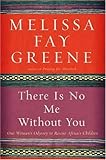 There Is No Me Without You: One Woman’s Odyssey to Rescue Africa’s Children