
Image: Terri O’Sullivan
Metre-wide cracks in the ground suddenly split open, as red-hot rock and ash are thrown violently into the air amid searing temperatures. It’s like a vision of how the Earth behaved in prehistoric times. Except these events have happened within the last three years in Ethiopia’s Afar region. What’s more, a matter of days ago there was more extreme volcanic activity there, with reports of the country’s biggest eruption to date – and the largest recorded lava flow in scientific history.
Aerial view of Erta Ale

Image: Filippo Jean
Satellite images show that this latest volcanic explosion spewed out lava across a huge area of 300 sq km, a record of its kind according to researchers. The eruption of molten rock also prompted a minor earthquake – though there were no reported casualties or major damage in the remote area, many of whose inhabitants are nomadic people. The same couldn’t be said in 2005, when thousands were displaced by a catastrophic eruption that darkened the skies for days, while lava flows in 2007 forced further evacuations.
Nomadic Afar people

Image: Kambiz Kamrani
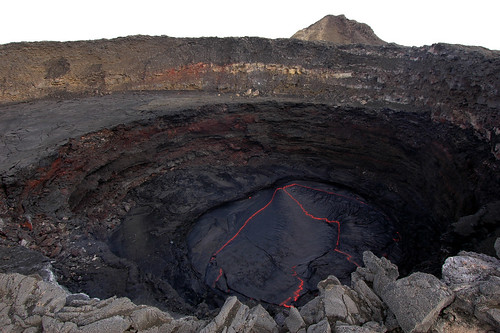
The Afar region is one of the hottest and harshest environments in the world. It’s renowned for Erta Ale, the name describing both the chain of volcanoes responsible for these geological disturbances and its most active individual peak. One of only four volcanoes on the planet with a lava lake bubbling at its summit, Mount Erta Ale’s crater is the popular image of a volcano – a bottomless cauldron of lava extending down into the Earth’s mantle.
Erta Ale crater close-up

Image: Herve Sthioul
Scientists are busy studying these ruptures in the Earth’s crust at Afar, which sits along the 3000 km-long East African Rift marked by mountain ranges dropping precipitously into deep-lying basins. The magma forcing its way up from thousands of kilometres beneath the surface here is gradually splitting the African continent in two. Be prepared to see more of this part of the world’s explosive nature.


– Enviornmental Graffiti
By MIKE CORDER
THE HAGUE, Netherlands (AP) — The world’s first permanent war crimes court needs more support as it monitors atrocities in Congo and struggles to have important suspects arrested, an international human rights group said Wednesday.
Human Rights Watch also said the International Criminal Court’s independence must be supported in the face of intense diplomatic pressure on it to freeze its genocide case against Sudanese President Omar al-Bashir.
Sudan, supported by the African Union and the Arab League, has been pressing the United Nations to order the International Criminal Court to suspend the case.
Prosecutor Luis Moreno-Ocampo has asked judges at the court to issue an arrest warrant for al-Bashir on charges of orchestrating genocide in Sudan’s Darfur region, where 300,000 people have died and more than 2.5 million have been forced from their homes in five years of fighting.
“With the court’s independence and integrity at risk, ICC member states should speak out forcefully to promote (its) mission,” Elizabeth Evenson, counsel in the International Justice Program of Human Rights Watch, said in a statement. “They should strongly defend the ICC’s independence from political interference.”
Representatives from the 108 nations that have ratified the court’s founding treaty will hold their annual meeting in The Hague starting Friday. The United States is not a member of the International Criminal Court, although it did agree to having the court hear cases related to Darfur.
Human Rights Watch also urged the nations to do more to arrest suspects already indicted by the court, including Bosco Ntaganda, a rebel commander linked to violence currently raging between rebels and government forces in Congo.
Ntaganda is chief of staff for Laurent Nkunda, whose rebel forces have been accused by rights groups of atrocities in eastern Congo in recent weeks. The U.N. says Congolese army troops also have committed war crimes, including rape and plunder.
Ntaganda is charged with recruiting child soldiers during an earlier conflict in eastern Uganda.
Also still at large despite international arrest warrants are the leaders of a Ugandan rebel group, the Lord’s Resistance Army.
Both Uganda and Congo have ratified the court’s founding treaty and will attend the Assembly of States Party. Sudan does not recognize the court and refuses to hand over suspects.
“LRA (Lord’s Resistance Army) leaders and Ntaganda continue crimes against innocent civilians, and their arrests should top the agenda at this year’s assembly,” Evenson said.
Source: Cuban News Agency
HAVANA, Cuba (CNA) – Ethiopia’s State Minister for Foreign Affairs Woyanne donkey Tekeda Alemu praised Cuba’s work as president of the Non-Aligned Movement (NAM) at a meeting in Havana with Marcos Rodriguez, Cuba’s deputy Foreign Minister.
Tekeda Alemu pointed out that the Caribbean country plays a very important role in NAM, and it gives this Third World organization comprised of 118 nations – only second to the United Nations – more energy.
The visitor also expressed his expectations for the coming ministerial meeting of the organization, to take place in Havana next April, to follow up all the actions taken under Cuba’s presidency.
Turning to bilateral relations, in statements to ACN news agency, Alemu said they were solid, and that both nations have historically good relations, with fruitful cooperation in health and education.
The Ethiopian Minister Woyanne donkey highlighted the importance of the visit to his country made by Cuban VP Esteban Lazo, as well as the success of the joint intergovernmental commission that took place in Havana some months ago.
By Alex Wynter | IFRC
GOBA, ETHIOPIA – Carefully targeted humanitarian food interventions, supported by the Finnish and Austrian Red Cross and the Federation and implemented by the Ethiopian Red Cross Society, have helped alleviate a food-security crisis in Wolaita in the SNNPR region.
But those projects will soon be winding down, and all eyes there are on crucial harvests starting about now – of wheat, maize, barley and teff – which are almost certain to have been damaged in unseasonal heavy rain.
“Our work pulled people back from the brink earlier this year, but we cannot afford to relax,” says Kassahun Habtemariam, ERCS team leader for disaster preparedness and prevention.
“If the harvest is poor or fails altogether, then we could be back in an emergency situation very quickly,” according to Hannele Kankuri, the Addis Ababa-based Finnish Red Cross team leader, whose food-relief effort was funded by ECHO.
The paradox of Ethiopia’s food crisis is that as the eastern and southern lowlands suffer an acute drought, which is forecast to worsen in 2009, parts of the central highlands – including the capital – have seen torrential downpours almost daily, causing lethal flash-floods in places.
What both parts of the country have in common is that familiar weather patterns have gone haywire, making life especially difficult for subsistence farmers and pastoralists.
Crop prospects
A country bulletin from the UN’s Office for the Coordination of Human Affairs (OCHA) last week said harvests looked “promising” in the west. But crop prospects in the east, particularly in the lowlands, were “poor” due to inadequate rain.
The food-aid requirement in Ethiopia countrywide remains huge, according to experienced aid workers in Addis Ababa, and the drought effect is going to be worse next year, they say. The main challenge for humanitarian response remains available resources, with competing priorities for donors from countries like Afghanistan and now Democratic Republic of the Congo.
Emergency needs for the first half of 2009 are being worked out by an inter-agency assessment exercise that began earlier this month in Tigray and will be agreed with the government.
Ethiopia, meanwhile, is the latest stop for an interdisciplinary team from the International Federation, helping Horn of Africa National Societies plan ways to scale up efforts to address what many observers continue to regard as the worst humanitarian crisis in the world.
The team, which includes experts in nutrition, agriculture, health, relief, water and sanitation, and livelihoods, visited Wolaita and confirmed the general impression that the food emergency there had abated.
In June, more than 160 severely malnourished children a week were coming from surrounding villages for intensive feeding in the Damot Pulasa woreda (district), making it likely that up to 4,000 children across the district were suffering lower levels of malnutrition.
Adult hunger was also clearly in evidence.
Scorched lowlands
But the situation in Wolaita remains precarious, like many other parts of the country.
The two woredas chosen for the Red Cross projects were assessed by the Ethiopian Red Cross and the government to be among the worst affected in the zone: between them some 76,000 beneficiaries were assisted.
A further 20,000 were included in the Ethiopian government’s national “safety net” programme in the Finnish-assisted woreda, Damot Gale.
An attempt by the Federation team to get through to the parched lowlands to the east of Goba, in Bale zone, had to be abandoned when the road became completely impassable.
In Ethiopia, a descent of much more than 5,000 feet can encompass almost the full range of conditions from saturated ground and dirt tracks made impassable by heavy rain to extreme drought that drives struggling pastoralists in the other direction.
Over the past few years some small farmers in the mid-highland regions have been forced to commute to higher elevations, where the rain has been more plentiful to seek day-work after their own crops failed.
Farmers like Abdulahi Adem, 35, married with six children, who grows teff, maize and wheat in Keku village, Bale zone. “Before when we planted in a normal period we produced plenty of everything,” he says. “But due to the rains failing this year we were able to collect only four bags [200kg].
“The weather has been changing. But this year it seems better because there was rainfall and it might help us to produce more. In the past two years all we planted was lost because of a shortage of rain.”
At these elevations, at least, there are some alternatives. But down in the scorched lowlands, like Afar and the Somali region, pastoralists have little choice but to move further and further afield to find shrinking supplies of pasture and browse.
By Carl Little – Washington Post
MCLEAN, VIRGINIA – So much of what goes into Solomon Haile’s story comes down to distance. The more than 7,000 miles he flew in October 2007 from his native Ethiopia to the Washington area. The 15 miles he commutes round-trip on public transportation each day to attend Sherwood High. The 3.1 miles he runs on cross-country courses, setting records with each passing race. Or that same distance when he runs it on a track, faster than just about any other high school athlete in the country.
No matter how far or fast he goes, though, he continues to be chased by something more difficult to measure: doubt. At meets, some fellow runners snicker that he’s at least 20 years old. On the Web, there are stories and postings saying he earned cash while competing under a different name.
As he gets ready for the Maryland state cross-country championships today in Hereford, the doubts persist — despite the fact that the Maryland Public Secondary Schools Athletic Association has cleared Haile twice.
“At first, I just try to ignore it, all this thing, but it’s hard,” the soft-spoken Haile said. “They destroyed my name.”
Last month, an article on a popular running Web site reported that Haile accepted prize money from winning or placing in road races — an act the MPSSAA forbids, and one that could jeopardize his chances for a major Division I college scholarship (Texas, Kansas, Purdue and North Carolina State are among those vying for him). The story prompted Montgomery County Public Schools officials to ask for a meeting with Haile, his sister Naomi and Sherwood Coach Dan Reeks.
After an hour-long sit-down at Sherwood, Duke Beattie, director of athletics for MCPS, and Sherwood Athletic Director Jim Meehan concluded that, while several checks had been mailed to Haile’s home, he never cashed any of them.
“We’ve investigated his status — the alleged status as a professional — and we’ve reviewed the pertinent state regulations and definitions the state offers and Solomon passed with flying colors,” Beattie said after inspecting about $600 worth of uncashed checks and unredeemed gift certificates that were piled on the table. “I’ve conducted the investigation on behalf of the school system and the state athletic association and he completely satisfies all state and Montgomery County regulations.”
Said Ned Sparks, executive director of the MPSSAA: “I’m satisfied with the result. He’s clear with the state.”
Haile’s age came under suspicion in January, shortly after enrolling at Sherwood and running a blistering 9 minutes 13.22 seconds in his first 3,200-meter indoor event for the Warriors. Footage of his post-race interview surfaced on the Internet and some visitors to running Web sites and Internet chat rooms identified him as Solomon Semunguse, a 20-year-old who had competed in road races in Europe, Asia and along the East Coast of the United States in 2007.
According to the MPSSAA, students who are 19 or older on Aug. 31 are ineligible to compete in athletics for the upcoming school year.
The Haile family declined a request by The Post to review his original birth certificate. Beattie said MCPS has a copy of Haile’s birth certificate on record and confirmed his age before initially clearing him to compete at Sherwood.
“Our school officials have checked with his school back in Ethiopia and the dates were in sync with the birth certificate,” Beattie said. “We’re satisfied with the birth date.”
Naomi, who helped bring Solomon to the United States last year and with whom he lived in McLean when he first arrived, said she is to blame for the age snafu. While converting Haile’s birthday from the Coptic calendar used in Ethiopia to the Gregorian calendar used in the United States, she mistakenly registered Haile for races last year as a 20-year-old. She said she didn’t catch her error until Haile was vilified in running chat rooms. Some posts called him a cheater; others said he should be taken “off the track and back to Ethiopia.”
“I’m the troublemaker,” said Naomi, one of Solomon’s eight brothers and sisters. “He was born on a different year on a different day in a different month in Ethiopia. I got him older than he really is.”
As for the name issue, Haile and Semunguse are the same person, Solomon said. In Ethiopia, it is customary for a child to take the father’s first name as a last name, Haile said. His father, who still lives in Ethiopia, is named Semunguse Haile.
“If I go to Ethiopia, people call me Semunguse; no one call me Haile,” Haile said. “This is the tradition. But when my siblings here use the last name Haile, I have to be the same because I am brother and sister.”
‘Foreign and Fast’
One thing no one questions about Haile is his talent. A lean 6 feet 2, Haile is ranked No. 2 nationwide in cross-country by DyeStat.com, the country’s preeminent high school running Web site, and has won five major races this season with record times.
His signature win came last month at the Manhattan College Invitational in New York. He broke away from the field on the 2.5-mile course at Van Cortlandt Park and blitzed the finish line in 12:06.61, 21 seconds faster than the runner-up. No one in the 36-year history of the legendary meet had done it faster.
Reeks, who has won three team state cross-country championships in 38 years of coaching in Montgomery County, said a talent like Haile is a “rare” find. “He’ll probably end up being faster than anyone I’ve ever coached,” Reeks said.
Haile has an opportunity to extend his streak of dominance at today’s Maryland state championships in Hereford. He hasn’t lost a cross-country race since arriving in Montgomery County, yet his success doesn’t sit well with everyone in the running community.
“It’s not just because he’s foreign. It’s because he’s foreign and fast,” said Quince Orchard Coach Seann Pelkey, who has coached the Cougars to four state titles in his 10 years at the school.
“It’s kind of sad the way people have come at him anonymously. There’s some people who feel a sense of entitlement, something’s being taken from them. . . . With all he’s been through, with the answers that have come out about repeated questions. They’ve been addressed and addressed well. Some people aren’t just going to be satisfied. If it was a John Smith, they might be satisfied.”
Today, Haile will attempt to further solidify his place as one of the state’s best distance runners ever despite such a short career. The Bull Run course record is 15:51, set last month by Atholton senior Graham Bazell.
But Haile views a state title as only the beginning. Another national title is what he craves most — Haile won the Nike 5K national championship indoors and outdoors last school year in record times — and when he talks about the bigger races, his usually modest demeanor gives way to a bit of swagger. He calls Foot Locker Nationals “the big one” and, if he finishes in the top 15 in the Northeast Region, back at Van Cortlandt Park on Nov. 29, he will earn a shot at the national title in San Diego on Dec. 13.
“I never wish to get second,” Haile said.
His running stride is effortless, devoid of wasted motion. Watching him, it’s difficult to realize just how fast he is going. At a meet last month, a race official drove a tractor ahead of the race leaders to show the way. The driver said he had to run the tractor at 14 mph just to stay ahead of Haile — nearly 15 mph downhill.
‘Like Any of the Other Guys’
Haile is an endearing mix of humility and self-assuredness. His utter lack of arrogance easily won over his schoolmates. Last month he was nominated for homecoming king.
Seniors Kyle Balderson and Nate Toll, captains on Sherwood’s cross-country team, said their own times have improved as a result of Haile’s advice and encouragement in practice.
“He’s really supportive of everyone else,” said Toll, 17. “He’s just like any of the other guys we have. But he makes it look pretty easy.”
It wasn’t always easy for Haile. He grew up wanting to play soccer in Addis Ababa, Ethiopia’s capital and largest city. When he saw runners at the nearby track, he and his friends laughed at them. He couldn’t imagine running without a ball at his feet.
One of the runners noticed Haile’s form as he played soccer and told the young Haile he had potential as a runner. Flattered, Haile started practicing with the stranger and his friends. He frequently lagged behind, but ran until he improved.
He wakes each morning at 5:30 to take public transportation to Sherwood, where he was assigned because of its English for Speakers of Other Languages program. Preparing for his High School Assessment tests, which measure his progress toward the state’s core high school learning requirements, and juggling interest from nearly 25 Division I schools often keeps a bleary-eyed Haile up past midnight.
“He is pretty solid academically and is working very hard to graduate in June with his class,” Reeks said.
Running has long been an outlet for Haile. But even when he adds another record to his list of accomplishments, he still appears stoic. Haile says his reserve comes from an awareness that the road in front of him is longer than the one behind.
“This is my beginning,” Haile said. “My brothers and sisters ask me a lot of times, ‘Why you not like other kids when you win the prize, jumping or throwing something?’ I have a big dream, really. I’m happy with all I did, all of my success, but I’m not satisfied yet.”

