

Electronic Extracts from
the Official Newspaper of the Ethiopian Crown
The First Edition of
the New Negarit
The first edition of
the new series of Negarit, the Official Voice of the Ethiopian Crown, went to press
in March 1999, datelined March 31. It is being distributed throughout the world. Annual
subscriptions are available by sending a check or money order in US dollars, in the amount
of US$24, to:
Negarit, Inc.
PO Box 20863
Alexandria, Virginia 22320,
United States of America.
or send e-mail to: [email protected].
The following
main stories appeared in Volume I, No. 1 (new series):
- Ethiopia, 103 Years
After Adwa, Must Unify to Survive, Crown Says - US Congress Calls for Crown’s
Restitution To Stabilize Region - Crown Announces $1.2m
in US College Scholarships - Crown Pays Final
Respects to the Late King Hussein - Restoration of Stability
Along the Red Sea is a Global Priority - Editorial: On the Meaning of
Negarit - The Military Lessons of the Battle of
Adwa - Campaign to Save Holy Trinity
Cathedral - Crown Council President Meets with
Rwanda’s King Kigeli V at Strategy Conference - New Crown Medal Commemorates the
Victory Adwa - Adwa Anniversary is a
Reminder of the Joys of Sovereignty - Moa Anbessa is Freed to Become
Political Party - Legal Status for Haile
Selassie Memorial Foundation
On the Meaning of Negarit
Negarit has
always been the official Court Circular of the Crown of Ethiopia: the source of record for
the Solomonic Crown. That the Crown is currently in exile does not minimize the fact that
the Crown continues to serve Ethiopia, and will always be part of the life of the
Ethiopian peoples, as it has been for the past 3,000 years. Negarit derives its
name from the ancient practice by which criers, preceded by drums, would go throughout the
cities and towns proclaiming the news and pronouncements of the Imperial Court, and
rallying the people to action. In later years, under the Constitutional Monarchy period of
HIM Emperor Haile Selassie I, Negarit, under the Minister of
the Pen, was a more formal record of official positions, promotions and changes within the
Civil Service and Armed Forces, and a place in which the achievements of Ethiopians could
be broadcast. On the facing page, Ethiopians will be pleased to read, in Amharic, a
scholarly description of the origins of the name.
Today, the Crown is in Exile and in an Interregnum, and the Crown and Throne
of Solomon are represented by the Constitutionally-appointed Imperial Crown Council of
Ethiopia ( ). The
current Crown Council was re-convened by HIM Emperor Amha Selassie I in 1993, and His Imperial Highness Prince Ermias Sahle-Selassie
Haile-Selassie, the Grandson of HIM Emperor Haile
Selassie I, was named President of the Council. HIH Prince Bekere Fikre-Selassie was named Enderassé, or
Viceroy. The Crown Council moved, upon the death in January 1997 of HIM Emperor Amha Selassie, to ensure that the Crown would be
revitalized. And since that time, the Crown has indeed acted to help re-united the
Ethiopian Peoples as they face challenges on all fronts.
Principal among these challenges facing Ethiopia today is the multi-faceted
security threat posed by the Eritrean military invasion of our sovereign territory,
coupled with the now-open declaration by the effective powers in Sudan that dismemberment
of Ethiopia is an avowed objective. These military threats come at a time when Ethiopia is
still weak following more than two decades of civil war and civil unrest. Democracy —
which was beginning to flourish in Ethiopia under Emperor Haile Selassie — is still
not restored to our land, and nor are our peoples brought back together after years of
bitter internecine warfare in which the different nations of our Empire were forced to
fight one another.
The Crown of
Ethiopia is the Crown of all Ethiopians, and a
uniting symbol of our Empire of Peoples, whatever their language, whatever their religion,
whatever their ethnicity. Ethiopia’s Crown represents the oldest unbroken chain of
civilization in the World; it is a treasure beyond price. The Crown is the tool of the
Peoples of Ethiopia in their quest to build a better, united society, an example not only
to Africa, but to all societies.
International Relations
US Congress Call for Crown’s
Restoration To Stabilize Region
Washington DC: March
15, 1999: — In a series of moves, the United States Congress has taken up the cause
of Ethiopian unity and support for the cause of the Ethiopian Crown. Much of the momentum
began in September 1998, when the President of the Crown Council, Prince Ermias
Sahle-Selassie Haile-Selassie, participated in a major briefing to the US Congress on
“New Winds in Africa”.
This was followed by
presentations at the Strategy’98 conference in Washington DC, at which Prince
Ermias offered the mediation services of himself and the Crown Council to help end the
conflict between Ethiopia and Eritrea.
This was followed,
on October 14, 1998, by a special briefing for the US Senate Foreign Relations Committee
on changes in Africa, and particularly in the Horn of Africa. Subsequent discussions led
to two major policy statements being made in February 1999 on the floor of the US House of
Representatives, calling for support for the Ethiopian Crown, and its restoration.
Mr Saxton’s
First Statement
Washington DC, February 11, 1999: — In an important policy statement
in the US Congress this week, the Chairman of the House of Representatives Task Force on
Terrorism and Unconventional Warfare called for the restoration of the Ethiopian Monarchy
as a means of helping stop “the building crisis and slide toward a regional and
fratricidal war” in the Horn of Africa.
Congressman Jim
Saxton (Republican, New Jersey) (pictured) also called for support for His Imperial
Highness Prince Ermias Sahle-Selassie Haile-Selassie, President of the Crown Council of
Ethiopia, “who has repeatedly exeplified the capable, unifying symbolism which
Ethiopia desparately needs”. Congressman Saxton is also a member of the National
Security Committee. He made his remarks on the floor of the House of Representatives on
February 9.
The full text of his
statement is as follows:
“Mr Speaker, if
permitted to escalate, the mounting crisis in the Horn of Africa will have dire
ramifications on the strategic posture of the United States. Presently, there is no end in
sight, other than war, in this Ethiopia-Eritrea conflict. The mediation of Assistant
Secretary of State Susan Rice and former National Security Advisor Anthony Lake have so
far failed to reverse the slide toward war. Vital interests of the United States, Israel
and the West are jeopardized, particularly if the Islamist-supported further break-up of
Ethiopia is permitted to occur.”
“A unified
Ethiopia is vital to the regional security and economic structure. If Ethiopia were to
become fragmented, as Sudanese leaders seek, then Israel’s economic and military
security, as well as its access to the Red Sea would be jeopardized. Instability in
Ethiopia would destabilize Egypt and Saudi Arabia and the vital Red Sea-Suez trade
link.”
The key to the
reversal of the Ethiopia-Eritrea conflict and e ensuing fragmentation of Ethiopia lies in
the rejuvenation of Ethiopia’s national identity. Toward this end, the US needs to
help Ethiopia find the unifying symbols to strengthen the country and ensure its
commitment to moderation. Until 1974, Ethiopia, the region and the US benefited greatly
from the statesmanship and friendship of Emperor Haile Selassie. Ethiopia has since
declined into ethnic enclaves and divisiveness, and lays open to Eritrean, Sudanese and
irridentist attacks.”
“The Ethiopian
Crown today is a Constitutional Monarchy, ready to return home to provide the
inspirational symbolism under which elected day-to-day government can emerge and flourish.
Moreover, the stature of the Crown throughout the Horn of Africa makes the Crown uniquely
capable of mediating an indigenous solution to the building crisis and slide toward a
regional and fratricidal war. The President of the Ethiopian Crown Council and grandson of
Emperor Haile Selassie is Prince Ermias Sahle-Selassie, who has repeatedly exemplified the
capable, unifying symbolism which Ethiopia desperately needs. By encouraging Prince
Ermias’s use of the prestige of the Crown and Ethiopia’s traditional elders and
institutions to resolve conflict, we can help heal the rifts which are a legacy of decades
of civil strife.”
“Mr Speaker, I
therefore urge Ethiopia’s civil government to allow the Crown’s return to help
unify and stabilize the State, and thereby help preserve Ethiopian, regional and Western
security and economic interests.”
Mr Saxton’s
Second Statement
The Ethiopia-Eritrea
war escalated still further after Congressman Saxton’s first statement on the floor
of the House of Representatives on February 9. As a result of this, and the failure of
diplomatic efforts to resolve the crisis, the Congressional leadership again expressed
concern over the situation, resulting in a second major policy statement by Congressman
Saxton on February 23.
Congressman Saxton,
Chairman of the House of Representatives Task Force on Terrorism & Unconventional
Warfare, is also a senior member of the National Security Committee and a former Chairman
(and currently Vice-Chairman) of the powerful Joint (House-Senate) Economic Committee
(JEC) which is involved in issues including international trade and US aid.
The full text of
Congressman Saxton’s second statement was as follows:
“Mr. Speaker, I
spoke on February 9, 1999, to remark that it was essential that we act to help stop the
escalation of the crisis in the Horn of Africa, and particularly the Ethiopia-Eritrean
war, if the region was not to slide further into chaos. Since then, the anticipated war
between Ethiopia and Eritrea has erupted and it keeps escalating. The war has already
long-term and dire ramifications for both countries—beyond the impact of the growing
numbers of casualties on both sides.”
“The war is
largely a low-tech and fairly static war of attrition along long miles of rugged and
inhospitable terrain. The new offensive just launched by the Ethiopians is yet to alter
the overall character of the war. However, both sides have embarked on an intense effort
to acquire high quality air power in order to break the deadlock. Both countries not only
purchased several late-model combat aircraft and helicopters from states of the former
Soviet Union but also engaged a large number of air crews and technicians to fly and
maintain them. This effort, that is yet to impact the situation on the front line, is
rapidly exhausting the hard currency holdings of these already impoverished states, thus
further reducing their chance of economic recovery and development.”
“Dire as the
situation in the Horn of Africa is, and as much as the casualties are lamentable, it is a
valid question to ask: Why should we — the US — care about yet another
debilitating war in a remote part of Africa? Fortunately, the war has so far had little
impact on the civilian population, there were no massacres, and there is no famine.”
“Hence, there
is no humanitarian catastrophe to attract our attention. Hence, I repeat, why should we
care?”
“The reason we
should pay close attention to the mounting crisis and escalating war is the vital
strategic importance of the Horn of Africa to the United States and its close allies. The
geo-strategic position of Ethiopia is central to several mega-dynamics stretching all the
way from the Middle East to East Africa. Thus, the impact of instability and war
reverberates directly to the heart of such areas commonly accepted as vital interests of
the United States as Israel or the oil producing states of the Persian Gulf. Here are
several major strategic factors in the region, demonstrating its great importance to the
security interests of the United States:”
“1. The
security of the Red Sea/Suez Canal Sea Lane of Communication (SLOC), which vitally affects
EastWest trade (not just the oil trade) between Europe and Asia, including particularly
Japan and Australia. Within this context, the ability of Israel and Jordan to maintain
adequate maritime access to the Red Sea (and therefore world trade) is significant.”
“2. The
containment of the spread of Islamist radicalism and terrorism—a process currently
sponsored by Sudan’s National Islamic Front (NIF) Government with the assistance of
Iran. The hub of international terrorism in Sudan supports subversion throughout the Arab
world and East Africa. A personal patron of Osama bin Laden, Hassan al-Turabi,
Sudan’s spiritual leader, was instrumental in inspiring and sponsoring the bombing of
the US Embassies in Kenya and Tanzania. Having sponsored the eviction of the United States
from Somalia, Khartoum is now trying to capitalize on the crisis in the Horn of Africa in
order to evict the United States from the rest of this strategically critical area. Toward
this end, the Islamists support several Islamist separatist movements in both Eritrea and
Ethiopia, most notably the support for the radical separatist Oromo forces designed to
break up Ethiopia still further.”
“3. The
management of the Nile waters is critical to the stability, prosperity and growth of Sudan
and Egypt, and therefore the stability of the entire Middle East. Egypt is completely
dependent on the Nile water for its very existence and Cairo will therefore do anything to
ensure the Nile’s uninterrupted flow — including joining the radicals of the
Muslim world, turning on the United States, Saudi Arabia, and Israel, etc. Sudan is also
the driving force behind and key sponsor of the destabilization of Egypt. Gaining a
foothold in Ethiopia will provide Khartoum with the possibility to manipulate the
Nile’s flow without direct implications.”
“Thus,
stability in the Horn of Africa, and especially the existence of a unified and pro-Western
Ethiopia, is of crucial importance to the national security of the United States. We must
care and worry about the escalation of the Ethiopia-Eritrea war and the Sudan-sponsored
Islamist forces exploiting it. This position is shared by the Ethiopian Crown Council. In
my previous comments, I urged that we help reinforce the position of Prince Ermias
Sahle-Selassie, the President of the Crown Council of Ethiopia, who is attempting to
restore a policy of unity and moderation on Ethiopia and the region. Recently, Prince
Ermias has written an excellent analysis of the crisis for the Defense & Foreign
Affairs: Strategic Policy, the journal of the respected International Strategic
Studies Association. In this overview, he urges that we see the Eritrea-Ethiopia conflict
in the context of the broader regional strategic situation, to ensure that radicalization
of the region. Prince Ermias stresses the dire ramifications of the deteriorating
situation in Ethiopia:”
“ ‘What we
see now [in Ethiopia] is far less democracy and opportunity and prosperity than was being
created under the Constitutional Monarchy of Haile Selassie. What we are witnessing today
is a society led by people who arrived on the scene by accident; who are mired in
divisive, petty squabbling. The result is that the region is divided and at risk. And the
risk is one shared by the entire world: a further breakdown in the region could lead to
the collapse of the pivotal powers, and a total disruption of the trade routes and the
Middle Eastern oil trade. But worse than this, by not seeing the Ethiopia-Eritrea dispute
in the broader context and acting accordingly, the world may be condemning the peoples of
the region, including those of Egypt and North Africa, Arabia and the Northern Tier, to
many more years of despair.’”
“I share the
view and the anguish. I add that the strategic posture of the United States is adversely
affected by the reverberations from, and impact of, the continued war in the Horn of
Africa. This is why we should not only pay attention to events there, but also act to
bring an end to the war. However, any negotiated settlement that would leave the regional
strategic posture unchanged would only be a short term and temporary solution. Ultimately,
it is imperative that long-term solutions are attained — nation building and economic
revitalization under condition conducive for flow of private funds, not just hand outs of
humanitarian assistance.”
“What makes the
situation in the Horn of Africa so unique is that there is no need for a US military
intervention in order to establish such stability. There are indigenous forces in Ethiopia
that, if properly supported, can help their own country and the entire region. I’m
talking about the Ethiopian Crown Council. Constitutional monarchy, as was the case in the
days of Emperor Haile Selassie, provides the best opportunity for Ethiopia. Mr Speaker, it
is clear that in Prince Ermias we have someone who understands, and can help stabilize the
entire Horn of Africa. The situation is now becoming critical, and we must find ways to
support him in the process of reunifying Ethiopia, which cannot be allowed to be
dismembered, and in helping to bring about regional reconciliation — thus protecting
and furthering national security interests of the United States and its close
allies.”
Crown Issues Medal to Mark Menelik’s
Victory at Adwa
The Crown Council in
1996 struck a special medal to commemorate the great military victory which Emperor
Menelik II won over the invading Italian forces a century before, in March 1896. This
month, the Crown Council authorized the issuance of an additional number of the medals, to
mark the 103rd anniversary of the Victory.
This time, however,
there will be some subtle changes in the special “Adwa Medal”.
The first issuance
of the Medal, in 1996, went to prominent Ethiopians — many of whom could not be named
because of the fear at the time of political reprisal within Ethiopia — and to a list
of major national leaders around the world, particularly including leaders in Africa and
the Caribbean.
The original Adwa
Medal is shown above, in its two forms: the Medal with Royal Riband (left), and the Medal
with Diplomatic Riband (right). The front (obverse) and reverse of the medal in both
instances is the same. The Royal Riband is a deep purple, with gold stripes at the side;
the Diplomatic Riband is in the Ethiopian colors of red, yellow and green, with a black
stripe down the center.
The obverse features
a profile of Emperor Menelik, with the words “One Hundred Anniversary of the Battle
of Adwa. March 2, 1896”, in English. The reverse features and Imperial Ethiopian
Lion, facing left, with the inscription in Amharic and the date in the Ethiopian calendar.
A device —
heraldically known as a “bezant” — is fixed to the center of the riband of
the two forms of the Award, on which is the Imperial Ethiopian Lion, again facing to the
left.
The Imperial Lion
was placed facing left on the original form of the medal to signify that the Crown was in
Exile and that the Ethiopian people were in distress. The new issuance of the Adwa Medal
will show the Lion facing to the Right, to honour the dead and wounded of the current
conflict and to show that they — with the Crown and the Ethiopian People — are
once again united in their determination to restore Ethiopia’s greatness and
progress, and the fact that the Crown is now, once again, on the march with the People.
The new Adwa Medal
is being struck for the Crown by Bezant, the Official Maker of Orders, Decorations and
Medals for the Crown Council.
Ethiopians to be
Recognized: The Crown
Council has said that it will soon issue the names of the first group of Ethiopians who
would be recognized by the Award of the new Adwa Medal.
The Victory of Adwa
medals are usually presented by the President of the Imperial Crown Council, Prince Ermias
Sahle-Selassie Haile-Selassie; or by the Viceroy (Enderassé:  ), His Imperial Highness Prince Bekere
Fikre-Selassie, pictured above, a great-grandson of Emperor Haile Selassie I.
Recipients of the
new Awards of the Adwa Medal will be announced in the next Negarit.
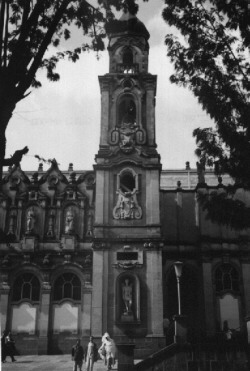
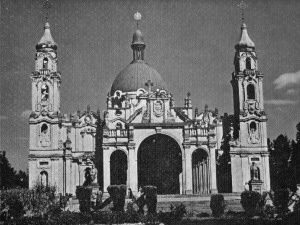
Addis Ababa’s famous Holy Trinity
Cathedral
Heritage
Crown Backs Urgent Campaign to Save
Addis’s Holy Trinity Cathedral
One of Ethiopia’s great cultural and religious treasures of the
modern era, the Holy Trinity Cathedral, in Addis Ababa, is in urgent need of repairs and
restoration. The Cathedral — which houses the tombs of Her Imperial Majesty Empress
Menem, His Imperial Majesty Emperor Amha Selassie I, Their Imperial Highnesses the Duke of Harar and Prince Sahle
Selassie — is home to the Battle Standards of the Imperial Ethiopian forces,
including the units which fought in the Korean War.
The Ethiopian Crown
Council has taken up the cause of trying to raise funds for the urgent repairs, which are
estimated to cost some 2.4-million birr (appr. $330,000), and is urging readers to
send donations to the Haile Selassie Fund for Ethiopia’s Children, in the US, along
with the form on page seven, earmarking the funds to be forwarded to the Cathedral
authorities’ restoration fund. An address in Addis will be advised soon where
donations can be made. Meanwhile, readers in Ethiopia should send their donations directly
to the Cathedral, specifying that the money is to go to the restoration program.
The cornerstone for
the great cathedral was laid by His Imperial Majesty Emperor Haile Selassie I in December 1931 (Western calendar; 1924 EC), only a year after his coronation as Emperor, and well before the
Italian invasion. His Holiness the Patriarch, Abuna John the 18th of Alexandria,
blessed the occasion.
Work on construction
was suspended with the Italian invasion of 1935 (1928 EC), but resumed in 1941 with the liberation of the nation. The
cathedral, which was inaugurated in 1944, was named “Holy Trinity” and dedicated
to the memory of the patriots who died defending Ethiopia. The Emperor had taken a
personal and constant rôle in overseeing the construction of Holy Trinity.
The cathedral has
since witnessed the consecration of a number of archbishops and the ordination of many
priests and deacons of the Ethiopian Orthodox Church.
Emperor Haile
Selassie used the cathedral on public holidays, and members of the Imperial Family
frequented it. Several of them were later laid to rest there.
The cathedral was
enlarged in 1946, the second of three phases in the construction of what is now the
completed Holy Trinity. The third and final phase was underway in 1964, adding an
additional 500sq.m. of space. Today, this, the most modern and largest church in Ethiopia,
is used for the major religious ceremonies of the country.
One of the great
murals in Holy Trinity depicts Emperor Haile Selassie pleading for the liberation of
Ethiopia at the League of Nations. Another mural, which takes a full wall, depicts
“the progressive march of four modern Ethiopian emperors, Téwodros, Yohannes,
Menelik II, and Haile Selassie I”, under the watchful gaze of the mounted figure of Saint
George, Ethiopia’s patron saint.
A bronze plaque in
the cathedral commemorates the collaboration of the British and Ethiopian armies in the
liberation of the nation, and the battle ensigns of Ethiopian regiments, garlanded with
their battle honors, hang from staffs in the walls.
Superb examples of
silver and wooden processional and hand crosses in the traditional Ethiopian style, along
with an extensive library, sacred vessels, pyxes and ceremonial umbrellas are among the
treasures in Holy Trinity, while outside are the graves of many who died defending the
country.
The beautiful
cathedral now, however, is facing problems. Leakage in various parts of the roof is
worsening, causing serious damage to the interior, including damage to some precious
religious paintings and to the windows.
A meeting was called
on May 27, 1995, to take preliminary steps to address the problem. The present Patriarch,
His Holiness Abuna Paulos, was present and called for the faithful to fulfill their
religious obligations by contributing their share to the restoration of the cathedral. A
Fundraising Committee of 15 people was established to work within the country and abroad
on the project.
An international
contractor, EMC (Elmecon plc,), of the UK, was called in to make a complete study of the
problems, and has filed a full report to the cathedral committee. The cost for repairing
the roof, the most urgent part of the program, is estimated at 975,687 birr
($137,000 appr.).
“Holy Trinity
represents the unity of modern Ethiopia,” the President of the Crown Council, Prince
Ermias Sahle-Selassie Haile-Selassie said. “The cathedral is an important physical
and spiritual home of the Nation. My Father, Grandmother and Uncles are entombed there,
but so, too, are the bodies and spirits of those who have lived and died for the integrity
and unity of our country.”
“We must now
give willingly to preserve it.”
Legal Status for Haile Selassie Memorial
Foundation
The Crown Council
has learned that the Haile Selassie Memorial Foundation has won legal status and
recognition in Ethiopia. The purpose of the Foundation is to create a special library and
museum honoring the achievements of His Imperial Majesty Emperor Haile Selassie I, and to provide educational scholarships for Ethiopian students at
home and abroad.
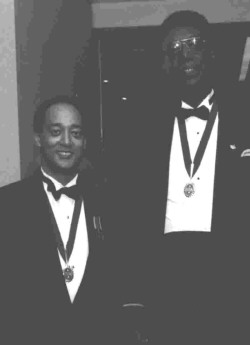
His Majesty King Kigeli V of Rwanda
talks with HIH Prince Ermias Sahle-Selassie Haile-Selassie at the Strategy ’98 Conference
in Washington DC last October.
Ethiopian and Rwandan Crowns Meet at
Strategy Conference
Rwanda’s King
Kigeli V, the Umwami w’u Rwanda, and
current head of a dynasty which goes back in an unbroken line to the year 1081 (Western
calendar), is seen here (right of picture) meeting with Ethiopian Crown Council President
Prince Ermias Sahle-Selassie Haile-Selassie at the Strategy’98 dinner in
Washington DC on October 6, 1998.
Both Prince Ermias
and His Majesty are wearing decorations awarded by the International Strategic Studies
Association (ISSA), a worldwide NGO for senior government officials involved in national
policy and strategic affairs. King Kigeli was awarded the ISSA Gold Medal Award for
Outstanding Contributions to Strategic Progress for Humanitarian Achievements for
1998. This recognized the King’s work to warn the world of the impending genocides in
Rwanda over the past decade.
Prince Ermias is
wearing the ISSA medal he was awarded in 1997 for his work in attempting to draw
international attention to the plight of Ethiopian refugees, who are often in difficult
conditions in remote parts of the world. Prince Ermias has travelled extensively
throughout Africa, the Caribbean and the Middle East, and has met with dozens of
heads-of-state, heads-of-government and senior government officials during the past three
years to raise the awareness of the needs of the Ethiopian refugee communities in their
midst.
Prince Ermias is
also wearing the Battle of Adwa Centenary Medal, issued by the Crown Council to
recognize the great victory by the forces of his kinsmen, Emperor Menelik II, over the Italians in 1896. The medal is being re-struck (see
story, page seven) to recognize Ethiopian patriots and supporters of Ethiopia to recognize
the 103rd anniversary of the battle this month.
Both Prince Ermias
and King Kigeli spoke at the big Strategy’98 conference, the Global
Strategic Forum, about the strategic situations in their respective countries. As
well, both participated in a special briefing to the United States Congress in September,
and then again to the United States Senate Foreign Relations Committee on October 14.
The briefing to the
Senate was held in the rarely-used Senate Treaty Room, the ornate and
beautifully-decorated chamber used by the Senate to greet heads-of-state and special
dignitaries.
It was at the Senate
briefing that Prince Ermias repeated the offer — initially made at Strategy’98
— for the Crown Council to act as a mediating, or conflict resolution, body for the
Ethiopia-Eritrea dispute. At the time, Prince Ermias warned that not only would the
conflict worsen if not resolved, it would also create animosities within the Ethiopian
family of nations which would take generations to heal.
Neither party to the
conflict was, at that time, disposed to consider a resolution to the conflict which did
indeed worsen.
King Kigeli also
discussed, at the conference, the seemingly intractable civil war situation in his
country. Discussions are now underway to try to get the King’s return to Rwanda by
modifying the colonial constitution (left to the state by the Belgians) to allow his
return, where he is seen as the only national unifying figure capable of bringing about
reconciliation between the three major groups in Rwanda: the Hutu, Tutsi and Twa.
The ISSA Awards
automatically invested both leaders as Life Members of the prestigious association, which
is involved in global conflict resolution studies.
Moa Anbessa Is Freed by Crown to Enter the
Political Arena
The organization, Moa
Anbessa: Ethiopians for a Constitutional Monarchy, has been formally separated from
the Ethiopian Crown, which helped bring it to life, so that it can become an independent
political party inside and outside Ethiopia. Moa Anbessa — the Conquering Lion
— was formed by His Imperial Majesty Emperor Amha Selassie I as a support organization for the Crown.
A Crown Council
Proclamation ( ) of June 3, 1998, (
 1991) set the stage by announcing the Crown’s decision to
bring about the separation, noting: “Whereas His Imperial Majesty Emperor Amha
Selassie I, of blessed memory, mindful in exile of
the importance of providing an organization which could link the Crown with all
Ethiopians, promoted and encouraged the formation of Moa Anbessa as a mass
membership body wherein all Ethiopians would be eligible to make their wishes known to the
Crown;”
“The Crown
Council of Ethiopia ( ), upon which the affairs of the Crown now
Constitutionally rest following the death of Emperor Amha Selassie I, mindful of the fact that our beloved Ethiopia is now facing
military attack and political upheaval, and mindful of the fact that the rôle of the
Crown of Ethiopia is symbolic, unifying and healing for the peoples of Ethiopia, and
should not be, or be seen to be, engaged in political activities, and yet mindful of the
important rôle which Moa Anbessa can make to Ethiopia as a movement of our peoples
concerned about the unity and sovereignty of the entire nation, Does Hereby Declare
That”
“1. The Crown
of Ethiopia hereby severs all formal links, and whatever influence and control with and
over Moa Anbessa it may have in the past enjoyed, in order that Moa Anbessa
be freed to pursue political and social goals on behalf of the peoples of Ethiopia,
whether as a mass organization or as a political party, free to decide among its
membership its charter and goals;”
“2. The Crown
of Ethiopia wishes to express its warmest thanks to the membership and executives of Moa
Anbessa for their voluntary and spontaneous support for the Crown, and hopes that this
support, understanding and dialog which has developed through Moa Anbessa toward
and with the Crown be sustained forever into the future;”
“3. The Crown
of Ethiopia in particular recognizes the enormous creativity, drive and commitment of
those members of Moa Anbessa who made the organization a viable and vibrant symbol
of the Ethiopian people’s ongoing familial bond with the Crown and the Throne of
Solomon, and in this regard pays tribute to Dr Getachew Mekasha, the [Founding] President
of Moa Anbessa, and those executives and members of the organization who remain in
our beloved homeland, defending its traditions, symbols, way of life and our national
freedom;”
“4. The Crown
of Ethiopia reaffirms that it is not linked with any individual political party of
Ethiopia, or of any other country, in any way other than diplomatic, and except in the
pursuit of the reaffirmation of the Crown’s ongoing rôle as the symbol of leadership
of all of the peoples of Ethiopia, and execept and other than in the normal function of
the relationship which all political parties and all peoples may have with their
Sovereign, and the Sovereign with them.”
Moa Anbessa,
in a letter this month to members, noted:
“The Ethiopian
Monarchy has played a significant rôle in the administration of the country over a long
period of time. The Crown had united the country under one administration and made it
internationally known. This has enabled the Crown to be identified with maintaining the
nation’s freedom, unity, equality, justice, the continuation of modernization, and
the protector and guarantor of its soveriegnty. The Crown as part of the people, has
contibuted its share in the social, cultural, and economic development of the
nation.”
“In the context
of protecting the people and the nation, the Crown has defended the country from both
external and internal enemies. It has also been victorious. In times of disagreements or
conflicts arising from internal squabbles between differing ethnic groups or in matters of
religious disputes the Crown has played the rôle of peacemaker, and by taking the high
ground was able to render a mediating role to fascilitate an era of tranquility, peace and
stability. It is for this reason that Ethiopia was able to defend its sovereignty, and
continue on the path of modernization from one generation to the next.”
“This is not to
say that all those who occupied the throne were all faultless or forward looking. History
will tell us that there were those Emperors who were not in touch with the people’s
needs or were not willing to advance with the times and as such were detrimental to the
advancement of the nation.”
“The fact that
the reigns of certain Emperors were detrimental to the life of the nation does not
necessarily negate the purpuse or need for a constructive rôle for the monarchy. It is
precisely for this reason that the current Crown Council having assesed trends and
development within Ethiopia and internationally has proposed the introduction of a
constitutional monarchy which would not supplant the elected government, but facilitate a
nescent democracy to emerge.”
“Under a
constitutional monarchy, the monarchy will play its due historical rôle given to it by
the constitution. Government with the responsibility of running the administration would
then be electable through the people voting for an individual candidate or a single party
that would be able to garner the largest amount of votes.”
“Moa Anbessa
and the supporters of the Monarchy, to make this feasible, have created a political party
and have named it Ethiopians for Constitutional Monarchy. This political party will carry
the following agendas.
“A. It will
organize and lead all those supporters of the monarchy both inside and outside the
country.”
“B. It will
educate people about the beneficial rôle of a constitutional monarchy in relevance to
Ethiopia’s unity, historical legacy and continuity, in protecting the country’s
sovereignty.”
“C. It will
create and implement these programs.”
“D. It will
research and put in place beneficial foundations that will enable Constituional Monarchy
to be feasible.”
“The principal
aim of Ethiopians for Constitutional Monarchy will be that Ethiopians will be able to
freely choose through a referandum to reinstate the monarchy.”
“Ethiopians for
Constitutional Monarchy will from time to time create and formulate new programs.”
“A. It will
conduct diplomatic and propoganda programs.”
“B. It will
work along with other political parties that believe in the unity of Ethiopia, in the
equality of its citizens and inthe fundemental prinicipal that all power eminsates from
the people.”
“Ethiopia
reaches her hands unto God.”
Moa Anbessa
officials have now begun the process of re-registering members in the organization in its
political form. It is anticipated that the party will soon re-open its offices in Addis
Ababa and around the world.