
Internet in Ethiopia
by Samuel Kinde
February 2001
Internet’s Presence Felt
In a small Internet Café right around the corner near the National
Theatre in Mid-town Addis Ababa, visitors are greeted by that familiar dialing sound of
modems heard in millions of homes and businesses around the world. This particular
Internet Café has been open only for a few days, but all the 6 or so terminals were
occupied and visitors may have had to wait as much as half an hour before getting a chance
to surf the Web or use Internet telephony to call up friends overseas as a group of
Somalian youth were doing over in the corner.
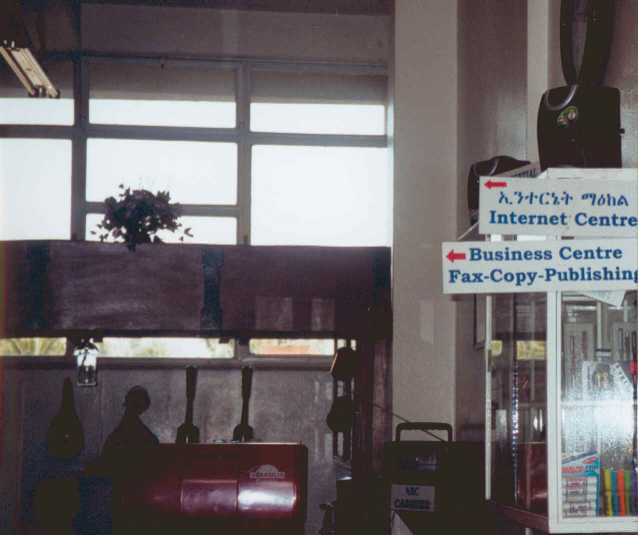
Huge demand exists for Cyber Cafes in
Addis Ababa
Rates for Internet usage, among the
half-dozen Internet Cafes that have sprung in the city over the past few months, vary from
75 cents to 4 Ethiopian Birr per minute. This translates to as high as 120 Birr/hour
($15/hour). But most do not seem to worry about the steep price and seem to have fun in
discovering the wide world of the Net. Unlike their counterparts in other parts of the
world, however, the only things these cyber cafes seem to be missing are espresso,
macchiato and tea; this itself being a paradox given that Addis Cafes serve some of the
finest espresso anywhere in the world and that Addis residents like hanging out at cafes.
But still, this was a site to behold as the promise of the Net was finally available for
the tens of thousands of Addis residents who are still in the long waiting-list for a
personal account.
In a matter of few days, though, all this
was to change, as the Ethiopian Telecommunications Corporation (ETC), the government body
which has monopoly over the telecom industry in the country, started clamping on these
entrepreneurs by closing the facilities citing obscure and archaic regulations. It seemed
ETC felt it was the sole legitimate body in the country to be an ISP (Internet
Service Provider) and also Internet Café operator.
Meanwhile in the same week, two public
seminars on IT and the Internet were being conducted in the city; one organized by Unity
College, the city’s newest private college and the other on E-commerce organized
by the Addis Ababa Chamber of Commerce at the Sheraton Hotel. It was in the E-commerce
seminar that Dr. Dawit Bekele, one of Addis Ababa’s most visible and outspoken IT and
Internet evangelist reminded the attendants that Ethiopia is already losing a market-share
in hides and skin, for long its second largest foreign-exchange earner, because competing
countries are enabling their sellers do a real-time e-commerce trading through the web
with current and new buyers. Ethiopian farmers, businessmen and industrialists face a
further isolation from the new digital global economy as access to the Internet remains
almost negligible, attendants were told. The case of how Ugandan coffee growers and
traders use the Internet to follow the world coffee market minute-by-minute on a daily
basis hence gaining a competitive advantage over our farmers and traders was also
mentioned here in informal side talks.
“……Ethiopia is already losing a market-share in hides and skin,
for long its second largest foreign-exchange earner ….. Ethiopian farmers, businessmen
and industrialists face a further isolation from the new digital global economy as access
to the Internet remains almost negligible….”
Dawit Bekele, AAU
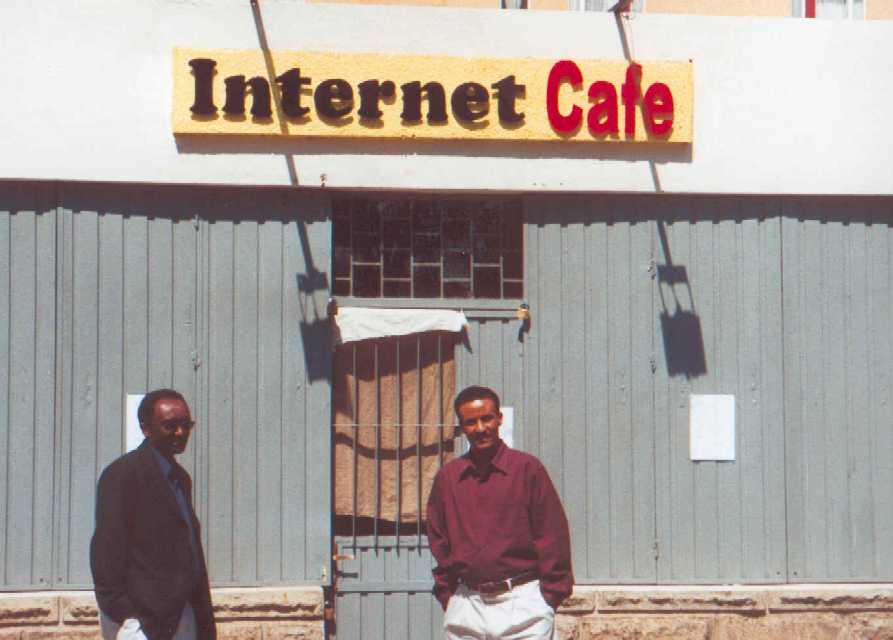
Customers at a
local Cyber Cafe were greeted by a notice of closure.
The Unity College’s Fesseha
Eshetu and Kibur Gena of the Addis Ababa Chamber of Commerce,
two men who have slowly built a reputation of persistence and patience, pointed out that
it is the archaic and out-dated telecom regulations at ETC (some as old as 50-80 years)
and its monopoly that are a major stumbling blocks towards getting a meaningful and
affordable Internet presence in Ethiopia. Most speakers at both seminars openly expressed
disappointment with the ETC officials who were no-shows at both events despite
invitations. However, Kibur Gena summed up the sentiment among the attendees that the
stakes in IT are so high that the private sector should take it as its responsibility in
increasing awareness and waging a continued struggle to get ETC and senior policy makers
interested and pro-active in IT issues.
ETC’s Expansion Plan
Meanwhile we talked with network engineers at EIC (Ethiopia
Internet Center), the ISP arm of ETC who were symphatetic to the frustration of customers but were optimistic that the
upgrades which are in the works should alleviate the problem of access in the country. EIC
plans to increase its modem pool from the current 500 by almost 5 fold to 2500, we were
told by the engineers. This represents an increase of subscribers to about 12500, a large
improvement from the current subscriber base of a meager 2500 or so, but miniscule when
compared to the demand which is estimated to be as high as 100,000 – 125, 000 in this city
of 3 million residents alone. EIC, we were told, further plans to launch at least
eight of its own cyber cafes in Addis Ababa and other cities like Bahr Dar and Gondar. The
time frame for implementation, we were assured by the engineers, could be as early as few
weeks, perhaps few months.
Access Type
Subscriber
Category
Connection
Fee ($US)
Monthly
Fee ($US)
Allowed
Hours/ Month
Extra
Charge – Rate/Hour ($US)
DIAL UP
C-1
56.00
19.00
8.00
4.00
C-2
75.00
34.00
15.00
4.00
C-3
56.00
38.00
40.00
2.00
C-4
113.00
75.00
40.00
4.00
C-5
38.00
25.00
40.00
2.00
LEASED LINE
500.00
1000.00
Unlimited
–
Table: Rates for Internet
Connection in Ethiopia as charged by Ethiopian Internet Center.
The University Gets wired by
Fiber Optics
More encouraging news came out, albeit unofficially, from the
country’s premier institute of higher education, the Addis Ababa University (AAU). Dr.
Abebe Dinku, Associate Dean of the Technology Faculty
of AAU was very much pleased to indicate that the Sidist Kilo and Arat Kilo campuses were
now completely wired with state-of-the-art fiber-optics network. Work on the Amst Kilo
campus that houses the Technology Faculty was progressing well into completion and we were
shown some of the construction and laying of cables. A microwave link to the South Campus
of the faculty at Lideta which houses the Architecture and Building School will be
completed also very soon, we were told. If all things go according to plan, we were told
by Dr. Abebe Dinku, all faculty members at the university will have
access to the Internet right from their desktops by as early as April 2001. This
should come as a major good news to the students and faculty alike who have been waiting
patiently for many years for this link to the rest of the world. Dr. Ermias Dagne,
a full professor of Chemistry at AAU who heads a world-class Natural Products Research
Group and Center confided his hope that at last, with the help of the Net, his center’s
extensive database on natural products that has been built over the years will be
available to researchers around the African continent and the rest of the world.
We talked to Dr. Gebre Ammanuel,
an Associate Professor at the Electrical and Computer Engineering Department, who
is the chief architect of the fiber-optics based WAN (Wide area network) that will
ultimately and shortly bring Internet Nirvana to students and faculty at this institute.
The network architecture consists of redundant systems linking the various offices and
computer centers in all the departments in the university to three hubs, one each at the
Sidist Kilo, Amst Kilo and Arat Kilo campuses, explained Dr. Gebre. The three hubs which
form the backbone of the WAN will then be controlled by a central server which is
ultimately connected to the national backbone at EIC through a dedicated leased line. The
redundancy is limited to the hubs in the three campuses only mainly due to cost; but Dr.
Gebre is confident that the architecture has enough redundancy to assure an almost 24/7
service. The story of this project and the men and women involved in turning it to a
reality itself is fascinating. Dr. Gebre, a very enthusiastic man in his early 40’s, has
been working on the project with a group of techies and administrators who understood the
importance of Internet connection at the university. We found the Dean of Technology, Dr.
Abebe and his colleagues at the different departments very much dedicated to the project.
Since September 2000, Dr. Gebre was working on the project on his own free time which
could easily translate to tens of thousands of dollars.
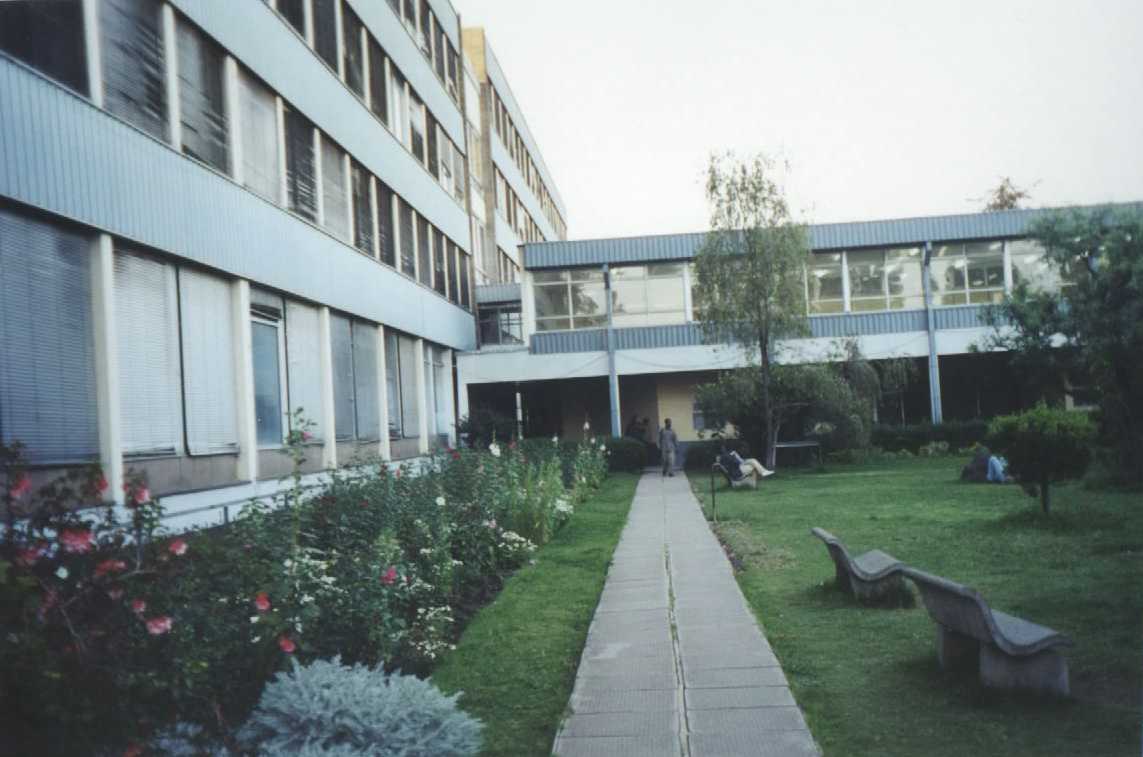
High Speed Internet Access at the
University – Work is progressing fast on wiring the Technology Faculty Campus with Fiber
Optics.
Even given the state of things in
the country where the last mile may face the most stumbling blocks, one senses that the
critical mass for Internet access at the University has already been built and it is very
likely that this state-of-the-art project will soon see the light of day. We left the
university with an upbeat feeling and hope for networking in the country.
It needs to be mentioned that the spirit
of “yichalal!” (It can be Done!) that the Chamber of Commerce
is popularizing in the country (and backed by the Athletic legend himself-Haile Gebre Sellasie who
has lent his name to the compaign) seems to be pervasive and holding roots among the
private citizenry of the City.
What do Professionals and
Students Say?
“……the
Sidist Kilo and Arat Kilo campuses are now completely wired with state-of-the-art
fiber-optics network…..”
Dr. Abebe Dinku, Dean of Technology Faculty, AAU
It is when you talk to businessmen
and women, engineers, architects, contractors, medical doctors and college students, to
name a few, that the thirst for the Net becomes more evident. Perhaps only few other
places in the world could boast of a more Net-thirsty community than ours.
Over some of Addis’ finest macchiato, we
talked to Ehprem Tamene, a senior mechanical engineer who has worked for
such big engineering names as the Akaki Spare Parts Factory and Midroc’s Kombolcha Steel
Products Industry about this thirst for access. Ephrem was very much straight forward.
“I would like to be able to get on the Web, search for products (be it
valves, pumps or generators) and get the latest and most accurate information on their
specs and prices,” said Ephrem. The way things are now, most
professionals have no access to such information and if their work-place has one, they may
have to go through a layer of bureaucracy before being allowed to send even a single
e-mail. “You can’t be competitive this way,” adds
Ehprem hoping that things will improve soon.
A medical doctor we had talked to earlier
also had the following to say: “True, most of the clients of my private
practice come from the rural areas and the Internet will not be useful as a marketing tool
for my business. However, access to global suppliers of medical equipment such as X-Ray
machines and ECG is what interests me. If an X-Ray machine breaks, my business is
pretty much at the mercy of the one or two dealers (middlemen) in town who can quote me
any price they want. And this has happened many times. I would like to see if the
Net can give us access to a wider segment of sellers around the world and help us save
money.“
Samuel Ayalew, an
Electrical Engineer at Yadot Engineering and Trading, on the other hand, seemed to have a
practical problem just like most Internet users around the world; a hacker had broken in
into their account and used it for hundreds of hours leaving the company with a huge
Internet access bill. “It took me a whole day to undo the damage and get
our e-mail access back on; but it reminded me how much indispensable the Internet has
become to our company even though our use is limited to e-mail, and a few hours of
web-surfing in a month,” was what Samuel told us.
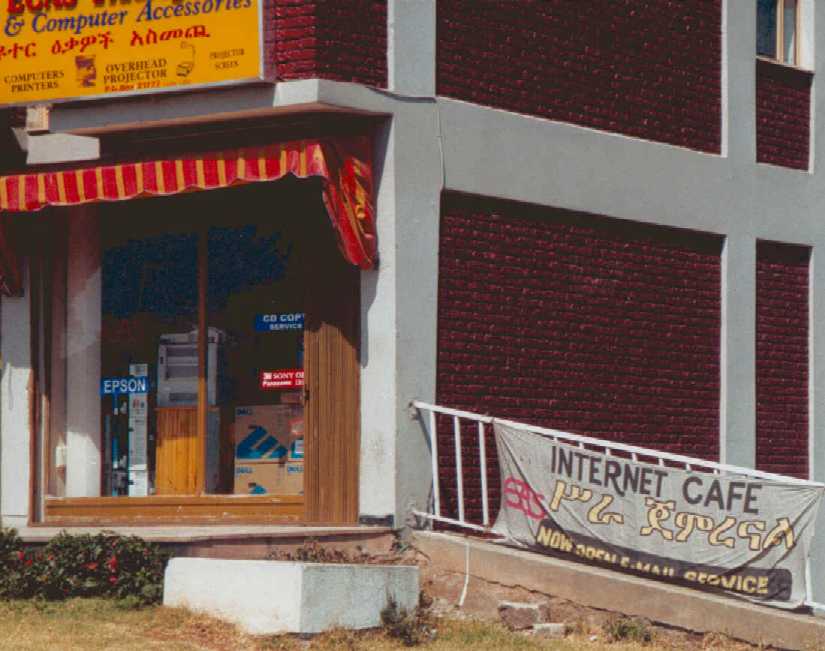
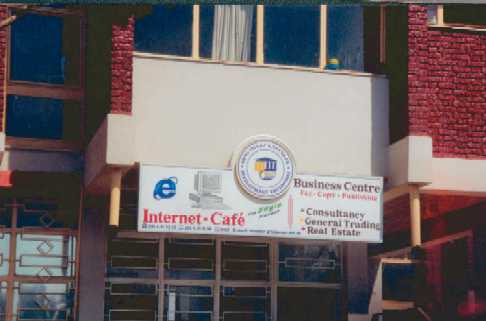
Cyber Cafes at Bole Road
Meanwhile, students seem to be very
much interested in harnessing the resources and power of the web to look for undergraduate
and graduate education opportunities abroad. “We are pretty much limited
to the few old catalogues we find here at the university or elsewhere. It is almost
impossible to check the status of our applications, correspond with researchers and
professors,” seems to be the theme of what most students say in Addis.
Almost none of the city’s high-schools have basic computer programming let alone Internet
access; thereby further eroding the student’s competitiveness in the job market and higher
education. The many computer schools that have sprung over the city are in a way a
response to this need; however as Gizachew Woldeyes, the Head of
Department at Ethiopia’s Science and Technology Commission mentioned in a conversation we
had, the quality of training and curriculum begs for radical improvement.
How about Internet Entrepreneurs
and Techies?
The question that begged an answer and
that came up time and again was; if there is a huge demand for access to the Internet and
if that is to be met to some extent at one point, then who is going to supply the value
added services, such as web-publishing, web-hosting, network designs (LAN and WAN) both
for individuals and businesses? Does the country have a growing base of techies and
Internet gurus to help the Net penetrate business, governance and education?
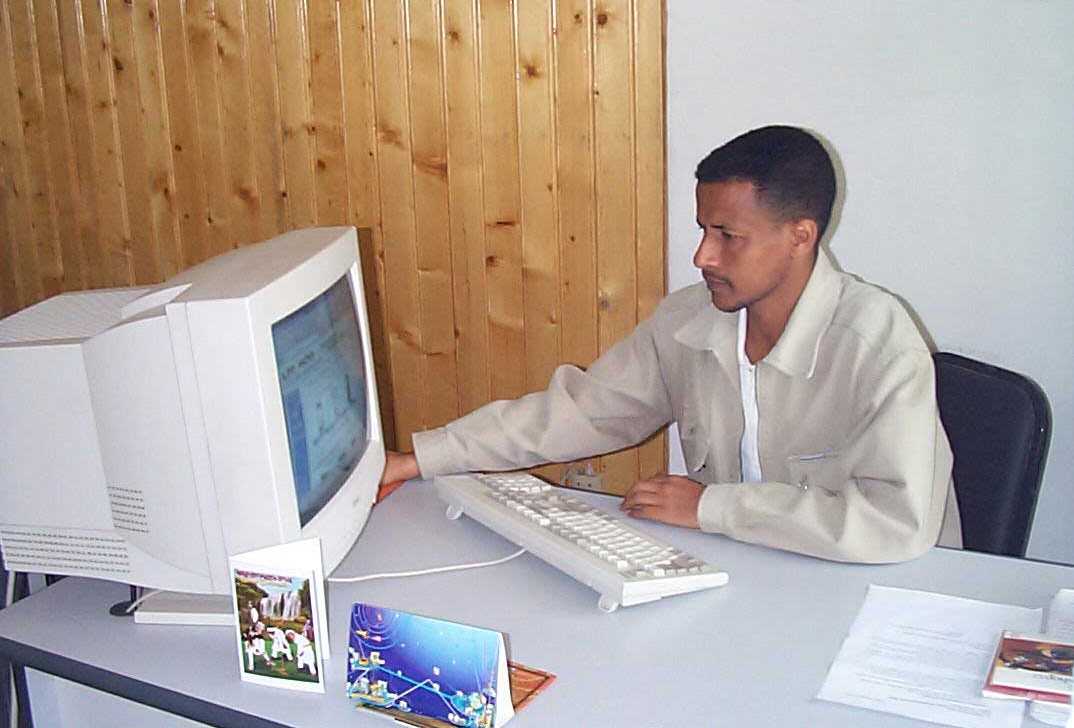
EthioLink web techies design and maintain
the web-sites of some of the city’s major businesses.
To find the answer to this question
and more, we met with two of the founders of EthioLink, the city’s most visible web-hosting,
networking, and e-commerce company, Dr. Dawit Bekele, Menberu
and a banker friend of theirs for lunch. Dawit and Menberu talked at length about the
kinds of Internet business they plan to do and have managed to do so far despite a limited
bandwidth and lack of infrastructure that supports e-commerce.
The talk about the Telecommunications
Agency’s clamp down on Cyber Cafes came up but both were not surprised that it had
happened. Dr. Dawit added: “It is the out-dated and unclear telecom
regulations that is used as an excuse by ETC; but we sense it is about letting the control
go. We had gone to the ETA – Ethiopian Telecom Authority – which devises policy and sort
of oversees ETC – the telecom corporation – to ask them for a permit to operate an e-mail
account business. While ETA said it had no problem with our request, it, nevertheless,
instructed us to work with ETC and get their blessing, effectively. ETC, as you may know,
holds the monopoly and has its own ideas and interests“.
We also talked about that week’s IT
conferences and all the three were optimistic that with a continued public awareness and
media coverage, IT and Internet policies will change eventually, albeit slowly. Perhaps
what Menberu said sums up their absolute resolve: “Look, we have two choices;
either to get totally discouraged and throw in the towels by the obstacles placed on our
way or else do our best to face the problems and hopefully get some positive results.”
And these guys are only in their early 30’s! It looked to us, beyond any doubt, that there
is a new generation of Ethiopian men and women willing to face the reality with more
optimism and vigor than ever.
For a moment, one would be tempted to
draw a parallel with these young men and women with other notable Internet evangelists in
other parts of the world like Narayanan Murthy (InfoSys), Vivek
Paul and Azim Premji (Wipro Tech) of India who had consistently and un-tiredly
faced up with the country’s archaic and stubborn telecom regulators to change. Once again,
“yichalal!” (It can be Done!) is the theme that one senses
seems to be the source of inspiration here.
Dawit took us over to EthioLink’s office
at Haile Gebre Selassie Avenue to show us what an IT/Internet business was like in
Ethiopia. The company is housed in a 2 story new concrete building right off the main
road. There were about 8-10 people working in the different divisions, accounts,
networking, and web-publishing. The place could be Hydrabad or Bangalore in India or a
start-up in Silicon Valley (perhaps, minus the freebies like a soda machine). The
high-tech start-up look and feel in this office by the Haile G/Selassie Avenue was
unmistakably present. These are the people who design, maintain and host most of the sites
of the prominent businesses in the city, like the Commercial Bank. We asked Dawit what the
working hours are like at EthioLink. Yes, they are pretty much like any Internet start-ups
around the world. Some of the techies come as late us 10:00 AM in the morning and
leave sometime around 10 or 11:00 PM in the evening. Addis by 11:00 PM is a quiet city
with almost no public transportation and it requires a lot of love of work to pull in long
hours. We had visited Ethiolink right around the holiday times and one could detect the
sense of urgency as they were taking e-commerce orders that had come through their
servers. While e-commerce makes up less than 10% of their revenue, we were told by Dr.
Dawit, EthioLink is most recognized for its delivery of goods like sheep, cakes and
flowers for the local relatives of Ethiopian residing abroad. The company has come a long
way from its early days to become a fledging and respectable company now. “Is
there enough interest from the business community to fund such Internet/IT companies?”
was one more question we posed to the EthioLink folks. “Yes, funds are
not the problem” is the answer we got.
In all fairness, it is also important to
mention that there are other IT companies in the city such as OMNITECH and also an
e-commerce company that has been generating revenue – Ethio Leather Products. The
indications, therefore, are that more such companies may be in the pipeline.
And the Future is?
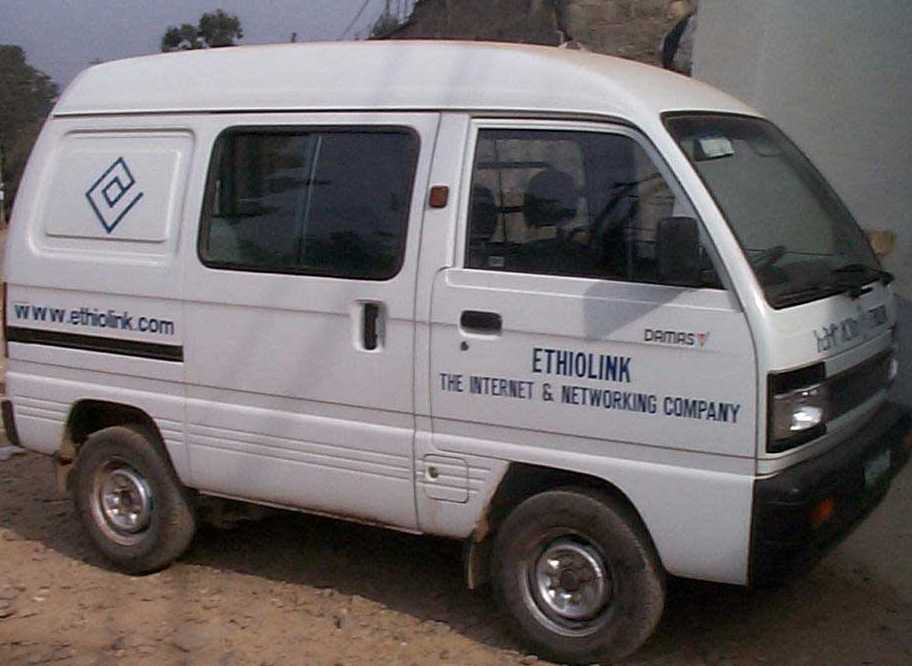
EthioLink operates a unique E-commerce
model.
As one ponders the magnitude of
changes that a wider and meaningful access to IT tools, particularly the Internet can
bring to the country and its people, it is difficult to avoid a sense of excitement and
pioneering. Ethiopia is a huge country with a population of almost 64 million. Even under
a worst case scenario, if a very small percentage of its population gets access to IT
tools, this itself is big enough to generate a very sizable market for IT products and
services. All the important economic sectors such as manufacturing, trading, services,
construction, transportation, energy, health services, etc need a modern IT based
management. The country’s economic destiny, as much as any other developing country’s, is
intertwined with the increasingly sophisticated and integrated global economy. Ethiopia
can’t maintain even its current level of participation in the global economy unless it
enables its coffee traders, hide and skin traders, policy makers and businessmen of all
kind to have access to business tools every one else is having around the world.
Already an increasingly self-reliant and
confident segment of our business, technology and education community is trying hard and
fast to introduce these information and knowledge economy. Yellow pages, house, business
and land ownership and leases records for our cities have to be digitized. Building and
business permits can’t and shouldn’t take for ever where IT promises a neater solution.
Farmers, traders and manufacturers need an efficient access to information not only on the
domestic market of 65 million people but also of the Horn region and beyond. The growing
number of private banks and insurance companies who are building all the new high-rises in
the city need information and database on the market and their customers.
It is easy to overestimate the market
potentials. But judging from the need and thirst of the society for growth and technology,
it is almost impossible to ignore them. Business opportunities at home are as riskier as
anywhere in the world; but judging from what others have accomplished, the rewards may be
impossible to ignore.
For comments and feedback,
you may reach the writer at E-Mail.