Interior Ministry representatives will continue checking the eligibility for aliya of some 3,000 Ethiopian Falash Mura, who claim that under a 2003 government directive they should be allowed to immigrate to Israel, the government announced Sunday.
The decision to continue the flow of immigration from the African nation follows more than a year of high-profile protests from the local Ethiopian community and its supporters after Interior Ministry officials declared that all eligible Falash Mura – Ethiopian Jews whose ancestors converted to Christianity under duress more than a century ago – had been checked and approved for aliya.
In January, the ministry recalled its Gondar-based representative.
Despite claims that aliya from Ethiopia was all but over, local community members, representatives of North American Jewry and a growing number of MKs believe that there are still between 9,000-15,000 Falash Mura who fit the criteria. Over the past year, they have demanded the government continue checking their applications.
Sunday’s decision will allow almost a third of those to at least try proving that they fit the criteria, which includes a maternal link to Judaism and relatives already living in Israel.
In addition, the Interior Ministry will now be obliged to determine an official policy on immigration from Ethiopia.
“We welcome the government’s decision,” said a spokesman for the Public Council for Ethiopian Jews, an impromptu committee consisting of former Supreme Court president Meir Shamgar, former Supreme Court justice Menachem Elon, Prof. Irwin Kotler, Ethiopian Rabbi Yosef Adaneh, and other prominent figures, which was set up a year ago to lobby the government to continue bringing Jews from Ethiopia.
“However, there are still thousands more Jews in Ethiopia, currently living in appalling conditions, that appear on the initial Efrati list [the official registry of eligible Falash Mura that the government is now following] and should be allowed to come to Israel but who have still not been checked,” the spokesman continued.
“The committee calls on the government to uphold its 2003 commitment and to continue with the aliya until every last Falash Mura that fits the criteria has arrived in Israel.”
The debate over continuing the immigration of the remaining Falash Mura stems from a 1999 census compiled by then Interior Ministry Director-General David Efrati and Rabbi Menachem Waldman, an expert in the field of Falash Mura conversion.
According to that register, 17,500 people were eligible for aliya. Of that initial figure, 16,000 people have already arrived in Israel, while a total of over 20,000 have actually been checked by Interior Ministry officials.
However, in a previous interview with The Jerusalem Post, Waldman said that some people’s names were taken off the list and that “while it is a useful guide, the list should not override the government’s decision to allow people who can prove their Jewish matrilineal lineage to come here.”
Also, community leaders in Israel claim that the list, which was divided into three volumes – Falash Mura in Addis Ababa, Gondar and those living in the outlying villages – was partially lost, and data on people from the villages is therefore not complete.
The government’s most recent decision will see the arrival in Israel each month of 100 families, a fall from the previous quota of 300.
The Jewish Agency for Israel will continue to facilitate the aliya of those who have been approved and will aid in their absorption here following their arrival.
This flight is long! We are just about to land in Rome to refuel, and I am already more than done with flying! Alas, there are several hours yet to go. At nearly 6 feet tall (and most of that being leg!) both my mom and I are ready for a nice long stretch and walk to get our blood flowing and sensation returning to all of our extremities. J
Here are some thoughts about our trip so far…
After we checked in, we had to take a shuttle to our terminal. We happened to get on the same shuttle as our entire ETA flight crew! Abigail loved to look at all the flight attendants, and as we walked behind them to the gate, she said “I want to be one of them when I grow up, even thought I have this skin and I don’t match them.”
So far, the food has been great. They served dinner shortly after take-off (Abigail slept through dinner) at about 9:30pm EST. Dinner was a beef, potato, and vegetable pot roast, and it was good! They also served salad, cheese and crackers, and cheesecake. For breakfast we had a croissant and roll with butter/jam, strawberry yogurt, fruit cup, and beverages. Neither my mom nor I have needed to break into our snack pack yet. In fact, we have not really been hungry for most of the trip, but have eaten and drank lots of fluids.
If you check in at the Ethiopian terminal at Dulles (no connection), you have to check in and get your boarding pass and then drop off your luggage at a TSA luggage check point. It was interesting, but we managed (glad of the carts!) We left our rolling carry-on bags with John while we checked in and dropped off our luggage. No one weighed our carry-on bags, but as we were boarding, they did ask us to check one of the rolling carry-ons. I already had chosen one that I would check (it mostly had food/snack for in Ethiopia- we packed our “snack pack” for the plane in another bag) so I had no problem doing a gate check on that bag.
I am SOOOOOO glad I brought earplugs. Between Abigail laying her head on my lap (thus necessitating the need to keep still and not move/stretch) and the kid behind me kicking the seat, I really didn’t get much sleep. But the earplugs and my neck pillow have definitely contributed to my comfort!
Abigail and I took off our rain boots as soon as we sat down and haven’t had them on since. Ethiopian distributes a pair of socks shortly after take-off, and I suppose we could have put those on over our socks, but for now, we have just been wearing our socks to walk to the bathroom, etc. In fact, that is what most people have been doing!
I will be glad of a real bed tonight when we land. I am super-happy that our flight lands in the evening and then we just go straight to our guest house. I can’t imagine getting off this plane and getting a baby! That would be great, but I am already so tired, I think the baby would meet the worst part of Momma, not the best! J
More thoughts about travel…
The rest of our flight was uneventful. Our plane actually landed early! We were trying to help a mom traveling alone with her 2 young children, so de-boarding and getting the visas was a bit complicated, and we ended up being last in line.
We were asked to gate check a rolling carry on, and that, along with all of our luggage, came through just fine. One of my Rubbermaid bins had been searched by security in the USA, but nothing was missing. I used zip ties to “lock” my luggage, and that worked well. We ended up waiting a long time for our final suitcase, and because of that delay, poor Ryan and Philip (a student who is working with Gladney for the semester) had to wait about 2 hours for us!
For those who travel Ethiopian Airlines, here is what you need to know:
On the plane, they will hand you an “Entry Card.” There will be no explanation. Fill this out, including all the info that you have (passport number, date of birth, etc.) When you get off the plane, go down the stairs. If you walk straight, the bathrooms are on the right. Do not use these unless necessary- go on the plane after you land if possible, but do not use these toilets.
For those who arrive on any airline in Addis, here is some info:
Once down the stairs, look to the left. The “sharp” left will be a place for “Interlink” transfers or something of that nature. To the “easy” left, you will see signs for a visa. Get in line here, and have your passport and entry cards ready. If you have not received an entry card on the plane, request one and fill it out. They cannot issue your visa until the entry card is complete. Then you wait in line, and they review your entry card and passport. The final step is to pay for the visa- $20 USD.
When you exit the visa room, if you look straight ahead, you will see a bank where you can exchange some money. There will also be ropes that form lines, and you want to be in the first line, closest to the visa office, unless otherwise directed. We were the last people in line, so we had plenty of time to use the bathroom and exchange some money. And then stand and wait.
When it is your turn, have your passport and visa ready. (On the card, when asked where I was staying, I wrote “hotel.” At this cubicle, the person asked which hotel, and I stated that it was a private guest house. I think it would have been okay to just write “guest house” on the entry form.) They will ask a few questions and stamp your passport. Exit and go to the right to baggage claim. There are 4 belts, and you will be able to see which one is for your flight. There are free carts (you have to push down on the top handle to get them to move- it is a built-in break, and while it takes getting used to, it is actually quite nice!)
While waiting for your luggage, have your baggage claim tickets ready. You will have to show your tickets to be able to exit with your luggage. If any piece of your luggage is missing, there is a “Lost Bag” area in the back left corner of the luggage claim area. It is a small office, but you will probably find it easily, since there is really nothing else in the area.
When you have your luggage, head towards the exit. You will be asked to show that it is your luggage (claim tickets) and you may be asked to X-ray your bags. We had to X-ray all of our bags, and then they wanted to search my bins as well. However, they couldn’t get the zip ties open! (No scissors or knifes or anything.) In the mean time, I also supplied them with a copy of the humanitarian aid letter supplied by Gladney, and they were satisfied and let us go.
Interestingly, one of the questions that they asked before they let us leave was “Are you bringing any projectors into the country?” And no, I wasn’t. Then they asked “Are you telling me the truth?” Maybe I looked like some sort of projecting criminal aiming to start a rally or something? I don’t know- not having traveled internationally, maybe this is something they ask everyone?
On the way to Ayat house, we stopped at the grocery. I had already exchanged a small amount of money at the airport, so I was able to get some groceries without difficulty. At the grocery I went to, they had bags of milk (1 liter size) and I picked up some “full cream milk” (whole milk) for the baby, and some 2.7% milk for the rest of us. They were out of eggs and bread, but I did get water (buy lots!), coffee grinds, and Honey Nut Cheerios.
It was during our grocery trip that Ryan B. confessed that Sparrow is one of his favorites. He has a soft spot for the children who come in ill and grief-stricken. I could tell from pictures that Anna loves him, and it was so calming to my heart to know that he was taking special care of my girl!
It was 10:30pm by the time we got home, so we quickly unpacked enough to find our warm pajamas. (Seriously, you need warm jammies this time of year- without heat, the evenings and early mornings are chilly! And warm socks or slippers since the floors at Ayat are tile and very cold.) Ryan made plans to bring Misrak over around 9am and then he and the driver left for the evening (I felt so bad for keeping them waiting so long at the airport!) Mer, Ryan, and Simon had already gone to bed for the night, and Waguyu had already left as well when I realized that I had no clue what time it was, so I could not set my alarm clock. Hint: bring a watch and travel alarm clock, for sure! There are no clocks in Ayat House!
This was also when I realized that my purse, which I realized I had left on the plane, had my cell phone in it. Oops! I was not concerned about loosing my purse since I thought it only had my lip gloss. Kind of sad when I realized it also had my celly! Not sure what I am going to do about that.
Abigail and I settled in for the night and after a few rounds of dogs barking, we fell asleep. I was so glad to be horizontal! Once I heard a sound that could have been Simon crying… but then, it could have been a cat crying, as well, so I went back to sleep. Abigail woke up in the middle of the night and was sleepwalking- that was fun! But overall, I slept fairly well, considering that I kept waking up to see if it was light out!
CAMBRIDGE, MASSACHUSETTS – Though most people rang in 2001 eight years ago with paper hats, noisemakers and champagne, hundreds of Ethiopians officially started partying this past weekend in Cambridge.
[Photo by David Gordon]
Wegene Wells-Bogue (a U.N.H. student) dances in traditional Ethiopian dress during the Ethiopian Community Mutual Assistance Association sponsored “Enkutatash” (Ethiopian New Years) celebration on Saturday night at the St. Paul AME Christian Life Center.
That’s because Ethiopia uses the Julian calendar, which has 12 30-day-long months and a 13th month of five days, putting it about eight years behind the West’s Gregorian calendar. Enkutatash is celebrated with music and dancing on Sept. 11 and marks the end of the rainy season in Ethiopia.
The skies were clear at the St. Paul AME Christian Life Center last Saturday, where the Ethiopian Community Mutual Assistance Association, a networking and support group for recent Ethiopian immigrants, hosted its annual Enkutatash celebration.
Misrak Assefa, the association’s board president, said many of the families at the Enkutatash celebration were there to connect with each other and immerse their children in the culture.
“It will strengthen them,” she said of the immigrant families. “You’re American, you’re Ethiopian. This is how you survive; you keep both cultures.”
Cambridge boasts the highest concentration of Ethiopians in Massachusetts, said Mayor Denise Simmons during her “proclamation” at the celebration. In fact, there are 4,000 Ethiopians living in Cambridge, according to one estimate. “It’s wonderful to watch how the Ethiopian community has grown,” she said.
Ethiopians are a relatively new group in the U.S. compared to other refugee and immigrant communities, said Binyam Tamene, the association’s executive director. Many Ethiopians in Cambridge are political refugees who may come to the United States on a work or student visa and then request political asylum, he said, and are “mostly law-abiding citizens that aspire to take advantage of the American Dream.”
One Ethiopian, Ashebir Gubir, an Ethiopia native and former Cambridge resident, moved to the United States when his family “won the visa lottery” in 1997.
For him, America means possibility, a place where one of his daughters became a doctor and the other an assistant researcher at MIT.
“[Cantabrigians] allow this community to live a decent life,” Gubir said. “No doubt about it. It’s a land of many opportunities.”
Enkutatash is a time for Gubir to reflect on the hardships and triumphs of past years, but also celebrate the prospects for the future. “We don’t want to forget what we had or what we inherited from our parents,” he said. “We want to keep going with that tradition.”
Traditional Ethiopian families were not the only ones trying to connect to the culture last week. Rick Wheeler, the adoptive father of two Ethiopian children, heard about the event through a network of other adoptive parents, and traveled from his Connecticut home to ring in the New Year with his family.
“We do want the boys to know some of their culture,” Wheeler said. “We want them to be exposed to their culture, even if we don’t know a whole lot about it yet.”
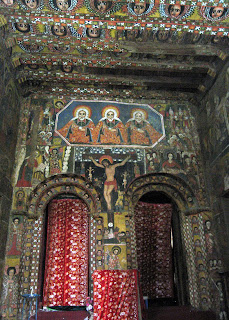
Gondar, which I constantly mispronounced as Gondor (from The Lord of the Rings), was nice but the two days we spent there was too much. Gondar was the place everyone said you had to see along with Lalibela. I suppose I was just expecting so much more. It’s a nice town with a center piazza and it was very walkable. We arrived in the morning and by early afternoon we had seen most of the big highlight sights. The castle ruins were excellent and gave a great perspective to the vast history of Ethiopia. It was certainly worth visiting but didn’t live up to all I heard and pales in comparison to Lalibela as a place to visit.
The above photos courtesy of Iris as my camera was acting up.
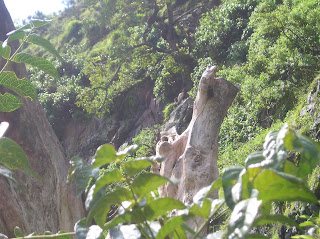
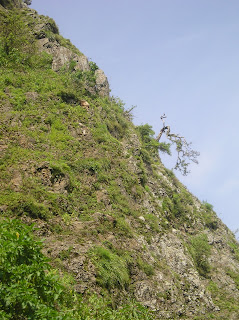
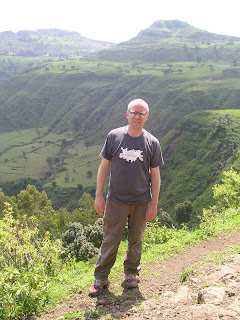
Gondar is used as a staging town for people who are going to spend a few days in the Simien Mountains. As a result every person with a taxi or minibus wants to take you to the mountains. When informed that I was only staying for another day the offer changed to a half-day trip to see baboons. I was told by another faranjo that the half-day trip would not bring me close to the Simien Mountains but that it was probably worth going out there. So the next morning I went on a half-day trip. Iris had a “sick foot” as she injured it before arriving in Ethiopia. As a result she didn’t join me on this trip which involved a hike to see baboons. I talked them down to Birr 250 for the hour drive out to the area and back. I paid an extra Birr 50 to the herdsman that led the way through game trails until we got to the area where the baboons hang out. I had a fantastic time hiking through the mountains. The scenery was gorgeous. I can’t say enough about what a beautiful country Ethiopia is. I am disappointed that I was there only during the rainy season as I would like to compare the lush landscape I viewed with how it looks during the non-rainy season. I did see baboons but never got close enough to see their “bleeding heart.” Gelada baboons have a unique red marking on their chest. So I am told as I couldn’t verify based upon the distance and my inadequate camera. All in all it was a nice trip.
You need to play “Where’s Waldo” to find baboons int he above photos.
After this trip I returned back to Gondar. The same people who offered me the half-day trip all wanted to drive us to the airport the next day. It seemed like everyone in Gondar knew Iris and I were leaving the next morning. Everywhere I went I ran into someone wanting to set up a taxi to the airport for the next morning. My negotiating skills still aren’t anything to write home about. But because I still haven’t met up with Iris yet after my side trip I held to my guns and didn’t commit to anything. I figured if I was getting asked every 10 minutes if I needed a ride then Iris may have been also. I wanted to speak to Iris before I did anything. I still hadn’t seen Iris by the time evening came and by this time the offers for an airport taxi had gone from Birr 80 for both if us to Birr 40. I didn’t think we would ever get lower than Birr 20 each so I made the arrangements and gave Birr 20 as a down payment. As it turns out Iris didn’t make any arrangements. The next morning the taxi was a little late and the guard at the hotel laughed when I told him that I gave some guy Birr 20 as a down payment. “Do you think they’ll show?” “You never know.” Was all he would say. Another taxi passed by and said he would take us for Birr 70 and incredulously claimed that no one in their right mind would bring us to the airport for Birr 20 each. Then our taxi showed and I paid the other Birr 20 and off to the airport and then Lalibela.
One highlight of Gondar was a coffee ceremony that Iris and I went to. A young man had taken a shining to Iris and followed us around quite a bit. He invited Iris to a coffee ceremony at his mother’s house and I tagged along. We ended up at his older sister’s house. Along with her two little precocious children (the two year old called me faranjo non-stop and they both sung and danced to whatever pop songs came on the radio.), and grandmother we had a traditional coffee ceremony. The coffee beans were roasted, then ground and then we had three cups as called for in the ceremony. I really had a great time playing with the kids and interacting with the rest of the family. It was one of those events that I wasn’t looking forward to (it was raining fairly hard and I really didn’t want to walk the 10-15 minutes from the hotel to the house) but turned out to be very enjoyable. I’m glad I went.
Lalibela
Lalibela is amazing. I’d say that Lalibela is probably the second most amazing place I have ever visited. The Grand Canyon takes first place in my amazing rankings. I don’t think I can even do justice to how amazing it is with my description or photos. Lalibela has rock churches built like 900 years ago. Not just churches carved into rock but churches entirely freed from the rock. Think of a rock face you can walk over. All rock all the way down. The churches are dug out of the rock so what you are left with is a quarry with a church standing in it. I can’t describe how amazing it is and it is more amazing when you realize that there are 11 of these churches within 42 km of Lalibela and they were all supposedly built within 23 years. Scholars still argue over how they were exactly made although the locals just say that god and angels helped out or that god made the rock like mud so it was easy to make the churches. Regardless, it is still amazing. We only saw the three groupings (5 or 6 total churches) that are within Lalibela itself.
Iris was still hobbling along on her “sick foot” so we went nice and slow through the churches. I think this slow down allowed me to enjoy it all even more. I was able to soak in how incredible it all was and appreciate it that much more. I give Iris a lot of credit for continuing on through all the churches as the ground was rocky and uneven and must have been extremely difficult for her to transverse. I’m not glad that Iris was injured but I am happy that we went through the churches at a snail’s pace. Really amazing.
Lalibela isn’t much of a town. It’s more like a large village. But nice to walk around and buy souvenirs. I got a nice scarf supposedly made by some local monks. A restaurant had some very tasty local honey. Thick and raw it was great spread on some fresh bread. I also visited a tej beat and upon the waiter’s instructions had the medium tej rather than the strong. The medium was strong enough. At the tej beat I met a couple from Sweden that knew a friend I work with and her boyfriend. So the small world continues in Ethiopia.
Although I was still called a faranjo in Gondar and Lalibela Iris took almost all of the attention away from me. Iris is Filipino and very pretty. While walking around with her I didn’t get stared at like I usually do as all the focus was on her. “Konnichiwa!” or “Hey, Chinese!” were the most common shout-outs to her. Her response was always the same: “I’m not Chinese/Japanese/Korean” or whatever other country they shouted at her. No one ever got Philippines, though. Iris said she was determined to put the Philippines on the map in Ethiopia and that’s why she responded to everyone who yelled something at her. Conversely, I kept to my unwritten rule to ignore shout-outs. But in Lalibela the tendency was to yell the country of origin. (“Hey Chinese!”) There seemed to be many tourists from Spain in Lalibela at the same time. I laughed as I heard “Hey Spanish!” followed by “Hey English!” and finally “Hey American!” after ignoring the first two. But this was only shouted at me when I was alone.
I can’t recommend Lalibela enough. Ethiopia needs to conduct better marketing. These churches should be must see for traveling people interested in different cultures and history. Amazing.
Final Thoughts
I had an incredible time in Ethiopia. Despite being sick on and off for too much time during my first month I still enjoyed my entire time immensely. It’s a great country with great people. Although I have written plenty about the annoyance of people yelling stuff at this faranjo it was never done with any malice. I really only had positive experiences with all the people I met. From those I worked with, especially Meron to Serkie from Cocoon Burger & Juice to Dawit and Mahi at Mr. Martin’s Cozy Place to my interactions with taxi drivers and people who just want to talk to a faranjo were all great. I hope to return to Ethiopia some day and see those people again.
Some other thoughts:
I am happy to report that I took minibuses more than taxis but walked most of all.
Bahir Dar will always hold a special place for me. It was my first trip outside of Addis. It was a weekend that I needed at that time. I remember feeling like the Morgan Freeman character from The Shawshank Redemption while riding on the bus. I was entranced by the countryside and alternatively excited and nervous about the trip itself. But, like Red in that movie, I felt a hopeful anticipation for what lay ahead.
Ethiopia is a country with so much to offer. It’s culture, it’s history, it’s beauty. This is a place that more people should visit. The Ethiopian tourist department should do a much better job of advertising. Especially Lalibela but also places like Harar. And I am sure there are many more places that I never got to that are worth going as well.
So that’s it. That’s Ethiopia. Or more correctly, this is my impression of Ethiopia from three months of being there. It doesn’t tell the whole story of Ethiopia but it’s my story. Maybe it will continue some day.
WASHINGTON DC — For almost a half-mile, the National Press Club 5K looked like a close race. A throng of runners sprinted down 13th Street NW and fanned out across Pennsylvania Avenue. But a few blocks later, it became clear who was the former Olympian in the field.
Ethiopian Dagne Alemu, 27, sped from the pack and remained unchallenged for the remainder of the 11th annual race yesterday in downtown Washington.
He finished in 16 minutes 5 seconds, good enough for a comfortable 28-second margin of victory, but far from his best time. In the race’s second half, Alemu glanced over his shoulder often, seeking a reason to summon the speed that once brought him within seven-tenths of a second of an Olympic bronze medal in the 5,000 meters.
When he crossed the finish line, Alemu wasn’t even breathing hard. Unlike many of the 573 finishers who battled humidity and a steep hill shortly before the finish, he didn’t stop, bend over and rest his hands on his knees.
Although Alemu skipped the water station halfway through the race, he was in no hurry to grab a post-race drink.
ad_icon
“Sixteen, 15 minutes, it’s easy for me,” Alemu said. “It’s a small race. No one would compete with me.”
Alemu ran a 13:37.17 in the 5,000 meters at the 2000 Summer Games in Sydney, taking sixth place.
He still resides in Ethiopia, but is traveling from race to race, raking in prize money. Two days ago he won a 5K in Baltimore. Soon he’ll head to Iceland for a race.
Baltimore’s Ingram Benjamin, 31, took second place in the men’s division in 16:33.
Alemgena Desta, 27, of Silver Spring won the women’s division. She finished in 17:22, 10 seconds faster than her third-place time in last year’s race.
“Last year was not good. This year was okay,” she said through an interpreter while munching on a muffin.
Sarah Spalding, 27, of Washington placed second in the women’s division in 18:20.
Perhaps the most impressive performance was Burke’s Larry Dickerson, 77, who won the 75-99 age group in a time of 26:59.
Dickerson ran high school cross-country, but got serious about running after smoking for 20 years. At age 48, he began running competitively, knowing it would force him to quit his habit.
Now he’s retired and has run in more than 1,000 road races in 32 states, including six marathons.
“It’s a great feeling,” said Dickerson, who recently self-published a memoir titled “Running All the Way.” “I enjoy the sore muscles because I can use them.”
The Mesgana Dancers, a troupe of seven Ethiopian girls ages 9-12, will perform traditional cultural dances on Sept. 13 at 2 and 7 p.m. at the Rose Wagner Center for Performing Arts, 138 W. 300 South, Salt Lake City.
Mesgana, which means gratitude in Amharic, the national language of Ethiopia, is part of the Utah-based Children of Ethiopia Education Fund, founded by Murray residents Norm and Ruthann Perdue. The nonprofit foundation finds sponsors worldwide to help girls living in Addis Ababa, the country’s capital, get an education.
The Perdues offer Ethiopian students a chance to join the Mesgana Dancers, which tours America in the summers. Tickets to the performance are $15, available by calling 801-355-ARTS or visiting www.arttix.org. For more information about the Mesgana Dancers or COEEF, visit www.coeef.org.


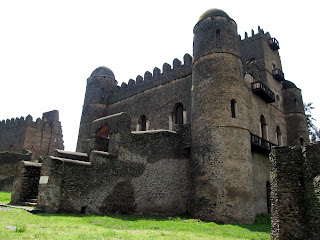 Gondar, which I constantly mispronounced as Gondor (from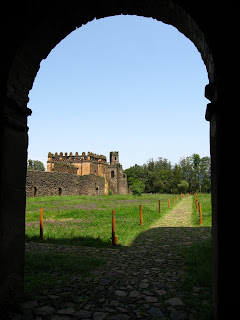
 After this trip I returned back to Gondar. The same people who offered me the half-day trip all wanted to drive us to the airport the next day. It seemed like everyone in Gondar knew Iris and I were leaving the next morning. Everywhere I went I ran into someone wanting to set up a taxi to the airport for the next morning. My negotiating skills still aren’t anything to write home about. But because I still haven’t met up with Iris yet after my side trip I held to my guns and didn’t commit to anything. I figured if I was getting asked every 10 minutes if I needed a ride then Iris may have been also. I wanted to speak to Iris before I did anything. I still hadn’t seen Iris by the time evening came and by this time the offers for an airport taxi had gone from Birr 80 for both if us to Birr 40. I didn’t think we would ever get lower than Birr 20 each so I made the arrangements and gave Birr 20 as a down payment. As it turns out Iris didn’t make any arrangements. The next morning the taxi was a little late and the guard at the hotel laughed when I told him that I gave some guy Birr 20 as a down payment. “Do you think they’ll show?” “You never know.” Was all he would say. Another taxi passed by and said he would take us for Birr 70 and incredulously claimed that no one in their right mind would bring us to the airport for Birr 20 each. Then our taxi showed and I paid the other Birr 20 and off to the airport and then Lalibela.


