Meles Zenawi’s dictatorial regime in Ethiopia release eight of nine Kenyans detained in secret jails since 2006 for questioning–some of them by US agents–return home.
The suspects were under arrest in Ethiopia without charge for one-and-half-years on suspicion of ties to al-Qaeda-linked groups. They were among a group of at least 150 who were arrested in late 2006 by Kenyan forces on its border with Somalia as they fled Ethiopia’s war with Somali rebels.
Later they were handed over to the EthiopianWoyanne military and transferred to several detention facilities in Ethiopia, Ali-Amin Kimathi, the chairman of Kenya’s Muslim Human Rights Forum (MHRF), told AFP.
Kimathi said the ninth suspect, Abdulkadir Mohamed Aden, who worked with Somalia Red Crescent when arrested, remains in Ethiopian Woyanne custody for unknown reasons. A number of the detainees are said to have been interrogated by US agents in an aggressive manner.
MHRF and other rights groups said several of them were tortured, and accused Kenya, Somalia and Ethiopia of breaking humanitarian laws.
Kimathi also accused Washington of pressuring these African governments to violate human rights.
US and other intelligence services interrogated several foreign nationals – including men, women and children – in detention in Nairobi and Ethiopia. The detainees were also denied access to legal counsel and their consular representatives, rights groups have said.
The detainees were from more than 18 countries — including the United States, the United Kingdom and Canada. Other detainees included Somalis, Ethiopian Ogadenis and Eritreans.
Addis Ababa will host the fifth India-Ethiopia Joint Trade Commission meeting from 6th and 7th October, 2008.
Minister of State for Commerce & Power, Jairam Ramesh, will lead the Indian delegation at the meeting where number of important bilateral agreements is expected to be signed.
Among them are pacts to (i) expand the supply of raw skins and hides that are abundantly available in Ethiopia for India’s growing leather manufacturing industry; (ii) to set up an apparel fashion design institute in Ethiopia with the assistance of the Apparel Export Promotion Council (AEPC); and (iii) to set up a 38 Mw hydel project by BHEL/IL&FS.
In addition, bilateral agreements on standards, small and medium enterprises and agricultural research are on the anvil. The two countries are also in the advanced stages of finalizing a trade agreement to replace the earlier trade agreement signed in November 1982.
India is the single largest foreign investor in Ethiopia with approvals crossing $ 3.5 billion. Of this, $ 2 billion is in the agriculture and floriculture sector alone. A number of Indian private companies are using Ethiopia as a base for the export of flowers to Europe.
In the context of India emerging as the single largest foreign investor in Ethiopia, the two countries are negotiating a double taxation avoidance agreement which is expected to be clinched in the next three months.
India enjoys a huge trade surplus with Ethiopia (exports in 2007/08 were over $ 400 million and imports around $ 14 million).
At the annual U.N. General Assembly meeting in New York, the African Union [of thieves and murderers] reaffirmed its opposition to issuing an arrest warrant at the International Criminal Court for Sudan’s president, in connection with crimes committed in the conflict in the country’s Darfur region. Some observers have raised concern that the episode could create difficulty for future cooperation between Africa and the ICC, but other supporters of the court attribute less significance to the dispute. Derek Kilner has more from VOA’s East Africa bureau in Nairobi.
Since even before the International Criminal Court’s chief prosecutor, Luis Moreno-Ocampo announced in July that he would seek an arrest warrant for Sudan’s President, Omar al-Bashir, the Sudanese government has been working to rally diplomatic support against such a move, and in favor of the U.N. Security Council issuing a deferral of the warrant request, a provision allowed for under article 16 of the International Criminal Court’s charter.
Sudan had already secured the support of the African Union, as well as the Arab League, but the Sudanese delegation gave the move for a deferral a high profile at the recent General Assembly meeting. The country’s vice-president, Ali Osman Taha, called the attempt to pursue President Bashir “a failed attempt at political and moral assassination.”
Following a meeting on September 22, the African Union’s Peace and Security Council issued a second communique, reiterating its support for deferring the warrant.
Tanzanian president Jakaya Kikwete, the chairman of the African Union, conveyed the group’s position in his address to the General Assembly the following day. “It is the considered view of the African Union that the indictment of President Omar al-Bashir at this point in time will complicate the deployment of UNAMID and the management of the humanitarian crisis in Darfur. It is for this reason that the African Union sees deferment as the most expedient thing to do now. We are simply concerned with the best possible sequencing of measures so that the most immediate matters of saving lives and easing the sufferings of the people of Darfur are taken care of first,” he said.
So far, the Security Council has taken no action. Deferral of the warrant request requires the approval of nine of the 15 members of the UN Security Council. Permanent members China and Russia have been supportive of Sudan’s position, as have nonpermanent members from Africa, including South Africa, Burkina Faso, and Libya. But attaining the remaining required votes may prove difficult.
A vote for deferral will also have to escape a veto by one of the permanent members of the council. Western human rights activists have pounced on recent statements from France and Britain, indicating that they would support a deferral, but both countries have said this would require substantial changes in Sudan’s behavior. The United States has expressed a similar position, but with harsher rhetoric towards Sudan.
Some observers have cautioned that the pursuit of President Bashir, in the face of African resistance, could threaten future African cooperation with the court.
One concern is that the court is giving the impression that it is unfairly targeting Africa. The cases it has taken up to date: Uganda, the Democratic Republic of the Congo, Central African Republic, and Sudan are all in Africa. The head of the AU’s Peace and Security Council Jean Ping, complained in an interview with the BBC this week that the court seemed to
be singling out Africa. Benin’s President expressed a similar sentiment to Radio France International.
But Priscilla Nyokabi, the acting executive director of the Kenya chapter of the International Commission of Jurists, a human rights organization, rejects such reasoning.
“We think it’s just a historical coincidence rather than a targeting of African states,” she said. “Recently the ICC newsletter also said they are looking at Georgia and other countries. So it’s not a deliberate attempt, so we human rights groups don’t feel that way. And also in terms of human rights violations, you can’t say if we get to you as a violator, you cannot say we should get other violators as well, you should answer to the violations that speak to you and not worry about who other people have been gotten by the ICC. So we don’t think that that is a valid argument.”
While there have been reports of some African countries threatening to pull out of the International Criminal Court, Issaka Souaré, a researcher on international law with the Institute for Security Studies in South Africa, says the African Union has gone out of its way to signal its support for international justice, while raising problems with the particular issue of a warrant for Mr. Bashir.
“If you look at the facts, of the 106 members of the ICC, 30 are from Africa, the largest single region in that regard. So I would not read much into such arguments unless they have been officially and expressly stated as such. African countries are not against the ICC. Even in its communique. The Peace and Security Council reiterates the AU’s commitment to combating impunity. No one condones this. The issue is about the timing and the implications for this move on the peace process so there is no antagonism per se against the ICC,” Souaré said.
Some observers have also warned that the case of Sudan will make those African countries that have not yet signed on to the ICC, Ethiopia and Rwanda, for example, even less likely to do so in the future. But Souaré points out that cases can still be brought in the ICC against countries that are not members of the court. “For this to prevent other African countries to join, it might, in the case of some countries, but it doesn’t make much difference for you to be a signatory or not, because Sudan after all is not a signatory,” Souaré said.
Nyokabi says that the leaders of such countries, many of whom have been accused of rights violations in their countries, were already hostile to the court, and would have been unlikely to join regardless of President Bashir’s indictment.
“As to the leadership, they have their own individual reasons why they don’t support the ICC. And each African country I believe has its own historical concerns. And you can give examples of them. You can give, say, the examples of President Kagame, or Meles Zenawi in Ethiopia, the political elite, it is not even a case of losing confidence, they just did not want the ICC from the beginning.”
Perhaps of more concern is the possibility that African countries that have joined the court will be less inclined to actively support it in the future. Nyokabi says that there are challenges to getting Kenya, which has joined the court, to implement the legislation in Kenyan law, but says these have little to do with the case of Sudan. “The speed with which we are getting into the ICC jurisprudence needs to improve, but we are not sure that the Bashir case is going to slow it in any way. Kenya was slow even before [Mr.] Bashir, we are still slow. So it is not the Bashir case that is making us any slower.”
Nyokabi points out that Kenyan rights activists are particularly concerned about keeping the International Criminal Court as a viable option in Africa, given the rights violations committed in the aftermath of last year’s disputed presidential election, and the potential for future ethnic and political violence.
SEATTLE, WASHINGTON – It is fitting that one of the most signature discoveries of humankind — a finding that has helped define a big part of our prehistory — would take place in one of the most unusual and historic places on the planet.
As the ancient fossil known as Lucy indicates, that portion of northern East Africa we now call Ethiopia may well have been the cradle of humanity. The oldest known fossils of modern humans, dated at 190,000 years old, have been found there along with the remains of chimplike ancestors who preceded Lucy by more than 2.5 million years.
But Ethiopia’s contributions certainly didn’t stop with possibly launching human evolution that eventually spread these inquisitive and creative hairless apes all over the place to ultimately build skyscrapers, fly airplanes and try to drive a car while talking on a cell phone.
This ceramic head is from the Beta Israel (literally, “House of Israel”) culture of Ethiopia, comprised of Jews of Ethiopian decent who have had a presence in the country since the 14th century. They are known for agriculture as well as exquisite crafts and jewelry, blacksmithing and pottery making.
As the exhibit at the Pacific Science Center emphasizes, Ethiopia has continued to play a significant — if often unrecognized — role in the global and cultural affairs of Homo sapiens up to the present.
Ethiopia is mentioned in the Bible many times — beginning with the book of Genesis, as Cush or Abyssinia, as perhaps the home of King Solomon’s Queen of Sheba and even of one of Moses’ wives. It is the only African country that successfully fought off European colonization, except for a brief occupation by Mussolini’s forces during World War II. It has long been a spiritual home for strong traditional communities of Christians, Muslims, Jews and even (symbolically, at least) for the cannabis-celebrating Rastafari movement, named after the precoronation name of Ethiopia’s last emperor, Haile Selassie, who was deposed the same year, 1974, that Lucy was discovered.
And, especially for Seattle residents, it is important to mention that ninth century Ethiopia also gave us coffee.
“But all anyone ever thinks about when you mention Ethiopia is famine,” chuckled Ezra Teshome, a leading figure in Seattle’s large Ethiopian community who moved here from Addis Ababa in 1971. “We’re hoping that Lucy coming here will provide an opportunity for people to learn more about the rich culture and history of the place.”
Diana Johns, the lead curator for the Lucy exhibit at the science center, worked with Teshome and others to make sure that this happens for visitors.
“People will come at the science in many different ways,” Johns said, and the Ethiopian context is critical. It’s impossible to talk about Lucy without talking about Ethiopia, she said, adding that it’s likewise impossible to talk about Ethiopia without talking about its amazingly rich — and sometimes peculiar — religious and cultural history.
The Ethiopian civilization of Aksum produced the first indigenous coinage in Africa. This example is from the reign of King Endubis, the first African king to mint coins.
“Take the Ark of the Covenant, for example,” Johns said. This legendary container of Moses’ stone tablets — the same ones Indiana Jones sought in the movie “Raiders of the Lost Ark” — is said to reside under lock-and-key in a church in Axum, Ethiopia. Johns added that Haile Selassie is still celebrated by many Ethiopians as the final heir to the so-called Solomonic Dynasty (again, thanks to the Queen of Sheba) as a direct descendent of King Solomon.
“In Ethiopia, myth and fact mix comfortably together,” Johns said.
It can also be hard to remember what year it is in Ethiopia. In the late 1500s, when the Christian world was ordered to change from the Julian calendar system to the Gregorian system (our current dating and time-keeping system), Ethiopia refused. As such, the country continues to stubbornly live about seven years in the past.
This fascinating East African country is not without its problems, of course. Despite its rich and proud history, it remains one of the poorest nations in the world and today has been again caught up in the midst of a food crisis. Following the toppling of Selassie, a brutal Communist regime set up shop, leading to years of strife and civil war. In the mid-1990s, a democratically elected government was established but well after that had happened elsewhere in Africa.
The roof of the 12th-century Church of St. George, perhaps the best known of all rock-hewn churches in Lalibela.
Even the decision by the Ethiopian government to allow Lucy to travel and be exhibited abroad was viewed with suspicion and criticism by some who either thought it was inappropriate to move the fossils out of the country or that officials would misuse the revenue from the exhibit.
“There is still a lot of mistrust,” Teshome said.
And for such a deeply religious country, how do Ethiopians resolve the potential for conflict between Lucy’s place in evolutionary science and some of the more traditional Judeo-Christian (and Muslim) teachings of human origins?
“In Ethiopia, it’s not a big issue because we don’t put science and religion against each other,” Teshome said.
ADDIS ABABA (Reuters) – Ethiopia’s dictatorial regime and U.S.-based Trans Global Petroleum on Wednesday signed an exploration and production sharing deal for the Horn of Africa country’s Greater Afar Block.
“The agreement … provides exclusive right for the company to engage in exploration and development of petroleum covering 109,304 square km (42,200 square mile) in Afar commonly known as Afar Triple Junction, Tigray and the Amhara regions,” Minister of Mines Alemayehu Tegenu said at the signing ceremony.
“The basins have potentials of hydrocarbon habitat,” he said.
The exploration will last four years and can be extended twice while the development and production period is set at 25 years with a possible extension, according to the agreement.
Nick Abraham, president and general manager of Trans Global Petroleum, said his company views “Ethiopia as a perspective country for petroleum deposits that only requires serious and effective work to unlock the resources.”
Trans Global Petroleum is the third American company to sign a petroleum exploration agreement with Ethiopia this year.
Falcon Petroleum Limited initialed a deal for the Abay (Nile Basin) in the Amhara region in August.
Titan Resources Corporation also signed an agreement for the exploration of petroleum in Abay and the Ogaden Basin in Somali region in August, the ministry said.
About 15 international companies including Malaysia’s Petronas are engaged in oil exploration in different parts of the country.
Seeing as how I’m absolutely terrible at this whole blog thing I have the impression that most of you do not know where I was last week. Well, to keep you updated, I was in ETHIOPIA!!! that’s right, as if being in Malawi wasn’t lucky enough, I was able to take a break from work and visit my friend Roger in Addis Ababa for a little over a week. So much to talk about…
I arrived in Addis with my friends Anne and Carl on the 19th. We spent the weekend eating really good food, staying out way too late with Roger’s new friend Tedy, shopping at nice shops, drinking phenomenal coffee, and all around enjoying the busy city that is Addis. Highlights from the weekend:
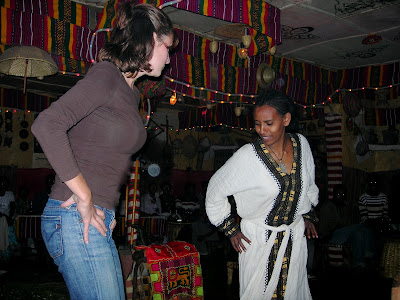
An intense night of shoulder shaking on Saturday night. Just when I thought I had semi-mastered the Malawi hip-shake I go to Ethiopia where the object of dancing is to keep your lower body still and move you shoulders in ways that make you wonder if they’re really attached. As you may guess, I’m not so good…
Roger has befriended a movie producer named Tedy and he was kind enough to take us out to all of the happening clubs in Addis. We ended up eating injera and meat at 3:30 am and going to bed around 6:30 am. whew!
Drinking at least a liter of machiatos in cafes. Ethiopia is not only the original home of the coffee bean but it also used to be occupied (though not colonized) by Italy, the result: a fantastic assortment of really tasty coffee drinks served at charming cafes. The going price of a machiato? about 3 birr which equals about 35cents, why not have 2 or 3 in one sitting?
Shopping shopping shopping. While I adore Lilongwe, there is something to be said about going into a store and the owners having more than one pair of those shoes that you want in stock. The odds of finding my size in Addis were much, much better.
Enjoying traditional Ethiopian food and honey wine in a fantastic restaurant with live music and dancers! Not to offend my regular Ethiopian restaurant in Boston but this was honestly the best Ethiopian food I’ve ever had. I’m already craving injera… (watch for a video posting of the amazing dancing soon)
And shopping for beautiful handwoven cotten fabrics outside of town. I ended up with 5 new scarves to add to my wardrobe. Now seeing as how I don’t really wear scarves, owning 5 of them seems a bit silly but perhaps they’ll be making an entry into my daily wear soon!
Sadly Anne and Carl had to return to Lilongwe on Tuesday so I was left to roam the streets of Addis while Rog was at work. I think I did okay. Roger’s taxi driver, Mulugeta was kind enough to take me to Mt. Entoto for a day. This mountain lies right outside of the city and has some really old Ethiopian Orthodox churches on top in addition to Emperor Menelik’s ‘palace.’ The countryside was beautiful and green and the road was covered with mules and women carrying extremely heavy loads up and down, to and from town.
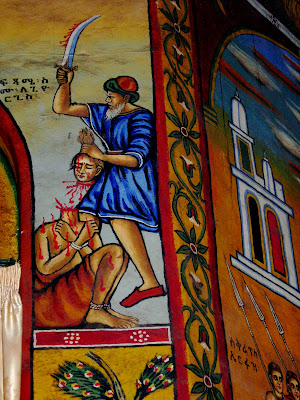
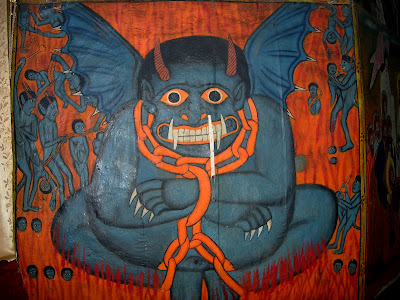
A majority of Ethiopians are Orthodox Christian and very religious, touring the churches is one of the main activies. I became facinated with the artistic depictions of Bible stories painted on the walls inside (painted around the 16th century). A bit graphic for church don’t you think?
Mulugeta then took me to Mercato. The largest market in Eastern/Southern Africa. We all know how much I love markets and this one was no exception, but due to the enormous size it was very helpful to have a guide. It is said that you can buy anything at this market, from AK-47s to potatoes and goats. I myself stuck to incense, spices, raw coffee and jewelry. Thanks to Mulugeta I got some pretty good deals and learned a ton about what that white powdery stuff is and what the many uses are for berebery spice.
I also visited a few museums while in Addis, one of which contains the skeleton of Lucy (the oldest skeleton every found). These museums were extremely interesting as Ethiopia is not only the cradle of human existence but also home to some 87 tribes, each with distinct cultural practices and ways of life. The only thing better would have been to travel out to each tribe and spend a few weeks learning how to stretch my lip around a lip plug or grind up tef to make injera. Now I’ve got a plan for my next visit!
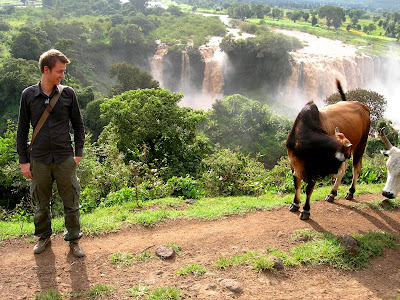
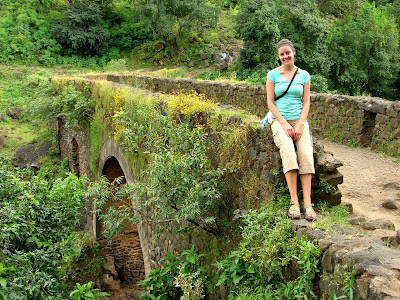
On Friday Rog and I traveled up north to do a bit of touristy sight-seeing. First we flew to Bahir Dar on Lake Tana, home to tons of monestaries and really devout monks. We took a tour of a few of the monestaries (at least the ones I was allowed in to, some don’t allow women to even set foot on the island so as not to “tempt” the monks). Most of the monestaries are located on islands or peninsulas around the lake so our transport consisted of a boat and a few bumps. Lake Tana is the source of the Blue Nile so after a few churches we took a car and a short hike to the Blue Nile Falls where we marveled at the amount of water pouring over the edge (and of course the surrounding wildlife).
Sadly we discovered that the falls don’t always appear so grand. The recent installation of an electric power plant next to the river usually diverts the water to produce electricity for the surrounding towns, diminishing the great falls to a mere trickle on most days (we just happened to be lucky enough to come on a day where the falls were “switched on”). Of course the environmentalist in me is mourning the loss of rare ecosystems and animal life below the falls, but the development dork in me has witnessed the enormous benefits that electricity can bring to human lives. Hmmm, a bit of a conundrum I’d say. Anywho, now that I’ve seen the Nile, my next task is to float down it!
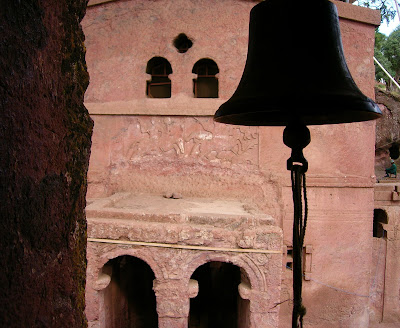
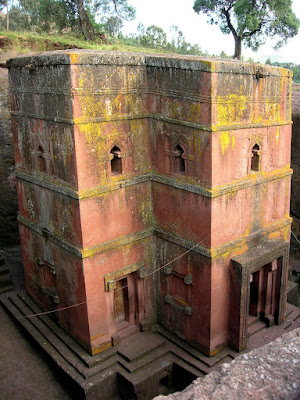
From Bahir Dar we flew to beautiful Lalibela, a town located high in the hills of Ethiopia that happens to be home to amazing feats of architectural genious. a.k.a the rock-hewn churches of Lalibela. We spent the majority of our day climbing around rocks that doubled as churches. According to our guide, most of the churches were believed to have been carved in the 13th century, around 800 years ago. And all of them are carved out of a single rock, some are free-standing, others attached to walls like caves, all of them are absolutely stunning. It was crazy to wonder around among ancient buildings that must have taken millions of man-hours to construct, some with intensely intricate carving detail and decoration.
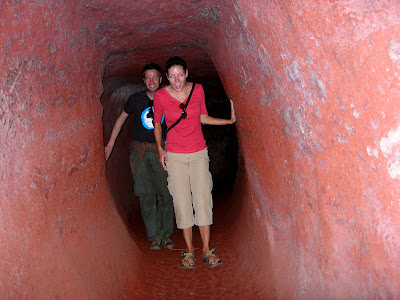
Most of the churches were dug down from ground level and go some 12 meters under ground, connected by super dark secret passage ways and tunnels.
Incredible! My favorite was St. George’s church but they all were immensly impressive.
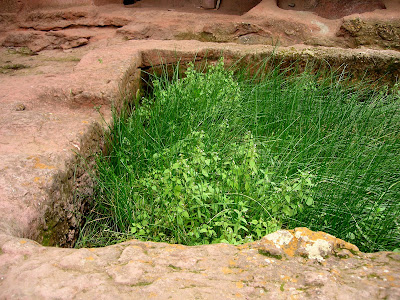
Equally impressive is the fact that service is still held at these churches and priests and monks were constantly wandering about. Within the compound there are also baptism pools and a fertility pool, which apparently works “a bit too well” for the women who are brave enough to be lowered into the green murky (and grassy) water…
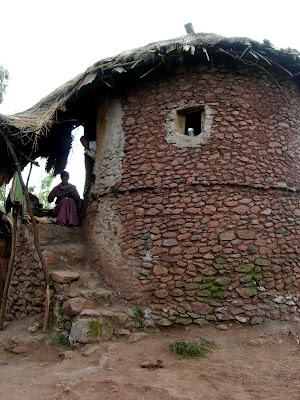
Of a different but still impressive architectural scope are the two story huts found scattered throughout Lalibela.
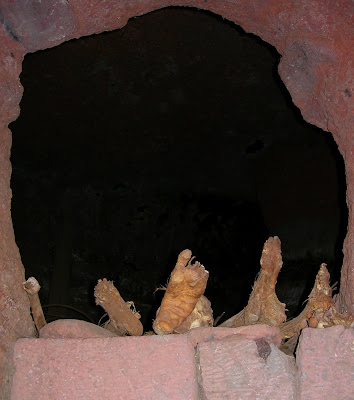
And lastly, Lalibela is seen as a kind of Orthodox Christian Mecca and remenants of some pilgrims were found in caves carved into the walls around the churches. Oddly the burial within a wall is not that uncommon, this one just happened to be open…
And now I am back in HOT Lilongwe, planning a few trips to the field, keeping plenty busy with the scheme and savoring my final months at UNICEF/Malawi.



 I arrived in Addis with my friends Anne and Carl on the 19th. We spent the weekend eating really good food, staying out way too late with Roger’s new friend Tedy, shopping at nice shops, drinking phenomenal coffee, and all around enjoying the busy city that is Addis. Highlights from the weekend: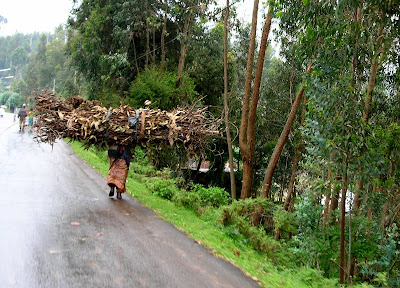
 Mulugeta then took me to Mercato. The largest market in Eastern/Southern Africa. We all know how much I love markets and this one was no exception, but due to the enormous size it was very helpful to have a guide. It is said that you can buy anything at this market, from AK-47s to potatoes and goats. I myself stuck to incense, spices, raw coffee and jewelry. Thanks to Mulugeta I got some pretty good deals and learned a ton about what that white powdery stuff is and what the many uses are for berebery spice.
 I also visited a few museums while in Addis, one of which contains the skeleton of Lucy (the oldest skeleton every found). These museums were extremely interesting as Ethiopia is not only the cradle of human existence but also home to some 87 tribes, each with distinct cultural practices and ways of life. The only thing better would have been to travel out to each tribe and spend a few weeks learning how to stretch my lip around a lip plug or grind up tef to make injera. Now I’ve got a plan for my next visit!
 On Friday Rog and I traveled up north to do a bit of touristy sight-seeing. First we flew to Bahir Dar on Lake Tana, home to tons of monestaries and really devout monks. We took a tour of a few of the monestaries (at least the ones I was allowed in to, some don’t allow women to even set foot on the island so as not to “tempt” the monks). Most of the monestaries are located on islands or peninsulas around the lake so our transport consisted of a boat and a few bumps. Lake Tana is the source of the Blue Nile so after a few churches we took a car and a short hike to the Blue Nile Falls where we marveled at the amount of water pouring over the edge (and of course the surrounding wildlife).
 Sadly we discovered that the falls don’t always appear so grand. The recent installation of an electric power plant next to the river usually diverts the water to produce electricity for the surrounding towns, diminishing the great falls to a mere trickle on most days (we just happened to be lucky enough to come on a day where the falls were “switched on”). Of course the environmentalist in me is mourning the loss of rare ecosystems and animal life below the falls, but the development dork in me has witnessed the enormous benefits that electricity can bring to human lives. Hmmm, a bit of a conundrum I’d say. Anywho, now that I’ve seen the Nile, my next task is to float down it!
 From Bahir Dar we flew to beautiful Lalibela, a town located high in the hills of Ethiopia that happens to be home to amazing feats of architectural genious. a.k.a the rock-hewn churches of Lalibela. We spent the majority of our day climbing around rocks that doubled as churches. According to our guide, most of the churches were believed to have been carved in the 13th century, around 800 years ago. And all of them are carved out of a single rock, some are free-standing, others attached to walls like caves, all of them are absolutely stunning. It was crazy to wonder around among ancient buildings that must have taken millions of man-hours to construct, some with intensely intricate carving detail and decoration.