Finally I’ve been walking with all coffee trees surrounding me. Coffee left, coffee right, coffee everywhere. I felt so good to see all these beans in different colors. It just rained, but then by miracle the sun came through and made the coffee tree look like a shiny multi colored jewel. I picked the darkest red bean at the tree and tasted the delicious fruit. The beans gulped out the berry directly. It felt weird but magical, these fresh coffee beans in my mouth.
I thought I was dreaming that day at the Aregash lodge in Yirga Lem, Sidamo.
The weather was very bad and we didn’t have a lot of time. Luckily Haile Mariam gave us a quick guidance at the Aregash logde’s coffee plantation.
It was an unforgettable experience and we want to thank him and the owners and staff of the Aregash logde for their warm welcome, friendship and good food. I can recommend this place to all you traveling Ethiopia.
As Senior Program Manager at Academic Travel Abroad (ATA), I have the responsibility of visiting international destinations and inspecting all aspects of the itineraries our groups will follow. The past twelve years at ATA have given me countless opportunities to travel to and develop programs in far-flung destinations in the South Pacific, Latin America, the Iberian Peninsula, Italy, Scandinavia, and Cuba , However, my recent visit to Ethiopia profoundly impacted me in a way that rarely occurs to well-seasoned travelers.
My journey followed the highland route, just like the Pacific Science Center’s itinerary. This encompasses Addis Ababa, Bahir Dar, Gondar, the Simien Mountains, Axum, and Lalibela. Each site I visited in these cities fascinated me and offered insight to distinct aspects of Ethiopia’s history, art, and lifestyles.
One of my favorite stops was Awaramba, a unique secular community where the people work hard to support their residents from cradle to grave. Men and women are equal, the elderly are cared for, children are not responsible for chores beyond their ability, and daily tasks are designated according to an individual’s skill.
I also enjoyed a visit to Lalibela, where the numerous rock-hewn churches are Ethiopia’s most famous site. These architectural and engineering feats are most impressive, but what also impacted me was how important these churches and the Orthodox Christian religion are to Ethiopians.
Another great surprise for me was the beautiful landscapes. The drives were never dull because there was always something new to see, whether it was extensive plains full of crops or the changing perspectives while driving through the mountains. In addition, there were always people to observe as they engaged in their daily activities—children on their way to school, people walking miles to the local market, subsistence farmers clearing crops of sorghum with ancient tools, or young boys shepherding their animals. I also kept quite busy waving back to all the people who waved to us as we drove by.
At the end of each day, I would think, “Wow, that was an amazing day.” I always enjoy my travels to other countries, but I can’t think of a time where I would consistently describe each day with such superlatives.
ADDIS ABABA, ETHIOPIA – African airlines face hard times as a global economic downturn could spur the industry’s US and European giants to seek new markets on the continent, a pan-African body said Tuesday.
“With traffic in America and Europe decreasing, there will be fierce competition created in Africa as a result of more infiltration by foreign carriers,” Christian Folly-Kossi, Security General of the African Airlines Association, told AFP on the sidelines of a meeting in Addis Ababa.
“Many African airlines will be at risk of disappearing because of competition. You can not put a heavyweight and a featherweight together in a boxing match,” he explained.
Folly-Kossi said African carriers have already been affected, as several past agreements signed with Western counterparts had paved the way for a reduction of their market share in the continent’s fledgling aviation industry.
“I am preaching more consolidation, more political support and protection from governments,” he said.
In addition, soaring oil prices have compounded the industry’s woes, Folly-Kossi said, as most carriers use obsolete and fuel-consuming fleets.
According to the London-based financial firm JP Morgan, the global airline industry will spend nearly 20 billion euros (25 billion dollars) more on fuel expenses in 2008 than in 2002.
While a downturn is expected for most African carriers, continental heavyweight Ethiopian Airlines is expecting a boom in revenue.
Ethiopia’s flagship carrier generated 941 million dollars (743.3 million euros) during the 2007/2008 fiscal year, and is expecting the figure to rise to more than 1.2 billion dollars (948.2 billion euros) for the current year.
“For us, there has been a slight dip in imports and exports due to the financial crisis but we haven’t been affected that much,” Girma Wake, the company’s CEO, told AFP.
Girma said he expected a tightening of loan availability and drop in tourism but predicted Ethiopian Airlines would survive better than others.
“It might be difficult for other African airlines but for us, the more flexibility we get the better. Liberalisation is very important for our programmes to succeed.”
ZURICH, Switzerland (AP) – Ethiopia remained under suspension from world soccer’s governing body Tuesday after talks collapsed at FIFA headquarters.
Two rival groups are vying for control of Ethiopia’s national federation. The country was suspended in July and later kicked out of qualifying for the 2010 World Cup.
FIFA said representatives of a {www:faction} led by Ahmed Yassin could not accept that Ashebir Woldegiorgis was rightfully elected to lead the national federation in January.
FIFA said it “regrets that no solution could be found.”
The world body has strict rules protecting elected soccer officials from outside interference. The ban means national teams, officials and referees cannot take part in international soccer.
ADDIS ABABA, ETHIOPIA – Experts from Citibank, the New York based banking giant that recently was swindled of 27 million dollars from the Ethiopian National Bank’s US account, have scheduled to visit the National Bank of Ethiopia (NBE) within the next few weeks to verify NBE’s SWIFT security code system through which the two banking entities have been communicating.
NBE had made a claim to Citibank for the amount defrauded.
A source close to the issue at NBE told Fortune that the international banking giant is sending its experts to verify the strength of the security system the national central bank has.
“They have already communicated their intended visit to us, but the schedule is known only by top officials of the two banks,” Bekalu Ayelew, deputy director for Modernization and Foreign Communications Department of NBE told Fortune.
It is the bank’s stance to cooperate with Citibank to probe exactly where the problem occurred. In the event that the outcome of their investigations point to NBE, the bank will, in turn, investigate its employees, Bekalu highlighted.
The Ethiopian central bank has correspondent banking relations with many international banks to facilitate servicing the government’s debts and its international procurements.
NBE receives financial statements from all the banks on a daily basis to check against its balance.
However, a statement it received from Citibank on October 9, 2008, showed a withdrawal of 27 million dollars from its account which it had not endorsed.
After NBE realized the fraudulent transaction on its account, it immediately alerted Citibank that it had not endorsed any payment and brought to the latter’s attention that a larceny had been committed on the account as the withdrawal of the amount was unauthorized.
Accordingly, three Nigerian nationals were detained as they allegedly went to a bank in South Korea to withdraw the said amount.
The fraud was committed with the forgery of the signature of Teklewold Atnafu, governor of NBE. Copies the financial documents with the forged signature were faxed to Citibank, which the bank has never used before, according NBE officials.
Society for Worldwide Inter Bank Financial Telecommunication (SWIFT) is a reliable and secured network that operates financial message between financial institutions. As of December 2007, SWIFT linked 8,332 financial institutions found within 208 countries.
Investigators are currently checking as to whether it was a global financial scam, or a forgery that contains signatures of the governor and board chairman. The details as to what actually transpired are still unclear.
ADDIS ABABA, ETHIOPIA (IRIN) – At least 52,000 people have abandoned their homes in Ethiopia’s Somali region after the Wade Shabelle and Genale rivers burst their banks following heavy rains.
“Heavy rains pounded western highlands and six woredas [administrative wards] in the Somali region, causing floods,” Ramadan Haji Ahmed, head of the government’s disaster prevention department in the region, said.
“The rain lasted six days from 2 November,” he told IRIN.
The six woredas were in Gode, Afeder and Liben zones. Ramadan said 36,888 people were displaced and three killed in the worst-affected woreda, Kelafo, in Gode.
“The flood hit 14 kebeles [smallest administrative wards] and 85 villages in Kelafo,” Ramadan said. “It washed away crops on 164 hectares.”
Crops were also destroyed in West Emi woreda of Afder zone. “The Wabe Shebelle River burst its banks and flooded 17 kebeles in West Emi,” Ramadan added. “Thanks to early warnings, the villagers fled to nearby mountains. The flood damaged crops on 3,200 hectares.”
At least 10,740 displaced people have been registered in Dolo Odo woreda of Liben zone. “Dolo Odo was flooded after the overflow of Genale river,” Ramadan said. “The roads from Dolo Odo to Filtu and Negele are also blocked.”
Floods cut off the road linking Degahabur town with Gode zone after the Dirkot River burst its banks.
“We brought 30 vehicles of aid from Dire Dawa central warehouse but we could not continue to Gode due to the damaged road,” Ramadan said. “We are now preparing to use another road.”
However, he feared the continued heavy rains would hamper relief efforts.
“Meteorology reports show there will not be heavy rain in the next three days,” he said. “If there is any heavy rain, the only choice is an airlift.”
The Disaster Prevention and Preparedness Bureau in the region has begun dispatching relief food and was preparing to distribute non-food items.
“All affected woredas need emergency relief,” Ramadan said. “We have not yet released any appeal, but it will be ready as soon as we get a complete assessment of the situation.”
In 2007, flooding left 135,000 people displaced across Ethiopia. In August, flash floods in Gambella regional state displaced about 20,000 people.

 Finally I’ve been walking with all coffee trees surrounding me. Coffee left, coffee right, coffee everywhere. I felt so good to see all these beans in different colors. It just rained, but then by miracle the sun came through and made the coffee tree look like a shiny multi colored jewel. I picked the darkest red bean at the tree and tasted the delicious fruit. The beans gulped out the berry directly. It felt weird but magical, these fresh coffee beans in my mouth.
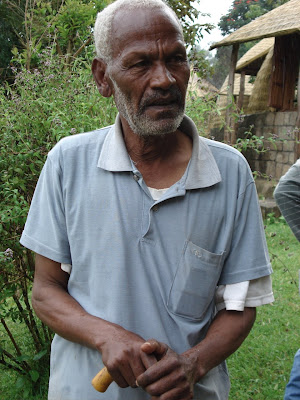 The weather was very bad and we didn’t have a lot of time. Luckily Haile Mariam gave us a quick guidance at the Aregash logde’s coffee plantation.