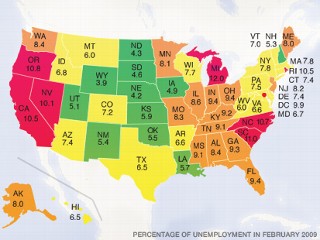
Despite better-than-expected reports on everything from housing to manufacturing this week, recession-wary U.S. companies are still shedding hundreds of thousands of jobs. The government reported that the nation’s employers cut 663,000 workers in March, pushing the unemployment rate up to 8.5 percent, the highest in nearly 26 years.
Since the recession began in December, 2007, 5.1 million jobs have been lost, with almost two-thirds of the decrease — 3.3 million job cuts — occurring in the last five months, the U.S. Bureau of Labor Statistics reported today.
“The ramifications of the financial crisis have been broadly spread across the whole country, wherever you are, whatever industry, whatever kind of job you have,” said Steve Cochrane, managing director of Moody’s Economy.com.
USAID/OFDA supports a variety of emergency and preventive nutrition interventions in disasters and complex emergencies. USAID/OFDA nutrition programs include treatment for severe and moderate acute malnutrition; infant and young child feeding; nutrition education; and support for nutrition systems, including operational research to advance best practices and build local system and humanitarian community capacity. In Fiscal Year (FY) 2008 and to date in FY 2009, USAID/OFDA has provided more than $55 million in nutrition assistance in 15 countries as well as on a regional basis in West Africa. During this period, USAID/OFDA introduced guidance for the U.S. Government (USG) on the use of breast milk substitutes (BMS) in emergencies, commenced new research on milk use in pastoralist communities, and supported emergency nutritional interventions.
ENCOURAGING BREASTFEEDING TO IMPROVE INFANT HEALTH AND NUTRITION
During a humanitarian emergency, breast milk is the safest form of food for infants and young children, according to nutrition experts. Disaster-affected and displaced mothers frequently lack access to safe drinking water necessary for preparing BMS and cleaning implements. In addition, non-breastfed infants are more vulnerable to infection, diarrhea, dehydration, and malnutrition. Field studies indicate that nonbreastfed infants face diarrheal disease mortality rates 14 times greater and acute respiratory infection mortality rates four times greater than breastfed infants.
In FY 2009, USAID/OFDA issued new internal policy guidance explaining the benefits of breastfeeding and detailing the limited circumstances when BMS is acceptable for use in USAID/OFDA-funded projects. The new guidance is intended to help USG emergency response personnel, including USAID Mission, U.S. Embassy, and U.S. Military staff, learn and employ breastfeeding best practices, including determining if BMS are acceptable and recognizing the proper methods for distributing and using BMS. In support of internationally-recognized best practices, USAID/OFDA encourages breastfeeding. In addition, USAID/OFDA policy adheres to standards in the Convention on the Rights of the Child, the Innocenti Declaration on the Protection, Promotion, and Support of Breastfeeding, and the World Health Assembly’s International Code of Marketing of Breastmilk Substitutes. The new USAID/OFDA guidelines promote infant and young child health and nutrition by expanding knowledge of breastfeeding benefits.
RESEARCHING MILK’S ROLE IN PASTORALIST COMMUNITIES
Recurrent droughts and associated livelihood disruptions, combined with livestock disease and violent conflict, severely affect pastoralist communities in the Horn of Africa. As a result, family livestock holdings have noticeably decreased compared to 40 to 50 years ago, increasing pastoralist dependency on cereals. Due to the staple food status of milk in pastoralist children’s diets, the availability of milk is directly linked to child health and nutrition. In response to economic shocks and livelihood disruptions, coping mechanisms, such as the sale of livestock, further deplete already reduced livestock holdings, particularly negatively affecting children. SC/US notes a peak in child malnutrition when milk becomes less accessible, before the onset of the cereal shortage hunger season, demonstrating a link between livestock production and child nutrition. USAID/OFDA supports emergency nutrition programs in affected pastoralist communities as an immediate humanitarian response. In addition, USAID/OFDA supports nutritional research activities to enhance understanding of the impact of pastoralist livelihood disruption on child health and nutrition in order to improve emergency and long-term responses.
For example, in 2008, and with USAID/OFDA support, Tufts University and SC/US launched a knowledge and practices study on milk in pastoralist communities in Somali Region, Ethiopia, to examine the impact of milk production and consumption on infant and child nutrition. Building on past research, the Tufts University-SC/US study focuses on the quantity and quality of human and animal milk production, as well as milk access for different socio-economic groups. In addition, the study seeks to evaluate milk interventions with the goal of designing food assistance that reflects the importance of milk. The study aims to improve the understanding of the causes of chronically high malnutrition rates in pastoralist areas in order to prioritize interventions to improve child health and nutrition.
FIGHTING MALNUTRITION IN ETHIOPIA
Chronic food insecurity in Ethiopia, resulting from consecutive seasons of failed rains, a rapidly growing population, increased inflation, endemic poverty, and limited government capacity, has necessitated USAID/OFDA nutrition interventions in FY 2008 and FY 2009. During the 2008 hunger season, the U.N. World Food Program identified malnutrition rates among adults and children above the emergency threshold, requiring additional targeted nutrition interventions.
With USAID/OFDA support, the U.N. Children’s Fund (UNICEF) implemented therapeutic feeding programs (TFPs) benefiting approximately 100,000 people affected by chronic food insecurity. As part of the program, beneficiaries received ready-to-use therapeutic food from UNICEF implementing partners. In FY 2008 and to date in FY 2009, USAID/OFDA has provided more than $12 million to support nutrition activities in Ethiopia, including health interventions designed to prevent the deterioration of nutritional levels among populations in Amhara, Oromiya, Somali, Tigray, and Southern Nations, Nationalities, and Peoples regions. USAID/OFDA and partner organizations continue to monitor the nutritional situation in vulnerable areas and provide assistance to mitigate drought effects.
ONGOING USAID/OFDA ACTIVITIES TO STRENGTHEN NUTRITION INTERVENTIONS:
– Facilitating best practices in Supplementary Feeding Program (SFP) reporting: SFPs often fail to meet humanitarian standards and the overall impact of SFPs has been difficult to assess as a result of incomplete reporting, according to a USAID/OFDA-funded Emergency Nutrition Network (ENN) and SC/US review. In a follow-up USAID/OFDA-supported effort to improve SFP accountability and effectiveness, ENN currently facilitates two working groups to draft comprehensive SFP reporting standards and better understand reasons for beneficiary drop out. Through both SFP working groups, the ENN aims to maximize the impact of nutrition programs for affected populations during emergencies.
– Supporting the U.N. Standing Committee on Nutrition (SCN): With USAID/OFDA support, SCN is performing a Web site upgrade to enhance practitioner access to nutrition tools, including a resource database and SCN publications. In addition, USAID/OFDA provides funding for SCN News, a biannual journal for nutrition experts.
– Facilitating nutrition practitioner communication through a new interactive forum: ENN, a USAID/OFDA partner, is creating a new online forum for field nutritionists to rapidly seek and offer technical advice.
SANA’A (Saba) – Yemen is to take part in the 120th assembly of the Inter-Parliamentary Union which will be held in the Ethiopian capital Addis Ababa from next Sunday to 10 April.
To represent Yemen in the 120th assembly of the IPU, Speaker of the Parliament Yahya Ali al-Ra’ei headed on Friday for Addis Ababa, leading his country’ delegation to the meeting of the IPU.
Speaking to Saba, al-Ra’ei said that Yemen’s participation in the 120th assembly of the IPU would contribute to addressing a number of the issues of common concern of all parliamentarians and representatives of the peoples of the world associated with the strengthening of their roles in maintaining the continuity and consistency of security and stability in the World.
“The 120th assembly of the IPU will review the political, economic and social developments in general and the set-up of a just and lasting peace, democracy and development, particularly in the times of crisis”, said the Yemeni official, noting that the reduction of nuclear proliferation and disarmament would be discussed in the meeting.
“The delegates will also discuss the situation and the latest developments in the Middle East, particularly the Palestinian situation and the risk of the Israeli occupation which threats security, stability and peace in the region”.
The meeting will discuss basic human rights and democracy issues. Nearly 3,000 delegates are expected at the Addis summit.
The assembly will also discuss the proposed comprehensive nuclear test ban treaty and issues related to freedom of expression in various parts of the world. Climate change and energy issues are also lined up for discussion.
The 154-member states union was established in 1889. It is based in Geneva, Switzerland.
Ibro Bekeri Yusef feeds therapeutic milk to his severely malnourished five-year-old daughter Khesna, at the UNICEF-supported feeding unit of Bissidimo Hospital in East Harerghe Zone of Oromia Region. [UNICEF/KENA00397/Shehzad Noorani]
(UNICEF) – When five-year-old Khesna Ibro arrived in her father’s arms at Bissidimo Hospital in Ethiopia’s Oromia Region, she was weak and glassy-eyed from acute malnutrition. Her father, Ibro Bekeri Yusef, had carried the young girl for a full day to get from his small farm to the UNICEF-supported feeding unit at the hospital. As soon as they arrived, nutrition workers started Khesna on a feeding program to help her body recover from the shock of malnutrition.
Soon, Mr. Ibro and Khesna were sitting in the hospital’s courtyard, where he gently gave her small sips of therapeutic milk from a bright orange cup. This nutrient-rich milk is often the first food given to children as severely malnourished as Khesna (in small doses, eight times a day) because it helps condition their bodies to digest food again. At first, Khesna’s system was unable to cope with even a little milk, and she threw it back up. Slowly but surely, though, her body would begin to adjust.
As I’ve written before, the global food crisis has hit Ethiopia incredibly hard. UNICEF estimates that over 100,000 of the country’s children are severely malnourished. Khesna’s father, Ibro Bekeri Yusef, was deeply worried about his six other children. “My other children are also suffering,” he said. “I used to live well with the income I earned. But now the price of grain has gone up. We can’t afford to buy sorghum… We have no water.”
Packages of Plumpy’nut—high-protein therapeutic food.
In Ethiopia, UNICEF is the main provider of ready-to-use therapeutic foods like Plumpy’nut, the high-protein peanut paste we write a lot about here on Fieldnotes. UNICEF and its partners—including other UN agencies and non-governmental organizations—are working closely with the Government of Ethiopia to continue to respond to the emergency.
But the problem is huge: UNICEF estimates it will require as much as 1,100 tons of ready-to-use therapeutic food per month to stave off Ethiopia’s nutrition crisis. That means Khesna is one of the lucky ones. At Bissidimo Hospital she received treatment that would return her to health in a few weeks. As the food shortage continues, however, UNICEF will need a lot of help from donors to save the lives of tens of thousands of children like Khesna.
Less than $23 can buy nearly 50 liters of therapeutic milk to save children like Khesna. 50 liters! That’s many, many children pulled back from the brink of starvation. You can buy therapeutic milk and other emergency nutritional foods for kids right here.
(UNHCR) – We are starting today the relocation of Somali refugees from a transit centre in Dolo Ado, Ethiopia, near the Ethiopian-Somali border, to the newly opened Bokolmanyo camp some 90 kms inside Ethiopia. The first convoy, consisting of 10 buses, is transporting 157 Somali refugees who fled the renewed fighting in central and southern Somalia over the past few months. They are part of a group of 5,000 Somalis who have recently been recognized as refugees by the Ethiopian government with the expert support of UNHCR.
In addition, some 5,000 Somalis are staying with the local community in Dolo Ado and waiting to be screened. They claim to have fled the fighting and general insecurity in Somalia, most of them leaving the country after withdrawal of Ethiopian troops last December.
In February, we reported the presence of an estimated 10,000 Somali asylum seekers in Dolo Ado, most of whom have been enjoying the hospitality of Ethiopians who are also ethnic Somalis. The opening of the new camp and subsequent extension of international protection and assistance might encourage thousands of others living with the community to apply for asylum.
The land at Bokolmanyo on which we constructed the new camp site north-west of Dolo Ado, has been provided by the local authorities. The new camp can accommodate up to 20,000 refugees and we and our partners are intensifying the work of expanding basic infrastructure, including water and sanitation services, a health center, relevant basic communal facilities and a children’s center. Establishment of schools and other facilities and services is also planned.
After arriving at Bokolmanyo, the refugees will spend about three days in a reception area where they will be allocated plots of land and given building materials to construct their huts. Refugees will also be provided with food as well as tarpaulins, blankets, kitchen sets, jerry cans, family tents and mosquito nets.
The Somali Region of Ethiopia already hosts more than 33,000 Somali refugees in three camps – Kebribeyah, Sheder and Au-Barre. With the new arrivals, the total is expected to pass the 40,000 mark very soon.
At the peak of the Somali refugee crisis in the early 90s, the region hosted 628,000 refugees in eight camps. The overwhelming majority of those refugees returned to their homes between 1997 and 2005. However, by mid 2005, we had closed all camps but the Kebribeyah site. Unfortunately, due to renewed conflicts and general violence in southern and central parts of Somalia, two new camps had to be opened in Ethiopia in 2007 and 2008 to accommodate new refugees fleeing Somalia.
OTTAWA, CANADA – The lawyer for a Canadian jailed in Ethiopia has gone to court trying to block foreign aid payments to the Ethiopian regime in protest over his client’s treatment.
Lorne Waldman filed papers in Federal Court on Thursday on behalf of Bashir Makhtal, who has been held in prison in Addis Ababa for two years.
Ethiopian authorities claim he is a member of an outlawed separatist group known as the Ogaden National Liberation Front, a charge he denies.
Two federal cabinet members, Immigration Minister Jason Kenney and Transport Minister John Baird, have expressed public support for Makhtal and vowed to work for his release and return to Canada.
Baird, who took an interest in the affair at the urging of constituents in his Ottawa riding, has said he’s ready to travel to Ethiopia to met with officials there.
“I hope to go in the coming weeks,” he repeated today.
“My role in this case has been to push due process and fairness. That is the message I want to take to the Ethiopian government”.
He voiced reservations, however, about the legal action taken by Waldman, saying he’s “not optimistic” that putting pressure on Ethiopia through the Canadian courts will further Makhtal’s interests.
The action filed by Waldman notes that Canada currently provides $89 million a year in aid to Ethiopia, some of which is earmarked to fund improvements to the country’s legal system.
The court documents contend that, given the treatment of Makhtal, the payments violate provisions in Canadian law that call for foreign aid to be “consistent with Canadian values” and with international human rights standards.
Waldman said in an interview he’s not interested in cutting off aid for clean water projects, agricultural development or other worthy goals. But he does want an end to aid for a legal system he characterizes as corrupt, lacking in transparency and subject to political interference.
“The purpose of this lawsuit is to prevent Canada from continuing to send aid to what we believe is an unfair legal system which is subjecting a Canadian citizen to an unfair process,” said Waldman.
The suit was filed as Makhtal appeared in court in Addis Ababa to hear a parade of prosecution witnesses offer evidence against him.
Cousin Said Maktal – a Hamilton, Ont. resident who spells the family name slightly differently – said he was told by relatives who attended the hearing that the witnesses offered mainly hearsay testimony rather than first-hand accounts of Bashir’s activities.
A spokesman for the Foreign Affairs Department said staff of the Canadian embassy also attended the proceedings but had yet to file a report to Ottawa. No judgment has been delivered and it’s unclear when the next hearing will be.
Although Waldman maintained his suit is based on sound legal principles, he frankly acknowledged it’s also intended to put political pressure on the Ethiopian government.
“The whole process in this case is political, it’s obvious, so the only solution is political,” said Waldman. “There’s no way Bashir Makhtal will ever get a fair trial in Ethiopia.”
He drew a parallel with the case of Maher Arar, whom he also represented and who was released by Syrian authorities only after then-prime minister Jean Chrétien intervened on his behalf.
A public inquiry later found Arar had been wrongly accused of terrorist links by the RCMP, but there have been no similar allegations against Makhtal by Canadian authorities and no suggestion that Ottawa played any role in his detention.
Makhtal, though born in Ethiopia, grew up in neighboring Somalia and came to Canada in 1991. He studied computer programming, became a Canadian citizen and held jobs at two banks over the next 10 years, before deciding to return to East Africa to start a used-clothing business.
He was in Somalia travelling on a Canadian passport when Ethiopian troops invaded in 2006, and was detained by Kenyan police in December of that year as he tried to cross the border into their country.
He was held at first in Nairobi, then transferred to Somalia and eventually to Ethiopia, apparently as part of a multi-country roundup of suspects linked to the U.S.-led war on terror.

 SANA’A (Saba) – Yemen is to take part in the 120th assembly of the Inter-Parliamentary Union which will be held in the Ethiopian capital Addis Ababa from next Sunday to 10 April.
.jpg "Ibro Bekeri Yusef feeds therapeutic milk to his severely malnourished five-year-old daughter Khesna, at the UNICEF-supported feeding unit of Bissidimo Hospital in East Harerghe Zone of Oromia Region.")

 (UNHCR) – We are starting today the relocation of Somali refugees from a transit centre in Dolo Ado, Ethiopia, near the Ethiopian-Somali border, to the newly opened Bokolmanyo camp some 90 kms inside Ethiopia. The first convoy, consisting of 10 buses, is transporting 157 Somali refugees who fled the renewed fighting in central and southern Somalia over the past few months. They are part of a group of 5,000 Somalis who have recently been recognized as refugees by the Ethiopian government with the expert support of UNHCR.
 OTTAWA, CANADA – The lawyer for a Canadian jailed in Ethiopia has gone to court trying to block foreign aid payments to the Ethiopian regime in protest over his client’s treatment.