 BLAINE, Washington (AP) – Fears of stalled commerce and travel didn’t materialize at U.S. border crossings Monday as people stayed home or were gently warned on the first day of stricter identification requirements for Americans returning from Mexico and Canada.
Traffic generally moved smoothly as those without proper identification stayed home or immigration officials let them pass through with a reminder to get a passport or other accepted ID.
Those crossing the Hidalgo-Reynosa International Bridge in South Texas described the light traffic Monday morning as normal, with cars and pedestrians facing short lines.
“There was nothing. Everything is all right,” said Yvonne Rivera, a U.S. citizen who lives in Reynosa, Mexico, and commutes to work in Texas. The 22-year-old said she got her passport in anticipation of the rule change.
There were some hiccups.
Rosario Aragon said she got into a heated, 30-minute discussion with a border agent demanding a passport for her 9-year-old girl, even though U.S. and Canadian children under the age of 16 only have to present a birth certificate.
The agent at an El Paso crossing let her through after taking her daughter’s name and warning her to get an official ID from local police.
“I’m angry because he held us up for 30 minutes,” the U.S. citizen said after she crossed into Ciudad Juarez, Mexico.
The new security rules for land and sea border crossings require U.S. citizens to show a passport, passport card or enhanced driver’s license, which use a microchip to store a person’s information. Some citizens may also use a trusted traveler document, which require background checks and are generally used by people crossing the border regularly for business.
At the busiest passenger crossing along the northern border, the Peace Bridge between Buffalo, N.Y., and Fort Erie, Ontario, traffic flowed smoothly with Customs and Border Protection officers reporting a 95 percent compliance rate with the new ID requirement. The Peace Bridge handled 8.9 million autos and 47,100 commercial buses in 2008.
Jessica Whitaker of London, Ontario, didn’t have a passport but was allowed in to the U.S. after showing her birth certificate and driver’s license. “They were very nice, very polite,” she said.
Kevin Corsaro, U.S. Customs and Border Protection spokesman in Buffalo, N.Y., said it’s been a “routine Monday” with officers seeing a compliance rate as high as 95 percent throughout the Buffalo field office.
“We want to see 100 percent but we know that will take some time,” he said. “We won’t refuse entry to a Canadian if their only violation is they are noncompliant today, as long as we can verify their citizenship.”
The new rules for land and sea ports under the Western Hemisphere Travel Initiative were supposed to have gone into effect in 2008 but were delayed a year over concerns about the impact on commerce. The requirement for re-entering the country by air went into effect in 2007.
Traffic at San Diego’s busy San Ysidro border crossing is down about 12 percent from last year, partly due to the weak economy and fears of swine flu, said Oscar Preciado, the port director for the CBP.
About 85 percent of the U.S. citizens filing through the crossing Monday carried a passport or other acceptable travel document, he said. Others were waved through after being handed a sheet of paper that said they were not complying with the new rules.
“It’s a nonevent,” Preciado said.
The new requirement also did not cause any delays at Highgate Springs, Vermont’s largest entry point from Canada. Two lanes were open and there was hardly any wait.
Daphnee Roy, 23, of Montreal, who was driving to Boston with a friend, said after passing through that the crossing was the same as always. “It’s no big deal.”
Customs and Border Protection area port director John Makolin said 99 percent of the people crossing into the U.S. at Highgate Springs after midnight had the required identification documents.
At the Peace Arch crossing in Blaine, Wash., the third busiest port of entry on the northern border, compliance was reported at about 90 percent.
Some travelers were sanguine about the new requirement; others said it was unnecessary.
“It’s overkill,” said James French of Lewiston, Idaho, after returning from vacation in British Columbia. “I understand the needs of security because of terrorism. But I think (the border) is safe.”
By David Calleja | Foreign Policy Journal
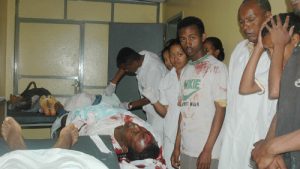
A victim of the Ethiopian government’srepression during the 2005 elections (AP)
In May 2005, the ruling Ethiopian Revolutionary Patriot’s Democratic Front won elections amid allegations of electoral fraud and a campaign of intimidation against opposition groups. Six months and two protests later, nearly 200 civilians were killed and tens of thousands arrested, including high profile opposition leader Birtukan Mideksa. The former judge and popular politician was initially jailed for life, then pardoned, and then commanded to serve out the rest of her sentence.
Next year, Ethiopians will go to the polls again, and the political maneuvering is already underway. Last week, the Sudan Tribune reported on the Meles Zenawi government claims of an alleged coup plot masterminded by former opposition leader Behanu Nega, now an academic in the United States of America. And on May 27, the opposition Unity for Democracy and Justice (UDJ) had their permit application for a protest against the Zenawi government in Addis Ababa’s Meksel Square rejected by the city’s administration. A spokesman for the UDJ, Hailu Araya, was quoted as saying the government continued to play political games, thus weakening the UDJ’s effectiveness in the country.
Ethiopia is an important ally for the United States. Its strategic location near the Horn of Africa makes the country key to Barack Obama’s attempts to win the War On Terror.
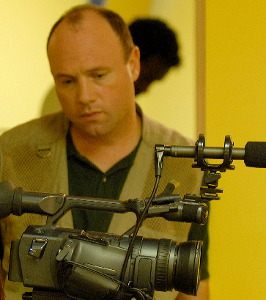
Director of ‘Migration of Beauty’ Chris Flaherty (Photo courtesy of Chris Flaherty)
Against the backdrop of the 2010 election, the documentary Migration of Beauty is due for release on the international film festival circuit. Directed by Chris Flaherty, the film recalls the experiences of Ethiopian genocide survivors of the 1970s and the community activism led by the Ethiopian diaspora in Washington D.C. in the run-up to the 2005 election. Flaherty spent two years researching and befriending the witnesses involved in the historic event covered in the film. Migration of Beauty has screened at the AFI Institute in Maryland and Goeth-Institute in Washington D.C.
The Ethiopian government has sent a chilling message to all opposition groups by declaring that it will achieve peace at all costs, a clear reference to the crackdown on protests that tainted the election four years ago that also revives haunting memories of the Dergue’s massacre of students and other civilians in the 1970s. Although the country is not officially a one-party state, the signs of political intimidation risk leading the nation along the path of Burma and Zimbabwe into tyranny.
Chris Flaherty spoke with David Calleja in an interview for Foreign Policy Journal about what could be in store for sub-Saharan Africa’s second most populous country.
Four years after the violence that occurred in the aftermath of Ethiopia’s general elections, what news do you have of the mood in the country, and how do you think this will affect the lead-up to the 2010 poll?
Obviously I have been keeping track of recent events as they relate to the upcoming Parliamentary election in Ethiopia. I would have to say that at this point it looks pretty grim. I think the party in power has been doing a good job at intimidating any possibility of viable opposition against themselves in 2010. With the re-arrest of one of Ethiopia’s strongest opposition leaders, Birtukan Mideksa and the recent announcement by the Ethiopian government that they have launched an investigation against people suspected of overthrowing the government, the prospects look grimmer by the day. From what I have observed many Ethiopians appear to be slipping into a feeling of helplessness. Many are saying, “Here we go again, this government will stop at nothing to retain power.” The biggest fear for me is that Ethiopians will simply give up and accept what happens no matter how illegitimate the outcome.
What factors compelled you to make your documentary Migration of Beauty? Why did you feel that it was necessary to tell people what happened in the 1970s under The Dergue as a prelude to the 2005 elections?
Perhaps the biggest factor that helped me mold the idea for Migration of Beauty was the inspiration I experienced from documenting seemingly powerless immigrants from a third world country engaging the U.S. political process. During the filming I was able to better understand the conditions that drove many of them to zealously fight for ideas that most ordinary Americans take for granted. My approach was to tell their deeply personal human stories about struggling for freedom and dying for it. Some of the people in the film lived through one of the most horrific chapters of Ethiopian history, the “Dergue” period or the “Red Terror”.
By bringing their stories to light I was trying to make clear that it doesn’t matter who takes away your freedom as much as it is criminal for anyone to do such a thing. If your freedom has been taken away the end result is always the same no matter who takes it away, whether it’s Adolf Hitler, Mao Tse-Tung, Mengistu Haile Mariam or Meles Zenawi. And while the current Prime Minister of Ethiopia, Meles Zenawi, has not committed acts as open and obvious as his predecessor Mengistu Haile Mariam, he is still repressing democratic ideas and has committed numerous human rights abuses. It was important for the Ethiopian Americans in Migration of Beauty to connect both stories. They have seen it all before.
There were some moments in the documentary in which you were prevented from filming. Who was behind the threats and what level of intimidation did they offer to the crew or yourself?
I did B-roll filming in Ethiopia directly after the 2005 election massacres. There was a certain tension in the streets. Foreign journalist and filmmakers are highly suspect in the eyes of the Ethiopian government. The Ethiopian government has a long history of repressing the media so I expected I might run into problems. There were two instances where I and my Director of Photography were stopped by the police. The first time I managed to talk my way out of potential arrest by speaking in Amharic and smoothing my way out of the situation. The second time it was the Ethiopian Army that tried to stop us. I quickly discovered that they did not speak Amharic, therefore my language skills yielded no results. I could not understand what they were saying but it was obvious they wanted the video camera. My DP and I simply took off running. For whatever reason they stopped following us and we lost them. We quickly realized that we had to keep our equipment “under the radar” and out of sight. I have heard of worse stories involving intense harassment and arrest of video camera operators. There is one such instance documented in my film.
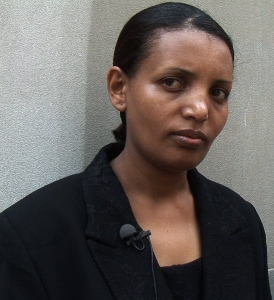
Birtukan Mideksa (AP)
Last year, the opposition leader Birtukan Mideksa was jailed for life. According to a Voice of America report, Prime Minster Meles Zenawi government’s official line was that “she had not asked for the pardon” handed to her. What do you think is the real reason for the order to serve out her life sentence? What does Meles Zenawi have to fear from her?
The situation of jailed dissident Birtukan Mideksa is a very interesting one. The former District Judge represented the biggest threat to the party currently in power, the Ethiopian People’s Revolutionary Democratic Front (EPRDF). And while she was jailed for what would appear to be rather “convenient” technical reasons it’s obvious to me that she was put away because there was a good possibility she would beat the EPRDF in a fair election. Considering what happened in 2005 the ruling party appears not to be taking any chance of losing a national election. This is an old story and a proven formula: intimidate, jail and kill all of your viable opponents in order to keep power. No matter how proper and clean everything appears on the surface it’s all the same.
The same report from Voice Of America indicated a tough stance from the government, vowing that they will not allow the protests of 2005 to occur again in 2010. Zenawi reportedly said that, “We will do everything in our power to have peace.” He has also vowed to not only stop any anti-government protests in the wake of the results, but also prevent any possible build-up of opposition support. What tactics do you think he intends to deploy?
We can only speculate what the Zenawi led government has planned for the next election. I will acknowledge that the Prime Minister is extremely crafty with words and has leveraged this skill to benefit his position in the world view. However, to say, “We will do everything in our power to have peace” is an extremely ominous indication considering his well documented past endeavours to keep the peace. Besides possible use of military force, it’s a safe bet to expect him to shut down the press completely and quell all avenues of dissent. My fear is that it could be much worse than it was in 2005. I’m not sold on the idea that everyone will go back into their houses if the government murders a bunch of unarmed civilians. It appears that the populace is deeply frustrated and they might go much further with the civil disobedience than they did in 2005. Either way, I sincerely hope no one gets hurt.
You have quoted Dr. Jedyani Frazer as to making remarks about the dangers of a free press at the Batten School of Leadership and Public Policy at the University of Virginia, and that in African countries, could lead to “ethnic cleansing”, such as what happened in Rwanda in 1994. What message do you think Dr. Frazer’s remarks send, and what justification did he use?
I was taken aback with Dr. Frazer’s comment. To specifically call out the so called “irresponsible press” without mentioning the dangers of media repression is a horrible proposition. Considering Dr. Frazer’s past influence on foreign policy in Africa it was a chilling comment. If the government in hand deems their press to be irresponsible, are we to base our foreign policy on their beliefs? Exactly who gets to decide the parameters of irresponsibility? And while Dr. Frazer did not specifically mention the role of the press in the Rwandan Genocide, most people know it is the 5000 pound elephant in the room. And therein lies the question- how do we balance the two?
My belief is that it is the right of the press to be free… We must base our foreign policy on the ideas we believe in ourselves, regardless of how uncomfortable it makes us feel. And when a particular government is proven to repress their media we should call them out and do nothing to lend them credence. It was the Ethiopian Ambassador to the U.S. himself, Samuel Assefa, who told me that the Ethiopian government must control the press, otherwise Ethiopians might commit ethnic genocide on themselves. All this is coming from a government that has instituted a policy of “Ethnic Federalism” which intentionally creates a divide between the many ethnic tribes within the country. This government has done little or nothing to foster a sense of national identity. It’s an old formula, control the press and divide everyone to decrease the threat of losing power. Comments like the one Dr. Frazer made simply send the wrong signal to the world.
What has U.S. President Barack Obama said regarding the Ethiopian leadership and what foreign policy initiative has he proposed? How can he be more effective in dealing with Meles Zenawi than his predecessor, George W. Bush?
To date, I haven’t heard much from the Obama Administration in regards to issues of democratic process in Africa. It’s obvious they are being very careful. In this respect I believe they are doing the right thing. However, many Africans as well as those in the diaspora appear to be holding their breath to see exactly where he will stand. I can safely say that many have high hopes. It’s a very difficult line for Obama to walk. News coming out of Somalia gets grimmer by the day and the Zenawi led government is the only one that appears to support our interests in the region.
In fact, the Ethiopian government makes this very clear to our elected officials. In my view, it is perhaps the biggest bargaining chip Zenawi can leverage. He knows that many U.S. Congressmen and Senators deplore his style of government but they are willing to deal as long as he represents our so called interests. He’s proven himself to be very skillful in keeping just within the parameters of acceptability in the U.S. As far as Obama is concerned he must make clear where his priorities lie. It was the Bush Administration that justified dealing with any despotic regime in the name of fighting the war on terror.
This policy has proven to be disastrous for the U.S. It makes no sense to support governments that use military force to control their people in the name of fighting terrorism. In fact, the whole idea is absolute insanity to me. This is a special time in U.S. history. We stand at a precipice. We are forced to decide who we are as a nation in the eyes of the world. So often we have preached the virtues of democracy and freedom to virtually everyone. And now more than ever we are understandably challenged on those core beliefs. It is my hope that the Obama Administration will understand and adapt our foreign policy with this in mind.
Do you believe that Birtukan Mideksa is Africa’s answer to the jailed leader of the National League for Democracy (NLD) in Burma, Aung San Suu Kyi? Are there any similarities between the Burmese military regime and the Ethiopian leadership?
No doubt, jailed dissident leader Birtukan Mideksa is an aspiring figure. I notice many similarities between her and Aung San Suu Kyi. Besides both of them being women they possess the types of charismatic characteristics that would help them go far in national appeal. Both are smart and unwavering in their ambitions to see true democracy and freedom in their countries. In the case of Ethiopia, I think many Ethiopians have become disillusioned with the opposition in the past. From what I have been able to access there appears to be tremendous anger with the Coalition for Unity and Democracy Party (CUDP) opposition, the party Birtukan used to lead with Hailu Shawel.
Like anyone anywhere, Ethiopians need to believe in the strength of their leadership. Many felt let down and betrayed when the CUDP failed to stand their ground after their arrest in 2005. Many felt that they made deals selling out the cause of democracy and freedom simply to get out of jail. However, Birtukan was able to help form her own party, the Unity for Democracy and Justice Party and appeared to have a change of heart concerning the conditions of her release from prison. At this point she appears willing to stand her ground against Meles Zenawi and her popularity has dramatically risen as a result. Like Aung San Suu Kyi, her status could become legendary as long as she remains unwavering in her peaceful struggle for true democracy, human rights and the rule of law in Ethiopia. It will obviously be a long hard struggle but if she has the stomach for it she could be instrumental in leading her country to a better future.
While there are many similarities between the regimes in Ethiopia there are also many differences. The regime in Burma appears to be “straight out” dictatorial rule. They make no secret of their endeavours to ruthlessly quash dissent. They have shown time and again that they will send out their military to shoot unarmed civilians in the streets and make no apologies for doing it. However, it’s a bit more complicated in Ethiopia, as the government claims to have something called an “emerging” democracy and says it’s not perfect as it is evolving. In the mean time the end results are always the same.
When push comes to shove, the Zenawi-led government has shown to the world they will commit the same exact human rights crimes the regime in Burma has done. And while Ethiopia has labored very hard to create the perception of legitimacy they will use their military on their own people if they feel threatened to be removed by democratic process. In my opinion the only measure of democracy is whether you have it or whether you don’t. If you have no ability to change the government by virtue of free and fair elections then it doesn’t exist. This is the case in Ethiopia.
How organized and active is Washington DC’s Ethiopian community? What messages have they delivered and who has been at the forefront of such efforts?
From what I see, organization within the Ethiopian diaspora over opposition and election issues is sporadic at best. Certainly I have seen nothing on the level I witnessed a couple years ago in the fight for the Human Rights and Accountability Bill, HR 2003. True, the Ethiopian government has spent millions to stall the bill in the Senate but zealous petitioning from the Ethiopian diaspora has gone flat. I get the sense that many are just frustrated and tired of the fight.
I believe one of the biggest problems is their inability to nationalize the cause. They have a tendency to internalize the issues and keep it to themselves. It’s sad because their causes are ones most Americans can identify with. In my opinion it might work best for them if they phrase their cause as a universal human rights struggle rather than as an internal one. I think it would be most effective if they appealed directly to the American voters themselves the way the Cuban Americans have done.
In the past, the diaspora worked so hard to gain the assistance of people like Congressmen Chris Smith and Donald Payne and now the diaspora is almost never heard from. Nonetheless, I still have high hopes that they will eventually use their rights as U.S. citizens to bring deafening light to their cause, especially as the next Ethiopian election approaches in 2010.
What role has Ethiopia’s past played in shaping a future catastrophe? Do you believe that the persona of former dictator Mengistu Haile Mariam is still prominent in shaping the fear instilled by the Ethiopian leadership today?
This is a very good question. No doubt, many Ethiopians possess what I call “generational fear” which is the type of fear passed down and learned from family and others. For the latest generation of Ethiopians this is not a fear based on personal experience. During the period of the Red Terror thousands were brutally murdered in the streets and as a result an overpowering sense of fear has virtually become part of the culture. Who could blame them? If you knew how young men and women were systematically murdered, their bodies pinned with notes warning everyone to heed the Red Terror, you might better understand. It’s no wonder that the older generation warns their children to, “stay away from politics, it will get you killed”. The damage of cultural fear has stifled healthy interest in governmental participation.
Without a doubt, the Zenawi government has effectively capitalized on the culture of fear instilled by Mengistu Haile Mariam. I am aware that some Ethiopians might be offended by what I am saying but I am speaking from my heart. Recently I read that an opposition party was desperately struggling to get a permit to hold a peaceful rally in a public area known as Meskel Square. Of course the government denied the permit. I was dismayed because no one had the courage to stage the rally without the permit. The rally was planned to be peaceful with no malice intended against the government. While I absolutely do not condone violence, I do believe in peaceful protest. Martin Luther King routinely staged public demonstrations without permits. He knew people would get hurt but he also knew they would never be able to advance their movement if everyone stayed home because there was no permit.
In 1999, the BBC reported that the US Embassy in Harare admitted to assisting Mengistu in finding a safehaven where he was eventually offered sanctuary by Zimbabwean President Robert Mugabe. Should Obama publicly acknowledge that this tactic was a mistake and has this contributed to the political unrest experienced by Ethiopia since?
While it might not bring total closure for Ethiopians the gesture would certainly go miles to break down the years of mistrust they have been feeling as a result of our misguided foreign policy. Besides the issue of the U.S’s involvement in Mengistu’s escape to Zimbabwe they should also be more transparent about their motives with the current regime. From my point of view, the U.S. has very little to lose by appealing to the Ethiopian people apart from the government.
As I said, many politicians in the U.S. are very uncomfortable with the Ethiopian government. Since the 2005 election massacres their credibility has never been the same. The U.S. absolutely needs to acknowledge the bravery of the thousands who struggle for true democracy and freedom in Ethiopia.
Following a trial that lasted 12 years, an Ethiopian court sentenced Mengistu to life imprisonment in absentia in March 2007 for his role in the genocide that took place during the 1970s. Amnesty International and Human Rights Watch estimate that between half a million and 1.5 million people were killed during Mengistu’s reign, beginning in 1974 and ending in 1991.
Before receiving asylum in Zimbabwe, Mengistu is said to have pocketed an undisclosed figure following Israel’s purchase to evacuate 5,000 Falasha Jews at a cost of $300 million. In addition, he pocketed all proceeds following the sale of the Livestock Development Company for $10 million shortly before fleeing Ethiopia for Zimbabwe, where he is now a permanent resident. The Ethiopian people received no compensation.
The Zimbabwean Government has said that it would not force Mengistu to return to Ethiopia. A spokesman for Zimbabwean President Robert Mugabe said that the role Mengistu played in supplying arms and pilot training to the Zimbabwe African National Union (ZANU) in its war against white minority rule in the country formerly known as Rhodesia, helped resistance fighters achieve independence. The Movement for Democratic Change (MDC) accuse him of masterminding President Mugabe’s Operation Murambastvina (Clean Out The Trash), whereby government militiamen allegedly bulldozed the houses of between 700,000 to 1 million civilians in Harare, mainly MDC supporters. He is reportedly offered personal protection by Mugabe’s Presidential Guard battalion and owns multiple properties.
(Email Chris Flaherty with your questions and comments about his documentary or this interview at: [email protected].David Calleja graduated with a Bachelor of Social Science and Master of Social Science from RMIT University in his home city of Melbourne, Australia. He has taught English in China, Thailand, South Korea and Cambodia, where he worked for a local NGO, Sorya, based in Tropang Sdok village. In addition he has also volunteered as a kindergarten English teacher, tutor and a football coach to male orphan students in Loi Tailang, Shan State. He has narrated and produced a video biography of Cambodian students learning English entitled I Like My English Grilled. His video documenting life at Stung Meanchey, Cambodia, A Garbage Life, can be viewed online. Contact him at [email protected].)
By Omer Redi | Addis Fortune
The crisis in the power supply has reached such a critical point that blackouts now occur every other day. With the water level in the currently operating hydropower generation dams going down by an average of one to two centimetres everyday, the expected rains in the coming few months will determine whether the power utility can continue supplying energy given the current state of affairs. Nevertheless, Miheret Debebe, chief executive officer of the Ethiopian Electric Power Corporation (EEPCo), says – in an exclusive interview with OMER REDI, FORTUNE STAFF WRITER – that it is not all doom and gloom as there are upcoming power generation stations to be commissioned in a matter of months.
Fortune: It is obvious that Ethiopia is now in such a serious power crisis that you have been forced to introduce load shedding with a frequency that now has reached every other day. What exactly has happened to the power generation sector to make you introduce this schedule?
Miheret: The current situation of power shedding is because of the imbalance in supply and demand. We have short, mid and long term planning. This is the supply-demand forecast and the planning that follows this forecast. From the demand side, this year we anticipated between 17pc to 20pc growth in actual demand, despite the surface demand growth being 24pc.
There is a gap between the demand and supply side growth because forecast depends on different methodologies, knowledge base and experience of the sector. Other major factors, such as economic growth, social development, environmental situations, industrial, commercial and domestic GDP growth, have their own impact on the growth of energy demand. Population growth is a very important factor for the increase in energy demand. To mitigate this demand, definitely there should be supply side planning and this supply side planning starts based on the master plan, which includes all the factors I have mentioned.
Q: Let us discuss the work on the supply side because obviously, the supply has not grown as much as, or at least close to the demand, has it?
The supply side planning follows ways to mitigate this demand growth in the coming five, ten or twenty-five years, focusing on what should be the generation, transmission, distribution and the universal electricity access planning aspects. The generation planning is very critical factor in this regard. But the generation has its own limiting factors to meet its own schedule.
Around the world, generation projects are not completed on time or ahead of schedule; they are delayed significantly due to forced or voluntary situations. For both reasons, our projects are delayed and that is one factor causing the deficit.
The second factor is the hydrology; especially considering that Ethiopia depends on hydrological resources for 95pc of its power generation. This factor was not in our favour; the situation in the existing dams is not in line with the metrological or hydrological forecast anticipated for this year. There is quite a big gap between the water volume we had anticipated and what we actually got from the Belg season. In addition to the low level of water we got in the dry season, the dry season has also aggravated the evaporation at the dams.
The other factor is that though we have had an emergency plan of a capacity the country could afford, the plan was to supply power to meet half of the 24pc demand growth. That means the emergency plan was meant to increase the supply by 12pc. If we had planned to mitigate the entire (24pc) demand growth, that means the country should deploy four times what we have invested today to rent generators. And this is beyond the country’s foreign currency capability.
Q: How did you get the funding for the emergency plan?
It is a complex subsidy element. We initially planned to get financing from the World Bank and the Ethiopian government. Though we started work on the same day with the same objective, financing from the Ethiopian side went efficiently and the emergency generation started in December 2008.
The World Bank financing has been delayed; even the bureaucratic decision making process has not been finalized up to today. Hence, yet again, we now have the capacity to generate only half the emergency plan we had prepared for. The lengthy bureaucratic decision making process at World Bank has delayed half the financing for the emergency plan and thus we rented half the generators we initially wanted to.
The minimum duration of generators rental agreement we can enter to is about six months. So if [the World Bank is going to release the fund afterwards] we enter another agreement for the remaining generators, we will put the country into a serious loan burden for a facility that we can use for weeks or one month [because the rainy season is already closer].
So we have to drop this option and it creates a big gap. All these factors contributed to the big deficit. In any country’s practice, this is [load shedding] how you mitigate the deficit in such situations.
Q: So can we say it is not feasible to rent those diesel generators for six months because it puts a lot of loan burden on the country?
It is not about feasibility. We started the same scheme for six months with Ethiopian and foreign financing. With the Ethiopian financing, the same was completed in a few months and started operations in December last year. With the foreign financing, because of the financiers own conditions and decision making processes, the scheme has been delayed even without approving the tender up to today.
So, even if it is approved today, negotiating, signing a contract agreement and placing orders to rent the generators will take until July and they can be used only after July. By then, the scheme will have lost its service purpose; we have already lost the time we want to fill the gap.
Q: Your plan was for more diesel generators to be rented for the short term and now you are actually using half of your actual plan. Even so, I expect it is a lot of financial burden on the government. Let us talk about this burden. How much do you pay in terms of kilowatt hours for the rent and how much do you charge your customers in the same measurement?
Though the plan was to generate 120Mw from the emergency scheme, we are now getting 60Mw for 20 hours a day continuously.
Of course it creates a lot of financial burden. Yet, for the short term, it is a big scale and feasible practice in any global experience, as in the case of Afghanistan, Iraq and some African countries like Uganda, Kenya, Tanzania, Ghana and almost everywhere because the continent is suffering a huge energy crisis now. This is the best short term solution as the containerized generators are mobilized, installed and synchronized fast.
Their impact – we pay more than 0.20 dollars for a kilowatt hour and collect less than 0.5 dollars from the consumer. This is a huge subsidy from the government and the corporation. We are doing this only to mitigate the negative socio-economic effect, not as a business objective.
So roughly, we are now spending about 100 million Br to 120 million Br per month for fuel, in addition to the capacity costs we have to pay to the owners of the two generators, which is 10 million dollars for each for the six months rental period. The 20 million dollars for the 60Mw is the least cost available. In addition, we have to pay for fuel and other costs. The monthly breakdown of the six months’ rental cost is about three million dollars.
Q: Do you anticipate any possibility of the rental of these generators being extended for a longer period than the six months?
Well, hopefully, since the problem depends on the start of the rainy season, whether it would start in early or late July, the deficit could last a bit longer. In that case, it could extend for couple of weeks or for a month.
Q: You are now almost close to the end of agreement period, which began in December. Do expect any power supply from the almost finalized hydroelectric power generation stations, such as Gilgel Gibe II and Tekeze to replace these generators?
The agreement period ends around June. Already in Gibe II, only about 200m of the 25.85Km tunnel remains to be completed. So you can imagine what huge progress it is. But still, the last one metre is a challenge for us. Once we complete the breakthrough on the tunnel, hopefully in early June, the two tunnels to the powerhouse [penstocks] will join the 25.85Km tunnel.
This is one of the biggest tunnel projects. Cleaning the tunnel; removing the railing and ventilation system, along with qualitative consolidating of electromechanical system and civil works are expected to be completed at the end of July. Immediately after that, we will start filling the tunnel and generate power according to the schedule.
Q: Still on Gilgel Gibe II, which you expect to be the solution to the current situation, now the remaining part of the actual physical works are the about 200m of construction of the tunnel and other tunnel related works. When these are finalized, there is cleaning. Then, there are three stages of testing: dry test, wet test and commercial test, how long will all this take in total?
I think first of all, there is something we should not forget; the highest voltage (400Kv) and the longest transmission line (230Km) is also going to be commissioned. This is the first of its type in Ethiopia. The transmission is completed. It also includes opticfiber communication wire for telecom purposes and two of the biggest substations in the country – Sebeta II and Gibe End – are completed.
Now dry test is going on simultaneously at the power plant and the substation along with the remaining works because we want to save time. The wet test starts when the water is full in the tunnel and the good thing about it is even if it is somehow disrupted, we test it by loading [power] and supplying to the system; that is the advantage. The wet test and the commissioning test, even if in terms of time we stop and start, we can do that by synchronizing to the system. That means by supplying power to the system.
Q: So you are planning to undertake wet test and commercial test at the same time?
We do it simultaneously. We test it by actually feeding the power to the system and that is also what we mean by loading. Even we want the big industries to be on because we have to test it with the highest load in the system.
Q: How long does the cleaning take?
We are trying to make it shorter and expect this to be finalized in about two months. Let us not forget it is a more than 25Km long tunnel which is so unpleasant for human beings. You can’t survive 200m in the tunnel without air and people, in fact, have died because of humidity and high temperature. For that reason, we have been using ventilation with safety standards and very standard technological facilities that we have to take out now.
Q: What elements does cleaning include?
Cleaning the more than 25Km long tunnel includes removing the railing, a very complicated ventilation system, and equipment that helps the Tunnel Bowering Machine for lighting the tunnel. It is after the tunnel that we see consolidated grouting and the tunnel should be solidified by the civil work. This is also called curing time, once you do the concrete wall, you need civil work of cement and concrete, so it is a drying and curing standard engineering time. And there are some works at the intake part before opening the tunnel.
Q: The dry test does not need water because you simply load power (voltage) to the generators from another sources to check its capacity, proper operation and sustainability. So I expect you have started this test alongside other works long before. How long have you been doing that test and what elements do the dry system include?
It is an every day job. In the past months, we were doing it on the turbines system, the control system, the protection system and the SCADA system. It includes the turbine (turbo machine) system and its functionality, generator, other hydraulic and electromechanical systems which have measurement, control, protection and safety systems. And the SCADA system, where you can control the whole plant using a computer, and where you can see the plant synchronized with the national grid, is also part of this test. This is a high-tech system that we stimulate by installing and feeding some false data to test the whole system. It is a matter of high evaluation on how stable the plant is with a very high standard quality that requires professional work.
Q: Once the dry test and cleaning are finalized, you go on to the wet test along with the commercial test, which is actually commissioning the power, is that right?
Yes, we clean and test the tunnel first. This includes testing the pressure, the water flow, the intake structure, the penstocks (the two 1.2Km each long steel pipes) and the turbo machine system with water. After these works are completed, we will make sure the whole system is ready, by feeding and supplying power from zero to the maximum capacity, then after that the commercial test goes on.
Q: I am aware that what you referred to as an internationally accepted standard and procedure of testing power generation plants demands the three levels of tests to be undertaken one after the other. It is only after these tests that the contractor will handover the project to you for actual commissioning. And of course, you test the plant for sometime before you release the performance guarantee bond. In total, it takes about six months. Now you are telling me that you are going to finalize the tests in about two months or so, while undergoing wet and commercial tests at the same time. I can understand the immense pressure you have been under due to the power crisis and how quick you want this project to be commissioned. But won’t that be risky? Will the project contractor be willing to hand you over the project without going through the normal practice?
No! Not that way! You do not have to isolate some part of the system. You can do some separate tests but you synchronize them to the system. I am sure EEPCo’s capacity and experience in the past 60 years in the power system is competitive and the contractor has to rely on our capacity on the particular matter. So I’m sure we know our business and we will do it to the best interest of the public. Since it is team work, we will achieve our timing and keep the one year warranty with the contractor. After that, we can stop the plant and check everything before taking out its liability. But we will not undermine the safety rules because of the pressure.
Q: Let me take you back to the blackout issue. There used to be a line dedicated for businesses engaged in export trades. There are reports that you have stopped that. Along with the current situation of the power shedding arrangement, which is at least every other day’, that indicates the shortage of power supply and the level of water at the dams has reached a critical level. Considering the worst case scenario, for example, if the expected rain turns out to be negative, how long will you be able to supply power with the current amount of water?
With regard to the consumer grouping, it is based on the economic and social impact of the power outage. We have classified consumer groups. In terms of the industrial aspect, we have heavy industry consumers who have a dedicated line or one mixed with the other domestic or commercial consumers. We have export industries which have a dedicated line or one mixed up with the other from domestic or commercial consumers. When it is the social aspect, we have very sensitive consumers, like hospitals, schools, clinics, as well as water supply and telecom facilities.
The significant power demand is from the industry with commercial and domestic sectors. Thus, the saving is also from these sectors. Those heavy industries are warned to plan their maintenance in this time of shortage to mitigate the impact with the possible demand side management.
Most of them are to be appreciated for obeying the notice, and they are doing major inspection and maintenance works. Some of them are preparing their emergency supply for this period. They will be able to survive by doing their critical activities. Export industries are classified under a clearly committed market. They have been given power, whether through a line dedicated to them or in between consumers; since they are the major aspects of the Ethiopian economy they are given priority.
But as citizens of this nation, sometimes they should share the burden by using their own internal capacity. Since they have the financial capacity, they have to be part of the solutions by using their resources.
About the water level, on our part, we are very vigilant not to let the volume go below the lowest acceptable level. Though we have been successful in maintaining that level of water, the peak hour is still challenging us. Nevertheless, our optimistic plan is to keep to the same situation up to July. It also depends on consumers’ behaviour, like in workshops, garages, and bakeries. They have to shift to stay with today’s consumption for tomorrow, and it also requires consumers’ behaviours to live with discipline for short periods and hope for a bright future. This is the fact of life in the whole continent, even in the world.
Q: From the report on your desk, I can see that the red line indicates the lowest acceptable level of water, while the black line indicates the actual water level in the dams. But I also see that for most of the dams, for the most part, these lines are overlapping. Has the current aggregate water level throughout the dams across the country reached the lowest level?
Now we want to keep the aggregate reduction per day to an acceptable centimetre. This [the report I have] is of hourly reductions for every 24 hours. But the net effect, we want to keep where it should be. [For example] if we want to maintain a one centimetre reduction a day in Melka Wakena Dam, we will avoid further reduction by cutting power because we cannot compromise any other way. We have been successful so far and we have to monitor levels 24 hours. Every one at the dams, the transmission lines, sub-stations, the distribution centres and the consumer must be vigilant.
Q: What is the daily acceptable level of reduction?
Well in Melka Wakena, say one centimetre, while in Gilgel Gibe II, it is about two centimetres.
Q: In normal times, how much is the daily average reduction?
It depends on the season, the time, the day, the volume of water in the dams; but it could be 10cm to 20cm.
Q: What about the water supply to Gigel Gibe (GG) II. Obviously there is a problem with the level of water in all the dams, including Gilgel Gibe I, which is the source of water for the former. So, if the volume of water in the source dam (GG I) is low, if it remains at that level in the coming months, how you will you be able to generate power from GG II even if it is commissioned?
In the first operation, hopefully by the end of July, which is also a good season, the dam would get sufficient water. But even with the minimum water level with which GG I can’t operate, there is a possibility of opening the bottom outlet gate and filling the tunnel and getting power from GG II. Its hydrological harmony is taken care of in earlier design steps. So we still have room to play in and July is a still a reasonable time when even in the worst case scenario, we can generate power from GG II.
Q: There are experts who argue that though the plans for the currently under construction hydroelectric power generation projects have long been on the shelves of EEPCo’s offices, they have not been implemented and initiated until recently when you started this aggressive and intensive works on about six hydroelectric power projects. Why have those plans waited for so long while the demand was obviously expected to increase when the country entered into a free market economy?
Unfortunately, it is not wise to blame the past. We have to learn from our mistakes and weaknesses in the past because it is the best way to benefit from the future. In this aspect, we can look at where we were in the early 90s. There were only 320Mw with only 3,000Km of high voltage and about 7,000Km of medium and low voltage networks and about 320 towns with access to electricity.
But now, including the emergency 270Mw, we have 9,000Km high voltage lines, 75,000Km medium and low voltage lines and 3,200 towns under service. The delay has internal and external factors. While following a very sluggish and conventional way of expansion in the planning, feasibility, designing, implementation and financing phases, what we had achieved in 50 years was about six, seven or a maximum of 10Mw per annum. Hydro plants came into operation at about 10 to 15-year intervals with hundreds of megawatts. But there were no complete and full-fledged feasibility study and bankable document.
Q: There are also arguments that before indications of the possible power crisis started to float – the time the current power generation projects were started – there was less commitment at the highest level of the government about power generation. That means the sector had not been given the emphasis it deserves at the beginning of the free market system. Do you share this view?
It is not always the same. There is no complete homogeneity in such thinking. But as far as I know, there is a far-sighted vision and commitment from top leaders. But there were also those in the top level of the government who thought otherwise. There were, thus, two conflicting ideas.
For example, though our financiers had said that Gibe I would be enough for 10 years, and thus, advised us to invest the money in other sectors, the government continued to work on the other projects. In fact, it was before we consumed Gibe I for only 10 months that the power problem started, let alone being enough for 10 years.
Q: For example, the infrastructure development area the government is known to be successful in is the road sector. This is due to the emphasis the sector has enjoyed from the government. Do you believe that your sector has been given equal attention?
Here there is a mixed approach. Like you said, the road sector gets a lot of attention and is attractive to financiers since it is a main development infrastructure. But in the case of power, the financiers want us to be stable financially and work as a business entity on one hand. On the other hand, they want us to be development-oriented businesses. So in this respect there is a dual approach and definitely this sector faces two challenges in bringing these to one.
Q: When do you expect to reach a level where EEPCo and you, as a senior official of the corporation, enjoy compliments following your successful achievements in developing the energy sector as the road sector doe now?
Handling the power sector is a very tough issue, which, sometimes, is higher than the socio-economic crisis. Unfortunately, power is a very determinant factor in every bit of life. Every single life in every second is dependent on energy. So has the fast development move. Our big challenge is the dependence on foreign resources. When we are out of this dependence, definitely this will mean we can achieve all our national objectives.
Q: When do you expect EEPCo to take Ethiopia out of the current situation?
To be frank, we have a very bright future. If we finish the three projects ahead of us – Beles, Tekeze and GG II – and when we come out of the daily challenges we have to face over GG III, then we are likely to be free from the current problems.
Beyond that, we have another cascade of projects in line; I am not going to mention the details because these will be announced by the government soon. And our strong foreign market will start in January 2010. Then our dependence on foreign financing will end.
Q: EEPCo has been under different structures under the current government. In the first ten years since EPRDF has come to power, it was under the former Ministry of Infrastructure, along with 12 other government agencies. Now it is under the Ministry of Mines and Energy. Do you feel that you should have been under a ministry which deals only with energy issues, as in the case of some other countries like Kenya? Do you believe that such structural issues and instability have hindered you from achieving what you could and should have achieved, perhaps, if you were under a ministry that is directly responsible only for energy or power generation?
As you know, there is a major national level restructuring process going on in the country right now. The national transformation covers all sectors; the energy or power sector is one of them.
If you see the development [over the years] the infrastructure ministry was multi-disciplinary, now it is reduced to a few focused sectors. The structural issue is a top government level, macro-level policy makers’ issue. If you see the natural progress more focused sectoral ministries have been making; after that, the national reform program has been launched.
As a result of the past and current development, as well as the dynamism of the power sector, now we are also entering a new restructuring phase. For my own sector, within my own mandate, I could say it very much demands very basic restructuring. We need a more focused, optimum, customer-oriented and sectoral structure based on the core process. The construction and the operation should be separate businesses; the generation, transmission and distribution should be organized into a bundle under public ownership.
Q: So have you suggested these changes? Does that mean it should have its own ministry?
The natural growth of the sector leads us to the restructuring, and I think the issue is being discussed by higher officials in the government.
