OMO VALLEY, ETHIOPIA –- It’s the traveler’s Catch-22. We want to explore and interact with exotic people from exotic lands, but the fact that we’re interacting changes the dynamics of the encounter. This unfortunate reality is illustrated in southern Ethiopia, one of the most culturally diverse regions on the planet.
A photo op of this boy, or any other member of most
Ethiopian tribes, involves a cash transaction that can
make a traveller feel sad and empty.
[Photo by ROBIN ESROCK]
Fifty-three tribes inhabit the area, most have unique traditions that range from incredible art to self-inflicted mutilation. Tour operators offer the chance to meet several of the tribes found in or around the southern Omo Valley, and an increasing number of tourists brave horrific roads and long drives in order to go tribal. But the experience comes with challenges.
The root of the problem is popularly known as the “Ferengi (Aramaic for foreigner) Frenzy,” the mob that surrounds tourists in the region wherever they seem to go. Whether it is the result of prolific non-government organizations (NGOs), aid workers or irresponsible tourists, ferengis are heavily associated, by rural people in the south, with free handouts. While it is tradition in Ethiopia to refuse gifts and be generous with what you have, anyone booking a “tribal” tour will find these traditions hard to come by. Instead, ferengis (also the name of an alien race from the Star Trek series) are often mobbed for money, pens, empty water bottles, anything. Especially, and sadly, by children with few clothes.
Our Land Cruiser stopped off the side of the highway to visit a band of Alaba, a Muslim tribe living in dark mud huts with thatch coverings. Immediately, children with their hands out surrounded me as our guide negotiated a price with the leader of the family. An argument ensued, a price was settled, the atmosphere became as welcoming as a doctor’s waiting room. A band of several dozen people stood looking through me, admiring my cheap watch, pulling my shirt with the request of “one birr.” In Ethiopia, it is customary to pay anyone you take a picture of one or two birr for their image; one birr is equivalent to 10 cents Canadian. It’s fair and well-intentioned, but many locals now see it as a quick and easy way to make money.
Like many travellers, I always ask people permission to take their picture, with the aim of capturing a moment, an authentic image, the picture to speak a thousand words about life in that country. An Italian tourist expressed the problem when he told me, “I don’t mind paying for a photo, but I’m finding it hard to find people being natural. They want to pose for me, so I can pay them.”
After entering a dark, smoky hut and asking some casual questions, it was time to leave. Most tourists spend about 15 minutes with the tribe, longer than most exhibits in a zoo, but not by much. As uncomfortable as I felt, it was about to get much worse.
The Mursi Tribe, numbering between 6,000 and 10,000, are nomads in one of the country’s most remote regions. Famous for the clay lip plates worn as a sign of beauty by their women, ritual scarification and stick fighting, the Mursi are embroiled in an unfortunate dispute with the Africa Parks Board, which is creating national parks in the tribe’s roaming area.
As one of the most extreme tribes to be found anywhere on the continent, the Mursi have been visited by tourists for decades. Foreigners are fascinated by a “primitive” culture as alien to the West as whales are to poodles. It’s a three-day drive to the town of Jinko, and takes more than three hours to drive just 27 kilometres on a bulldozed dirt road into the Mago National Park.
My guide warned that visiting the tribe in the afternoon was a bad idea, because of rampant alcohol abuse and the unpredictability of violence within the group. The Mursi are also aggressive in charging for photos: one birr for an adult, one for a child, and three for a mother and child. They only accept crisp, new one-birr notes.
Deep in the bush, the four-by-four pulled up to a small village of a dozen thatch huts. Immediately, we were mobbed by a tribe both frightening, fascinating and thrillingly exotic. With their faces painted, the women made it impossible not to stare at them and their lips that extended inches below their chins.
“Take picture, take picture, take picture!” I was told, then pushed, poked and prodded by half-naked men, women and children, several of whom held semi-automatic rifles that were used in inter-tribe warfare. As more four-by-fours of tourists arrived, the tribe swept themselves into a frenzy, the tourists took photos while their subjects violently grabbed cash notes. More and more people did their best to get into the photo.
It was sickening, yet the photographs are undeniably incredible. “We want people to stay longer, some don’t even get out of the car. They come, take picture and leave,” a Mursi man told me. But how can tourists be expected to stay longer when they’re mobbed with such feverish aggression? When it was nothing less than a human zoo, everyone was exploited.
Perhaps the solution is organized structure, such as what I found with the Konzo. Tourists pay the government-run central office a fee to visit the tribe in the southern Omo Valley and are assigned a local guide.
While kids initially surrounded me with familiar pleas for money, the guide kept them at check, explaining fascinating traditions and customs. I was told that half the tourist fee is distributed to the tribe, and, although it might not be enough, it benefits all parties.
It is, of course, heartbreaking to turn down children, but aid organizations and charities say giving money, clothes or coveted empty water bottles in Ethiopia only breeds a culture of begging.
A nutritionist for a local NGO told me Ethiopia has moved on from the famine of the 1980s. Kids just want things as a sign of prestige. Better to donate to groups that know local traditions and how best to help.
(Robin Esrock is a Vancouver-based travel writer and TV host.)
“You can’t beat this, Taylor Dent said. And he proceeded to take a victory lap around the Grandstand court, slapping hands with fans who repeatedly were chanting, “Dent! Dent! Dent! Dent!” during his four-hour, nine-minute 6-4, 5-7, 6-7 (1), 7-5, 7-6 (9) second-round victory over Spain’s Ivan Navarro.
NEW YORK (AP) — After 4 hours, five sets and a match he won’t soon forget, Taylor Dent grabbed the umpire’s microphone and thanked the raucous U.S. Open crowd.
Really, though, they should have been thanking him.
Dent kept his inspiring comeback story on track with a crowd-pleasing victory over Spain’s Ivan Navarro.
The American won on his fourth match point, with a backhand return winner past Navarro that brought the fans at the Grandstand court to their feet. Really, they had been on their feet through most of this match, a tussle between a pair of serve-and-volleyers who played a lot of short points and high-risk, high-reward tennis.
Dent had a bigger game. He finished with 121 winners and 50 unforced errors, with his serve topping out at 147 mph. One of his serves, a 138-mph offering, broke the strapping on the net and caused a 7-minute delay.
None of this, of course, seemed possible two years ago when the 28-year-old, once ranked as high as No. 21, was bedridden with a back injury that some doctors said would never allow him to play tennis again.
He underwent delicate surgery and proved them wrong.
“When they told me I had the opportunity to play tennis again, how could I pass that up?” he said. “A select few get to play professional sports. It would have been naive and irresponsible of me to not try to capitalize and come out here and give it my best.”
Ranked 195th and playing in his first U.S. Open since 2005, Dent’s best has been good enough so far.
Next up, though, is a third-round match against No. 2 Andy Murray. He’ll be a huge underdog. He has overcome these kind of odds before.
“It’s going to be rough, there’s no way around it,” Dent said. “My execution is not where I want it to be, but that’s not going to stop me from battling. That’s how I won today. Even if it’s 6-0, 6-0, 6-0, I’m going to go out and hustle and give everything I’ve got.”
* * *
Taylor Phillip Dent (born April 24, 1981) is a tennis player from the United States.
He has won 4 ATP singles titles during his career: Newport (2002), Bangkok (2003), Memphis (2003), and Moscow (2003), and reached the finals of three other events on tour.
Dent’s most memorable performance of his career so far came at the 2004 Summer Olympics, where he made a push all the way to the semifinals, where he was defeated by eventual gold medalist Nicolás Massú of Chile. Even more memorable was his bronze medal match against Fernando González, also of Chile, which he lost 16-14 in the 3rd set.
Dent, paired with Lisa Raymond, won the 2006 Hopman Cup, defeating the Netherlands two rubbers to one in the final.
In 2006 Dent did not play very many competitive matches, due to the recurring back and groin problem. Dent had back surgery on March 19, 2007.
On May 26, 2008 Dent received a wild card and played at the Carson challenger in the United States. It was his first match since February 2006. He lost his first round match to Cecil Mamiit. In July 2008 Dent took a wild card into his first ATP tour event for two seasons at the Hall of Fame tennis tournament in Newport, Rhode Island. He lost in three sets to Canada’s Frank Dancevic.
On November 12, 2008 Dent won his first comeback match at the Champaign challenger against Frederic Niemeyer 6-3 7-6(3). He followed this win up by defeating number 2 seed and fellow American Robert Kendrick. In the third round Dent had to withdraw against Sam Warburg.
Using his protected ranking of 56, Dent played the 2009 Australian Open, where he was eliminated in the first round by Amer Delic.
As a qualifier, he reached the fourth round of the 2009 Sony Ericsson Open, defeating Nicolas Almagro and Tommy Robredo in the process. He lost to Roger Federer in the fourth round, 3-6, 2-6. Despite the scoreline, the first set was a very entertaining encounter, with Federer’s longest service game lasting just short of a quarter of an hour; Dent had 8 break point opportunities. He had a poor run of form following this, but reversed the poor form by qualifying for Wimbledon, having entered the qualifying via a wildcard. He won his way through to the main draw, where he lost to Daniel Gimeno-Traver in five sets in the first round.
Unusual for a contemporary tennis player, Dent favors a pure serve-and-volley style of play. He possesses a powerful serve and strong volleys. He is the owner of the fourth fastest serve in the world, at a velocity of 243 km/h. Andy Roddick, Ivo Karlović and Joachim Johansson are the only three players to have served faster.
Dent is the son of former ATP player and 1974 Australian Open finalist Phil Dent. Taylor’s mother, Betty Ann (Grubb) Stuart, who has remarried, reached the U.S. Open doubles final in 1977 with Renée Richards and was a former Top 10 player in U.S. His stepbrother, Brett Hansen-Dent (born July 2, 1972), played on ATP circuit briefly after reaching the NCAA singles final while representing the University of Southern California. His godfather is former top ten player, Australian John Alexander, who was also Phil Dent’s doubles partner when they won the 1975 Australian Open doubles title. His first cousin Misty May-Treanor is one of top pro volleyball players in the world and a gold medalist at both the 2004 Summer Olympics and the 2008 Summer Olympics.
Dent appeared in a US television commercial for insurer Genworth Financial as the opponent of a young boy playing the role of Jaden Agassi, the son of Andre Agassi and Steffi Graf.
Dent attended Corona del Mar High School in Newport Beach, California, whom he played for. He also attended Monte Vista High School, also in California. He has a tattoo of American and Australian flags on his right shoulder. On December 8, 2006, he married WTA Tour player Jennifer Hopkins. Wedding guests included Maria Sharapova, Nick Bollettieri, Jan-Michael Gambill, Tommy Haas and Mashona Washington.
(Strotty) — If you have been watching ESPN at any time over the past two weeks or so, you knew that yesterday marked the beginning of the 2009 NCAA Football season. I’m more of an NFL man myself but over the last couple of years have began to get into the college game as well. Marquette has no football team so I haven’t picked a school to root for (despite my man-crush on Tim Tebow), but I am starting to respect and enjoy the game more.
The year was kicked off on ESPN with a top-25 matchup between the 14th ranked Boise State Broncos and 16th ranked Oregon Ducks. The bordered rivals entered the game with BCS berth aspirations, full-well knowing that the loser of the game was pretty much out of the running with Boise State playing in a non-BCS conference and Oregon having USC in theirs, the Pac-10.
Much hype was made of the game, but a lackluster 19-8 Boise State win became a whole lot more exciting after the final whistle blew. As the two teams congregated on the field in a standard post-game handshake, Boise State sophomore defensive end Byron Hout ran by Oregon running back LeGarette Blount and said something. Blount then stared at Hout for a moment and delivered a sucker-punch, knocking Hout to the ground.
Blount then punched a teammate trying to hold him back as he attempted to get back to where Hout was. He was escorted off the field by a few teammates and security as he got into it with a group of fans who, Blount says, punched him and held up a chair as if to throw at him.
The melee was a mess and really took away from the start to what looks to be an excellent college football season. Blount will have repercussions from his actions, but the real question is this: is Byron Hout at fault as well?
The beginning of this story goes way back to last season, after Boise State had defeated the Ducks 37-22 in Oregon. Two late hits in the game by the Broncos were the talk of the town, and last month Blount told Sports Illustrated that Oregon owed Boise State “an ass-whooping”.
Here’s a lesson that young (OK, he’s older than me) Byron Hout needs to learn: bulletin board talk is supposed to psych you up before the game and during it, not after. How many times we seen players come out in the media and say something to rile the other team up before a huge rivalry? It’s part of sports and something that happens all the time.
Mature players speak with their actions on the field, something all but one Bronco did Thursday night. I played four years of high school football, and while I would never compare it to a meeting between a Pac-10 school and a WAC powerhouse, the jist of what goes on is the same.
Trash talk happens in every facet of the game during all minutes of the game. From the second the kickoff takes place to the final whistle, kids are hooting and hollering at the opposition to get their squad jacked up. In Hout’s case, he had 60 minutes to say anything and everything he wanted to Blount. Odds are he said quite a bit during the game, meaning he clearly got his point across enough that he could have shut up after the game.
The other aspect of all this is that Boise State won the game handily. Despite the score, Boise State controlled the game and never let Oregon back in it. Blount rushed for negative yards on eight carries and caught just two passes on the evening. He was shut up in every aspect as the Broncos delivered him his self-proclaimed “ass-whooping”.
The term “leaving everything on the field” does not just apply to work ethic and heart. It applies to the trash-talking and bitterness towards your opponent. After the game, Blount was seen shaking hands with Boise State players just as any normal player would do. The game was over and so was the trash-talking.
(LeGarrette Blount was extremely wrong for punching Byron Hout, but why did Hout talk in the first place?)
If Hout wants to hate Oregon and LeGarrette Blount for the rest of his life, that’s his prerogative and something I wouldn’t blame him for. After all, the rivals have had a battle of words but in the end, Boise State has two “W’s” that any Oregon Duck wishes they had. Those two wins in the last two years were enough for everyone on the Smurf Turf expect one Byron Hout.
For some reason he needed more than just a victory to settle the score with Blount. The Oregon running back had just started off his senior year in the worst way possible, had just blown any realistic chance at a BCS berth, and had one of the worst games of his football career. Hout taunted him like a child and basically kicked him while he was down. Hout does not deserve to be suspended, but some internal action needs to be taken so Hout knows he wasn’t just a victim in this incident.
As for Blount, the proverbial last straw has been taken from his and his days in an Oregon uniform need to be over. First year head coach Chip Kelly suspended Blount in the off-season for “failing to fulfill team obligations” before being re-instated for the start of the season. Out of high school, Blount did not qualify academically and had to jake the JUCO route before winding up at Oregon.
If Kelly wants to make a statement with his new program, he will sacrifice his starting running back to show that Oregon is not full of punks. It’s true that Hout is at fault for talking after the game, but if a player can not show enough restraint to not sucker-punch a player, his own teammate, and go after fans after the fact of the matter, then he has no place on a respected Division-I football team.
It’s sad that the end of a game between two great football teams had to end in such a poor way, but don’t think that Blount is the only one at fault here. Hout had no place going and taunting, not talking to, Blount after the game. He was jumping around him, patted him on the back and said something that clearly angered Blount. It was immature and stupid of Hout, but Blount’s even dumber actions seem to be covering that up.
Whatever happens to Blount, likely a suspension of some sort, Hout needs to come out publicly and apologize for his words and actions to clean this act up. Not only will it make him look better, but it will remove some of the dark cloud that is being put over the heads of the poor winners of Boise State. Only one person took it too far, but every second Hout wears the Boise State blue, he represents the school and has to know that anything he does is a representation of the school.
Oregon running back LeGarrette Blount straight lost his mind Thursday night, sucker punching a Boise State player and requiring physical restraint to leave the stadium after the Ducks’ embarrassing 19-8 loss. Boise State’s Byron Hout appeared to tap Blount on the shoulder during postgame interactions, before turning away, only to take a Blount sucker punch to his jaw that floored him. Broncos coach Chris Petersen rushed in to separate him from further incident.
Blount then hopped away, only to get into another altercation with several Boise State fans seated near the field. At that point several people had to restrain him and forcibly drag him down the tunnel into an unknown but probably dark future. Its not unreasonable to speculate that his college career is over. Blount was particularly atrocious in Thursday’s game, netting negative five yards on eight carries including being on the wrong end of a safety.
Video after the jump.
Hout is not immune from criticism in his role in the affair, but Blount crossed a line in punching a player who had turned away from him. His inexplicable escalation after arguing with some Boise State fans while leaving the stadium only further condemns him to a severe fate.
Boise State coach Chris Petersen, who was witness to the sucker punch, was more diplomatic, telling ESPN’s Heather Cox that emotions had gotten the better of some players while turning attention to his team.
Its too bad, because, despite his bad game, Blount is a marvelous talent who would have done great things for Oregon this year. At this point he’s just as likely to face a lengthy suspension or outright booting from the Oregon football program as he is to play again this year.
Of no small irony — the American Football Coaches’ Association had recommended full-team pregame handshakes to build sportsmanship in the game during opening weekend.
BRUSSELS (Reuters) — World and Olympic champion Kenenisa Bekele is driven by the prospect of breaking his 10,000 and 5,000 meters records and is also is considering an attempt at the 3,000 world best set 13 years ago.
The 27-year-old Ethiopian told reporters on the eve of the Brussels Golden League meeting he felt there was no particular part of his racing he needed to improve.
“Really it’s perfect,” Bekele said on Thursday with a broad smile. “The only thing is I want to run faster than my records. I also want to attack the 3,000 meters. It has stayed for a long time.”
Bekele’s 5,000 and 10,000 meter records date back to 2004 and 2005 respectively. The 3,000 record of seven minutes 20.67 was run by Kenyan Daniel Komen in 1996.
Coach Jos Hermens said Bekele would aim to be selective in 2010, a year with no major championships, in a bid to better his times.
“The 3,000 meters is a longer dream… then he would need to put in a few 1,500 meters for pace,” Hermens said.
Bekele also said he would like to run the marathon, but was not willing to be drawn on when that would happen.
He is one of three athletes still in the hunt for at least a share of the $1 million Golden League jackpot going into the final meeting in Brussels.
To earn the jackpot, competitors must win their events at all six Golden League meetings.
“Those races are not easy… To win six is very tough. For many, four or five is tough. It’s very good to win all six,” said Bekele, who spent four days recuperating in Ethiopia after last week’s Zurich meeting.
Olympic pole vault gold medalist Yelena Isinbayeva and 400 meters world champion Sanya Richards are the other two athletes with 100 percent Golden League records so far.
Bekele argued he faced the most difficult challenge of the three given the strength of the 5,000 meters field on Friday and the chance of a new athlete breaking through.
“In the 400 meters or the pole vault you can’t really get strong new athletes,” he said.
(Reporting by Philip Blenkinsop; Editing by Alison Wildey)
More than a dozen pupils of Ethiopian origin had yet to be accepted by any school in Petah Tikva on Wednesday, despite a widely praised, last-minute agreement between the Education Ministry and the city regarding the placement of over 100 such pupils in a number of schools.
Ministry officials said they might not have the problems sorted out until the start of next week.
Additionally, the ministry and municipality had conflicting information as to the number of pupils still in need of placement. While the ministry said that 16 first graders were facing “admission difficulties,” the Petah Tikva Municipality put the number at 20.
Ministry officials also said that the problem was not that the schools were refusing to admit the pupils, but that there were discrepancies between the municipality, the schools and the ministry, regarding the lists of pupils and where they were supposed to be enrolled.
On Tuesday, Education Ministry Director-General Shimshon Shoshani, along with municipality officials, said that some children had been sent to the wrong school by mistake, while some of pupils’ families complained of language difficulties.
Under the agreement, which was reached during a meeting between Education Minister Gideon Sa’ar, Petah Tikva Mayor Yitzhak Ohayon, and Shoshani, 30 of the 108 Ethiopian pupils in question were supposed to begin their studies on Tuesday at the three “recognized but unofficial” religious schools that had been reluctant to admit them – Lamerhav, Da’at Mevinim and Darkei Noam.
An additional 18 pupils are set to begin studying in those semi-private institutions as well when they arrive in Petah Tikva in the coming weeks.
The remaining 60 pupils, who are expected to arrive in the city throughout the school year, will be admitted to semi-private schools in accordance with Education Ministry assignments.
Additionally, the city and the Education Ministry said they were to appoint a joint task force to examine the implementation of the pupils’ enrollment and the general integration of Ethiopian pupils in the city’s schools.
It was unclear what role, if any, that task force was playing in helping sort through Wednesday’s confusion.



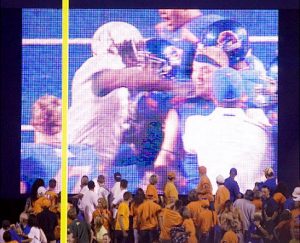 (LeGarrette Blount was extremely wrong for punching Byron Hout, but why did Hout talk in the first place?)