Here’s what we did six or seven weeks ago: We raised bread with sourdough starters made from several ancient grains: amaranth, sorghum, quinoa, millet, and teff.
My favorite of these wasteff. It’s best known for the Ethiopian staple flatbreadinjera, but it makes a wonderful addition to loaf breads as well (although it contains little or no gluten, so a 100%-teff bread would require some of that gluten-free expertise that I don’t have yet). I’ve heard the flavor variously described as chocolate-y coffee-y, nutty, earthy. You could just call ittastyand leave it at that. And it imparts a lovely reddish crust color in the bargain.
So, enamored of this tasty and cute grain (Did I saycute? Well, yes, I think any grain whose diameter is less than 1 mm qualifies as cute, don’t you?), I was inspired to give it a whirl in my own kitchen. I picked up a 1.5-pound bag of teff flour for about $7. Addexpensiveto teff’s personality profile.
My first attempt was a teff sourdough. I took a portion of my starter, fed it with teff flour for a few days and proceeded to mix up a simple bread dough with it. The dough was too dry. I added water. It was still too dry. I added more water. It was the perfect consistency. Then in the next breath, it was soup.
This was when I remembered that teff is not only cute and tasty and expensive, buttemperamental. It drinks and drinks up water, and suddenly lets it go (kind of like having an infant in the house again). I decided to try to work with the soup; this was a bad idea. I wound up with flat boards that could serve as cricket bats in a pinch:
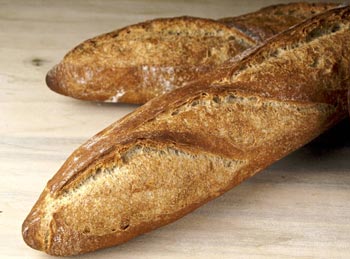
I’ll do teff sourdough again some day, but in the meantime I took another tack — with a teff poolish this time. This was also one we had made in class. Determined not to overhydrate again, I held back quite a bit of water (more thanI usually do) when mixing the final dough — and realized as I was cleaning up that I had not added any of it back in. I weighed it and it turned out to be a whopping 70 grams — about 10% of the total water in the formula. So instead of 68% hydration, this one came in at about 62%. On paper, practically a bagel.
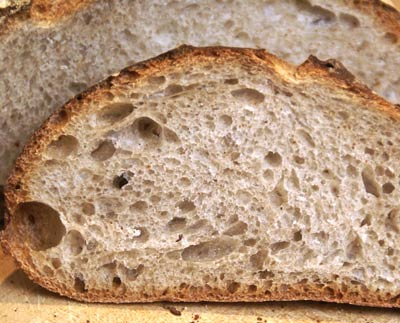
And yet, the crumb was not super dense and dry. Not the most open I’ve ever done, for sure, but not terrible either. Go figure.
My final analysis: teff is tasty, cute, expensive, temperamental, andenigmatic. Now I dare you to try it.
This enigmatic bread goes to IDania (El Aroma de IDania) and Zorra (1x umrühren bitte) for BreadBakingDay #24,Mixed Breads, along with my appreciation for creating and hosting this wonderful monthly event.
In a bowl, combine the poolish ingredients. Cover and ferment for 12 hours at room temperature.
In the bowl of a stand mixer with a dough hook, combine all of the final dough ingredients. Mix on low speed until incorporated.
Continue mixing in low or medium speed to a medium level ofgluten development.
Transfer the dough to a lightly oiled container. Cover and ferment for 1.5 hours, with afoldafter the first 45 minutes if the dough seems very slack.
Turn the dough into a lightly floured counter. Divide into 250 – 350 g for baguettes, 500 – 700 g for boules or batards. Preshape into cylinders (for baguettes) or balls and let rest, covered, for 20 minutes.
Shape the dough into its final shapes and place it, seam-side-up, on a very well-floured couche or linen-lined baskets.
Proof, covered, for 45 minutes or longer, until the indentation left by a fingertip springs back very slowly. Baguettes will take less time to proof than boules or batards, so bake them first.
Meanwhile, preheat the oven, with baking stone, to 475F. You will also needsteamduring the initial phase of baking, so prepare for this now.
Just before baking, slash the loaves as you like.
Once the loaves are in the oven, reduce the temperature to 450. Bake for 8 minutes with steam, and another 12 – 25 minutes or so without steam. Then turn off the oven and leave the loaves in for another 5 – 10 minutes, with the door ajar.
Dozens of youth village directors have organized a joint trip to Ethiopia in which they will travel through various cities,villages, immigrant camps and Jewish centers.
The trip is not for recreation, nor is it being sponsored by the Ministry of education – these leaders will pay for their own visit to Ethiopia in the upcoming Hanukkah holiday, in hopes to better understand their students who emigrated from the African country.
“It’s the initiative of the youth village directors,” said David Elboim, director of Tom Herev Le’et, a youth village in the central Hefer Valley Regional Council, who was behind the initiative.
“The route will pass through all the areas from which students arrived: from Addis Ababa to Axum and all the way to Gondar,” Elboim added.
As part of the trip, which is filled with domestic flights and long commutes, the directors will visit the villages, immigration camps and Jewish schools where their students hail from.
“Over 50 Ethiopian students attend the Wizo Nir HaEmek youth village. This trip will allow us to better understand where these kids come from and help satisfy their needs,” explained Esti Choen, the Manager of the Wizo Nir HaEmek village, which is located near the northern city of Afula.
“We will meet with students that will study with us after making aliyah. Our current students already gave us addresses of family members, synagogues and cemeteries where their family members are buried. They are very excited about our trip,” said Cohen.
Dar es Salaam (ThisDay) — Police in the east African nation of Tanzania has arrested 28 immigrants from Ethiopia yesterday. The Ethiopians were heading to an unknown destination, probably South Africa.
The immigrants were traveling aboard a bus with registration number T245 BDD and were being escorted by two officials from the immigration department, one from the headquarters and the other from an immigration office in Temeke.
According to sources, human trafficking is now a lucrative business in border towns.
Officials from the immigration department who were escorting the Ethiopian immigrants told the police that the immigrants had just finished a one-year-term in jail at Babati Prison after being arrested living in the country illegally.
“This is a business for some officials within the immigration department who are earning money by trafficking Ethiopians and Somali people to South Africa,” sources said. After the bus had been held at Urafiki Police Post for some hours, directives from the immigration office were given to allow the bus to continue with the trip and there were no more explanations.
One of the officials escorting the immigrants said the immigrants were to take another vehicle to the border with Malawi where they will be escorted again by other officials.
Illegal immigrants from Ethiopia and Somalia are coming into Tanzania in droves taking advantage of the country’s porous borders.
Hardly does a month pass without the police and Immigration officers nabbing scores of illegal immigrants not only at border posts but deep in the inner towns of Tanzania.
LONDON — Sir Bob Geldof fought back tears as he visited Ethiopia on a recent trip to open a school funded by the profits of his 2004 Band Aid 20 record.
Do They Know It’s Christmas? was re-recorded to raise funds five years ago, with stars including Chris Martin, Robbie Williams and Will Young participating on the record. The money raised has gone to the poorest parts of Africa, and Geldof was delighted to return to the country to open an education facility in Hagere Salaam, southern Ethiopia, which was paid for with some of the proceeds from the track.
(Bob Geldof reunites with Birhan Woldu)
He reunited with Birhan Woldu, who featured in the video for the original 1984 release, and the rocker admits she has had an overwhelming affect on him since they first met. Geldof tells Britain’s The Sun newspaper, “Many people here, like beautiful Birhan, wouldn’t have been around but for the massive outpouring of generosity by the British public.”
“Birhan is the daughter of Band Aid. I feel like her stepfather. You do stupid things like a record and a concert and it really does save lives. I saw people here 25 years ago starving and on the brink of being wiped out – but now their kids are playing rock ‘n’ roll and going to school. This is a different country now. The economy is growing at seven per cent and it needs an educated workforce.”
World marathon record holder and Ethiopia’s famous athlete Haile Gebrselassie travels this week to South Africa’s Cape Town to assist at the FIFA World Cup draw on 4 December.
In acknowledgment that Haile Gebrselassie is one of the African continent’s most celebrated and decorated athletes of all time, the multiple Olympic and World champion and world record breaker has been invited to assist Secretary General Jérôme Valcke on this important night for the 32 countries competing at the football World Cup next year.
Gebrselassie will be joined on stage by sport celebrities such as David Beckham, Makhaya Ntini who was the first black player in the South African cricket team, John Smit who is the captain of Rugby World Champions, South Africa, and Bafana Bafana defender Matthew Booth.
The Final Draw will be beamed live to an estimated audience of more than 350 million people in more than 200 territories.

 (Bob Geldof reunites with Birhan Woldu)
 By Marleen Rennings |